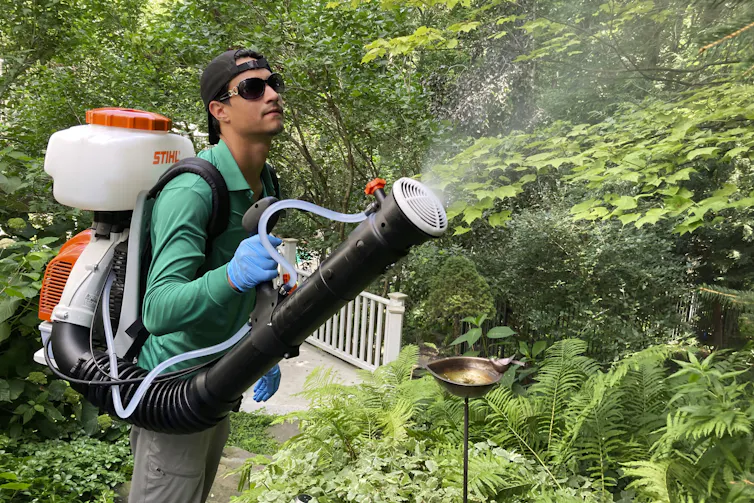
The EPA, which regulates pesticides in the U.S., defines a pesticide as any substance or mixture of substances intended to prevent, destroy, repel or mitigate any pest, such as weeds, insects and organisms, that attack plants. Pesticides are often referred to as toxins when found in food, water bodies or other places where they are not intended. But just because something is detected doesn’t mean it’s harmful to humans or wildlife. Toxicity depends on how much of the substance a person or animal is exposed to, how they are exposed to it – such as breathing it, or getting it on their skin – and for how long. The Department of Agriculture began regulating pesticides in 1947 with the Federal Insecticide, Fungicide, and Rodenticide Act. Most of the department’s interest was whether a particular pesticide was effective against the target pests. In 1970, the newly formed EPA took over responsibility for pesticides. It shifted its focus to the safety of consumers, farmworkers and the environment after the Federal Environmental Pesticide Control Act took effect in 1972.A wide range of pesticides are available to consumers for use in their homes and yards.Jeffrey Greenberg/Universal Images Group via Getty Images
Risk-benefit analysis
Federal law requires the EPA to evaluate both the risks and the benefits of each pesticide – and to revisit that analysis at least every 15 years for every pesticide used in the U.S. The EPA determines whether the risks to people, animals or the environment are too high for the benefits the pesticide provides and whether any of those risks can be reduced. Sometimes a chemical’s risk can be lessened by recommending mitigation strategies such as wearing protective clothing, reducing environmental spread by barring the use of pesticides near the edges of a property, or decreasing the amount of a pesticide that’s legal to use. In its analysis of any given pesticide, the EPA requires a massive amount of data from the manufacturer about what ingredients the pesticide contains and how they work. The agency also reviews scientific research on the pesticide and uses its own scientists and independent experts to evaluate any studies that were submitted by the manufacturer. The EPA uses all the available data on a pesticide to evaluate the dose that would be toxic to a range of organisms, as well as what residues the pesticide may leave on plants, in the soil and in water. The data is incorporated into computer models that estimate the potential amount of the chemical that may come in contact with humans, animals and the environment. Those models’ results are then combined with toxicity data to determine risk. The models used by EPA scientists are very conservative. They often use significant overestimates of exposure, which means that when the models determine the risk of a pesticide is below a particular level, they are evaluating the risk posed by far higher quantities of the chemical than will ever actually be used. The risk from the amount actually used, therefore, is even less likely to cause harm. The EPA also provides opportunities for public comment on a pesticide and uses that information in its evaluations as well.Pesticides are commonly used in commercial agriculture.Charlie Neibergall/AP
Additional scrutiny
The Endangered Species Act also requires the EPA to evaluate the effects of pesticides on threatened and endangered species. If a pesticide is found to potentially be dangerous to a protected species or its habitat, the EPA will discuss those findings with the U.S. Fish and Wildlife Service and the National Marine Fisheries Service, which enforce the Endangered Species Act, and determine what to do to ensure the species aren’t harmed. The law’s requirement to reevaluate each pesticide every 15 years is based on the fact that science evolves and information becomes more precise. New data can shed light on potential risks and benefits, and even lead to pesticides being banned or more closely restricted. Until recently, for instance, pesticide residues on plants, food and in the environment were measured in parts per million. Newer equipment can measure even smaller amounts, determining parts per billion, which is as precise as identifying one single second in 32 years. Some chemicals can even be measured in parts per trillion, equivalent to one drop of water in 20 Olympic-size swimming pools. That means exposures can be more accurately measured. While some chemicals can be toxic in very small concentrations, most pesticides can be detected at levels that do not pose a biological risk.
Allowing a pesticide to be used
If the EPA determines that a pesticide’s risks outweigh its benefits, then its staff will conduct additional analyses to determine how to mitigate the risks enough to justify using it. If that’s not possible, the EPA will reject the application and not allow the pesticide to be used in the U.S. If the agency determines that the benefits outweigh the risks, the EPA approves the pesticide for sale and use in the U.S. The law requires the pesticide come with a label providing a strict set of guidelines for how, when and where to use the pesticide. The guidelines define amounts and timing for applying the pesticide safely, and specific restrictions or protection strategies to control the target pests while eliminating or minimizing harm to the environment, workers and the public. The EPA also makes information on pesticides available to the public, so anyone can find out how to use them safely. Using the pesticide without following those directions is a violation of federal law.Jeffrey Gore, Professor of Agricultural Science and Plant Protection, Mississippi State University This article is republished from The Conversation under a Creative Commons license. Read the original article.
STM Daily News is a vibrant news blog dedicated to sharing the brighter side of human experiences. Emphasizing positive, uplifting stories, the site focuses on delivering inspiring, informative, and well-researched content. With a commitment to accurate, fair, and responsible journalism, STM Daily News aims to foster a community of readers passionate about positive change and engaged in meaningful conversations. Join the movement and explore stories that celebrate the positive impacts shaping our world.
DoorDash Driver Arrested After Claiming Sexual Assault: What Really Happened?
A DoorDash driver who claimed she was sexually assaulted during a delivery is now facing felony charges after police say her viral video showed an unconscious, partially nude customer without consent. Here’s what investigators found and why the case is sparking national debate.
DoorDash delivery driver involved in a viral video controversy after claiming sexual assault; police say no assault occurred, and the driver now faces felony charges.
DoorDash Driver Arrested After Claiming Sexual Assault: What Really Happened?
A Viral Accusation Turns Into a Criminal Case
A routine food drop-off turned into a national controversy this month after a DoorDash delivery driver claimed she was sexually assaulted during a delivery — only to later be arrested herself following a police investigation. The incident, which quickly spread across TikTok and other platforms, has generated fierce debate over privacy, personal safety, and the power of viral video culture.
The driver, identified as Livie Rose Henderson, posted a video on social media in mid-October claiming that when she arrived at a customer’s home in Oswego, New York, she found the front door open and discovered a man “half-naked and unconscious” on his couch. She publicly described the moment as a sexual assault, saying she felt endangered and traumatized.
Her posts went viral almost immediately, drawing attention from millions of viewers and sparking outrage over the safety risks faced by gig workers — particularly women — who make deliveries to unfamiliar homes.
But the narrative took a dramatic turn.
Police: No Sexual Assault Occurred
According to the Oswego Police Department, an investigation found no evidence that Henderson was sexually assaulted. Instead, authorities say that she:
Entered the home without consent
Recorded the unconscious customer, who was partially nude
Posted the footage online, identifying him
Made claims police say were “false and misleading”
Investigators concluded the man was intoxicated and unconscious, not acting with intent or awareness. As a result, Henderson was arrested and charged with:
Second-degree unlawful surveillance (felony)
First-degree dissemination of unlawful surveillance images (felony)
Police emphasized that recording a person who is nude or partially nude inside their home — regardless of context — constitutes a violation of New York’s surveillance and privacy laws if done without permission.
DoorDash Drops the Driver
Henderson also claimed that DoorDash deactivated her account, something she described as retaliation for “exposing her assaulter.” But following her arrest, DoorDash stated that recording customers inside their homes violates company policy and local laws.
DoorDash said it cooperated with investigators but declined to comment further on personnel matters.
A Complicated Public Reaction
Social media reaction has been sharply divided:
Advertisement
Sympathy for the driver
Many viewers initially supported Henderson, arguing that gig workers often deal with unsafe conditions and should not be forced to decide between finishing a delivery or backing away from a potentially threatening situation.
Backlash over privacy violations
Others argue that Henderson crossed legal and ethical boundaries by:
Entering a private residence
Recording a vulnerable, unconscious person
Posting it publicly
Accusing the individual of a crime without evidence
These actions, critics say, show the dangerous consequences of rushing to social media before police or professional investigators evaluate the facts.
The Larger Issue: Safety vs. Responsibility
This case highlights a broader tension in the era of app-based work and viral content:
Gig workers do indeed face unpredictable and sometimes unsafe situations.
Customers have a right to privacy in their homes.
Social media, meanwhile, rewards the fastest and most dramatic version of a story — even before the truth is known.
As the criminal process continues, Henderson’s case may set a new precedent for how privacy laws interact with the realities of delivery work and the instant visibility of online platforms.
Focuses on the legal perspective, privacy violations, and the potential consequences of posting sensitive content online.
STM Daily News is a vibrant news blog dedicated to sharing the brighter side of human experiences. Emphasizing positive, uplifting stories, the site focuses on delivering inspiring, informative, and well-researched content. With a commitment to accurate, fair, and responsible journalism, STM Daily News aims to foster a community of readers passionate about positive change and engaged in meaningful conversations. Join the movement and explore stories that celebrate the positive impacts shaping our world.
How China cleaned up its air pollution – and what that meant for the climate
How China cleaned up its air pollution: Beijing’s air quality went from hazardous to good while Delhi and Lahore still struggle. Discover how China dramatically reduced pollution since 2013—and why cleaner air may have unintended consequences for global warming and climate change.
Delhi: 442. Lahore: 334. Beijing: 16. These are the levels of PM 2.5, one of the principle measures for air pollution, on November 19. As Pakistanis and Indians struggle with hazardous air quality, in Beijing – a city once notorious for its smog – the air quality is currently rated as good. Ahead of the 2008 Beijing Olympics, the Chinese government was so concerned about pollution that it introduced temporary restrictions on cars, shut down factories and stopped work on some construction sites. The measures worked and one study later found that levels of air pollution were down 30% during the period when the temporary Olympic restrictions were in place. It would take a few more years before the Chinese government implemented a clean air action plan in 2013. Since then, China has achieved a dramatic improvement in its air quality. In this episode of The Conversation Weekly podcast, we speak to Laura Wilcox, a professor at the National Centre for Atmospheric Science at the University of Reading in the UK, to understand how China managed to clean up its air pollution. But Wilcox’s recent research uncovered some unintended consequences from this cleaner air for the global climate: the pollution was actually helping to cool the atmosphere and by taking it away, it may have accelerated global warming. Wilcox explains:
What we’re seeing is a removing of cooling that’s revealing warming that’s already there. So the air pollution isn’t the cause of the warming. It’s just letting us see stuff that we’ve already done.
Dive into “The Knowledge,” where curiosity meets clarity. This playlist, in collaboration with STMDailyNews.com, is designed for viewers who value historical accuracy and insightful learning. Our short videos, ranging from 30 seconds to a minute and a half, make complex subjects easy to grasp in no time. Covering everything from historical events to contemporary processes and entertainment, “The Knowledge” bridges the past with the present. In a world where information is abundant yet often misused, our series aims to guide you through the noise, preserving vital knowledge and truths that shape our lives today. Perfect for curious minds eager to discover the ‘why’ and ‘how’ of everything around us. Subscribe and join in as we explore the facts that matter. https://stmdailynews.com/the-knowledge/
The Hong Kong high-rise fire shows how difficult it is to evacuate in an emergency
Hong Kong High-Rise Fire: The deadly Hong Kong fire exposes critical challenges in evacuating tall buildings. Learn why stair descent is slower than expected, how human behavior causes delays, and what modern safety features can save lives.
Evacuations of high-rises don’t happen every day, but occur often enough. And when they do, the consequences are almost always severe. The stakes are highest in the buildings that are full at predictable times: residential towers at night, office towers in the day. We’ve seen this in the biggest modern examples, from the World Trade Center in the United States to Grenfell Tower in the United Kingdom. The patterns repeat: once a fire takes hold, getting thousands of people safely down dozens of storeys becomes a race against time. But what actually makes evacuating a high-rise building so challenging? It isn’t just a matter of “getting people out”. It’s a collision between the physical limits of the building and the realities of human behaviour under stress.
It’s a long way down to safety
The biggest barrier is simply vertical distance. Stairwells are the only reliable escape route in most buildings. Stair descent in real evacuations is far slower than most people expect. Under controlled or drill conditions people move down at around 0.4–0.7 metres per second. But in an actual emergency, especially in high-rise fires, this can drop sharply. During 9/11, documented speeds at which survivors went down stairs were often slower than 0.3 m/s. These slow-downs accumulate dramatically over long vertical distances. Fatigue is a major factor. Prolonged walking significantly reduces the speed of descent. Surveys conducted after incidents confirm that a large majority of high-rise evacuees stop at least once. During the 2010 fire of a high-rise in Shanghai, nearly half of older survivors reported slowing down significantly. Long stairwells, landings, and the geometry of high-rise stairs all contribute to congestion, especially when flows from multiple floors merge into a single shaft. Slower movers include older adults, people with physical or mobility issues and groups evacuating together. These reduce the overall pace of descent compared with the speeds typically assumed for able-bodied individuals. This can create bottlenecks. Slow movers are especially relevant in residential buildings, where diverse occupants mean movement speeds vary widely. Visibility matters too. Experimental studies show that reduced lighting significantly slows down people going down stairs. This suggests that when smoke reduces visibility in real events, movement can slow even further as people hesitate, misjudge steps, or adjust their speed.
Human behaviour can lead to delays
Human behaviour is one of the biggest sources of delay in high-rise evacuations. People rarely act immediately when an alarm sounds. They pause, look for confirmation, check conditions, gather belongings, or coordinate with family members. These early minutes are consistently some of the costliest when evacuating from tall buildings. Studies of the World Trade Center evacuations show the more cues people saw – smoke, shaking, noise – the more they sought extra information before moving. That search for meaning adds delay. People talk to colleagues, look outside windows, phone family, or wait for an announcement. Ambiguous cues slow them even further. In residential towers, families, neighbours and friend-groups naturally try to evacuate together. Groups tend to form wider steps, or group together in shapes that reduce overall flow. But our research shows when a group moves in a “snake” formation – one behind the other – they travel faster, occupy less space, and allow others to pass more easily. These patterns matter in high-rise housing, where varied household types and mixed abilities make moving in groups the norm.
Why stairs aren’t enough
As high-rises grow taller and populations age, the old assumption that “everyone can take the stairs” simply no longer holds. A full building evacuation can take too long, and for many residents (older adults, people with mobility limitations, families evacuating together) long stair descents are sometimes impossible. This is why many countries have turned to refuge floors: fire- and smoke-protected levels built into towers as safe staging points. These can reduce bottlenecks and prevent long queues. They give people somewhere safe to rest, transfer across to a clearer stair, or wait for firefighters. Essentially, they make vertical movement more manageable in buildings where continuous descent isn’t realistic. Alongside them are evacuation elevators. These are lifts engineered to operate during a fire with pressurised shafts, protected lobbies and backup power. The most efficient evacuations use a mix of stairs and elevators, with ratios adjusted to the building height, density and demographics. The lesson is clear: high-rise evacuation cannot rely on one tool. Stairs, refuge floors and protected elevators should all be made part of ensuring vertical living is safer.Milad Haghani, Associate Professor and Principal Fellow in Urban Risk and Resilience, The University of Melbourne; Erica Kuligowski, Principal Research Fellow, School of Engineering, RMIT University, and Ruggiero Lovreglio, Professor in Digital Construction and Fire Engineering, Te Kunenga ki Pūrehuroa – Massey University This article is republished from The Conversation under a Creative Commons license. Read the original article.
STM Daily News is a vibrant news blog dedicated to sharing the brighter side of human experiences. Emphasizing positive, uplifting stories, the site focuses on delivering inspiring, informative, and well-researched content. With a commitment to accurate, fair, and responsible journalism, STM Daily News aims to foster a community of readers passionate about positive change and engaged in meaningful conversations. Join the movement and explore stories that celebrate the positive impacts shaping our world.