Many Americans will find on their November 2024 ballot a space to vote for an important office: local sheriff. While there are exceptions, sheriffs have a long history of using their power to maintain a particular, unequal balance of power in society, often along racial and class lines.
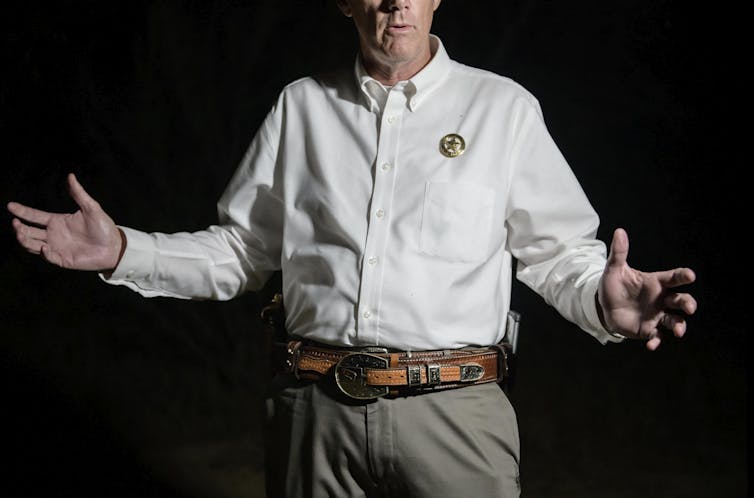
A recent example of this arose on Sept. 13, 2024, when Bruce Zuchowski, sheriff of Portage County, Ohio, posted a message on a Facebook page headed by a graphic that included his official portrait and which was labeled with his official title. Zuchowski called for the public to write down the addresses of people who have campaign signs supporting Democratic nominee Vice President Kamala Harris in their yards.
That way, he said, when immigrants arrive and need housing, “We’ll already have the addresses of the … families … who supported their arrival.”
The post, which Zuchowski later claimed appeared on his “personal Facebook page,” used derogatory terms for immigrants and for Harris. It also included screenshots of two Fox News stories about migrants in Aurora, Colorado, and Springfield, Ohio, which are both places that former President Donald Trump, the Republican nominee, and his running mate JD Vance have falsely claimed to be sites of dangerous activity by immigrants.The header of a page Sheriff Bruce Zuchowski claimed is a ‘personal’ Facebook page shows him in uniform and carries his full title. Screenshot of a Facebook pageAn Ohio sheriff posted an anti-immigrant message on Facebook. Screenshot of a Facebook post
Sheriffs in the U.S. don’t often get national news attention, but Zuchowski’s request was covered in The Washington Post, NBC News and The Guardian, among others.
There are more than 3,000 sheriffs elected at the county level in the United States, each of whom has authority and autonomy to both set and enforce law enforcement policy. For example, sheriffs in many states can decide whether their deputies will wear body cameras and what happens to the footage recorded during routine stops.
Zuchowski’s post, which vilifies immigrants and targets people who support immigrant rights, is just part of that long history of sheriffs using their power as a tool of social control, as we document in our book.
In the wake of Zuchowski’s post, The Portager, a news website in his community, reported residents saying the sheriff’s post constituted voter intimidation. Some residents have called for investigations of the sheriff’s office by local, state and national agencies, including the Department of Justice’s civil rights division.
So far, the Ohio Secretary of State’s Office says the sheriff has broken no laws.
Advertisement
In both our book and previous work, we document through two national surveys how variations in sheriffs’ views on race and ethnicity may shape their office’s policies and practices.
In our research, we have found that sheriffs’ negative attitudes toward immigrants are statistically correlated to their offices’ anti-immigrant policies. For instance, sheriffs with more negative attitudes are more likely to have an official policy to check the immigration status of crime victims and witnesses. That relationship held even after we controlled potential influence of other factors such as political partisanship and the share of the native-born population in a sheriff’s county.
Similarly, as we show in our book, sheriffs with racist views were less likely to report to us their deputies have been trained to reduce racial and ethnic bias in traffic enforcement. That issue is a problem in Portage County, according to the local NAACP, which in 2023 released a report claiming the sheriff’s office unfairly targets Black drivers.Sheriff Bruce Zuchowski posted a defense of his earlier post. Screenshot of a Facebook post
Politics plays a role
Since his initial post, Zuchowski has defended himself on social media, writing:
“If the citizens of Portage County want to elect an individual who has supported open borders (which I’ve personally visited Twice!) and neglected to enforce the laws of our Country … then that is their prerogative. With elections, there are consequences. That being said … I believe that those who vote for individuals with liberal policies have to accept responsibility for their actions! I am a Law Man … Not a Politician!”
Despite Zuchowski’s claims, he is indeed a politician. Like other sheriffs in the United States, he was elected by voters. He was the Republican nominee in 2020 and is running for reelection in 2024.
Like sheriffs across the country, Zuchowski had extensive law enforcement experience, including working in the Portage County Sheriff’s Office prior to running to head the office. We found that more than 85% of sheriffs worked for the previous sheriff before seeking election. And like most other sheriffs, Zuchowski is a whiteRepublicanman. We and others find that more than 90% of sheriffs are white and over 98% are men.
Across the United States, sheriffs will ask voters for their support this fall to remain in office. In most counties, these elections are uncompetitive: Sheriffs usually run either unopposed or against weak candidates.
In this way, Portage County is an exception. Zuchowski’s first election was a competitive race for an open seat, and he faces a challenger to his reelection bid in the 2024 election. His Democratic opponent, Jon Barber, is similarly a white man with a law enforcement background.
But Barber’s campaign website highlights another common challenge for voters: how to pick a good sheriff. His site focuses on transparency, accountability and community policing, with no discussion of immigration. Voters don’t get a clear message about any substantive differences that might exist between the two candidates.
Will Zuchowski’s comments matter for voters? Elsewhere around the country, voters have reelected sheriffs who have made anti-immigrant and racist comments.
The Bridge is a section of the STM Daily News Blog meant for diversity, offering real news stories about bona fide community efforts to perpetuate a greater good. The purpose of The Bridge is to connect the divides that separate us, fostering understanding and empathy among different groups. By highlighting positive initiatives and inspirational actions, The Bridge aims to create a sense of unity and shared purpose. This section brings to light stories of individuals and organizations working tirelessly to promote inclusivity, equality, and mutual respect. Through these narratives, readers are encouraged to appreciate the richness of diverse perspectives and to participate actively in building stronger, more cohesive communities.
Glad and Oscar the Grouch Team Up for a Trashy, Toe-Tapping Campaign
Glad teams up with Oscar the Grouch for a playful revival of the “Don’t Get Mad. Get Glad.” campaign, featuring a musical number, limited-edition Oscar-inspired trash bags, and a fresh take on making trash day fun for all ages.
Glad revives its most popular, decades-long, star-studded ad campaign, “Don’t Get Mad. Get Glad.”
What happens when the world’s most iconic grouch meets the nation’s go-to name in trash bags? You get a campaign that’s equal parts nostalgia, Broadway-style fun, and a reminder that even trash can bring a little joy to your day.
A Classic Campaign Gets a Grouchy Remix
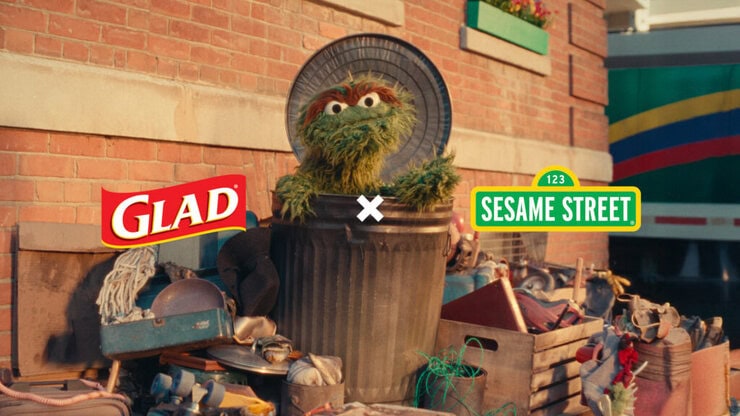
Glad has officially revived its legendary “Don’t Get Mad. Get Glad.” campaign, but this time, they’re ditching the usual celebrity faces for a true original: Oscar the Grouch. For the first time, the campaign’s star is none other than Sesame Street’s resident trash enthusiast himself, and he’s bringing his signature tune “I Love Trash” back with a contemporary twist.
The musical number, directed by the award-winning duo Will Speck and Josh Gordon, opens with Oscar in his element—surrounded by trash and a little bit of grumpiness. But the real magic happens when Oscar imagines a world where everyone else shares his passion for trash. The result? A joyful, Broadway-inspired remix that transforms everyday frustration into a celebration of Glad’s dependable trash solutions.
Why Oscar? Why Now?
According to Glad’s Marketing Director, Kellie Li, the choice was simple: “No one feels more strongly about trash than Oscar the Grouch.” The campaign aims to flip the script on how we think about trash—turning a dreaded chore into something a little more lighthearted. With Glad’s reliable bags, there’s less to get mad about, and maybe, just maybe, a little more to sing about.
Nostalgia Meets New Audiences
If “Don’t Get Mad. Get Glad.” sounds familiar, you’re not imagining things. The campaign has been a staple since 1987, featuring everyone from TV stars to athletes. But this new chapter, featuring Oscar and a cast of trash-loving co-stars, is designed to connect with both longtime fans and a new generation discovering Sesame Street on Netflix and PBS KIDS.
Limited-Edition Oscar Goodies and Where to Find Them
To celebrate the campaign, Glad is releasing limited-edition Oscar-inspired trash bag totes—complete with green fur, of course. Fans can snag these playful bags through a social media giveaway this December (follow @gladproducts on Instagram and TikTok for details). And if you miss out, don’t worry: special Oscar-branded Glad ForceFlex with Gain bags will hit Walmart shelves this April, just in time for spring cleaning.
Where to Watch
The campaign is rolling out across the U.S. and Canada, with full-length videos, bite-sized social teasers, and everything in between. Look for it on TikTok, Instagram, Facebook, and Reddit (for our friends up north). Featured products include Glad ForceFlex with Gain and Glad Cherry Blossom.
Glad revives its most popular, decades-long, star-studded ad campaign, “Don’t Get Mad. Get Glad.”
Glad revives its most popular, decades-long, star-studded ad campaign, “Don’t Get Mad. Get Glad.”
Bringing the Campaign Home: Phoenix Community Clean-Up
Here in Phoenix, we know the value of coming together to keep our neighborhoods clean and vibrant. Glad’s collaboration with Oscar the Grouch isn’t just a fun national campaign—it’s a reminder that tackling trash can be a community effort, too.
With spring cleaning right around the corner and special Oscar-branded Glad bags hitting Walmart shelves this April, it’s the perfect time for local groups, schools, and neighbors to organize clean-up events across the Valley. Whether you’re sprucing up a park, refreshing a neighborhood, or just making your own block a little brighter, every bag makes a difference.
Ready to join the movement? Rally your friends, family, or local organization and plan a Phoenix clean-up day this spring. Snap a photo of your crew with your Glad or Oscar-inspired trash bags and share it on social media using #GladToCleanPHX and #OscarLovesTrash. Let’s show how Phoenix turns trash day into a reason to celebrate!
“Phoenix, let’s get grouchy about litter and Glad about clean streets! Join our community clean-up and share your photos with #GladToCleanPHX.”
“Spotted: Oscar the Grouch in Phoenix! Grab your Glad bags, clean up your neighborhood, and tag #OscarLovesTrash for a chance to be featured.”
“Spring cleaning in Phoenix just got a lot more fun—thanks to Glad and Oscar! Who’s joining our next clean-up day? #GladToCleanPHX”
About the Brands
Glad, a member of The Clorox Company, has long been a leader in household waste solutions, while Sesame Workshop continues to inspire and educate families worldwide. This collaboration is a perfect blend of dependable products and beloved characters—reminding us all that even the messiest moments can spark a little joy.
The collaboration between Glad and Sesame Workshop for the “Don’t Get Mad. Get Glad.” campaign marks a creative partnership that blends household dependability with beloved children’s entertainment. By bringing Oscar the Grouch into the spotlight, Glad not only revives a classic campaign but also highlights the importance of making everyday chores more enjoyable for families. This partnership leverages Glad’s reputation as the nation’s leading provider of kitchen and outdoor trash bags and food protection products—trusted solutions designed to handle life’s messes with ease (Glad.com). Sesame Workshop, the nonprofit behind Sesame Street, has spent over 50 years enriching families worldwide through educational media and community outreach, helping children grow smarter, stronger, and kinder (Sesame.org). Together, their collaboration aims to inspire a new generation to see the positive side of cleaning up, all while celebrating the joy of community and play.
Ollie’s Bargain Outlet Turns Spare Change Into Holiday Hope with Feeding America Partnership
Ollie’s Bargain Outlet launches its sixth annual hOLLIEday Caring campaign with Feeding America, letting shoppers round up purchases to fight hunger. The initiative has raised over $4 million for local food banks since 2019.
Ollie’s Bargain Outlet Turns Spare Change Into Holiday Hope with Feeding America Partnership
When you’re hunting for bargains this holiday season, your spare change could do more than jingle in your pocket—it could put food on a neighbor’s table. Ollie’s Bargain Outlet is launching its sixth annual hOLLIEday Caring campaign, partnering with Feeding America® to give shoppers an easy way to fight hunger right at the register. From December 7th through December 24th, customers can round up their purchases to support local food banks in communities where Ollie’s stores operate. It’s a small gesture that adds up fast—over the past five years, these round-ups have generated more than $4 million for families facing food insecurity.
Why This Campaign Matters More Than Ever
Food insecurity isn’t just a holiday problem—it’s a year-round crisis that intensifies when the calendar turns to November and December. Rising costs for food, housing, and healthcare have pushed millions of Americans into impossible choices: pay the electric bill or buy groceries? Fill a prescription or feed the kids? The Feeding America network has responded to this growing need by rescuing more than 4 billion pounds of wholesome food over the past year. But as demand increases, so does the pressure on food banks to keep shelves stocked and families fed. “The holidays can be a particularly challenging period for those in need and the food banks that support them,” the campaign announcement notes. “This is a time when families are forced to choose between food and other necessity items, food banks face rising demand, and families nationwide are turning to the Feeding America network of partner food banks to help make ends meet.”
How Round-Ups Create Real Impact
The beauty of Ollie’s hOLLIEday Caring campaign lies in its simplicity. There’s no complicated donation process, no separate transaction, no guilt-inducing ask at the checkout. Just a quick question: would you like to round up your purchase? That extra 37 cents or 82 cents might not seem like much in the moment, but multiply it across hundreds of thousands of transactions at 613 stores in 34 states, and suddenly you’re talking about meaningful resources for local food banks. “Our hOLLIEday Caring campaign encourages shoppers to turn spare change into meaningful support that puts food on the table for neighbors and creates the kind of real change and hope families need right now,” said Tom Kuypers, Senior Vice President of Marketing at Ollie’s.
A Partnership Built on Community Values
What makes this initiative particularly effective is that donations stay local. The funds raised support Feeding America’s network of partner food banks in the communities where Ollie’s operates, ensuring that your round-up in Pennsylvania helps Pennsylvania families, and your contribution in Arizona supports Arizona neighbors. This localized approach reflects Ollie’s broader commitment to the communities it serves. “At Ollie’s, caring for our associates, customers, and the communities in which they live in is a core value,” Kuypers emphasized. Elizabeth Pettengill, Interim Vice President of Corporate Partners at Feeding America, echoed that sentiment: “We are grateful for partners like Ollie’s who help make our work possible. Every round up at the register supports local food banks in communities across the country, helping to ensure families can bring meals home during the holidays and beyond.”
Beyond the Holidays
While the hOLLIEday Caring campaign runs through Christmas Eve, the need for food assistance doesn’t end when the decorations come down. Food insecurity is a persistent challenge that requires sustained support throughout the year. That’s why partnerships like this one matter—they create awareness, build habits of giving, and demonstrate how easily everyday shoppers can contribute to solutions. When charitable giving is integrated into routine activities like grocery shopping or bargain hunting, it becomes accessible to everyone, not just those with disposable income to spare.
How to Participate
If you’re shopping at Ollie’s between December 7th and December 24th, simply say yes when the cashier asks if you’d like to round up your purchase. That’s it. Your spare change will be directed to Feeding America’s network of local food banks, helping families in your community access the food they need. And if Ollie’s isn’t part of your regular shopping routine, consider how you might support local food banks in other ways—whether through direct donations, volunteering, or participating in similar round-up campaigns at other retailers. The holidays remind us that community isn’t just about celebration—it’s about showing up for each other, especially when times are tough. Sometimes that looks like a grand gesture. Sometimes it’s as simple as rounding up to the nearest dollar.
About Ollie’s Bargain Outlet
Ollie’s is a leading off-price retailer specializing in brand name closeout merchandise and excess inventory. With 613 stores across 34 states, the company’s mission is to sell “Good Stuff Cheap®” at prices up to 70% below traditional retailers. Learn more at ollies.com. For more stories about people making a difference in the community, whether it’s locally or globally, visit our Stories of Change section.Sources:
Looking for more ways to support families facing food insecurity? Visit your local food bank’s website to learn about donation opportunities, volunteer shifts, and community programs.
Latin America’s Religious Shift: More Say ‘Yes’ to God but ‘No’ to Church
New research on 220,000 Latin Americans reveals a paradox: church affiliation dropped from 93% to 82% and attendance is declining, yet personal faith remains strong. Discover why Latin America’s religious decline differs dramatically from Europe and the US.
A woman takes part in a Christ of May procession in Santiago, Chile, parading a relic from a destroyed church’s crucifix through the city. AP Photo/Esteban Felix
Latin America’s Religious Shift: More Say ‘Yes’ to God but ‘No’ to Church
Matthew Blanton, The University of Texas at Austin In a region known for its tumultuous change, one idea remained remarkably consistent for centuries: Latin America is Catholic. The region’s 500-year transformation into a Catholic stronghold seemed capped in 2013, when Jorge Mario Bergoglio of Argentina was elected as the first Latin American pope. Once a missionary outpost, Latin America is now the heart of the Catholic Church. It is home to over 575 million adherents – over 40% of all Catholics worldwide. The next-largest regions are Europe and Africa, each home to 20% of the world’s Catholics. Yet beneath this Catholic dominance, the region’s religious landscape is changing. First, Protestant and Pentecostal groups have experienced dramatic growth. In 1970, only 4% of Latin Americans identified as Protestant; by 2014, the share had climbed to almost 20%. But even as Protestant ranks swelled, another trend was quietly gaining ground: a growing share of Latin Americans abandoning institutional faith altogether. And, as my research shows, the region’s religious decline shows a surprising difference from patterns elsewhere. While fewer Latin Americans are identifying with a religion or attending services, personal faith remains strong.Women known as ‘animeras,’ who pray for the souls of the deceased, walk to a church for Day of the Dead festivities in Telembi, Ecuador.AP Photo/Carlos Noriega
Religious decline
In 2014, 8% of Latin Americans claimed no religion at all. This number is twice as high as the percentage of people who were raised without a religion, indicating that the growth is recent, coming from people who left the church as adults. However, there had been no comprehensive study of religious change in Latin America since then. My new research, published in September 2025, draws on two decades of survey data from over 220,000 respondents in 17 Latin American countries. This data comes from the AmericasBarometer, a large, region-wide survey conducted every two years by Vanderbilt University that focuses on democracy, governance and other social issues. Because it asks the same religion questions across countries and over time, it offers an unusually clear view of changing patterns. Overall, the number of Latin Americans reporting no religious affiliation surged from 7% in 2004 to over 18% in 2023. The share of people who say they are religiously unaffiliated grew in 15 of the 17 countries, and more than doubled in seven. On average, 21% of people in South America say they do not have a religious affiliation, compared with 13% in Mexico and Central America. Uruguay, Chile and Argentina are the three least religious countries in the region. Guatemala, Peru and Paraguay are the most traditionally religious, with fewer than 9% who identify as unaffiliated. Another question scholars typically use to measure religious decline is how often people go to church. From 2008 to 2023, the share of Latin Americans attending church at least once a month decreased from 67% to 60%. The percentage who never attend, meanwhile, grew from 18% to 25%. The generational pattern is stark. Among people born in the 1940s, just over half say they attend church regularly. Each subsequent generation shows a steeper decline, dropping to just 35% for those born in the 1990s. Religious affiliation shows a similar trajectory – each generation is less affiliated than the one before.
Personal religiosity
However, in my study, I also examined a lesser-used measure of religiosity – one that tells a different story. That measure is “religious importance”: how important people say that religion is in their daily lives. We might think of this as “personal” religiosity, as opposed to the “institutional” religiosity tied to formal congregations and denominations.People attend a Mass marking the International Day against Drug Abuse and Illicit Trafficking in Buenos Aires, Argentina, on June 26, 2024.AP Photo/Rodrigo Abd Like church attendance, overall religious importance is high in Latin America. In 2010, roughly 85% of Latin Americans in the 17 countries whose data I analyzed said religion was important in their daily lives. Sixty percent said “very,” and 25% said “somewhat.” By 2023, the “somewhat important” group declined to 19%, while the “very important” group grew to 64%. Personal religious importance was growing, even as affiliation and church attendance were falling. Religious importance shows the same generational pattern as affiliation and attendance: Older people tend to report higher levels than younger ones. In 2023, 68% of people born in the 1970s said religion was “very important,” compared with 60% of those born in the 1990s. Yet when you compare people at the same age, the pattern reverses. At age 30, 55% of those born in the 1970s rated religion as very important. Compare that with 59% among Latin Americans born in the 1980s, and 62% among those born in the 1990s. If this trend continues, younger generations could eventually show greater personal religious commitment than their elders.
Affiliation vs. belief
What we are seeing in Latin America, I’d argue, is a fragmented pattern of religious decline. The authority of religious institutions is waning – fewer people claim a faith; fewer attend services. But personal belief isn’t eroding. Religious importance is holding steady, even growing. This pattern is quite different from Europe and the United States, where institutional decline and personal belief tend to move together. Eighty-six percent of unaffiliated people in Latin America say they believe in God or a higher power. That compares with only 30% in Europe and 69% in the United States. Sizable proportions of unaffiliated Latin Americans also believe in angels, miracles and even that Jesus will return to Earth in their lifetime. In other words, for many Latin Americans, leaving behind a religious label or skipping church does not mean leaving faith behind.An Aymara Indigenous spiritual guide blesses a statue of baby Jesus with incense after an Epiphany Mass at a Catholic church in La Paz, Bolivia, on Jan. 6, 2025.AP Photo/Juan Karita This distinctive pattern reflects Latin America’s unique history and culture. Since the colonial period, the region has been shaped by a mix of religious traditions. People often combine elements of Indigenous beliefs, Catholic practices and newer Protestant movements, creating personal forms of faith that don’t always fit neatly into any one church or institution. Because priests were often scarce in rural areas, Catholicism developed in many communities with little direct oversight from the church. Home rituals, local saints’ festivals and lay leaders helped shape religious life in more independent ways. This reality challenges how scholars typically measure religious change. Traditional frameworks for measuring religious decline, developed from Western European data, rely heavily on religious affiliation and church attendance. But this approach overlooks vibrant religiosity outside formal structures – and can lead scholars to mistaken conclusions. In short, Latin America reminds us that faith can thrive even as institutions fade. Matthew Blanton, PhD Candidate, Sociology and Demography, The University of Texas at Austin This article is republished from The Conversation under a Creative Commons license. Read the original article.
STM Daily News is a vibrant news blog dedicated to sharing the brighter side of human experiences. Emphasizing positive, uplifting stories, the site focuses on delivering inspiring, informative, and well-researched content. With a commitment to accurate, fair, and responsible journalism, STM Daily News aims to foster a community of readers passionate about positive change and engaged in meaningful conversations. Join the movement and explore stories that celebrate the positive impacts shaping our world.