

Sports
How the explosion of prop betting threatens the integrity of pro sports
Miami Heat guard Terry Rozier was among 34 individuals arrested in connection with federal investigations into illegal gambling, highlighting a growing concern in sports. Prop bets, which allow wagering on specific game outcomes, have become prevalent, increasing the risk of corruption and match-fixing. The global sports betting market is expanding rapidly, raising alarms about integrity in sports.

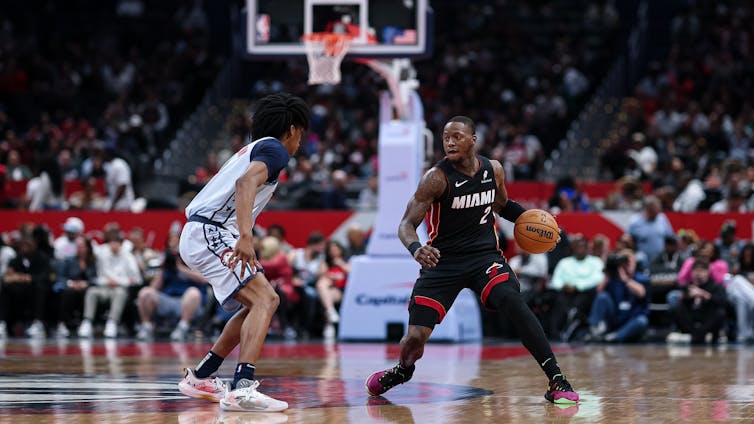
When I first heard about the arrests of Portland Trail Blazers coach Chauncey Billups, Miami Heat guard Terry Rozier and former NBA player Damon Jones in connection to federal investigations involving illegal gambling, I couldn’t help but think of a recent moment in my sports writing class.
I was showing my students a clip from an NFL game between the Jacksonville Jaguars and Kansas City Chiefs. Near the end of play, Jaguars quarterback Trevor Lawrence threw a perfect pass to receiver Brian Jones Jr. to secure a critical first down. Out of the blue, a student groaned and said that he’d lost US$50 on that throw.
I thought of that moment because it revealed how ubiquitous sports betting has become, how much the types of bets have changed over time, and – given these trends – how it’s naive to think players won’t continue to be tempted to game the system.
The prop bet hits it big
I’ve been following the evolution of sports gambling for about a decade in my position as chair of Penn State’s sports journalism program.
Back when legal American sports betting was mostly confined to Las Vegas, the standard bets tended to be tied to picking a winner or which team would cover a point spread.
But ahead of the 1986 Super Bowl between the Chicago Bears and the overmatched New England Patriots, casinos offered bets on whether Bears defensive lineman – and occasional running back – William “Refrigerator” Perry would score a touchdown. The excitement around that sideshow kept fan interest going during a 46-10 blowout.
Perry did end up scoring, and the prop bet took off from there.
Prop bets are wagers that depend on an outcome within a game but not its final result. They can often involve an athlete’s individual performance in some statistical category – for instance, how many yards a running back will rush for, how many rebounds a basketball center will secure, or how many strikeouts a pitcher will have. They’ve become routine offerings on sports betting menus.
For example: As I write this, I am looking at a FanDuel account I opened years ago, seeing that, for the Green Bay Packers-Pittsburgh Steelers game currently in progress, I can place a wager on which player will score a touchdown, how many yards each quarterback will throw for and much, much more. As the game progresses, the odds constantly shift – allowing for what are called “live bets.”
Returning to my student who lost the bet on Lawrence’s pass completion: It’s possible he’d placed a bet on Lawrence to throw fewer than a set number of yards. Or he could have been part of a fantasy league, which is also dependent on individual player performances.
Either way, a problem with prop bets, from an anti-corruption perspective, is that an individual can often control the outcome. You don’t need a group of players to be in on it – which is what happened during the infamous Black Sox Scandal, when eight players on the Chicago White Sox were accused of conspiring with gamblers to intentionally lose the 1919 World Series.
In the indictment against him, Rozier is accused of telling a co-defendant to pass along information to particular bettors that he planned to leave a March 2023 game early – a move everyone involved knew meant he would not reach his statistical benchmarks for the game. They could then place bets that he wouldn’t hit those marks.
In baseball, meanwhile, Luis Ortiz of the Cleveland Guardians was placed on leave during the 2025 season and is under investigation for possibly illegally wagering on the outcome of two pitches he threw. MLB authorities are essentially trying to determine if he deliberately threw balls as opposed to strikes in two instances. (Yes, prop bets have become so granular that you can even bet on whether a pitcher will throw a ball or a strike on an individual pitch.)
An exploding market with no end in sight
The popularity of prop bets feeds into a worldwide sports gambling industry that has experienced explosive growth and shows no sign of slowing.
Since the U.S. Supreme Court in 2018 ruled that states could decide on whether to allow sports betting, 39 states plus the District of Columbia have done so.
The leagues and media are more than just bystanders. FanDuel and DraftKings are official sports betting partners of the NBA and the NFL.
In the days after the Supreme Court ruling, I wondered whether journalists would embrace sports betting. These days, ESPN not only has a betting show, but it also has a betting app.
According to the American Gaming Association, sportsbooks collected a record $13.71 billion in revenue in 2024 from about $150 billion in wagers. A study released in February 2025 by Siena and St. Bonaventure universities found that nearly half of American men have an online sports betting account.
But those figures don’t begin to touch the worldwide sports betting market, especially the illegal one. The United Nations, in a 2021 report, reported that up to $1.7 trillion is wagered annually in illegal betting markets.
The U.N. report warned that it had found a “staggering scale, manifestation, and complexity of corruption and organized crime in sport at the global, regional, and national levels.”
Who’s the boss?
In early October 2025, I attended a conference of Play the Game, a Denmark-based organization that promotes “democratic values in world sports.” Its occasional gatherings attract experts from around the world who are interested in keeping sports fair and safe for everyone.
One of the most sobering topics was illegal, online sportsbooks that feature wagering on all levels of sport, from the lowest levels of European soccer on up.
It sounded somewhat familiar. This summer at the Little League World Series, which my students covered for The Associated Press, managers complained about offshore sportsbooks offering lines on the tournament, which is played by 12-year-old amateurs.
And with so much illegal wagering in the world, the issue of match fixing was bound to come up.
One session screened a recent German documentary on match fixing. Meanwhile, Anca-Maria Gherghel, a Ph.D. candidate at Sheffield Hallam University and senior researcher for EPIC Global Solutions, both in northern England, told me how she had interviewed a professional female soccer player for a team in Cyprus. The player described how she and her teammates were routinely approached with lucrative offers to throw matches.
Put it all together – the vast sums of money at play and the relative ease of fixing a prop bet, let alone a match – and you cannot be surprised at the NBA scandal.
I used to think that gambling was just a segment of the larger sports industry. Now, I wonder whether I had it exactly backward.
Has sports just become a segment of the larger gambling industry?
John Affleck, Knight Chair in Sports Journalism and Society, Penn State
This article is republished from The Conversation under a Creative Commons license. Read the original article.

Discover more from Daily News
Subscribe to get the latest posts sent to your email.


Sports
The U.S. Army Names Soldier-Athletes Headed to the 2026 Winter Games in Italy
The U.S. Army says nine WCAP Soldier-athletes and coaches will compete at the 2026 Winter Games in Italy in bobsled, biathlon, Nordic combined and figure skating—showcasing elite fitness, discipline and performance.

The U.S. Army is sending a new group of Soldier-athletes to one of the biggest stages in international sports.
In a Jan. 29, 2026 announcement, the Army said nine Soldier-athletes and coaches will represent the United States at the 2026 Winter Games in Italy, with two additional Soldiers traveling as alternates. The group will compete across bobsled, biathlon, Nordic combined, and pairs figure skating—sports that demand equal parts endurance, precision, and mental toughness.
Who’s representing the Army at the 2026 Winter Games
According to the release, the Army’s lineup of Soldier-athletes and coaches includes:
Competing and coaching in Italy
- Lt. Col. Chris Fogt (Bobsled Head Coach)
- Lt. Col. Garrett Hines (Bobsled Coach)
- Sgt. 1st Class Shauna Rohbock (Bobsled Coach)
- Sgt. Frank Del Duca (Bobsled)
- Spc. Azaria Hill (Bobsled)
- Staff Sgt. Deedra Irwin (Biathlon)
- Spc. Sean Doherty (Biathlon)
- Sgt. Ben Loomis (Nordic Combined)
- Pvt. Spencer Howe (Pairs Figure Skating)
Alternates
- Cpl. Hakeem Abdul-Saboor (Bobsled Alternate)
- Spc. Dana Kellogg (Luge Doubles Alternate)
Soldier first, athlete always
The Army emphasized that WCAP athletes remain full-time Soldiers while training and competing at the elite level. Brig. Gen. Matthew Braman, the Army’s Chief Marketing Officer, said the same traits built through military service—discipline, mental agility, teamwork, and readiness—translate directly into high-level athletic performance.
“Even when competing at the highest level, these athletes are U.S. Army Soldiers first,” Braman said in the release, adding that they’re trained to be “tactically and technically proficient” and prepared to perform in any environment.
What is the World Class Athlete Program (WCAP)?
The Soldier-athletes train and serve through the U.S. Army World Class Athlete Program (WCAP), which supports top-ranked Soldiers competing at the international level. WCAP provides coaching, facilities, and training resources while ensuring Soldiers maintain their readiness and complete mandatory Army requirements.
While WCAP was officially established in 1997, the Army says it has been training Soldier-athletes for more than 75 years. Over that span, the Army has sent more than 600 Soldier-athletes to compete on the world stage, earning more than 120 medals across summer and winter sports.
Italy adds a layer of Army history
This year’s Winter Games location also carries historical meaning for the Army. The release points to World War II, when the 10th Mountain Division—an elite unit trained for mountain warfare—climbed Riva Ridge in northern Italy in a mission that helped shift momentum in the war.
After returning home, many Soldiers from the 10th Mountain Division helped build the foundation of the American ski industry by establishing ski resorts and ski schools across the U.S.—a legacy that still shows up in winter sports culture today.
Braman called the upcoming Games “a unique moment” to honor both the Army’s history in alpine terrain and its long-standing presence in elite athletics.
What to Watch For
- Biathlon conditioning: How Soldier-athletes balance endurance output with shooting precision under fatigue.
- Bobsled power and speed: Starts win races—watch for explosive sprint mechanics and teamwork on push phases.
- Nordic combined workload: One of the toughest mixes in sport; look for training insights on strength-to-weight and aerobic capacity.
- Recovery and readiness: How WCAP athletes manage sleep, mobility, and injury prevention while staying Soldier-ready.
- Italy’s alpine backdrop: The region’s mountain history adds context—and pressure—for performance in cold, high-demand environments.
Learn more
For more information about the U.S. Army and opportunities like WCAP, the release directs readers to GoArmy.com, including GoArmy.com/world-class-athlete-program.
Source: U.S. Army (PRNewswire), Jan. 29, 2026
Related External Links
- U.S. Army World Class Athlete Program (WCAP) – Overview of how Soldier-athletes train and compete at the elite level.
- GoArmy.com – Learn more about U.S. Army opportunities and careers.
- Team USA – Athlete news, sport profiles, and updates across Olympic and Paralympic disciplines.
- Olympics.com – Official Winter Games coverage, schedules, and sport explainers.
- International Ski and Snowboard Federation (FIS) – Rules, rankings, and event info for Nordic disciplines, including Nordic combined.
- International Bobsleigh & Skeleton Federation (IBSF) – Bobsled and skeleton sport info, events, and athlete resources.
- International Biathlon Union (IBU) – Biathlon news, event calendars, and performance insights.
Stay Updated with STM Daily News Sports
Want more sports and fitness coverage that’s worth your time—athlete training, performance trends, major events, and the stories behind the grind? Keep up with our latest at STM Daily News – Sports .
Author

Discover more from Daily News
Subscribe to get the latest posts sent to your email.
Sports
CourtsApp Launches as “The Healthiest App in the World,” Turning Screen Time Into Play Time
CourtsApp, branded as “the healthiest app in the world,” aims to reduce screen time by encouraging users to engage in racquet sports like tennis and pickleball. The platform facilitates easy court bookings without membership fees, promoting movement and social interaction. Expansion plans cover various U.S. regions, maximizing accessibility for players.

If your New Year’s reset includes less scrolling and more moving, CourtsApp is trying to make that switch ridiculously easy.
CourtsApp has officially launched with a bold claim—calling itself “the healthiest app in the world”—and the positioning is clear: it’s not another wellness app asking for more screen time. It’s a tool designed to get you off your phone and onto a court.
What CourtsApp is (and why it’s different)
CourtsApp is an AI-powered marketing and booking platform that helps players instantly find and book open courts for tennis, pickleball, padel, and other racquet sports—often at discounted prices. The key point: no membership fees are required.
That matters because “friction” is one of the biggest reasons people don’t play as often as they want to. If booking a court means juggling memberships, phone calls, limited availability, or confusing club policies, most people default to the easier option: staying home.
CourtsApp’s pitch is simple: open the app, find a court, book it, and go play.
Turning screen time into play time
Most apps compete for attention. CourtsApp is leaning into the opposite idea—convert screen time into movement.
The average adult now spends more than seven hours a day looking at screens, a trend that’s often linked with rising rates of obesity, heart disease, anxiety, and social isolation. CourtsApp is positioning itself as a healthier relationship with your phone: use it briefly, then put it away and get outside.
Instead of tracking steps or pushing workouts through a screen, the app is built around real-world activity—full-body movement, outdoor play, and social connection.
Why racquet sports are having a moment
CourtsApp’s launch also taps into a bigger trend: racquet sports are booming, and not just because they’re fun.
Founder and CEO Daren Hornig argues that sports like tennis and pickleball can be a stronger path to fitness and longevity than the typical “10,000 steps” mindset.
“CourtsApp turns your phone into a gateway to real-world health,” Hornig said. “For years, we’ve been told that you can stay fit and lose weight by walking 10,000 steps a day, taking a Peloton class online or going to a gym. However, sports like tennis and pickleball give you a greater chance to achieve your health and fitness goals and live a longer and healthier life. And there’s no better time to start than the New Year.”
The company also points to research published in the British Journal of Sports Medicine, citing long-term data following more than 80,000 adults over nearly a decade. According to the release, participants in racquet sports saw a 47% lower risk of death from any cause and up to a 56% lower risk of cardiovascular-related death compared to non-participants.
Where CourtsApp is live now—and what’s next
CourtsApp is currently live for players across:
- New York
- New Jersey
- Connecticut
The platform already lists more than 1,500 courts across 150+ facilities in those markets.
Next up: expansion from Maine to Florida by Q1 2026, followed by market-by-market growth as club density increases. The release also calls out additional play-in markets including:
- Southern California
- Texas
- Pacific Northwest
Flexible pricing, more access, fewer barriers
One of the most practical angles here is affordability and access.
CourtsApp highlights discounted pricing during quieter hours—helping players turn a random free afternoon into court time without committing to a membership or paying peak-hour rates.
For clubs, the platform doubles as a marketing and booking engine. For players, it’s a shortcut to the thing they actually want: a court that’s open right now.
The bigger takeaway
CourtsApp is betting on a simple truth: people don’t need more motivation apps—they need fewer obstacles.
If the app delivers on its promise (fast booking, real inventory, and meaningful discounts), it could become a go-to tool for anyone trying to make movement a habit—especially in sports like pickleball and tennis where access and scheduling can make or break consistency.
Players and clubs can learn more or join the platform at CourtsApp.com.
Here’s a clean Related Links block you can paste into WordPress (HTML view). Swap in your actual URLs/titles where needed:
Related Links
- CourtsApp (Official Site)
- More Sports + Wellness Coverage on STM Daily News
- Pickleball News & Updates
- Tennis News & Court Culture
“`
Get the latest updates and information on the rapidly growing sport of pickleball, specifically designed for the senior community aged 50+. Check out Sleeve’s Senior Pickleball Report on YouTube to stay informed and up-to-date with the ever-changing world of pickleball. Join the community and stay ahead of the game. https://stmdailynews.com/sleeves-senior-pickleball-report/
Authors


Discover more from Daily News
Subscribe to get the latest posts sent to your email.
Daily News
Bad Bunny’s Super Bowl Halftime Show Fits the NFL’s Long Game to Win Latin America
The NFL aims to expand its reach into Latin America through strategic marketing and high-profile performers like Bad Bunny at the Super Bowl halftime show. While the choice has sparked controversy, particularly among conservatives, the league sees it as a business move to attract more fans, particularly in Mexico and Brazil.
Last Updated on February 7, 2026 by Daily News Staff
Jared Bahir Browsh, University of Colorado Boulder
Bad Bunny’s Super Bowl show is part of long play drawn up by NFL to score with Latin America
Donald Trump, it is fair to assume, will be switching channels during this year’s Super Bowl halftime show.
The U.S. president has already said that he won’t be attending Super Bowl LX in person, suggesting that the venue, Levi’s Stadium in Santa Clara, California, was “just too far away.” But the choice of celebrity entertainment planned for the main break – Puerto Rican reggaeton star Bad Bunny and recently announced pregame addition Green Day – didn’t appeal. “I’m anti-them. I think it’s a terrible choice. All it does is sow hatred. Terrible,” Trump told the New York Post.
National Football League Commissioner Roger Goodell likely didn’t have the sensibilities of the U.S. president in mind when the choice of Bad Bunny was made.
One of the top artists in the world, Bad Bunny performs primarily in Spanish and has been critical of immigration enforcement, which factored into the backlash in some conservative circles to the choice. Bad Bunny’s anti-ICE comments at this year’s Grammy Awards will have only stoked the ire of some conservatives.
But for the NFL hierarchy, this was likely a business decision, not a political one. The league has its eyes on expansion into Latin America; Bad Bunny, they hope, will be a ratings-winning means to an end. It has made such bets in the past. In 2020, Shakira and Jennifer Lopez were chosen to perform, with Bad Bunny making an appearance. The choice then, too, was seen as controversial.
Raising the flag overseas
As a teacher and scholar of critical sports studies, I study the global growth of U.S.-based sports leagues overseas.
Some, like the National Basketball Association, are at an advantage. The sport is played around the globe and has large support bases in Asia – notably in the Philippines and China – as well as in Europe, Australia and Canada.
The NFL, by contrast, is largely entering markets that have comparatively little knowledge and experience with football and its players.
The league has opted for a multiprong approach to attracting international fans, including lobbying to get flag football into the 2028 Olympics in Los Angeles.
Playing the field
When it comes to the traditional tackle game, the NFL has held global aspirations for over three-quarters of a century. Between 1950-1961, before they merged, the NFL and American Football League played seven games against teams in Canada’s CFL to strengthen the relationship between the two nations’ leagues.
Developing a fan base south of the border has long been part of the plan.
The first international exhibition game between two NFL teams was supposed to take place in Mexico City in 1968. But Mexican protest over the economy and cost of staging the Olympics that year led the game, between the Detroit Lions and Philadelphia Eagles, to be canceled.
Instead, it was Montreal that staged the first international exhibition match the following year.
In 1986, the NFL added an annual international preseason game, the “American Bowl,” to reach international fans, including several games in Mexico City and one in Monterrey.
But the more concerted effort was to grow football in the potentially lucrative, and familiar, European market.
After several attempts by the NFL and other entities in the 1970s and ’80s to establish an international football league, the NFL-backed World League of Football launched in 1991. Featuring six teams from the United States, one from Canada and three from Europe, the spring league lost money but provided evidence that there was a market for American football in Europe, leading to the establishment of NFL Europe.
But NFL bosses have long had wider ambitions. The league staged 13 games in Tokyo, beginning in 1976, and planned exhibitions for 2007 and 2009 in China that were ultimately canceled. These attempts did not have the same success as in Europe.
Beyond exhibitions
The NFL’s outreach in Latin America has been decades in the making. After six exhibition matches in Mexico between 1978 and 2001, the NFL chose Mexico City as the venue of its first regular season game outside the United States.
In 2005, it pitted the Arizona Cardinals against the San Francisco 49ers at Estadio Azteca in Mexico City. Marketed as “Fútbol Americano,” it drew the largest attendance in NFL history, with over 103,000 spectators.
The following year, Goodell was named commissioner and announced that the NFL would focus future international efforts on regular-season games.
The U.K. was a safe bet due to the established stadium infrastructure and the country’s small but passionate fan base. The NFL International Series was played exclusively in London between 2007 and 2016.
But in 2016, the NFL finally returned to Mexico City, staging a regular-season game between the Oakland – now Las Vegas – Raiders and Houston Texans.
And after the completion of upgrades to Latin America’s largest stadium, Estadio Azteca, the NFL will return to Mexico City in 2026, along with games in Munich, Berlin and London. Future plans include expanding the series to include Sydney, Australia, and Rio de Janeiro, Brazil, in 2026.
The International Player Pathway program also offers players from outside the United States an opportunity to train and earn a roster spot on an NFL team. The hope is that future Latin American players could help expand the sport in their home countries, similar to how Yao Ming expanded the NBA fan base in China after joining the Houston Rockets, and Shohei Ohtani did the same for baseball in Japan while playing in Los Angeles.
Heading south of the border
The NFL’s strategy has gained the league a foothold in Latin America.
Mexico and Brazil have become the two largest international markets for the NFL, with nearly 40 million fans in each of the nations.
Although this represents a fraction of the overall sports fans in each nation, the raw numbers match the overall Latino fan base in the United States. In recent years the NFL has celebrated Latino Heritage Month through its Por La Cultura campaign, highlighting Latino players past and present.
Latin America also offers practical advantages. Mexico has long had access to NFL games as the southern neighbor to the United States, with the Dallas Cowboys among the most popular teams in Mexico.
For broadcasters, Central and South America offer less disruption in regards to time zones. Games in Europe start as early as 6:30 a.m. for West Coast fans, whereas Mexico City follows Central time, and Brasilia time is only one to two hours ahead of Eastern time.
The NFL’s expansion plans are not without criticism. Domestically, fans have complained that teams playing outside the U.S. borders means one less home game for season-ticket holders. And some teams have embraced international games more than others.
Another criticism is the league, which has reported revenues of over US$23 billion during the 2024-25 season – nearly double any other U.S.-based league – is using its resources to displace local sports. There are also those who see expansion of the league as a form of cultural imperialism. These criticisms often intersect with long-held ideas around the league promoting militarism, nationalism and American exceptionalism.
Bad Bunny: No Hail Mary attempt
For sure, the choice of Bad Bunny as the halftime pick is controversial, given the current political climate around immigration. The artist removed tour dates on the U.S. mainland in 2025 due to concerns about ICE targeting fans at his concerts, a concern reinforced by threats from the Department of Homeland Security that they would do just that at the Super Bowl.
But in sticking with Bad Bunny, the NFL is showing it is willing to face down a section of its traditional support and bet instead on Latin American fans not just tuning in for the halftime show but for the whole game – and falling in love with football, too.
Jared Bahir Browsh, Assistant Teaching Professor of Critical Sports Studies, University of Colorado Boulder
This article is republished from The Conversation under a Creative Commons license. Read the original article.
Discover more from Daily News
Subscribe to get the latest posts sent to your email.





