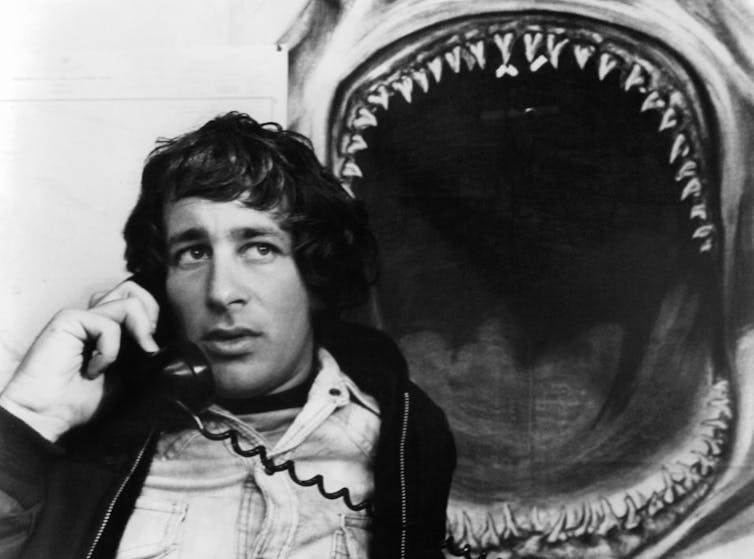
Many film historians see ‘Jaws’ as the first true summer blockbuster. Steve Kagan/Getty ImagesJared Bahir Browsh, University of Colorado Boulder “Da, duh.” Two simple notes – E and F – have become synonymous with tension, fear and sharks, representing the primal dread of being stalked by a predator. And they largely have “Jaws” to thank. Fifty years ago, Steven Spielberg’s blockbuster film – along with its spooky score composed by John Williams – convinced generations of swimmers to think twice before going in the water. As a scholar of media history and popular culture, I decided to take a deeper dive into the staying power of these two notes and learned about how they’re influenced by 19th-century classical music, Mickey Mouse and Alfred Hitchcock.
The first summer blockbuster
In 1964, fisherman Frank Mundus killed a 4,500-pound great white shark off Long Island. After hearing the story, freelance journalist Peter Benchley began pitching a novel based on three men’s attempt to capture a man-eating shark, basing the character of Quint off of Mundus. Doubleday commissioned Benchley to write the novel, and in 1973, Universal Studios producers Richard D. Zanuck and David Brown purchased the film rights to the novel before it was published. The 26-year-old Spielberg was signed on to be the director. Tapping into both mythical and real fears regarding great white sharks – including an infamous set of shark attacks along the Jersey Shore in 1916 – Benchley’s 1974 novel became a bestseller. The book was a key part of Universal’s marketing campaign, which began several months before the film’s release. Starting in the fall of 1974, Zanuck, Brown and Benchley appeared on a number of radio and television programs to simultaneously promote the release of the paperback edition of the novel and the upcoming film. The marketing also included a national television advertising campaign that featured emerging composer Williams’ two-note theme. The plan was for a summer release, which, at the time, was reserved for films with less than stellar reviews.TV ads promoting the film featured John Williams’ two-note theme. Films at the time typically were released market by market, preceded by local reviews. However, Universal’s decision to release the film in hundreds of theaters across the country on June 20, 1975, led to huge up-front profits, sparking a 14-week run as the No. 1 film in the U.S. Many consider “Jaws” the first true summer blockbuster. It catapulted Spielberg to fame and kicked off the director’s long collaboration with Williams, who would go on to earn the second-highest number of Academy Award nominations in history – 54 – behind only Walt Disney’s 59.
The film’s beating heart
Though it’s now considered one of the greatest scores in film history, when Williams proposed the two-note theme, Spielberg initially thought it was a joke. But Williams had been inspired by 19th and 20th century composers, including Claude Debussy, Igor Stravinsky and especially Antonin Dvorak’s Symphony No. 9, “From the New World.” In the “Jaws” theme, you can hear echoes of the end of Dvorak’s symphony, as well as the sounds of another character-driven musical piece, Sergei Prokofiev’s “Peter and the Wolf.” “Peter and the Wolf” and the score from “Jaws” are both prime examples of leitmotifs, or a musical piece that represents a place or character. The varying pace of the ostinato – a musical motif that repeats itself – elicits intensifying degrees of emotion and fear. This became more integral as Spielberg and the technical team struggled with the malfunctioning pneumatic sharks that they’d nicknamed “Bruce,” after Spielberg’s lawyer. As a result, the shark does not appear until the 81-minute mark of the 124-minute film. But its presence is felt through Williams’ theme, which some music scholars have theorized evoke the shark’s heartbeat.Mechanical issues with ‘Bruce,’ the mechanical shark, during filming forced Steven Spielberg to rely more on mood and atmosphere.Screen Archives/Moviepix via Getty Images
Sounds to manipulate emotions
Williams also has Disney to thank for revolutionizing character-driven music in film. The two don’t just share a brimming trophy case. They also understood how music can heighten emotion and magnify action for audiences. Although his career started in the silent film era, Disney became a titan of film, and later media, by leveraging sound to establish one of the greatest stars in media history, Mickey Mouse. When Disney saw “The Jazz Singer” in 1927, he knew that sound would be the future of film. On Nov. 18, 1928, “Steamboat Willie” premiered at Universal’s Colony Theater in New York City as Disney’s first animated film to incorporate synchronized sound. Unlike previous attempts to bring sound to film by having record players concurrently play or deploying live musicians to perform in the theater, Disney used technology that recorded sound directly on the film reel. It wasn’t the first animated film with synchronized sound, but it was a technical improvement to previous attempts at it, and “Steamboat Willie” became an international hit, launching Mickey’s – and Disney’s – career. The use of music or sound to match the rhythm of the characters on screen became known as “Mickey Mousing.” “King Kong” in 1933 would deftly deploy Mickey Mousing in a live action film, with music mimicking the giant gorilla’s movements. For example, in one scene, Kong carries away Ann Darrow, who’s played by actress Fay Wray. Composer Max Steiner uses lighter tones to convey Kong’s curiosity as he holds Ann, followed by ominous, faster, tones as Ann escapes and Kong chases after her. In doing so, Steiner encourages viewers to both fear and connect with the beast throughout the film, helping them suspend disbelief and enter a world of fantasy. Mickey Mousing declined in popularity after World War II. Many filmmakers saw it as juvenile and too simplistic for the evolving and advancing film industry.
When less is more
In spite of this criticism, the technique was still used to score some iconic scenes, like the playing of violins in the shower as Marion Crane is stabbed in Alfred Hitchcock’s “Psycho.” Spielberg idolized Hitchcock. A young Spielberg was even kicked off the Universal lot after sneaking on to watch the production of Hitchcock’s 1966 film “Torn Curtain.” Although Hitchcock and Spielberg never met, “Jaws” clearly exhibits the influence of Hitchcock, the “Master of Suspense.” And maybe that’s why Spielberg initially overcame his doubts about using something so simple to represent tension in the thriller.Steven Spielberg was just 26 years old when he signed on to direct ‘Jaws.’Universal/Getty Images The use of the two-note motif helped overcome the production issues Spielberg faced directing the first feature length movie to be filmed on the ocean. The malfunctioning animatronic shark forced Spielberg to leverage Williams’ minimalist theme to represent the shark’s ominous presence in spite of the limited appearances by the eponymous predatory star. As Williams continued his legendary career, he would deploy a similar sonic motif for certain “Star Wars” characters. Each time Darth Vader appeared, the “Imperial March” was played to set the tone for the leader of the dark side. As movie budgets creep closer to a half-billion dollars, the “Jaws” theme – and the way those two notes manipulate tension – is a reminder that in film, sometimes less can be more. Jared Bahir Browsh, Assistant Teaching Professor of Critical Sports Studies, University of Colorado Boulder This article is republished from The Conversation under a Creative Commons license. Read the original article.
The Substitute Teacher Who Wanted Blueprints of Our House
A fifth-grade assignment took a strange turn when a substitute teacher asked students to draw schematics of their homes. What followed — a wildly fictional floor plan and a priceless reaction from my mom — turned into one of my funniest childhood memories.
The Substitute Teacher Who Wanted Blueprints of Our House
Elementary school memories tend to blend together — cafeteria pizza, playground arguments, the eternal struggle of times tables — but every once in a while, something happens that sticks with you for life. For me, that moment came in the fifth grade during a week when our regular teacher was out, and we cycled through substitute teachers like we were testing models for durability. By midweek, in walked a substitute with a mysterious, slightly intense energy — the kind of vibe that suggested he either meditated at dawn or worked a graveyard shift doing something he couldn’t talk about. We settled into our seats, expecting worksheets or quiet reading time. But nope. He had other plans. “Today,” he announced, “we’re going to draw schematics of our houses.” Schematics. Not drawings. Not little houses with smoke coming out of the chimney. Actual blueprint-style schematics. He wanted the layout of our bedrooms, our parents’ rooms, and where the pets slept. Every detail. Now, to be fair, Highlights Magazine did have a feature that month teaching kids how to draw floor plans. So maybe he was just a bit overenthusiastic about cross-curricular learning. Or maybe — and this is my completely rhetorical adult theory — he worked the graveyard shift as a cat burglar gathering intel between heists. Just moonlighting between blueprints. While the rest of the class tried their best to recreate their actual homes, my imagination sprinted in a totally different direction. The house I drew had:
A massive master bedroom with an oversized bathroom for my parents
Separate bedrooms for us kids on the opposite side of the house
A kitchen placed right in the center like a command center
And the dog — the true VIP — had a luxurious two-story doghouse
I had basically created a dream home designed by a 10-year-old watching too much Fantasy Homes by the Yard. Later that day, my mom asked the usual question: “So, what did you guys do today?” “We drew schematics of our house,” I said casually. The look on her face was instant and intense. She wasn’t panicked, but there was definitely a “Why does a substitute teacher need to know the exact layout of my home?” expression happening. Parental instincts activated. But then I showed her my diagram. She stared at it. Blinked. Then sighed with massive relief. “This isn’t our house,” she said. “Nope! I made it up,” I replied proudly. Her shoulders relaxed so much she probably lost five pounds of tension in one instant. If the substitute was secretly planning a heist, my masterpiece of misinformation would have sent him to the wrong house entirely. Looking back, the whole moment feels like a sitcom setup — a mysterious substitute collecting “house schematics,” me creating a completely fictional piece of architecture, and my mom going on a full emotional journey in under 30 seconds. Maybe he was just excited about the Highlights Magazine floor-plan activity. Or maybe — just maybe — he moonlighted in cat burglary. We’ll never know. But if he was, I like to think I threw him completely off the scent.
Enjoy this story?
Check out more nostalgic and humorous stories on STM Daily News and be sure to sign up for our newsletter!
Our Lifestyle section on STM Daily News is a hub of inspiration and practical information, offering a range of articles that touch on various aspects of daily life. From tips on family finances to guides for maintaining health and wellness, we strive to empower our readers with knowledge and resources to enhance their lifestyles. Whether you’re seeking outdoor activity ideas, fashion trends, or travel recommendations, our lifestyle section has got you covered. Visit us today at https://stmdailynews.com/category/lifestyle/ and embark on a journey of discovery and self-improvement.
How China cleaned up its air pollution – and what that meant for the climate
How China cleaned up its air pollution: Beijing’s air quality went from hazardous to good while Delhi and Lahore still struggle. Discover how China dramatically reduced pollution since 2013—and why cleaner air may have unintended consequences for global warming and climate change.
Delhi: 442. Lahore: 334. Beijing: 16. These are the levels of PM 2.5, one of the principle measures for air pollution, on November 19. As Pakistanis and Indians struggle with hazardous air quality, in Beijing – a city once notorious for its smog – the air quality is currently rated as good. Ahead of the 2008 Beijing Olympics, the Chinese government was so concerned about pollution that it introduced temporary restrictions on cars, shut down factories and stopped work on some construction sites. The measures worked and one study later found that levels of air pollution were down 30% during the period when the temporary Olympic restrictions were in place. It would take a few more years before the Chinese government implemented a clean air action plan in 2013. Since then, China has achieved a dramatic improvement in its air quality. In this episode of The Conversation Weekly podcast, we speak to Laura Wilcox, a professor at the National Centre for Atmospheric Science at the University of Reading in the UK, to understand how China managed to clean up its air pollution. But Wilcox’s recent research uncovered some unintended consequences from this cleaner air for the global climate: the pollution was actually helping to cool the atmosphere and by taking it away, it may have accelerated global warming. Wilcox explains:
What we’re seeing is a removing of cooling that’s revealing warming that’s already there. So the air pollution isn’t the cause of the warming. It’s just letting us see stuff that we’ve already done.
Dive into “The Knowledge,” where curiosity meets clarity. This playlist, in collaboration with STMDailyNews.com, is designed for viewers who value historical accuracy and insightful learning. Our short videos, ranging from 30 seconds to a minute and a half, make complex subjects easy to grasp in no time. Covering everything from historical events to contemporary processes and entertainment, “The Knowledge” bridges the past with the present. In a world where information is abundant yet often misused, our series aims to guide you through the noise, preserving vital knowledge and truths that shape our lives today. Perfect for curious minds eager to discover the ‘why’ and ‘how’ of everything around us. Subscribe and join in as we explore the facts that matter. https://stmdailynews.com/the-knowledge/
What makes a true Santa is inside – and comes with the red suit
Research on 849 professional Santas reveals three types: prototypical, semi-prototypical, and nonprototypical. Discover how diverse Santas navigate stereotypes and why many see the red suit as a calling, not just a job.
Members of the Fraternal Order of Real Bearded Santas meet at Pink’s restaurant at Knott’s Berry Farm before the holiday rush in 2009. Business Wire via AP
What makes a true Santa is inside – and comes with the red suit
Christina Hymer, University of Tennessee When you picture Santa Claus, a white, bearded, overweight and jolly man who dashes around delivering gifts to children during the Christmas season probably comes to mind. Yet, not everyone who dons the red suit fits this stereotype. That’s what Bethany Cockburn, Borbala Csillag and I learned when we teamed up to study professional Santas. For our study, we looked into how these professional Santas were able to “be” Santa, even if they didn’t fully fit the image. As we explained in a forthcoming article in the Academy of Management Journal, many who do this work don’t see it as just a job – it’s a calling. For some professional Santas, it’s especially important that they look and feel like Santa to experience that sense of purpose in their work. We surveyed 849 professional Santas who live across the U.S. and interviewed 53 of them, collecting data between 2018 and 2021. We identified three types of professional Santas: prototypical (64%), semi-prototypical (23%) and nonprototypical (13%). Prototypical Santas look the part. They are white and overweight, have real beards and express confidence that they are the right fit. Semi-prototypical Santas looked the part, too, but felt like they weren’t quite suitable for a range of reasons. They might be introverted or use a fake beard. Nonprototypical Santas had characteristics at odds with the stereotype. They might be nonwhite, female or gay, or have a physical disability.Many Santas see their work, whether paid or volunteer, as a calling.Photo by Gwyn Sussman Whereas prototypical Santas could easily slide into the Santa role, the process was more complex for the others. Semi-prototypical Santas did things like come up with stories they’d tell themselves or share with children to explain away their fake beards. Nonprototypical Santas had values aligned with the Santa image, such as being peaceful, loving and kind. But they still made a big effort to look like what people expect when they visit a Santa. “Should it be a difference if you’re a Jewish Santa Claus or a Catholic Santa Claus?” asked an atheist professional Santa we called “Santa Aquila.” “No. You’re Santa Claus. What do you do? You’re not even supposed to preach anything.” Another Santa whom we called “Santa Lynx” hid that she was female in part by flattening her chest.
Why it matters
While anyone can take a turn being their neighborhood potluck’s Santa, the one you meet at the mall probably attended some combination of Santa schools, webinars and training. For instance, the Charles W. Howard Santa Claus School was founded in 1937 and conducts an annual Santa training each year. National networks also exist, such as the Fraternal Order of Real Bearded Santas, which says it has 1,000 members, – and the IBRBS, formerly known as the International Brotherhood of Real Bearded Santas, offering meetups and professional support.Actor B.J. Averell, dressed as Santa Claus, attends a toy drive for struggling Bay Area families in Burlingame, Calif., in December 2024.Tayfun Coskun/Anadolu via Getty Images There are also local organizations, such as the Lone Star Santas network in Texas. Although most professional Santas are paid for their work, many do this voluntarily. It’s not uncommon for there to be some sort of expectation around who should have a particular occupation. Pilots tend to be male, most schoolteachers are female, and salespeople are often seen as extroverted. But that doesn’t mean that women can’t be pilots, men can’t be teachers or that introverts can’t work in sales.
What’s next
I’m now looking at how broader institutional environments, current events and social movements can shape how people experience their callings and find meaning at work. The Research Brief is a short take on interesting academic work.Christina Hymer, Assistant Professor of Management and Entrepreneurship, University of Tennessee This article is republished from The Conversation under a Creative Commons license. Read the original article.
Dive into “The Knowledge,” where curiosity meets clarity. This playlist, in collaboration with STMDailyNews.com, is designed for viewers who value historical accuracy and insightful learning. Our short videos, ranging from 30 seconds to a minute and a half, make complex subjects easy to grasp in no time. Covering everything from historical events to contemporary processes and entertainment, “The Knowledge” bridges the past with the present. In a world where information is abundant yet often misused, our series aims to guide you through the noise, preserving vital knowledge and truths that shape our lives today. Perfect for curious minds eager to discover the ‘why’ and ‘how’ of everything around us. Subscribe and join in as we explore the facts that matter. https://stmdailynews.com/the-knowledge/


