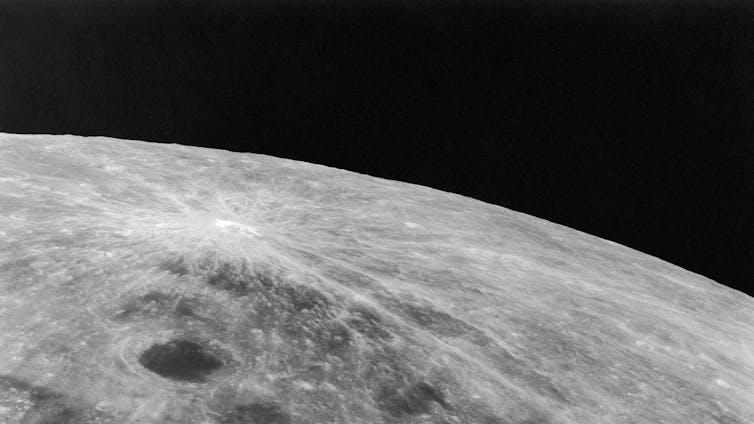
Several missions have already attempted to land on the lunar surface in 2025, with more to come. AP PhotoZhenbo Wang, University of Tennessee Half a century after the Apollo astronauts left the last bootprints in lunar dust, the Moon has once again become a destination of fierce ambition and delicate engineering. This time, it’s not just superpowers racing to plant flags, but also private companies, multinational partnerships and robotic scouts aiming to unlock the Moon’s secrets and lay the groundwork for future human return. So far in 2025, lunar exploration has surged forward. Several notable missions have launched toward or landed on the Moon. Each has navigated the long journey through space and the even trickier descent to the Moon’s surface or into orbit with varying degrees of success. Together, these missions reflect both the promise and difficulty of returning to the Moon in this new space race defined by innovation, competition and collaboration. As an aerospace engineer specializing in guidance, navigation and control technologies, I’m deeply interested in how each mission – whether successful or not – adds to scientists’ collective understanding. These missions can help engineers learn to navigate the complexities of space, operate in hostile lunar environments and steadily advance toward a sustainable human presence on the Moon.
Why is landing on the Moon so hard?
Lunar exploration remains one of the most technically demanding frontiers in modern spaceflight. Choosing a landing site involves complex trade-offs between scientific interest, terrain safety and Sun exposure. The lunar south pole is an especially attractive area, as it could contain water in the form of ice in shadowed craters, a critical resource for future missions. Other sites may hold clues about volcanic activity on the Moon or the solar system’s early history. Each mission trajectory must be calculated with precision to make sure the craft arrives and descends at the right time and place. Engineers must account for the Moon’s constantly changing position in its orbit around Earth, the timing of launch windows and the gravitational forces acting on the spacecraft throughout its journey. They also need to carefully plan the spacecraft’s path so that it arrives at the right angle and speed for a safe approach. Even small miscalculations early on can lead to major errors in landing location – or a missed opportunity entirely. Once on the surface, the landers need to survive extreme swings in temperature – from highs over 250 degrees Fahrenheit (121 degrees Celsius) in daylight down to lows of -208 F (-133 C) at night – as well as dust, radiation and delayed communication with Earth. The spacecraft’s power systems, heat control, landing legs and communication links must all function perfectly. Meanwhile, these landers must avoid hazardous terrain and rely on sunlight to power their instruments and recharge their batteries. These challenges help explain why many landers have crashed or experienced partial failures, even though the technology has come a long way since the Apollo era. Commercial companies face the same technical hurdles as government agencies but often with tighter budgets, smaller teams and less heritage hardware. Unlike government missions, which can draw on decades of institutional experience and infrastructure, many commercial lunar efforts are navigating these challenges for the first time.
Successful landings and hard lessons for CLPS
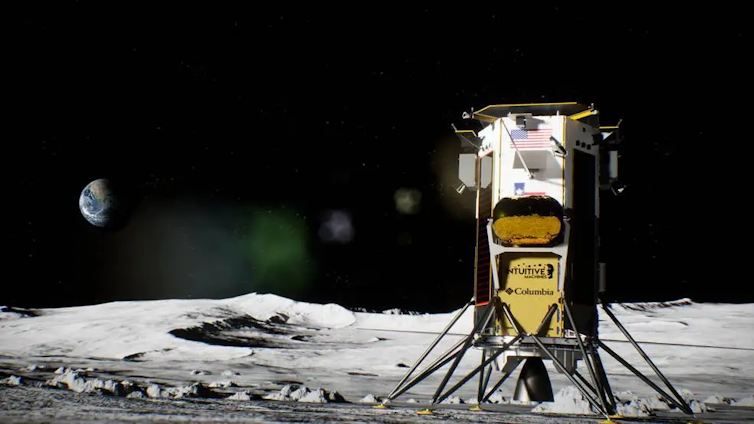
Several lunar missions launched this year belong to NASA’s Commercial Lunar Payload Services program. CLPS is an initiative that contracts private companies to deliver science and technology payloads to the Moon. Its aim is to accelerate exploration while lowering costs and encouraging commercial innovation.An artist’s rendering of Firefly Aerospace’s Blue Ghost lander, which navigated and avoided hazards during its final descent to the surface.NASA/GSFC/Rani Gran/Wikimedia Commons The first Moon mission of 2025, Firefly Aerospace’s Blue Ghost Mission 1, launched in January and successfully landed in early March. The lander survived the harsh lunar day and transmitted data for nearly two weeks before losing power during the freezing lunar night – a typical operational limit for most unheated lunar landers. Blue Ghost demonstrated how commercial landers can shoulder critical parts of NASA’s Artemis program, which aims to return astronauts to the Moon later this decade. The second CLPS launch of the year, Intuitive Machines’ IM-2 mission, launched in late February. It targeted a scientifically intriguing site near the Moon’s south pole region.An artist’s rendering of Intuitive Machines’ IM-2 mission, which is scheduled to land near the lunar south pole for in-situ resource utilization demonstration on the Moon.NASA/Intuitive Machines The Nova-C lander, named Athena, touched down on March 6 close to the south pole. However, during the landing process, Athena tipped over. Since it landed on its side in a crater with uneven terrain, it couldn’t deploy its solar panels to generate power, which ended the mission early. While Athena’s tipped-over landing meant it couldn’t do all the scientific explorations it had planned, the data it returned is still valuable for understanding how future landers can avoid similar fates on the rugged polar terrain. Not all lunar missions need to land. NASA’s Lunar Trailblazer, a small lunar orbiter launched in February alongside IM-2, was intended to orbit the Moon and map the form, abundance and distribution of water in the form of ice, especially in shadowed craters near the poles. Shortly after launch, however, NASA lost contact with the spacecraft. Engineers suspect the spacecraft may have experienced a power issue, potentially leaving its batteries depleted. NASA is continuing recovery efforts, hoping that the spacecraft’s solar panels may recharge in May and June.An artist’s rendering of NASA’s Lunar Trailblazer spacecraft. If recovered, it will orbit the Moon to measure the form and distribution of water on the lunar surface.Lockheed Martin Space
Ongoing and future missions
Launched on the same day as the Blue Ghost mission in January, Japanese company ispace’s Hakuto-R Mission 2 (Resilience) is on its way to the Moon and has successfully entered lunar orbit. The lander carried out a successful flyby of the Moon on Feb. 15, with an expected landing in early June. Although launched at the same time, Resilience took a longer trajectory than Blue Ghost to save energy. This maneuver also allowed the spacecraft to collect bonus science observations while looping around the Moon. The mission, if successful, will advance Japan’s commercial space sector and prove an important comeback for ispace after its first lunar lander crashed during its final descent in 2023.The Resilience lunar lander days before its launch in the payload processing facility at the U.S. Space Force station. The Resilience lander has completed its Earth orbit and a lunar flyby. It is now completing a low-energy transfer orbit and entering an orbit around the Moon.Business Wire The rest of 2025 promises a busy lunar calendar. Intuitive Machines plans to launch IM-3 in late 2025 to test more advanced instruments and potentially deliver NASA scientific experiments to the Moon. The European Space Agency’s Lunar Pathfinder will establish a dedicated lunar communications satellite, making it easier for future missions, especially those operating on the far side or poles, to stay in touch with Earth. Meanwhile, Astrobotic’s Griffin Mission-1 is scheduled to deliver NASA’s VIPER rover to the Moon’s south pole, where it will directly search for ice beneath the surface. Together, these missions represent an increasingly international and commercial approach to lunar science and exploration. As the world turns its attention to the Moon, every mission – whether triumph or setback – brings humanity closer to a permanent return to our closest celestial neighbor.Zhenbo Wang, Associate Professor of Mechanical and Aerospace Engineering, University of Tennessee This article is republished from The Conversation under a Creative Commons license. Read the original article.
Blue Origin Launches First Human Spaceflight of 2026 with New Shepard NS-38
Blue Origin successfully completed its first human spaceflight of 2026 with New Shepard NS-38, carrying six private astronauts and marking 98 humans flown to space.
Blue Origin has officially kicked off its 2026 flight calendar, successfully completing the 38th mission of its New Shepard program and further solidifying its role in commercial human spaceflight.
The suborbital flight, known as NS-38, carried six private astronauts beyond the Kármán line, offering several minutes of weightlessness and sweeping views of Earth before a safe return to West Texas. The mission marks the first New Shepard launch of 2026 and another milestone for Blue Origin’s reusable spaceflight system.
With this flight, New Shepard has now flown 98 humans into space, representing 92 individual passengers. The growing total reflects Blue Origin’s emphasis on routine, repeatable access to space—once considered experimental, now becoming operational.
A Reliable Start to 2026
Blue Origin leadership emphasized reliability and customer trust as central priorities moving into the new year.
“As we enter 2026, we’re focused on continuing to deliver transformational experiences for our customers through the proven capability and reliability of New Shepard,” said Phil Joyce, Senior Vice President of New Shepard. “We are grateful for our astronaut customers who put their trust in our team to bring this experience into reality.”
The fully reusable New Shepard rocket and capsule system has demonstrated strong safety performance, autonomous operations, and consistent recovery—key elements in scaling human spaceflight.
Building Toward a Larger Vision
Beyond space tourism, New Shepard plays a foundational role in Blue Origin’s long-term goal of enabling millions of people to live and work in space for the benefit of Earth.
As the company’s first operational human spaceflight system, New Shepard supports:
Reusable launch vehicle testing
Human-rated safety system validation
Increased launch cadence and manufacturing expertise
Future Blue Origin programs and missions
Each successful flight expands operational confidence while helping normalize commercial access to space.
What’s Next for Aspiring Astronauts
Blue Origin continues to accept interest from future New Shepard passengers, with additional flights expected throughout 2026. The company also released commemorative merchandise from the NS-38 mission, now available through the Blue Origin Shop.
As commercial spaceflight matures, missions like NS-38 highlight the industry’s shift from novelty to normalcy—bringing space closer to scientists, explorers, and private citizens alike.
For more updates, insights, and in-depth coverage of space exploration and commercial spaceflight, visit the STM Daily News blog at stmdailynews.com. From mission breakdowns to industry trends and technology explainers, STM Daily News keeps you informed about humanity’s journey beyond Earth.
NASA Astronaut Jonny Kim to Share Insights from Eight-Month Space Station Mission
NASA astronaut Jonny Kim will discuss his eight-month International Space Station mission during a live news conference on Dec. 19. Discover the science, technology, and teamwork behind his groundbreaking journey, streaming live via NASA and covered by STM Daily News.
NASA astronaut Jonny Kim poses inside the International Space Station’s cupola as it orbits 265 miles above the Indian Ocean near Madagascar. Credit: NASA
NASA Astronaut Jonny Kim Recaps Eight-Month International Space Station Mission in Live News Conference
Space exploration continues to push the boundaries of science and human achievement. This month, NASA astronaut Jonny Kim returns from an extraordinary eight-month mission aboard the International Space Station (ISS)—and he’s ready to share his story.
Event Details:
What: Jonny Kim’s ISS Mission Recap News Conference
Returning to Earth on Dec. 9 with Roscosmos cosmonauts Sergey Ryzhikov and Alexey Zubritsky, Kim logged an impressive 245 days in space as a flight engineer for Expeditions 72/73. The crew completed a staggering 3,920 orbits—covering nearly 104 million miles—and managed the arrival and departure of multiple spacecraft.
But it’s the science behind the mission that stands out:
Advancing Medicine and Technology
Bioprinted Tissues in Microgravity: Kim helped study the behavior of bioprinted tissues containing blood vessels, a step forward in space-based tissue production that could one day revolutionize patient care on Earth.
Remote Robotics Operations: Through the Surface Avatar study, Kim tested the remote command of multiple robots in space—work that could lead to more advanced robotic assistants for future missions to the Moon, Mars, and beyond.
Nanomaterials for Medicine: Kim contributed to the development of DNA-mimicking nanomaterials, opening doors for improved drug delivery and regenerative medicine both in space and at home.
How to Watch and Participate
NASA invites the public and media to join the news conference. For those interested in direct participation, media accreditation is required (details available via NASA’s newsroom). For everyone else, the event will be streamed live—no registration needed.
Learn more about International Space Station research and ongoing missions:NASA’s ISS Page
Why This Matters
Jonny Kim’s journey is a testament to the power of international collaboration and the relentless pursuit of knowledge. His work aboard the ISS is already shaping the future of medicine, robotics, and exploration—impacting lives both in space and right here on Earth.
Stay tuned to STM Daily News for more updates on science, innovation, and the stories that connect our community to the world beyond.
Want more space and science coverage? Visit STM Daily News for the latest updates, features, and community stories.
NASA goes on an ESCAPADE – twin small, low-cost orbiters will examine Mars’ atmosphere
NASA’s ESCAPADE mission launched two small, affordable orbiters to Mars on Blue Origin’s New Glenn rocket. Discover how these twin spacecraft will study Mars’ atmosphere, test new trajectories, and usher in a new era of rapid, low-cost space exploration.
NASA goes on an ESCAPADE – twin small, low-cost orbiters will examine Mars’ atmosphere
Christopher Carr, Georgia Institute of Technology and Glenn Lightsey, Georgia Institute of Technology Envision a time when hundreds of spacecraft are exploring the solar system and beyond. That’s the future that NASA’s ESCAPADE, or Escape and Plasma Acceleration and Dynamics Explorers, mission will help unleash: one where small, low-cost spacecraft enable researchers to learn rapidly, iterate, and advance technology and science. The ESCAPADE mission launched on Nov. 13, 2025 on a Blue Origin New Glenn rocket, sending two small orbiters to Mars to study its atmosphere. As aerospace engineers, we’re excited about this mission because not only will it do great science while advancing the deep space capabilities of small spacecraft, but it also will travel to the red planet on an innovative new trajectory. The ESCAPADE mission is actually two spacecraft instead of one. Two identical spacecraft will take simultaneous measurements, resulting in better science. These spacecraft are smaller than those used in the past, each about the size of a copy machine, partly enabled by an ongoing miniaturization trend in the space industry. Doing more with less is very important for space exploration, because it typically takes most of the mass of a spacecraft simply to transport it where you want it to go.The ESCAPADE mission logo shows the twin orbiters.TRAX International/Kristen Perrin Having two spacecraft also acts as an insurance policy in case one of them doesn’t work as planned. Even if one completely fails, researchers can still do science with a single working spacecraft. This redundancy enables each spacecraft to be built more affordably than in the past, because the copies allow for more acceptance of risk.
Space is not a friendly place. Most of it is a vacuum – that is, mostly empty, without the gas molecules that create pressure and allow you to breathe or transfer heat. These molecules keep things from getting too hot or too cold. In space, with no pressure, a spacecraft can easily get too hot or too cold, depending on whether it is in sunlight or in shadow. In addition, the Sun and other, farther astronomical objects emit radiation that living things do not experience on Earth. Earth’s magnetic field protects you from the worst of this radiation. So when humans or our robotic representatives leave the Earth, our spacecraft must survive in this extreme environment not present on Earth. ESCAPADE will overcome these challenges with a shoestring budget totaling US$80 million. That is a lot of money, but for a mission to another planet it is inexpensive. It has kept costs low by leveraging commercial technologies for deep space exploration, which is now possible because of prior investments in fundamental research. For example, the GRAIL mission, launched in 2011, previously used two spacecraft, Ebb and Flow, to map the Moon’s gravity fields. ESCAPADE takes this concept to another world, Mars, and costs a fraction as much as GRAIL. Led by Rob Lillis of UC Berkeley’s Space Sciences Laboratory, this collaboration between spacecraft builders Rocket Lab, trajectory specialists Advanced Space LLC and launch provider Blue Origin – all commercial partners funded by NASA – aims to show that deep space exploration is now faster, more agile and more affordable than ever before.NASA’s ESCAPADE represents a partnership between a university, commercial companies and the government.
How will ESCAPADE get to Mars?
ESCAPADE will also use a new trajectory to get to Mars. Imagine being an archer in the Olympics. To hit a bull’s-eye, you have to shoot an arrow through a 15-inch – 40-centimeter – circle from a distance of 300 feet, or 90 meters. Now imagine the bull’s-eye represents Mars. To hit it from Earth, you would have to shoot an arrow through the same 15-inch bull’s-eye at a distance of over 13 miles, or 22 kilometers. You would also have to shoot the arrow in a curved path so that it goes around the Sun. Not only that, but Mars won’t be at the bull’s-eye at the time you shoot the arrow. You must shoot for the spot that Mars will be in 10 months from now. This is the problem that the ESCAPADE mission designers faced. What is amazing is that the physical laws and forces of nature are so predictable that this was not even the hardest problem to solve for the ESCAPADE mission. It takes energy to get from one place to another. To go from Earth to Mars, a spacecraft has to carry the energy it needs, in the form of rocket fuel, much like gasoline in a car. As a result, a high percentage of the total launch mass has to be fuel for the trip. When going to Mars orbit from Earth orbit, as much as 80% to 85% of the spacecraft mass has to be propellant, which means not much mass is dedicated to the part of the spacecraft that does all the experiments. This issue makes it important to pack as much capability into the rest of the spacecraft as possible. For ESCAPADE, the propellant is only about 65% of the spacecraft’s mass. ESCAPADE’s route is particularly fuel-efficient. First, Blue and Gold will go to the L2 Lagrange point, one of five places where gravitational forces of the Sun and Earth cancel out. Then, after about a year, during which they will collect data monitoring the Sun, they will fly by the Earth, using its gravitational field to get a boost. This way, they will arrive at Mars in about 10 more months. This new approach has another advantage beyond needing to carry less fuel: Trips from Earth to Mars are typically favorable to save fuel about every 26 months due to the two planets’ relative positions. However, this new trajectory makes the departure time more flexible. Future cargo and human missions could use a similar trajectory to have more frequent and less time-constrained trips to Mars. ESCAPADE is a testament to a new era in spaceflight. For a new generation of scientists and engineers, ESCAPADE is not just a mission – it is a blueprint for a new collaborative era of exploration and discovery. This article was updated on Nov. 13, 2025 to reflect the ESCAPADE launch’s date and success.Christopher Carr, Assistant Professor of Aerospace Engineering, Georgia Institute of Technology and Glenn Lightsey, Professor of Space Systems Technology, Georgia Institute of Technology This article is republished from The Conversation under a Creative Commons license. Read the original article.


