Connect with us

Science

Mission possible − parastronaut programs can make space travel more inclusive and attainable for all

Published

on

Last Updated on May 3, 2025 by Daily News Staff

parastronaut
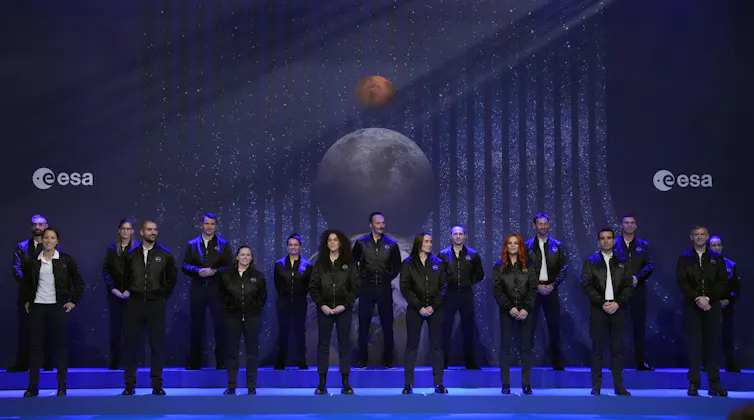
The European Space Agency’s astronaut cohort includes a parastronaut, as part of a feasibility project.
AP Photo/Francois Mori

Jesse Rhoades, University of North Dakota and Rebecca Rhoades, University of North Dakota

Humans will likely set foot on the Moon again in the coming decade. While many stories in this new chapter of lunar exploration will be reminiscent of the Apollo missions 50 years ago, others may look quite different.

For instance, the European Space Agency is currently working to make space travel more accessible for people of a wide range of backgrounds and abilities. In this new era, the first footprint on the Moon could possibly be made by a prosthetic limb.

An astronaut standing on the lunar surface and using a scoop to retrieve samples.
NASA plans to return humans to the lunar surface in the coming decade.
NASA Goddard

Historically, and even still today, astronauts selected to fly to space have had to fit a long list of physical requirements. However, many professionals in the field are beginning to acknowledge that these requirements stem from outdated assumptions.

Some research, including studies by our multidisciplinary team of aerospace and biomechanics researchers, has begun to explore the possibilities for people with physical disabilities to venture into space, visit the Moon and eventually travel to Mars.

Current research

NASA has previously funded and is currently funding research on restraints and mobility aids to help everyone, regardless of their ability, move around in the crew cabin.

Additionally, NASA has research programs to develop functional aids for individuals with disabilities in current U.S. spacecraft. A functional aid is any device that improves someone’s independence, mobility or daily living tasks by compensating for their physical limitations.

The European Space Agency, or ESA, launched its Parastronaut Feasibility Project in 2022 to assess ways to include individuals with disabilities in human spaceflight. A parastronaut is an astronaut with a physical disability who has been selected and trained to participate in space missions.

At the University of North Dakota, we conducted one of the first studies focused on parastronauts. This research examined how individuals with disabilities get into and get out of two current U.S. spacecraft designed to carry crew. The first was NASA’s Orion capsule, designed by Lockheed Martin, and the second was Boeing’s CST 100 Starliner.

Alongside our colleagues Pablo De León, Keith Crisman, Komal Mangle and Kavya Manyapu, we uncovered valuable insights into the accessibility challenges future parastronauts may face.

Our research indicated that individuals with physical disabilities are nearly as nimble in modern U.S. spacecraft as nondisabled individuals. This work focused on testing individuals who have experienced leg amputations. Now we are looking ahead to solutions that could benefit astronauts of all abilities.

Advertisement
Get More From A Face Cleanser And Spa-like Massage

Safety and inclusion

John McFall is the ESA’s first parastronaut. At the age of 19, Mcfall lost his right leg just above the knee from a motorcycle accident. Although McFall has not been assigned to a mission yet, he is the first person with a physical disability to be medically certified for an ISS mission.

A man with a prosthetic leg leans over next to mockup of a space capsule with the hatch open, another man kneels beside him.
John McFall stands by a mock-up of the SpaceX Dragon crew capsule.
SpaceX, CC BY-NC-SA

Astronaut selection criteria currently prioritize peak physical fitness, with the goal of having multiple crew members who can do the same physical tasks. Integrating parastronauts into the crew has required balancing mission security and accessibility.

However, with advancements in technology, spacecraft design and assistive tools, inclusion no longer needs to come at the expense of safety. These technologies are still in their infancy, but research and efforts like the ESA’s program will help improve them.

Design and development of spacecraft can cost billions of dollars. Simple adaptations, such as adding handholds onto the walls in a spacecraft, can provide vital assistance. However, adding handles to existing spacecraft will be costly.

Functional aids that don’t alter the spacecraft itself – such as accessories carried by each astronaut – could be another way forward. For example, adding Velcro to certain spots in the spacecraft or on prosthetic limbs could improve a parastronaut’s traction and help them anchor to the spacecraft’s surfaces.

Engineers could design new prosthetics made for particular space environments, such as zero or partial gravity, or even tailored to specific spacecraft. This approach is kind of like designing specialized prosthetics for rock climbing, running or other sports.

Accessibility can help everyone

Future space exploration, particularly missions to the Moon and Mars that will take weeks, months and even years, may prompt new standards for astronaut fitness. During these long missions, astronauts could get injured, causing what can be considered incidental disability.

An astronaut with an incidental disability begins a mission without a recognized disability but acquires one from a mission mishap. An astronaut suffering a broken arm or a traumatic brain injury during a mission would have a persistent impairment.

Two astronauts on an extravehicular activity in space, repairing part of a space station.
On longer missions, astronauts may need to troubleshoot issues on their own.
NASA

During long-duration missions, an astronaut crew will be too far away to receive outside medical help – they’ll have to deal with these issues on their own.

Considering disability during mission planning goes beyond inclusion. It makes the mission safer for all astronauts by preparing them for anything that could go wrong. Any astronaut could suffer an incidental disability during their journey.

Safety and inclusion in spaceflight don’t need to be at odds. Instead, agencies can reengineer systems and training processes to ensure that more people can safely participate in space missions. By addressing safety concerns through technology, innovative design and mission planning, the space industry can have inclusive and successful missions.The Conversation

Jesse Rhoades, Professor of Education, Heath & Behavior, University of North Dakota and Rebecca Rhoades, Researcher in Education, Health & Behavior, University of North Dakota

This article is republished from The Conversation under a Creative Commons license. Read the original article.

Advertisement
Get More From A Face Cleanser And Spa-like Massage

The science section of our news blog STM Daily News provides readers with captivating and up-to-date information on the latest scientific discoveries, breakthroughs, and innovations across various fields. We offer engaging and accessible content, ensuring that readers with different levels of scientific knowledge can stay informed. Whether it’s exploring advancements in medicine, astronomy, technology, or environmental sciences, our science section strives to shed light on the intriguing world of scientific exploration and its profound impact on our daily lives. From thought-provoking articles to informative interviews with experts in the field, STM Daily News Science offers a harmonious blend of factual reporting, analysis, and exploration, making it a go-to source for science enthusiasts and curious minds alike. https://stmdailynews.com/category/science/

Continue Reading
Advertisement SodaStream USA, inc

Space and Tech

I’ve fired one of America’s most powerful lasers – here’s what a shot day looks like

A lead scientist takes you inside the Texas Petawatt at UT Austin, where hours of careful alignment and safety checks build to a single, breath-holding laser shot that briefly creates star-like conditions in a vacuum chamber.

Published

on

file 20260410 57 e6icf4.jpg?ixlib=rb 4.1
Inside a laser clean room. The beam is contained within the blue pipe. Ahmed Helal

Ahmed Helal, The University of Texas at Austin

If you walk across the open yard in front of the Physics, Math and Astronomy building at the University of Texas at Austin, you’ll see a 17-story tower and a huge L-shaped building. What you won’t see is what’s underneath you. Two floors below ground, behind heavy double doors stamped with a logo that most students have never noticed, sits one of the most powerful lasers in the United States.

I was the lead laser scientist on the Texas Petawatt, or TPW as we called it, from 2020 to 2024. Texas Petawatt, which is currently closed due to funding cuts, was a government-funded research center where scientists from across the country applied for time to use specialized equipment. It was part of LaserNetUS, a Department of Energy network of high-power laser labs.

This type of laser takes a tiny pulse of light, stretches it out so it doesn’t blast optics to pieces, and amplifies it until, for a brief instant, it carries more power than the entire U.S. electrical grid. Then it compresses the pulse back to a trillionth of a second to create a star in a vacuum chamber.

On a typical shot day, the target might be a piece of metal foil thinner than a human hair, a jet of gas or a tiny plastic pellet – each designed to answer a different scientific question.

Scientists from across the country applied for time on TPW to study everything from the physics of stellar interiors and fusion energy to new approaches for cancer treatment.

Most people hear about petawatt lasers and picture something out of a movie. A “shot day” is actually hours of quiet, repetitive work followed by about 10 seconds where nobody breathes.

I now work as a research scientist at the University of Texas-Austin, studying the interaction of lasers with different materials, but a typical shot day during my time running TPW would look like this:

7 a.m.

I arrive two hours before the first scheduled shot. I put on my gown, boots and hairnet and step into the cold clean room. The laser doesn’t just turn on. You coax it awake.

I start with the oscillator, a small box that generates the first seed of light. I write down the parameters that define how the laser will behave during the shot: energy, center frequency, vacuum pressure in the tubes, cooling water level and flow. At this stage, they are fixed regardless of the experiment. The laser must perform the same way every time before the science can begin. Then I fire up the pump laser that will amplify this tiny pulse from nanojoules to about half a joule.

A diagram showing the layout of a large laser
The anatomy of a petawatt laser. A tiny pulse starts at the oscillator, gets stretched in time to avoid damaging the optics, is amplified through progressively larger stages, then is compressed back down to a trillionth of a second inside the vacuum chamber at right. Ahmed Helal, Fourni par l’auteur

The system needs at least 30 minutes to stabilize. During that time, I check alignment through every pinhole and every camera along the beam path. A slight misalignment at this stage isn’t just a problem; it can be catastrophic – a mispointed beam at full power can burn through optics that take months to source and replace, setting the entire laser back.

Building the beam

Once the system is warmed up, I send the beam into the first amplifier: a glass rod surrounded by bright flash lamps that pump light into the glass – like charging a battery. With each pass, the beam absorbs energy from the glass and grows stronger. Then the beam travels into a larger rod, where it makes four passes, picking up more energy each time until it reaches about 12 joules, roughly the energy of a ball thrown hard across a room.

Advertisement
Get More From A Face Cleanser And Spa-like Massage

This process alone takes the better part of an hour, most of it spent checking and confirming alignment and energy at each stage.

I expand the beam and send it through the final stage: the disk amplifiers. Two amplifiers, each consisting of two massive 30-centimeter glass disks, are pumped by a huge bank of flash lamps powered by capacitor banks – essentially giant batteries that store electrical energy and release it in a sudden burst. They are so large that they have their own room on a separate floor. Fast optical shutters between each stage act as gates, controlling exactly when and where the beam travels.

The shot

When the experimental team confirms that the target is in position, it asks me to prepare for a system shot. I run through the long checklist. We test the shutters and switch to system shot mode. Every monitor in the facility changes to display the same message – “System Shot Mode” – and flashes red.

A desk with 11 monitors displaying graphs.
The Texas Petawatt control room allows scientists to track a variety of parameters and metrics. On the left is the big red emergency stop button. Ahmed Helal

I lean into the microphone at the control desk, a vintage piece that looks like it belongs in a World War II radio room, and announce that we’re going into a system shot. Then I open the compressor beam dump: a heavy glass plate that normally blocks the beam from reaching the target. It takes about two minutes to move.

“Sweeping, sweeping for a system shot.”

The announcement goes out over speakers across the facility. I grab a small interlock key, put on my laser safety goggles and head downstairs. I walk a specific pattern through every room, checking that nobody is still inside. As I go, I lock each door with the key. If anyone opens one of those doors after I’ve locked them, the entire shot sequence aborts.

A microphone on a stand sitting on a desk.
Texas Petawatt scientists make announcements about the shot through a microphone in the control room. Ahmed Helal

Back in the control room, I sit down and start charging the capacitor banks. At this point, there’s no going back except for an emergency shutdown, and that means losing the shot and waiting for everything to cool down.

“Charging.”

The room goes silent. Everyone’s eyes are on the monitors. Nobody talks.

I typically will share a glance with the researcher whose project the shot is for – today it’s Joe, a visiting scientist from Los Alamos National Lab, who designed the target we’re about to vaporize. He’s gripping his coffee cup like it owes him money. I turn back to the console.

“Charge complete. Firing system shot in three, two, one. Fire.”

I press the button. A loud thud rolls through the building as all that stored energy dumps into the beam. The monitors freeze, capturing everything at the moment of the shot: beam profiles, spectra, diagnostics – these metrics provide a full picture of exactly how the laser performed and whether the shot was clean. Downstairs, in the vacuum chamber, a spot smaller than a human hair just reached temperatures measured in millions of degrees.

Advertisement
Get More From A Face Cleanser And Spa-like Massage

I lean back in my chair and start recording laser parameters as everyone exhales. A radiation safety officer heads down first to check readings around the target chamber before anyone else can enter. The experimental team follows to collect data.

Sometimes it all works perfectly. Sometimes a shutter fails to open and you lose the shot.

For example, one afternoon in 2023, we’d spent three hours preparing for a high-priority shot. Target aligned. Capacitors charged. I pressed the button and heard nothing. A shutter had failed somewhere in the chain. The monitors stayed frozen, showing black. Nobody said anything. I wrote SHOT FAILED in the logbook and started the hourlong cooldown sequence. That’s the part they don’t show in movies: sitting in silence, waiting to try again. We got the shot four hours later.

This anticipation is all part of the job: hours of patience for 10 seconds you never quite get used to. Everything happens underneath a campus where thousands of people walk above, unaware that for a fraction of a second, a tiny point of matter hotter than the surface of the Sun just existed below their feet.

Ahmed Helal, Research Scientist, The University of Texas at Austin

This article is republished from The Conversation under a Creative Commons license. Read the original article.

The science section of our news blog STM Daily News provides readers with captivating and up-to-date information on the latest scientific discoveries, breakthroughs, and innovations across various fields. We offer engaging and accessible content, ensuring that readers with different levels of scientific knowledge can stay informed. Whether it’s exploring advancements in medicine, astronomy, technology, or environmental sciences, our science section strives to shed light on the intriguing world of scientific exploration and its profound impact on our daily lives. From thought-provoking articles to informative interviews with experts in the field, STM Daily News Science offers a harmonious blend of factual reporting, analysis, and exploration, making it a go-to source for science enthusiasts and curious minds alike. https://stmdailynews.com/category/science/

View recent photos

Unlock fun facts & lost history—get The Knowledge in your inbox!

We don’t spam! Read our privacy policy for more info.

Advertisement
Get More From A Face Cleanser And Spa-like Massage
Continue Reading

Science

New Glenn’s Third Mission Set for April 19 as Blue Origin Advances Commercial Space Capabilities

Published

on

CAPE CANAVERAL, Fla. — Blue Origin has confirmed the launch window for the third mission of its heavy-lift New Glenn rocket, marking another step forward in the company’s expanding role in commercial spaceflight.

New Glenn’s Third Mission
Image Credit: Blue Origin

New Glenn’s Third Mission

Launch Details and Timeline

The mission is scheduled to lift off no earlier than Sunday, April 19, 2026, from Launch Complex 36 at Cape Canaveral Space Force Station. The two-hour launch window opens at 6:45 a.m. EDT (10:45 UTC) and closes at 8:45 a.m. EDT (12:45 UTC).

Viewers can follow the mission through a live webcast hosted by Blue Origin, beginning approximately 30 minutes before liftoff.

Mission Payload: Expanding Space-Based Connectivity

At the heart of the mission is the deployment of the BlueBird 7 satellite, developed by AST SpaceMobile. The satellite is designed to enhance a growing direct-to-smartphone broadband network, an emerging technology aimed at delivering connectivity to standard mobile devices without the need for ground-based towers.

BlueBird 7 will contribute to expanding network capacity and is expected to support initial service rollout plans targeted for 2026. The broader initiative reflects a significant shift in how satellite infrastructure could complement terrestrial telecom systems, particularly in underserved or remote regions.

Reusability Milestone: Booster Returns Again

A key feature of this mission is the planned reuse of New Glenn’s first-stage booster, “Never Tell Me The Odds.” The booster previously demonstrated a successful launch and landing during the rocket’s second mission in November, underscoring Blue Origin’s commitment to reusable rocket technology—a cornerstone of cost reduction and operational efficiency in modern spaceflight.

If successful, this mission will further validate the reliability of the New Glenn system and strengthen its competitiveness in a market increasingly shaped by reusable launch vehicles.

Industry Context: Competing in a Rapidly Evolving Market

The New Glenn program represents Blue Origin’s answer to heavy-lift launch demands, positioning the company alongside major players such as SpaceX. As satellite constellations grow in scale and ambition, reliable and cost-effective launch services have become a critical component of the global space economy.

The inclusion of commercial payloads like BlueBird 7 highlights the increasing collaboration between aerospace firms and telecommunications providers, signaling a future where space-based infrastructure plays a central role in everyday connectivity.

Looking Ahead

With its third mission, New Glenn continues to build momentum as a next-generation launch platform. The combination of reusable hardware, commercial partnerships, and advanced payload capabilities places this launch among the most closely watched developments in the 2026 spaceflight calendar.

For ongoing updates, mission tracking, and live coverage, audiences can follow Blue Origin across its digital platforms or visit its official website.

Advertisement
Get More From A Face Cleanser And Spa-like Massage

Source

Blue Origin Official Announcement – New Glenn Third Mission

Related External Links


Explore the latest in innovation, AI, gadgets, startups, and digital trends in STM Daily News’ Techsection.

Continue Reading

The Earth

Restore Our Earth: Celebrating Earth Day and Taking Action for a Sustainable Future

Published

on

Last Updated on April 17, 2026 by Daily News Staff

Earth Day is celebrated annually on April 22nd, and it serves as a reminder of the importance of taking care of our planet. It’s a day to reflect on our impact on the environment and to take action to create a better future for our planet.

The first Earth Day was celebrated in 1970, and it marked the beginning of the environmental movement. Since then, Earth Day has grown into an international event, with millions of people around the world participating in activities and events to raise awareness about environmental issues.

One of the main goals of Earth Day is to encourage people to take action to reduce their impact on the environment. This can include simple actions like recycling, conserving energy, and reducing waste. It can also involve more significant actions like advocating for environmental policies and supporting sustainable businesses.

Another important aspect of Earth Day is education. It’s a time to learn about environmental issues and to understand how our actions can impact the planet. Many schools and organizations use Earth Day as an opportunity to teach children about the importance of taking care of the environment.

This year’s Earth Day theme is “Restore Our Earth”, and it focuses on the idea that we can all play a role in restoring the planet’s ecosystems. This can include actions like planting trees, reducing plastic waste, and supporting sustainable agriculture.

Earth Day is an important reminder of the impact that we have on the environment and the importance of taking action to create a better future for our planet. By working together and taking small steps, we can make a big difference in protecting the planet and ensuring that it remains healthy and beautiful for generations to come.

Earth Day – April 22

https://nationaltoday.com/earth-day/

https://stmdailynews.com/category/science/

Advertisement
Get More From A Face Cleanser And Spa-like Massage

Author

  • Rod Washington

    Rod: A creative force, blending words, images, and flavors. Blogger, writer, filmmaker, and photographer. Cooking enthusiast with a sci-fi vision. Passionate about his upcoming series and dedicated to TNC Network. Partnered with Rebecca Washington for a shared journey of love and art.

    View all posts
Continue Reading

Trending