Connect with us

The Bridge

Muslim men have often been portrayed as ‘terrorists’ or ‘fanatics’ on TV shows, but Muslim-led storytelling is trying to change that narrative

Published

on

Muslim men
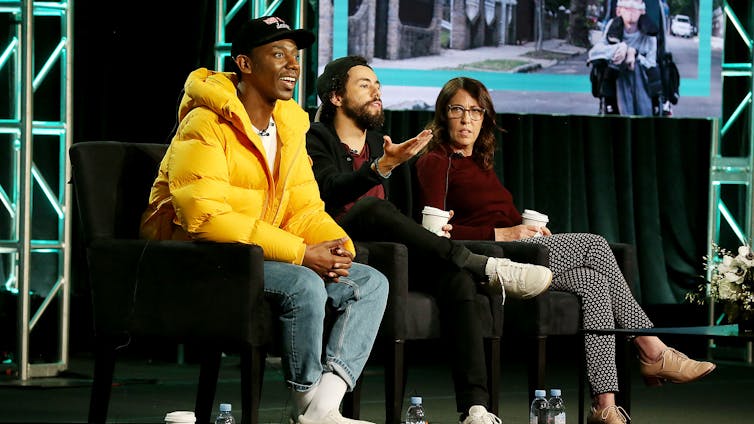
Hulu’s comedy-drama series ‘Ramy,’ created by actor-comedian Ramy Youssef, follows a young Egyptian-American Muslim navigating life’s challenges. Youssef, center, appears at a press conference in 2019.
Frederick M. Brown/Getty Images

Muslim men have often been portrayed as ‘terrorists’ or ‘fanatics’ on TV shows, but Muslim-led storytelling is trying to change that narrative

Tazeen M. Ali, Washington University in St. Louis

For over a century, Hollywood has tended to portray Muslim men through a remarkably narrow lens: as terrorists, villains or dangerous outsiders. From shows such as “24” and “Homeland” to procedural dramas such as “Law and Order,” this portrayal has seldom allowed for complexity or relatability.

Such depictions reinforce Orientalist stereotypes – a colonial worldview that treats cultures in the East as exotic, irrational or even dangerous.

However, recent years have seen a noticeable increase in Muslim-led storytelling across platforms in the U.S. and U.K. While still a minority, these stories depart from decades of misrepresentation.

As a scholar of Islam and gender who has conducted research on masculinity, sexuality and national belonging in Muslim entertainment media, I analyze a new wave of critically acclaimed shows where Muslim characters are at the center of the narrative.

Historical stereotypes

Scholar of media and race Jack Shaheen has documented the systematic vilification of Arabs and Muslims in Western media. In his 2001 book “Reel Bad Arabs,” he analyzed over a thousand films and found that the vast majority depicted Arab and Muslim men almost exclusively as fanatics, oil-rich villains and misogynists.

‘Reel Bad Arabs’ documentary.

More recently, a 2021 study from the University of Southern California’s Annenberg Inclusion Initiative looked at 200 popular movies and found that Muslim characters were either completely missing or shown as violent.

Despite the consistency of negative representations of Muslims on television following the rise in Islamophobia, the post-9/11 climate actually saw the introduction of more diverse Muslim characters. Such portrayals promoted the idea of the U.S. as a tolerant, liberal society.

Scholar of popular culture Evelyn Alsultany writes that Hollywood introduced Muslim characters who were often law-abiding citizens or patriotic allies. She explains that despite these positive attempts, these characters were still depicted in simplistic ways, as either “good Muslims” or “bad Muslims.” The “good Muslim/bad Muslim” framework was coined by scholar of postcolonialism Mahmood Mamdani to describe how Muslims are understood across this binary. The “good Muslims” distance themselves from their faith and align themselves with Western liberal values to gain acceptance.

Expanding on this theme, Islamic studies scholar Samah Choudhury explains how the mainstream success of South Asian Muslim male comedians such as Hasan Minhaj, Kumail Nanjiani and Aziz Ansari is shaped by their adoption of secular ideals.

Even so-called “positive” characters, such as Muslim FBI agents or loyal informants in shows like “NCIS” or “Homeland,” ultimately served to normalize state surveillance and justify the global war on terrorism, a global campaign initiated by the U.S. following the Sept. 11, 2001, terrorist attacks. These brown and sometimes Black Muslim characters are portrayed as “good” only when aligned with U.S. state power.

Advertisement
Get More From A Face Cleanser And Spa-like Massage

Effort in contemporary television

Hulu’s comedy drama series “Ramy” is a milestone in Muslim storytelling. Created by actor-comedian Ramy Youssef, the series, which debuted in 2019, follows a young Egyptian-American Muslim navigating family, faith and relationships in New Jersey.

Ramy is devoid of storylines about national security. Instead, the show foregrounds its main character’s grappling with religiosity, dating and identity. Moreover, as I have argued elsewhere, the protagonist’s religious devotion is never a punchline but a part of his everyday experience.

For instance, Ramy prays five times a day – at the mosque and at home, fasts during Ramadan, and abstains from alcohol as a matter of Islamic observance. At the same time, he also partakes in hookup culture and wrestles with guilt for falling short of Islamic ideals. By showcasing this duality, the show illuminates internal debates within American Muslim communities, including on gendered norms around marriage and sexual ethics.

Across the Atlantic, the BBC comedy series “Man Like Mobeen,” created by comedian-actor Guz Khan, offers a layered portrayal of Muslim life in inner-city Birmingham, England. The show follows Mobeen, a reformed British Pakistani gangster, striving and often failing to leave his criminal past behind and live as a devout Muslim while raising his teenage sister.

The show explores the struggles of the working class. It situates Muslim communities within broader class and racial dynamics whereby working-class Black and brown men are vulnerable to racial profiling by law enforcement and gang violence.

With incisive and dark humor, it challenges British racism against Muslims and offers social and political commentary on U.K. society. This includes critiques of British far-right movements and their racism, as well as the failures of the National Health Service.

Muslim women on screen

The flip side of stereotypical portrayals of Muslim men as violent and misogynist is the equally reductive portrayal of Muslim women as passive or oppressed. When Muslim women appear on screen, they are often presented as submissive or “liberated” only by a white non-Muslim male romantic interest. This process of liberation usually involves removing their hijab or distancing themselves from Islam.

A refreshing departure from such storytelling norms can be found in the British Channel 4 comedy “We Are Lady Parts,” created by filmmaker and writer Nida Manzoor, which debuted in 2021.

The show follows an all-female Muslim punk band in London. The bandmates are funny, creative and rebellious. While they defy Western views of Muslim women, they do not appear to be written solely to shatter stereotypes.

They reflect the contradictions that many Muslims live with, juggling faith, identity and politics in their music. The band’s songs include feminist themes but are diverse, subverting Islamophobic stereotypes against women with humor with songs like “Voldemort Under My Headscarf,” or lusting after a love interest in “Bashir with the good beard.”

Advertisement
Get More From A Face Cleanser And Spa-like Massage
‘Voldemort Under My Headscarf,’ a song from the music comedy ‘We Are Lady Parts.’

The band members are also often seen engaged in ritual prayer together, a unified display of worship among women who otherwise have very different personalities, fashion sensibilities and goals in life. The show also addresses queerness, Islamophobia and intergenerational conflict with nuance and humor.

I explore all of these themes in further detail in my forthcoming book, in which I examine how this new wave of Muslim media offers insights about the lived religious experiences of American and British Muslims.

Narrative authority

What unites these series is their rejection of reductive and stereotypical narratives. Muslim characters in these shows are not defined by violence, trauma or assimilation. Nor do they serve as spokespeople for all Muslims; they are written as flawed and evolving individuals.

This wave of nuanced portrayals of Muslim life includes other recent productions such as Netflix’s 2022 series “Mo” and Hulu’s 2025 reality series “Muslim Matchmaker,” which centers real people whose lives and romantic journeys showcase American Muslim life in authentic ways. Muslims in the show are depicted as having various professions, levels of faith and life experiences.

These series and their creators signal that real progress comes when Muslim voices are telling their own stories, not simply reacting to the gaze of outsiders or the pressures of political headlines. By foregrounding daily ritual, spiritual aspiration and even awkwardness and desire, “Ramy,” “Man Like Mobeen” and “We Are Lady Parts” all refuse the burden of “representation.”

By moving away from the binary of “threatening other” versus “assimilated citizen,” this new wave of media challenges the legacy of Orientalism. Instead, they offer characters who reflect the complex realities of Muslim lives that are messy, joyful and evolving.

Tazeen M. Ali, Assistant Professor of Religion and Politics, Washington University in St. Louis

This article is republished from The Conversation under a Creative Commons license. Read the original article.

Continue Reading
Advertisement SodaStream USA, inc

The Knowledge

Metrolink Offers Fare-Free Rides for Earth Day 2026 Across Southern California

Metrolink offers fare-free rides for Earth Day 2026 across Southern California, encouraging sustainable travel and reduced emissions.

Published

on

Last Updated on April 21, 2026 by Daily News Staff

Metrolink Offers Fare-Free Rides for Earth Day 2026
Image Credit: Metrolink

Metrolink Offers Fare-Free Rides for Earth Day 2026

LOS ANGELES — April 22, 2026 — In a continued push toward sustainable transportation, Metrolink will once again offer systemwide free rides on Earth Day, inviting commuters and travelers to leave their cars behind and explore a cleaner way to move across the region.

A One-Day Opportunity to Ride Free

On Wednesday, April 22, passengers can board any Metrolink train — including the Arrow service — without purchasing a ticket. The initiative is part of the broader celebration of Earth Day, encouraging environmentally conscious travel choices.

The fare-free program is designed to appeal to both regular riders and first-time users, particularly those navigating Southern California’s persistent traffic congestion and rising fuel costs.

ml earth emailheader eng.jpg
Image Credit: Metrolink

Encouraging Sustainable Travel Habits

“Earth Day is a reminder that small changes, like choosing public transit over driving one day a week, can have a meaningful impact on our environment,” said Doug Chaffee, chair of the Metrolink Board.

With gas prices continuing to strain household budgets, the agency hopes the initiative will inspire more residents to consider rail as part of their regular commute.

Regional Connections Expand Access

Metrolink’s Earth Day promotion aligns with similar efforts by other Southern California transit providers. Riders can seamlessly connect to services operated by: LA Metro and the Orange County Transportation AuthorityRiverside County Transportation CommissionSan Bernardino County Transportation Authority and Ventura County Transportation Commission.

These partnerships extend the reach of fare-free travel across a six-county region, making it easier for riders to explore destinations without relying on personal vehicles.

Service Adjustments and Rider Tips

Passengers should note that trains will operate on a reduced weekday schedule, implemented earlier this spring. Despite the adjustment, all Metrolink lines and station cities remain in service.

For those planning a trip:

  • No ticket is required — simply board the train
  • Bikes are welcome, with capacity ranging from three bikes per standard car to nine in designated bike cars
  • A curated destination guide highlights attractions within walking or biking distance of stations

Environmental and Economic Impact

Metrolink is also promoting its Personal Impact Calculator, a digital tool that allows riders to estimate how switching from driving to rail can reduce greenhouse gas emissions and lower fuel expenses.

A Broader Trend in Public Transit

Fare-free transit days have gained traction nationwide as agencies look to boost ridership and promote sustainability. Southern California’s expansive commuter rail network makes it particularly well-suited for such initiatives, offering a viable alternative to one of the country’s most car-dependent regions.


Bottom Line

Metrolink’s Earth Day promotion is more than a one-day free ride — it’s a strategic effort to shift commuter behavior, reduce environmental impact, and showcase the convenience of regional rail. For Southern Californians, April 22 presents a low-risk opportunity to rethink how they travel.

Advertisement
Get More From A Face Cleanser And Spa-like Massage

Source: Metrolink

https://metrolinktrains.com/news/metrolink-goes-fare-free-for-earth-day-on-april-22

Dive into “The Knowledge,” where curiosity meets clarity. This playlist, in collaboration with STMDailyNews.com, is designed for viewers who value historical accuracy and insightful learning. Our short videos, ranging from 30 seconds to a minute and a half, make complex subjects easy to grasp in no time. Covering everything from historical events to contemporary processes and entertainment, “The Knowledge” bridges the past with the present. In a world where information is abundant yet often misused, our series aims to guide you through the noise, preserving vital knowledge and truths that shape our lives today. Perfect for curious minds eager to discover the ‘why’ and ‘how’ of everything around us. Subscribe and join in as we explore the facts that matter.  https://stmdailynews.com/the-knowledge/

View recent photos

Unlock fun facts & lost history—get The Knowledge in your inbox!

We don’t spam! Read our privacy policy for more info.

Continue Reading

Entertainment

Grief Fest Launches as a Holiday Film Festival for Stories of Love, Loss, and Healing

Published

on

people gathering in a street. Grief Fest
Photo by Luis Quintero on Pexels.com

New hybrid event aims to give grieving audiences meaningful holiday viewing, with films from more than 25 countries and a mission centered on love, loss, and emotional truth.

A new film festival debuting in late 2026 is taking a different approach to holiday entertainment. Grief Fest™: The Grief Film Festival, created by My Grief Angels Inc., is being introduced as what organizers believe is the world’s first film festival dedicated entirely to grief, remembrance, resilience, and healing.

The hybrid festival will run in two segments: November 25–29, 2026, during Thanksgiving week, and December 24, 2026, through January 3, 2027, during Christmas and New Year’s. Top Honors films will be announced on December 31, 2026.

My Grief Angels Inc Image
GriefFest.com

Organizers say the timing is intentional. Research cited in the announcement shows that grief and loneliness are major holiday stressors for many Americans, making the season especially difficult for people coping with loss. In that context, Grief Fest™ is positioning itself as an alternative to the flood of traditional feel-good holiday programming.

The festival is open to short films, features, documentaries, experimental work, AI-generated projects, and VR experiences. It is described as inclusive, non-religious, and LGBTQ+ friendly, with submissions already received from more than 25 countries. All films will be presented in English, either spoken or subtitled.

Grief Fest™ will be available both in person and virtually through Film Festival Plus, making it accessible to audiences worldwide. The launch of GriefFest.com also includes Lumen, a multilingual AI guide designed to help filmmakers and attendees navigate the festival in their preferred language.

Rather than focusing on industry prestige, organizers say the festival is centered on community and emotionally honest storytelling. For audiences who feel unseen during the holidays, Grief Fest™ is aiming to offer something rare on the seasonal screen: recognition.

Source: PR Newswire

Related Reading

Catch the latest in movies, TV, music, pop culture, and live events in STM Daily News’ Entertainment section.

Continue Reading

Space and Tech

Astronaut Victor Glover is the latest in a long line of Black American explorers − including York, the enslaved man who played a key role in the Lewis and Clark expedition

Published

on

Last Updated on April 10, 2026 by Daily News Staff

Four astronauts in orange suits. Astronaut Victor Glover
The Artemis II crew will include Victor Glover, second from left, the first Black astronaut to fly to the Moon. NASA/Frank Michaux

Craig Fehrman, Indiana University

Astronaut Victor Glover

In April 2026, four astronauts are scheduled to fly around the Moon. As part of NASA’s Artemis II mission, they will become the first humans to do so in half a century. One crew member, pilot Victor Glover, will become the first Black astronaut to ever orbit the Moon.

Glover’s achievement is worth celebrating. But it’s also worth remembering that he belongs to a long and underappreciated history. America’s first Black explorer didn’t fly an Apollo rocket or sail with the U.S. Exploring Expedition. He traveled with Lewis and Clark, and he was known by a single name: York.

I’m a historian who spent five years writing a book about Lewis and Clark, and I found new documents that show York was one of the most important people on their expedition. Even in a party that could number as many as 45 men, York stood out – for his courage, his skill and his sacrifices that helped the famous captains reach the Pacific Ocean.

York’s life as a slave

A bronze statue of a man holding a bird and a gun, looking off into the distance
A statue of York stands at the Riverfront Plaza in Louisville, Ky. The statue is speculative, as there is no record of what York looked like. Lucky For You/Wikimedia Commons, CC BY-SA

York was born in Virginia around 1770. Growing up, he was a creative and sociable child, unusually tall with dark hair and a dark complexion – “black as a bear,” a contemporary noted.

He was also enslaved by the Clarks. William Clark, who was around the same age, was also unusually tall, though his hair was a rusty red, and sometimes the boys played together. But the playing stopped once York turned 9 or 10. That’s when he joined the adult slaves in working full time. That’s also when he began to note the differences between his life and William’s – differences that became only clearer once William started ordering him around.

In the 1780s, the Clark household headed to Kentucky. York met a Black woman there and married her. He also became William’s “body servant.”

A body servant was a slave who stayed close to his owner and prioritized his comfort, laying out his clothes and serving his meals. When Meriwether Lewis asked Clark to join his expedition, in 1803, Clark ordered York to accompany him.

Perhaps York was excited for this adventure. Perhaps he was not – it would be punishing, and he would be separated from his wife.

Either way, York didn’t have a choice.

The Corps of Discovery

York proved his worth from the start. Once they reached St. Louis, the soldiers, later known as the Corps of Discovery, rushed to raise winter quarters. Working in hail and snow, York and the others built log huts. They needed rough planks for their tables and bunks, but the carpenters had only a single whipsaw to make them. They chose two men to operate this crucial tool. One of them was York.

Advertisement
Get More From A Face Cleanser And Spa-like Massage

On May 14, 1804, the corps began ascending the Missouri River. York helped row and tow the party’s barge, which was the size of a semi-truck trailer. He carried a rifle and hunted – according to the expedition’s journals, he was only the fifth named member to bring down a buffalo. York cooked for the captains. He collected scientific specimens. He nursed the sick, including several soldiers and, later on, Sacagawea, a Shoshone woman who would also prove essential to the expedition’s success.

An old photo of a river with rushing rapids
York helped Lewis and Clark’s expedition cross rapids in the Columbia River. Carleton Watkins/Oregon Historical Society

The soldiers were not always kind in return. During this period, officers rarely brought along enslaved body servants. York’s race probably made some of the men angry or uncomfortable. One day, someone threw so much sand in his face that it nearly blinded him. Clark claimed it was “in fun,” but he also wrote that York was “very near losing his eyes,” and no one else got cruelly sprayed with sand.

That fall, during councils with Native leaders, York played a surprising and vital role. The Arikara, Mandan and Hidatsa all crowded in to see him and to touch his skin. They had never met a Black person before, and York showed off his strength and played with the Native children. Later, the Arikara said York was “the most marvelous” thing about the corps.

The next year, the expedition crossed the Rockies and the Continental Divide. York’s most important – and most overlooked – contributions came soon after. On the Columbia River and its tributaries, the party had to dig out five new canoes and then paddle them through treacherous rapids.

Lewis and Clark allowed only their best rivermen on these foaming, rock-riven waters. One of them was almost certainly York. During my research, I found an unpublished letter in which Clark praised York’s ability to “manage the boats.”

Just as important, York was a strong swimmer, a rare thing in an era when many people never learned to swim.

York’s life as an explorer

On the Columbia River, the corps survived a series of terrifying choke points – soggy hazards they referred to as the “Long Narrows” and the “Great Chute.” After that came the ocean. They had traveled together for more than 4,000 miles (6,400 kilometers), and when the captains asked the men to vote on where to put their final winter quarters, they made sure to ask York, too.

a photo of a journal scrawled with cursive handwriting
In his elk-skin journal, William Clark recorded York’s winter quarters vote. Missouri Historical Society

It was the latest sign that his role had changed during this epic journey. But those changes began with York. In the West, he found ways to make choices and assert himself. He sent a buffalo robe to his wife in Kentucky. When Clark told him to scale back his performances for Native people, York ignored him – because he wanted to, and because he could.

York’s vote was also evidence that, like Victor Glover today, he was an official American explorer, a key member of a sprawling, federally funded mission. From 1804 to 1806, the government devoted a larger percentage of its budget to the corps than it devotes to NASA today.

Part of that money was earmarked for York. The Army gave officers who brought along their slaves a monthly ration or its cash equivalent. When the corps made it home, the government paid US$274.57 for York’s labor, a sum similar to what the privates received. But that money didn’t go to York. It went to Clark.

The hidden history of Black explorers

There have been many Black explorers in American history. Thomas Jefferson launched other expeditions besides Lewis and Clark’s, and those expeditions also included enslaved people, though their names have not survived. Isaiah Brown served on the Wheeler Survey, which mapped the West in greater detail after the Civil War. Matthew Henson accompanied Robert Peary on his Arctic expeditions, which received some federal support. More recently, NASA has depended on Black astronauts such as Guy Bluford, Mae Jemison and Jeanette Epps, among others.

York and Victor Glover are, for now, the first and most recent examples of this inspiring tradition. But their contributions go beyond that. When the captains asked York to vote on the winter quarters, they were acknowledging in some small way that he’d proven he was more than a body servant.

Advertisement
Get More From A Face Cleanser And Spa-like Massage

Of course, York had always been more than that. It just took 4,000 miles for Lewis and Clark to see it.

Craig Fehrman, Adjunct instructor at the Media School, Indiana University

This article is republished from The Conversation under a Creative Commons license. Read the original article.

🧠 Forgotten Genius Fridays

A Short-Form Series from The Knowledge by STM Daily News

Every Friday, STM Daily News shines a light on brilliant minds history overlooked.

Forgotten Genius Fridays is a weekly collection of short videos and articles dedicated to inventors, innovators, scientists, and creators whose impact changed the world—but whose names were often left out of the textbooks.

From life-saving inventions and cultural breakthroughs to game-changing ideas buried by bias, our series digs up the truth behind the minds that mattered.

Each episode of The Knowledge runs 30–90 seconds, designed for curious minds on the go—perfect for YouTube Shorts, TikTok, Reels, and quick reads.

Because remembering these stories isn’t just about the past—it’s about restoring credit where it’s long overdue.

Advertisement
Get More From A Face Cleanser And Spa-like Massage

🔔 New episodes every Friday

📺 Watch now at: stmdailynews.com/the-knowledge

🧠 Now you know.

Continue Reading

Trending

