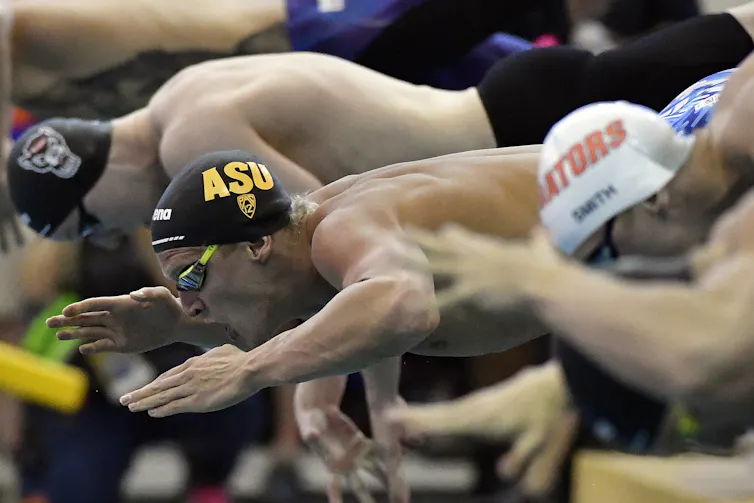
Former Arizona State University swimmer Grant House is one of the plaintiffs in the class action lawsuit filed against the NCAA. Mike Comer/NCAA Photos via Getty Images
NCAA will pay its current and former athletes in an agreement that will transform college sports
Joshua Lens, University of IowaThe business of college sports was upended after a federal judge approved a settlement between the NCAA and former college athletes on June 6, 2025.After a lengthy litigation process, the NCAA has agreed to provide US$2.8 billion in back pay to former and current college athletes, while allowing schools to directly pay athletes for the first time.Joshua Lens, whose scholarship centers on the intersection of sports, business and the law, tells the story of this settlement and explains its significance within the rapidly changing world of college sports.What will change for players and schools with this settlement? The terms of the settlement included the following changes:
The NCAA and conferences will distribute approximately $2.8 billion in media rights revenue back pay to thousands of athletes who competed since 2016.
Universities will have the ability to enter name, image and likeness, or NIL, agreements with student-athletes. So schools can now, for example, pay them to appear in ads for the school or for public appearances.
Each university that opts in to the settlement can disburse up to $20.5 million to student-athletes in the 2025-26 academic year, a number that will likely rise in future academic years.
Athletes’ NIL agreements with certain individuals and entities will be subject to an evaluation that will determine whether the NIL compensation exceeds an acceptable range based on a perceived fair market value, which could result in the athlete having to restructure or forego the deal.
The NCAA’s maximum sport program scholarship limits will be replaced with maximum team roster size limits for universities that choose to be part of the settlement.
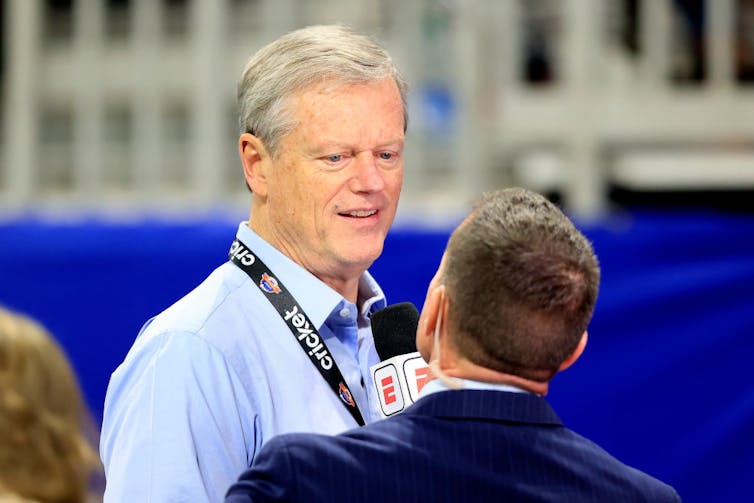
Why did the NCAA agree to settle with, rather than fight, the plaintiffs? In 2020, roughly 14,000 current and former college athletes filed a class action lawsuit, House v. NCAA, seeking damages for past restrictions on their ability to earn money. For decades, college athletics’ primary governing body, the NCAA, permitted universities whose athletics programs compete in Division I to provide their athletes with scholarships that would help cover their educational expenses, such as tuition, room and board, fees and books. By focusing only on educational expenses, the NCAA was able to reinforce the notion that collegiate athletes are amateurs who may not receive pay for participating in athletics, despite making money for their schools. A year later, in 2021, the U.S. Supreme Court unanimously ruled in a separate case, Alston v. NCAA, that the NCAA violated antitrust laws by limiting the amount of education-related benefits, such as laptops, books and musical instruments, that universities could provide to their athletes. The ruling challenged the NCAA’s amateurism model while opening the door for future lawsuits tied to athlete compensation. It also burnished the plaintiffs’ case in House v. NCAA, compelling college athletics’ governing body to take part in settlement talks. What were some of the key changes that took place in college sports after the Supreme Court’s decision in Alston v. NCAA? Following Alston, the NCAA permitted universities to dole out several thousand dollars in what’s called “education benefits pay” to student-athletes. This could include cash bonuses for maintaining a certain GPA or simply satisfying NCAA academic eligibility requirements. But contrary to popular belief, the Supreme Court’s Alston decision didn’t let college athletes be paid via NIL deals. The NCAA continued to maintain that this would violate its principles of amateurism. However, many states, beginning with California, introduced or passed laws that required universities within their borders to allow their athletes to accept NIL compensation. With over a dozen states looking to pass similar laws, the NCAA folded on June 30, 2021, changing its policy so athletes could accept NIL compensation for the first time. Will colleges and universities be able to weather all of these financial commitments? The settlement will result in a windfall for certain current and former collegiate athletes, with some expected to receive several hundred thousands of dollars. Universities and their athletics departments, on the other hand, will have to reallocate resources or cut spending. Some will cut back on travel expenses for some sports, others have paused facility renovations, while other athletic departments may resort to cutting sports whose revenue does not exceed their expenses. As Texas A&M University athletic director Trev Alberts has explained, however, that college sports does not have a revenue problem – it has a spending problem. Even in the well-resourced Southeastern Conference, for example, many universities’ athletics expenses exceed its revenue. Do you see any future conflicts on the horizon? Many observers hope the settlement brings stability to the industry. But there’s always a chance that the settlement will be appealed. More potential challenges could involve Title IX, the federal gender equity statute that prohibits discrimination based on sex in schools. What if, for example, a university subject to the statute distributes the vast majority of revenue to male athletes? Such a scenario could violate Title IX.NCAA President Charlie Baker, who has served in his role since 2023, has overseen major changes in conference governance and athlete compensation.David J. Griffin/Icon Sportswire via Getty Images On the other hand, a university that more equitably distributes revenue among male and female athletes could face legal backlash from football athletes who argue that they should be entitled to more revenue, since their games earn the big bucks. And as I pointed out in a recent law review article, an athlete or university may challenge
the new enforcement process that will attempt to limit athletes’ NIL compensation within an acceptable range that is based on a fair market valuation. The NCAA and the conferences named in the lawsuit have hired the accountancy firm Deloitte to determine whether athletes’ compensation from NIL deals fall within an acceptable range based on a fair market valuation, looking to other collegiate and professional athletes to set a benchmark range. If athletes and universities have struck deals that are too generous, both could be penalized, according to the terms of the settlement. Finally, the settlement does not address – let alone solve – issues facing international student-athletes who want to earn money via NIL. Most international student-athletes’ visas, and the laws regulating them, heavily limit their ability to accept compensation for work, including NIL pay. Some lawmakers have tried to address this issue in the past, but it hasn’t been a priority for the NCAA, as it has lobbied Congress for a federal NIL law. Joshua Lens, Associate Professor of Instruction of Sport & Recreation Management, University of Iowa This article is republished from The Conversation under a Creative Commons license. Read the original article.
The Sports section of STM Daily News is your ultimate destination for all things sports, catering to everyday fans and dedicated enthusiasts alike. We cover a wide range of topics, from the thrill of amateur competitions to the excitement of semi-professional and professional leagues. Our content delves into physical and mental fitness, providing insights and tips that help individuals elevate their performance, whether on the field or in their personal wellness journeys. Stay informed and inspired as we explore the dynamic world of sports, celebrating both the passion of the players and the joy of the fans.
The U.S. Army Names Soldier-Athletes Headed to the 2026 Winter Games in Italy
The U.S. Army says nine WCAP Soldier-athletes and coaches will compete at the 2026 Winter Games in Italy in bobsled, biathlon, Nordic combined and figure skating—showcasing elite fitness, discipline and performance.
The U.S. Army is sending a new group of Soldier-athletes to one of the biggest stages in international sports.
In a Jan. 29, 2026 announcement, the Army said nine Soldier-athletes and coaches will represent the United States at the 2026 Winter Games in Italy, with two additional Soldiers traveling as alternates. The group will compete across bobsled, biathlon, Nordic combined, and pairs figure skating—sports that demand equal parts endurance, precision, and mental toughness.
Who’s representing the Army at the 2026 Winter Games
According to the release, the Army’s lineup of Soldier-athletes and coaches includes:
Competing and coaching in Italy
Lt. Col. Chris Fogt (Bobsled Head Coach)
Lt. Col. Garrett Hines (Bobsled Coach)
Sgt. 1st Class Shauna Rohbock (Bobsled Coach)
Sgt. Frank Del Duca (Bobsled)
Spc. Azaria Hill (Bobsled)
Staff Sgt. Deedra Irwin (Biathlon)
Spc. Sean Doherty (Biathlon)
Sgt. Ben Loomis (Nordic Combined)
Pvt. Spencer Howe (Pairs Figure Skating)
Alternates
Cpl. Hakeem Abdul-Saboor (Bobsled Alternate)
Spc. Dana Kellogg (Luge Doubles Alternate)
Soldier first, athlete always
The Army emphasized that WCAP athletes remain full-time Soldiers while training and competing at the elite level. Brig. Gen. Matthew Braman, the Army’s Chief Marketing Officer, said the same traits built through military service—discipline, mental agility, teamwork, and readiness—translate directly into high-level athletic performance.
“Even when competing at the highest level, these athletes are U.S. Army Soldiers first,” Braman said in the release, adding that they’re trained to be “tactically and technically proficient” and prepared to perform in any environment.
What is the World Class Athlete Program (WCAP)?
The Soldier-athletes train and serve through the U.S. Army World Class Athlete Program (WCAP), which supports top-ranked Soldiers competing at the international level. WCAP provides coaching, facilities, and training resources while ensuring Soldiers maintain their readiness and complete mandatory Army requirements.
While WCAP was officially established in 1997, the Army says it has been training Soldier-athletes for more than 75 years. Over that span, the Army has sent more than 600 Soldier-athletes to compete on the world stage, earning more than 120 medals across summer and winter sports.
Italy adds a layer of Army history
This year’s Winter Games location also carries historical meaning for the Army. The release points to World War II, when the 10th Mountain Division—an elite unit trained for mountain warfare—climbed Riva Ridge in northern Italy in a mission that helped shift momentum in the war.
After returning home, many Soldiers from the 10th Mountain Division helped build the foundation of the American ski industry by establishing ski resorts and ski schools across the U.S.—a legacy that still shows up in winter sports culture today.
Braman called the upcoming Games “a unique moment” to honor both the Army’s history in alpine terrain and its long-standing presence in elite athletics.
Advertisement
What to Watch For
Biathlon conditioning: How Soldier-athletes balance endurance output with shooting precision under fatigue.
Bobsled power and speed: Starts win races—watch for explosive sprint mechanics and teamwork on push phases.
Nordic combined workload: One of the toughest mixes in sport; look for training insights on strength-to-weight and aerobic capacity.
Recovery and readiness: How WCAP athletes manage sleep, mobility, and injury prevention while staying Soldier-ready.
Italy’s alpine backdrop: The region’s mountain history adds context—and pressure—for performance in cold, high-demand environments.
Learn more
For more information about the U.S. Army and opportunities like WCAP, the release directs readers to GoArmy.com, including GoArmy.com/world-class-athlete-program.
Want more sports and fitness coverage that’s worth your time—athlete training, performance trends, major events, and the stories behind the grind? Keep up with our latest at STM Daily News – Sports .
CourtsApp Launches as “The Healthiest App in the World,” Turning Screen Time Into Play Time
CourtsApp, branded as “the healthiest app in the world,” aims to reduce screen time by encouraging users to engage in racquet sports like tennis and pickleball. The platform facilitates easy court bookings without membership fees, promoting movement and social interaction. Expansion plans cover various U.S. regions, maximizing accessibility for players.
If your New Year’s reset includes less scrolling and more moving, CourtsApp is trying to make that switch ridiculously easy.Photo by ThisIsEngineering on Pexels.com
CourtsApp has officially launched with a bold claim—calling itself “the healthiest app in the world”—and the positioning is clear: it’s not another wellness app asking for more screen time. It’s a tool designed to get you off your phone and onto a court.
What CourtsApp is (and why it’s different)
CourtsApp is an AI-powered marketing and booking platform that helps players instantly find and book open courts for tennis, pickleball, padel, and other racquet sports—often at discounted prices. The key point: no membership fees are required.
That matters because “friction” is one of the biggest reasons people don’t play as often as they want to. If booking a court means juggling memberships, phone calls, limited availability, or confusing club policies, most people default to the easier option: staying home.
CourtsApp’s pitch is simple: open the app, find a court, book it, and go play.
Turning screen time into play time
Most apps compete for attention. CourtsApp is leaning into the opposite idea—convert screen time into movement.
The average adult now spends more than seven hours a day looking at screens, a trend that’s often linked with rising rates of obesity, heart disease, anxiety, and social isolation. CourtsApp is positioning itself as a healthier relationship with your phone: use it briefly, then put it away and get outside.
Instead of tracking steps or pushing workouts through a screen, the app is built around real-world activity—full-body movement, outdoor play, and social connection.
Why racquet sports are having a moment
CourtsApp’s launch also taps into a bigger trend: racquet sports are booming, and not just because they’re fun.
Founder and CEO Daren Hornig argues that sports like tennis and pickleball can be a stronger path to fitness and longevity than the typical “10,000 steps” mindset.
“CourtsApp turns your phone into a gateway to real-world health,” Hornig said. “For years, we’ve been told that you can stay fit and lose weight by walking 10,000 steps a day, taking a Peloton class online or going to a gym. However, sports like tennis and pickleball give you a greater chance to achieve your health and fitness goals and live a longer and healthier life. And there’s no better time to start than the New Year.”
Advertisement
The company also points to research published in the British Journal of Sports Medicine, citing long-term data following more than 80,000 adults over nearly a decade. According to the release, participants in racquet sports saw a 47% lower risk of death from any cause and up to a 56% lower risk of cardiovascular-related death compared to non-participants.
Where CourtsApp is live now—and what’s next
CourtsApp is currently live for players across:
New York
New Jersey
Connecticut
The platform already lists more than 1,500 courts across 150+ facilities in those markets.
Next up: expansion from Maine to Florida by Q1 2026, followed by market-by-market growth as club density increases. The release also calls out additional play-in markets including:
Southern California
Texas
Pacific Northwest
Flexible pricing, more access, fewer barriers
One of the most practical angles here is affordability and access.
CourtsApp highlights discounted pricing during quieter hours—helping players turn a random free afternoon into court time without committing to a membership or paying peak-hour rates.
For clubs, the platform doubles as a marketing and booking engine. For players, it’s a shortcut to the thing they actually want: a court that’s open right now.
The bigger takeaway
CourtsApp is betting on a simple truth: people don’t need more motivation apps—they need fewer obstacles.
If the app delivers on its promise (fast booking, real inventory, and meaningful discounts), it could become a go-to tool for anyone trying to make movement a habit—especially in sports like pickleball and tennis where access and scheduling can make or break consistency.
Players and clubs can learn more or join the platform at CourtsApp.com.
Here’s a clean Related Links block you can paste into WordPress (HTML view). Swap in your actual URLs/titles where needed:
Get the latest updates and information on the rapidly growing sport of pickleball, specifically designed for the senior community aged 50+. Check out Sleeve’s Senior Pickleball Report on YouTube to stay informed and up-to-date with the ever-changing world of pickleball. Join the community and stay ahead of the game. https://stmdailynews.com/sleeves-senior-pickleball-report/
Rod: A creative force, blending words, images, and flavors. Blogger, writer, filmmaker, and photographer. Cooking enthusiast with a sci-fi vision. Passionate about his upcoming series and dedicated to TNC Network. Partnered with Rebecca Washington for a shared journey of love and art. View all posts
Over the past few years, Mike has become an insane pickleballer (pickler), fortunately for the senior 50+ crowd he started his show, Sleeve’s Senior Pickleball Report. He spends the rest of his time speaking on social justice and spending time with his beautiful wife, Karen, and enjoying simple living in his ger/yurt. View all posts
Bad Bunny’s Super Bowl Halftime Show Fits the NFL’s Long Game to Win Latin America
The NFL aims to expand its reach into Latin America through strategic marketing and high-profile performers like Bad Bunny at the Super Bowl halftime show. While the choice has sparked controversy, particularly among conservatives, the league sees it as a business move to attract more fans, particularly in Mexico and Brazil.
Bad Bunny’s Super Bowl show is part of long play drawn up by NFL to score with Latin America
Donald Trump, it is fair to assume, will be switching channels during this year’s Super Bowl halftime show.
The U.S. president has already said that he won’t be attending Super Bowl LX in person, suggesting that the venue, Levi’s Stadium in Santa Clara, California, was “just too far away.” But the choice of celebrity entertainment planned for the main break – Puerto Rican reggaeton star Bad Bunny and recently announced pregame addition Green Day – didn’t appeal. “I’m anti-them. I think it’s a terrible choice. All it does is sow hatred. Terrible,” Trump told the New York Post.
National Football League Commissioner Roger Goodell likely didn’t have the sensibilities of the U.S. president in mind when the choice of Bad Bunny was made.
But for the NFL hierarchy, this was likely a business decision, not a political one. The league has its eyes on expansion into Latin America; Bad Bunny, they hope, will be a ratings-winning means to an end. It has made such bets in the past. In 2020, Shakira and Jennifer Lopez were chosen to perform, with Bad Bunny making an appearance. The choice then, too, was seen as controversial.Shakira and Bad Bunny perform during the Pepsi Super Bowl LIV Halftime Show on Feb. 2, 2020, in Miami, Fla. Al Bello/Getty Images
Some, like the National Basketball Association, are at an advantage. The sport is played around the globe and has large support bases in Asia – notably in the Philippines and China – as well as in Europe, Australia and Canada.
The league has opted for a multiprong approach to attracting international fans, including lobbying to get flag football into the 2028 Olympics in Los Angeles.
Playing the field
When it comes to the traditional tackle game, the NFL has held global aspirations for over three-quarters of a century. Between 1950-1961, before they merged, the NFL and American Football League played seven games against teams in Canada’s CFL to strengthen the relationship between the two nations’ leagues.
Advertisement
Developing a fan base south of the border has long been part of the plan.
The first international exhibition game between two NFL teams was supposed to take place in Mexico City in 1968. But Mexican protest over the economy and cost of staging the Olympics that year led the game, between the Detroit Lions and Philadelphia Eagles, to be canceled.
Instead, it was Montreal that staged the first international exhibition match the following year.
In 1986, the NFL added an annual international preseason game, the “American Bowl,” to reach international fans, including several games in Mexico City and one in Monterrey.
But the more concerted effort was to grow football in the potentially lucrative, and familiar, European market.
After several attempts by the NFL and other entities in the 1970s and ’80s to establish an international football league, the NFL-backed World League of Football launched in 1991. Featuring six teams from the United States, one from Canada and three from Europe, the spring league lost money but provided evidence that there was a market for American football in Europe, leading to the establishment of NFL Europe.
But NFL bosses have long had wider ambitions. The league staged 13 games in Tokyo, beginning in 1976, and planned exhibitions for 2007 and 2009 in China that were ultimately canceled. These attempts did not have the same success as in Europe.
Beyond exhibitions
The NFL’s outreach in Latin America has been decades in the making. After six exhibition matches in Mexico between 1978 and 2001, the NFL chose Mexico City as the venue of its first regular season game outside the United States.
In 2005, it pitted the Arizona Cardinals against the San Francisco 49ers at Estadio Azteca in Mexico City. Marketed as “Fútbol Americano,” it drew the largest attendance in NFL history, with over 103,000 spectators.
The following year, Goodell was named commissioner and announced that the NFL would focus future international efforts on regular-season games.
Advertisement
The U.K. was a safe bet due to the established stadium infrastructure and the country’s small but passionate fan base. The NFL International Series was played exclusively in London between 2007 and 2016.
But in 2016, the NFL finally returned to Mexico City, staging a regular-season game between the Oakland – now Las Vegas – Raiders and Houston Texans.
And after the completion of upgrades to Latin America’s largest stadium, Estadio Azteca, the NFL will return to Mexico City in 2026, along with games in Munich, Berlin and London. Future plans include expanding the series to include Sydney, Australia, and Rio de Janeiro, Brazil, in 2026.
Although this represents a fraction of the overall sports fans in each nation, the raw numbers match the overall Latino fan base in the United States. In recent years the NFL has celebrated Latino Heritage Month through its Por La Cultura campaign, highlighting Latino players past and present.
Latin America also offers practical advantages. Mexico has long had access to NFL games as the southern neighbor to the United States, with the Dallas Cowboys among the most popular teams in Mexico.
For broadcasters, Central and South America offer less disruption in regards to time zones. Games in Europe start as early as 6:30 a.m. for West Coast fans, whereas Mexico City follows Central time, and Brasilia time is only one to two hours ahead of Eastern time.Bad Bunny poses with the Album of the Year, Best Música Urbana Album and Best Global Music Performance awards during the 68th Grammy Awards on Feb. 1, 2026, in Los Angeles. Matt Winkelmeyer/Getty Images for The Recording Academy
For sure, the choice of Bad Bunny as the halftime pick is controversial, given the current political climate around immigration. The artist removed tour dates on the U.S. mainland in 2025 due to concerns about ICE targeting fans at his concerts, a concern reinforced by threats from the Department of Homeland Security that they would do just that at the Super Bowl.
But in sticking with Bad Bunny, the NFL is showing it is willing to face down a section of its traditional support and bet instead on Latin American fans not just tuning in for the halftime show but for the whole game – and falling in love with football, too.


