Connect with us

Entertainment

Netflix-Warner deal would drive streaming market further down the road of ‘Big 3’ domination

Netflix’s planned acquisition of Warner Bros. marks a new era of “Big Three” domination in the streaming industry, joining Amazon and Disney at the top. Discover what this means for viewers and the future of digital entertainment.

Published

on

Netflix and Warner Bros. logos side by side, symbolizing the major streaming industry merger and the emergence of a dominant “Big Three” in digital entertainment.
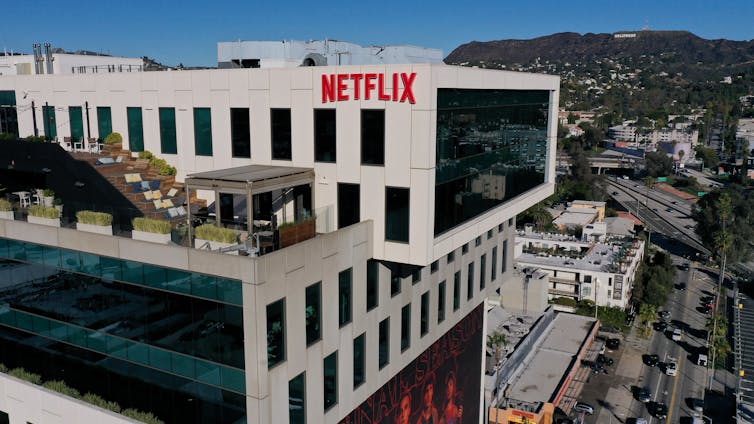
Netflix’s Hollywood studio offices at Sunset Bronson Studios in Los Angeles.
Patrick T. Fallon / AFP via Getty Images

Netflix-Warner deal would drive streaming market further down the road of ‘Big 3’ domination

David R. King, Florida State University

When it comes to major U.S. industries, three tends to be the magic number.

Historically, auto manufacturing was long dominated by Chrysler, Ford and General Motors – the so-called “Big Three,” which at one point controlled over 60% of the U.S. auto market. A dominant trio shows up elsewhere, too, in everything from the U.S. defense market – think Lockheed Martin, Boeing and Northrup Grumman – to cellphone service providers (AT&T, T-Mobile and Verizon). The same goes for the U.S. airline industry in which American, Delta and United fly higher than the rest.

The rule of three also applies to what Americans watch; the glory days of television was dominated by three giants: ABC, CBS and NBC.

Now, in the digital age, we are rapidly moving to a “Big Three” dominating streaming services: Netflix, Amazon and Disney.

The latest step in that process is Netflix’s plan to acquire Warner Bros. for US$72 billion. If approved, the move would solidify Netflix as the dominant streaming platform.

When streams converge

Starting life as a mail DVD subscription service, Netflix moved into streaming movies and TV shows in 2007, becoming a first-mover into the sphere.

Being an early adopter as viewing went from cable and legacy to online and streaming gave Netflix an advantages in also developing support technology and using subscriber data to create new content.

The subsequent impact was Netflix became a market leader, with quarterly profits now far exceeding its competitors, which often report losses.

Today, even without the Warner Bros. acquisition, Netflix has a dominant global base of over 300 million subscribers. Amazon Prime comes second with roughly 220 million subscribers, and Disney – which includes both Disney+ and Hulu – is third, with roughly 196 million subscribers. This means that between them, these three companies already control over 60% of the streaming market.

Netflix’s lead would only be reinforced by the proposed deal with Warner Bros., as it would add ownership of Warner subsidiary HBO Max, which is currently the fourth-biggest streamer in the U.S. with a combined 128 million subscribers. While some of them will overlap, Netflix is likely to still gain subscribers and better retain them with a broader selection of content.

Advertisement
Get More From A Face Cleanser And Spa-like Massage

Netflix’s move to acquire Warner Bros. also follows prior entertainment industry consolidation, driven by a desire to control content to retain streaming service subscribers.

In 2019, Disney acquired 21st Century Fox for $71.3 billion. Three years later, Amazon acquired Metro-Goldwyn-Mayer for $8.5 billion.

Should the Netflix deal go through, it would continue this trend of streaming consolidation. It would also leave a clear gap at the top between the emerging Big Three and other services, such as Paramount+ with 79 million subscribers and Apple TV+, which has around 45 million. Paramount on Dec. 8, 2025, announced a hostile takeover bid for Warner Bros. in a proposed $108.4 billion deal that would, unlike the Netflix plan, include Warner Bros. subsidiary Discovery+.

Why industries come in threes

But why do industries converge to a handful of companies?

As an expert on mergers, I know the answer comes down to market forces relating to competition, which tends to drive consolidation of an industry into three to five firms.

From a customer perspective, there is a need for multiple options. Having more than one option avoids monopolistic practices that can see prices fixed at a higher rate. Competition between more than one big player is also a strong incentive for additional innovation to improve a product or service.

For these reasons, governments – in the U.S. and over 100 other countries – have antitrust laws and practices to avoid any industry displaying limited competition.

However, as industries become more stable, growth tends to slow and remaining businesses are forced to compete over a largely fixed market. This can separate companies into industry leaders and laggards. While leaders enjoy greater stability and predictable profits, laggards struggle to remain profitable.

Lagging companies often combine to increase their market share and reduce costs.

Advertisement
Get More From A Face Cleanser And Spa-like Massage

The result is that consolidating industries quite often land on three main players as a source of stability – one or two risks falling into the pitfalls of monopolies and duopolies, while many more than three to five can struggle to be profitable in mature industries.

What’s ahead for the laggards

The long-term viability of companies outside the “Big Three” streamers is in doubt, as the main players get bigger and smaller companies are unable to offer as much content.

A temporary solution for smaller streamers to gain subscribers is to offer teaser rates that later increase for people that forget to cancel until companies take more permanent steps. But lagging services will also face increased pressure to exit streaming by licensing content to the leading streaming services, cease operations or sell their services and content.

Additionally, companies outside the Big Three could be tempted to acquire smaller services in an attempt to maintain market share.

There are already rumors that Paramount, which is a competing bidder for Warner Bros., may seek to acquire Starz or create a joint venture with Universal, which owns Peacock.

Apple shows no immediate plan of discontinuing Apple TV+, but that may be due to the company’s high profitability and an overall cash flow that limits pressures to end its streaming service.

Still, if the Netflix-Warner Bros. deal completes, it will likely increase the valuation of other lagging streaming services due to increased scarcity of valuable content and subscribers. This is due to competitive limits that restrict the Big Three from getting bigger, making the combination of smaller streaming services more valuable.

This is reinforced by shareholders expecting similar or greater premiums from prior deals, driving the need to pay higher prices for the fewer remaining available assets.

The cost to consumers

So what does this all mean for consumers?

I believe that in general, consumers will largely not be impacted when it comes to the overall cost of entertainment, as inflationary pressures for food and housing limit available income for streaming services.

Advertisement
Get More From A Face Cleanser And Spa-like Massage

But where they access content will continue to shift away from cable television and movie theaters.

Greater stability in the streaming industry through consolidation into a Big Three model only confirms the decline in traditional cable.

Netflix’s rationale in acquiring Warner Bros. is likely to enable it to offer streaming at a lower price than the combined price of separate subscriptions, but more than Netflix alone.

This could be achieved through additional subscription tiers for Netflix subscribers wanting to add HBO Max content. Beyond competition with other members of the “Big Three,” another reason why Netflix is unlikely to raise prices significantly is that it will likely commit to not doing so in order to get the merger approved.

Netflix’s goal is to ensure it remains consumer’s first choice for streaming TV and films. So while streaming is fast becoming a Big Three industry, Netflix’s plan is to remain at the top of the triangle.

This article was updated on Dec. 8, 2025, with news of Paramount’s hostile bid.

David R. King, Higdon Professor of Management, Florida State University

This article is republished from The Conversation under a Creative Commons license. Read the original article.

Start Your Morning Informed

Get the STM Morning Brief delivered to your inbox every weekday with breaking news, transportation updates, technology, science, and trending stories.

Advertisement
Get More From A Face Cleanser And Spa-like Massage
STM News Brief Ad 2

We don’t spam! Read our privacy policy for more info.

Entertainment

‘Jaws’ and the two musical notes that changed Hollywood forever

Published

on

Last Updated on July 31, 2026 by Daily News Staff

Jaws
Many film historians see ‘Jaws’ as the first true summer blockbuster.
Steve Kagan/Getty Images

Jared Bahir Browsh, University of Colorado Boulder

“Da, duh.”

Two simple notes – E and F – have become synonymous with tension, fear and sharks, representing the primal dread of being stalked by a predator.

And they largely have “Jaws” to thank.

Fifty years ago, Steven Spielberg’s blockbuster film – along with its spooky score composed by John Williams – convinced generations of swimmers to think twice before going in the water.

As a scholar of media history and popular culture, I decided to take a deeper dive into the staying power of these two notes and learned about how they’re influenced by 19th-century classical music, Mickey Mouse and Alfred Hitchcock.

The first summer blockbuster

In 1964, fisherman Frank Mundus killed a 4,500-pound great white shark off Long Island.

After hearing the story, freelance journalist Peter Benchley began pitching a novel based on three men’s attempt to capture a man-eating shark, basing the character of Quint off of Mundus. Doubleday commissioned Benchley to write the novel, and in 1973, Universal Studios producers Richard D. Zanuck and David Brown purchased the film rights to the novel before it was published. The 26-year-old Spielberg was signed on to be the director.

Tapping into both mythical and real fears regarding great white sharks – including an infamous set of shark attacks along the Jersey Shore in 1916 – Benchley’s 1974 novel became a bestseller. The book was a key part of Universal’s marketing campaign, which began several months before the film’s release.

Starting in the fall of 1974, Zanuck, Brown and Benchley appeared on a number of radio and television programs to simultaneously promote the release of the paperback edition of the novel and the upcoming film. The marketing also included a national television advertising campaign that featured emerging composer Williams’ two-note theme. The plan was for a summer release, which, at the time, was reserved for films with less than stellar reviews.

Advertisement
Get More From A Face Cleanser And Spa-like Massage
TV ads promoting the film featured John Williams’ two-note theme.

Films at the time typically were released market by market, preceded by local reviews. However, Universal’s decision to release the film in hundreds of theaters across the country on June 20, 1975, led to huge up-front profits, sparking a 14-week run as the No. 1 film in the U.S.

Many consider “Jaws” the first true summer blockbuster. It catapulted Spielberg to fame and kicked off the director’s long collaboration with Williams, who would go on to earn the second-highest number of Academy Award nominations in history – 54 – behind only Walt Disney’s 59.

The film’s beating heart

Though it’s now considered one of the greatest scores in film history, when Williams proposed the two-note theme, Spielberg initially thought it was a joke.

But Williams had been inspired by 19th and 20th century composers, including Claude Debussy, Igor Stravinsky and especially Antonin Dvorak’s Symphony No. 9, “From the New World.” In the “Jaws” theme, you can hear echoes of the end of Dvorak’s symphony, as well as the sounds of another character-driven musical piece, Sergei Prokofiev’s “Peter and the Wolf.”

“Peter and the Wolf” and the score from “Jaws” are both prime examples of leitmotifs, or a musical piece that represents a place or character.

The varying pace of the ostinato – a musical motif that repeats itself – elicits intensifying degrees of emotion and fear. This became more integral as Spielberg and the technical team struggled with the malfunctioning pneumatic sharks that they’d nicknamed “Bruce,” after Spielberg’s lawyer.

As a result, the shark does not appear until the 81-minute mark of the 124-minute film. But its presence is felt through Williams’ theme, which some music scholars have theorized evoke the shark’s heartbeat.

A fake shark emerging and attacking an actor on the deck of a fishing boat.
Mechanical issues with ‘Bruce,’ the mechanical shark, during filming forced Steven Spielberg to rely more on mood and atmosphere.
Screen Archives/Moviepix via Getty Images

Sounds to manipulate emotions

Williams also has Disney to thank for revolutionizing character-driven music in film.

The two don’t just share a brimming trophy case. They also understood how music can heighten emotion and magnify action for audiences.

Although his career started in the silent film era, Disney became a titan of film, and later media, by leveraging sound to establish one of the greatest stars in media history, Mickey Mouse.

When Disney saw “The Jazz Singer” in 1927, he knew that sound would be the future of film.

Advertisement
Get More From A Face Cleanser And Spa-like Massage

On Nov. 18, 1928, “Steamboat Willie” premiered at Universal’s Colony Theater in New York City as Disney’s first animated film to incorporate synchronized sound.

Unlike previous attempts to bring sound to film by having record players concurrently play or deploying live musicians to perform in the theater, Disney used technology that recorded sound directly on the film reel.

It wasn’t the first animated film with synchronized sound, but it was a technical improvement to previous attempts at it, and “Steamboat Willie” became an international hit, launching Mickey’s – and Disney’s – career.

The use of music or sound to match the rhythm of the characters on screen became known as “Mickey Mousing.”

“King Kong” in 1933 would deftly deploy Mickey Mousing in a live action film, with music mimicking the giant gorilla’s movements. For example, in one scene, Kong carries away Ann Darrow, who’s played by actress Fay Wray. Composer Max Steiner uses lighter tones to convey Kong’s curiosity as he holds Ann, followed by ominous, faster, tones as Ann escapes and Kong chases after her. In doing so, Steiner encourages viewers to both fear and connect with the beast throughout the film, helping them suspend disbelief and enter a world of fantasy.

Mickey Mousing declined in popularity after World War II. Many filmmakers saw it as juvenile and too simplistic for the evolving and advancing film industry.

When less is more

In spite of this criticism, the technique was still used to score some iconic scenes, like the playing of violins in the shower as Marion Crane is stabbed in Alfred Hitchcock’s “Psycho.”

Spielberg idolized Hitchcock. A young Spielberg was even kicked off the Universal lot after sneaking on to watch the production of Hitchcock’s 1966 film “Torn Curtain.”

Although Hitchcock and Spielberg never met, “Jaws” clearly exhibits the influence of Hitchcock, the “Master of Suspense.” And maybe that’s why Spielberg initially overcame his doubts about using something so simple to represent tension in the thriller.

Young man with shoulder-length hair speaks on the phone in front of an image of a shark with its mouth open.
Steven Spielberg was just 26 years old when he signed on to direct ‘Jaws.’
Universal/Getty Images

The use of the two-note motif helped overcome the production issues Spielberg faced directing the first feature length movie to be filmed on the ocean. The malfunctioning animatronic shark forced Spielberg to leverage Williams’ minimalist theme to represent the shark’s ominous presence in spite of the limited appearances by the eponymous predatory star.

As Williams continued his legendary career, he would deploy a similar sonic motif for certain “Star Wars” characters. Each time Darth Vader appeared, the “Imperial March” was played to set the tone for the leader of the dark side.

Advertisement
Get More From A Face Cleanser And Spa-like Massage

As movie budgets creep closer to a half-billion dollars, the “Jaws” theme – and the way those two notes manipulate tension – is a reminder that in film, sometimes less can be more.

Jared Bahir Browsh, Assistant Teaching Professor of Critical Sports Studies, University of Colorado Boulder

This article is republished from The Conversation under a Creative Commons license. Read the original article.

Dive into “The Knowledge,” where curiosity meets clarity. This playlist, in collaboration with STMDailyNews.com, is designed for viewers who value historical accuracy and insightful learning. Our short videos, ranging from 30 seconds to a minute and a half, make complex subjects easy to grasp in no time. Covering everything from historical events to contemporary processes and entertainment, “The Knowledge” bridges the past with the present. In a world where information is abundant yet often misused, our series aims to guide you through the noise, preserving vital knowledge and truths that shape our lives today. Perfect for curious minds eager to discover the ‘why’ and ‘how’ of everything around us. Subscribe and join in as we explore the facts that matter.  https://stmdailynews.com/the-knowl

Continue Reading

Entertainment

The End of an Era: Six Flags Magic Mountain Says Goodbye to an Original Piece of Park History

Published

on

Last Updated on July 21, 2026 by Daily News Staff

For millions of Southern Californians, a visit to Six Flags Magic Mountain meant more than just riding roller coasters. It was a rite of passage—a place where families spent summer vacations, teenagers celebrated graduations, and thrill seekers chased ever-faster rides.

Six Flags Magic Mountain is demolishing the historic Laughing Dragon restaurant, an original 1971 landmark that served generations of Southern California visitors.

Now, one of the last remaining reminders of the park’s opening days is preparing to disappear.

According to KTLA, Los Angeles County has approved demolition permits for the former Laughing Dragon Restaurant, an iconic structure perched atop Samurai Summit that has overlooked Magic Mountain for more than five decades.

Although the building has been vacant since 2008, its demolition marks the end of another chapter in one of California’s most famous amusement parks.

A Restaurant with Deep Roots

When Magic Mountain welcomed its first guests in 1971, the building opened as the elegant Four Winds Steakhouse.

Unlike the quick-service restaurants common in today’s theme parks, Four Winds offered guests a sit-down dining experience high above the park, complete with sweeping views of the surrounding Santa Clarita Valley.

In 1988, after the opening of the park’s suspended roller coaster Ninja, the restaurant was renamed The Laughing Dragon, embracing the area’s Asian-inspired theme.

For years, it became a familiar landmark for guests making the climb to Samurai Summit.

Eventually, changing guest habits and the park’s evolving dining strategy led to the steakhouse’s closure in 2006. The building briefly operated as a Papa John’s Pizza location before closing permanently in 2008.

Since then, it has quietly watched generations of visitors pass by.

Advertisement
Get More From A Face Cleanser And Spa-like Massage

More Than an Empty Building

To younger guests, the vacant structure may have seemed like little more than an abandoned restaurant.

To longtime visitors, however, it represented something much larger.

Magic Mountain has transformed dramatically since its opening more than 50 years ago. Wooden roller coasters gave way to towering steel giants. New technology replaced classic attractions. Entire themed areas evolved with each generation.

Yet the former Laughing Dragon remained—a silent reminder of what the park looked like during its earliest years.

For many fans, it was one of those familiar landmarks that helped connect today’s park with its past.

Samurai Summit Continues to Change

The demolition comes during a period of significant change for the Samurai Summit section of the park.

Nearby, Superman: Escape from Krypton closed in 2024 after decades of launching riders nearly 400 feet into the air. Meanwhile, Tatsu continues to dominate the skyline with one of the world’s most celebrated flying roller coasters.

Construction is also underway on Magic Mountain’s newest attraction—a Vekoma Thrill Glider Roller Coaster, expected to debut in 2027. While the park has not announced what will replace the Laughing Dragon site, many enthusiasts believe the area could become part of future expansion plans.

The Challenge of Preserving Theme Park History

Unlike museums or historic landmarks, amusement parks are constantly reinventing themselves.

Older attractions are removed to make room for larger, faster, and more technologically advanced experiences. Restaurants close as guest preferences change. Buildings that once bustled with activity can quickly become obsolete.

Advertisement
Get More From A Face Cleanser And Spa-like Massage

From a business standpoint, redevelopment makes sense.

But every demolition also removes another tangible connection to the park’s history.

Many Disney attractions have been preserved through photographs, documentaries, and archives. Regional parks like Magic Mountain often receive far less historical attention, making the loss of original structures even more significant for longtime fans.

Looking Ahead

Magic Mountain has not revealed what, if anything, will replace the Laughing Dragon building.

Whether the site becomes part of a new attraction, additional guest amenities, or another expansion remains to be seen.

What is certain is that another piece of the park’s 1971 identity is about to disappear.

For those who grew up visiting Magic Mountain, it’s another reminder that while roller coasters continue to evolve, nostalgia often rides alongside progress.


Did You Know?

  • 🎢 Magic Mountain opened on May 29, 1971.
  • 🥩 The building originally housed the Four Winds Steakhouse.
  • 🐉 It became The Laughing Dragon after Ninja opened in 1988.
  • 🍕 It briefly served as a Papa John’s before closing permanently in 2008.
  • 🏗️ The building sat vacant for nearly 18 years before demolition plans were approved.

STM Daily News Perspective

As someone who grew up in Southern California, I know that Magic Mountain wasn’t just another amusement park—it was part of the Southern California experience. While the biggest headlines usually focus on new roller coasters, it’s often the quieter stories, like the loss of a familiar restaurant overlooking the park, that resonate most with longtime visitors. Places like the Laughing Dragon became part of family traditions, first dates, school trips, and summer vacations. Its demolition is a reminder that every park evolves, but each change also closes another chapter of its history.


Join the Conversation

Have you ever eaten at the Four Winds or the Laughing Dragon? Do you have memories of visiting Magic Mountain in the 1970s, ’80s, ’90s, or early 2000s?

Share your favorite Magic Mountain memories in the comments below, and subscribe to the STM Daily News newsletter for more stories celebrating Southern California history, attractions, and the places that shaped our communities.

Related Links

Advertisement
Get More From A Face Cleanser And Spa-like Massage
Continue Reading

child education

Toy Story 5’s ‘Lilypad’ is an indictment of the world that birthed the ‘iPad Kid’

Toy Story 5 introduces “Lilypad,” a kid-friendly tablet that sidelines Woody and Buzz—and spotlights how the “iPad kid” debate is less about bad parenting and more about work, childcare costs, and a broken social safety net.

Published

on

A 10-year-old boy wearing a pink costume sits in the corner of a room and plays on his tablet.
Some parents call tablets the ‘square au pair.’ Danielle Villasana/The Washington Post via Getty Images

Aarushi Bhandari, Davidson College

In the trailer for “Toy Story 5,” a little girl named Bonnie is playing with her toys when a package arrives in the mail.

She opens it to find Lilypad, a tablet for children.

The iconic toys from the series – Woody, Buzz Lightyear, the Potato Heads, Forky and Slinky Dog – then watch in dismay as Bonnie casts them all aside in favor of the bright tablet screen. Rex the dinosaur exclaims, “What? Extinction? Not again!”

The film zeros in on a uniquely 21st-century phenomenon: the “iPad kid,” a term used – often disparagingly – to describe a generation of children who grew up enchanted by screens.

A lot of the discussion around tablet use among kids shames parents, framing it as an example of lazy or bad parenting. Yet factors such as long working hours and lack of access to affordable childcare compel many parents to rely on tablets.

As a scholar of the attention economy – and also as a mom to a 4-year-old – I’ve noticed a disconnect between the resources U.S. society offers parents versus what’s expected of them in the digital age.

’ Woody, Buzz and the gang must prove that traditional toys still matter when Bonnie becomes captivated by a high-tech tablet named Lilypad.

The pandemic and the ‘square au pair’

When the first “Toy Story” came out in 1995, many single-income families could still afford to comfortably raise multiple kids. It was more common for new parents to live near their extended families, such as grandparents, to provide childcare support. Federal policies provided some low-income families with cash assistance that helped ease the cost of transition to parenthood.

Since then, parenting has become a lot more challenging. Single-income households with kids under 18 have steadily declined as wages have stagnated, forcing both parents into the workforce. At the same time, it’s harder to qualify for government benefits.

And even when moms do earn a paycheck, working moms experience what sociologists call the “motherhood penalty” – career disadvantages, such as lower wages and promotion barriers, due to childbirth – even as U.S. parental leave policies remain weak.

Advertisement
Get More From A Face Cleanser And Spa-like Massage

So it’s hardly a surprise that fewer Americans are choosing to become parents under these conditions. But those who did have kids in the years leading up to 2020 ran smack into the COVID-19 pandemic.

The lockdown that started in March 2020 following the outbreak of the pandemic led to closures of schools and many workplaces. Many parents either worked from home or provided critical work in grocery stores and hospitals. Kids stayed home and schools transitioned to remote-learning models.

It’s important to remember that many institutions with social legitimacy and authority encouraged the use of tablets during the COVID-19 pandemic lockdowns.

School systems around the world normalized their use for remote learning. Children as young as 4 were given tablets, which gave their parents space to complete their own remote work and other household tasks, with some moms referring to it as “the square au pair.”

In this sense, the tablet became a form of school-sanctioned childcare.

Economic activity was minimally disrupted. Productivity hummed along. And the kids? Comfortably distracted.

For some households, there’s little choice

When lockdowns ended, tablets remained integrated into the education system. In 2021, 4 in 5 U.S. households with children had a tablet. Beyond schoolwork, kids also use tablets for activities, such as video games and watching TV.

The adverse impacts of excessive screen time in general has been well documented for decades. But scholars have only recently unpacked the specific harms of interactive tablet use among young children.

Children who use tablets are more likely to experience emotional dysregulation and dependency on screens. Researchers have also found tablet use among kids to be significantly associated with ADHD diagnoses.

At the same time, research shows screen time use among children is tied to social class.

Advertisement
Get More From A Face Cleanser And Spa-like Massage

Parents from working- and middle-class households are more likely to rely on screens compared to high-income parents, who can hire childcare services, such as full-time nannies.

Parental education is also a factor. Americans generally have little grasp of digital hygiene – knowledge about best practices to minimize negative effects of screens. But households with parents who didn’t graduate from college are even more in the dark.

And while schools hand out tablets, most of them fail to provide students and families with a comprehensive education on the adverse impacts of excessive screen time.

In other words, this isn’t a Generation Alpha problem. Most people – adults included, with or without children – aren’t properly educated and informed about their choices around technology use. Yet adults continue to be shamed if they hand their kid a tablet. All the while, parents navigate the added burdens of challenging the educational status quo around tablets.

Frankenstein’s village

When work is the only sturdy pillar in a society where government benefits for low-income people, family ties and community institutions have eroded, tablets replace the metaphorical village – the web of social support that helps families thrive.

In pursuit of jobs or affordable housing, many young parents move farther from their extended families and the communities where they grew up. The working parents who are forced to rely on daycare – sending kids as young as a few weeks old – end up spending an exorbitant amount of money on the service.

A woman plays with two infants on a colorful mat in a daycare.
Some parents have no other option but to send their infants to expensive daycare – often staffed by underpaid workers who are moms themselves. Pat Greenhouse/The Boston Globe via Getty Images

Meanwhile, the persistence of traditional gender roles ensures that many moms still go home to a second shift: Working women continue to disproportionately cook, clean and care for children. No matter how overworked or exhausted some parents are, they cannot afford to hire help as the inflation and cost-of-living crises hit historic highs.

Big Tech takes advantage of this crisis with a “solution” that ultimately treats children as products, manipulating their emotions and mining their data. As I argue in my book, “Attention and Alienation,” children’s dependency on screens is a key component of the attention economy.

The earlier a life is monetized, the longer it is profitable.

“Toy Story 5” and its critical take on the tablet may be helpful. But it will take more than a blockbuster movie to protect small kids from the harms of too much screen time. Instead, I think it will require strong parental leave policies, expansive and affordable childcare access, fair wages and shared household labor.

In other words, there needs to be a full rehabilitation of the village.

Advertisement
Get More From A Face Cleanser And Spa-like Massage

Aarushi Bhandari, Assistant Professor of Sociology, Davidson College

This article is republished from The Conversation under a Creative Commons license. Read the original article.

📰 Enjoying STM Daily News? Join the conversation!

💬 Leave a comment, share your thoughts, and subscribe to our newsletter for the latest stories, updates, and “News You Can Use This Moment!” delivered to your inbox.

Stay connected with STM Daily News!

Continue Reading

Trending