

Movie and television Reviews
No One Will Save You: A Gripping Sci-Fi/Horror Thriller on Hulu
“No One Will Save You: A chilling, dialogue-free alien invasion thriller that keeps you on edge. Streaming on Hulu.”

Last Updated on October 15, 2025 by Daily News Staff
No One Will Save You is a gripping sci-fi/horror thriller that delivers a unique and intense viewing experience. Director Brian Duffield masterfully creates tension and terror by crafting a story that unfolds without any dialogue, a bold and refreshing approach in the genre.
From the moment the film begins, it captivates the audience with its relentless pace. There is no slow build-up here; instead, we are immediately thrust into the heart of the action when an alien infiltrates the protagonist’s home. The absence of dialogue only enhances the suspense, as we are left to interpret the character’s emotions and motivations through her actions and expressions.
The film’s twist ending is a standout, subverting expectations and leaving a lasting impact. It takes the familiar concept of an alien invasion and adds layers of complexity, making it so much more than a typical genre film. Duffield’s direction keeps viewers fully engaged, eagerly leaning in as the story unfolds with its unexpected twists and turns.
One of the standout moments in the film is a chilling scene set in the bedroom, where the protagonist hides from a relentless alien creature. The tension is palpable, going beyond the typical fear of being alone in the dark, and truly immersing the audience in a claustrophobic and terrifying experience.
With a budget of $22.8 million, the production values are top-notch, creating a visually stunning and atmospheric world. The performances, particularly by the lead actress, convey the character’s anxiety and determination with remarkable skill.
No One Will Save You is an engaging and thrilling ride that will keep you on the edge of your seat. While it may have bypassed theaters and landed on Hulu, its impact is not diminished. It stands as a testament to the power of storytelling and showcases Duffield’s talent as a director. If you’re a fan of sci-fi, or horror, or simply crave a unique cinematic experience, this film is definitely worth streaming on Hulu. Watch No One Will Save You
Author


small business
When TV Talks About Gentrification and Shopping Local — and Where It Gets It Right (and Wrong)
A closer look at how the TV show The Neighborhood tackles gentrification and shopping local—and where the reality of online sales and small business survival is more complex.

In our continuing look at how entertainment—television, movies, and streaming shows—grapples with real-world issues, this time we turn our attention to gentrification and the often-repeated call to “shop local.” Once again, we examine how popular culture frames these conversations, this time through the CBS sitcom The Neighborhood and the episode “Welcome Back to What Used to Be the Neighborhood.”
A Familiar Story: When the Neighborhood Changes
In the episode, Calvin’s favorite longtime restaurant closes its doors and is replaced by a flashy new pet spa. To Calvin, the change symbolizes something much bigger than a single business closing—it represents the slow erosion of the neighborhood he knows and loves. In response, he launches a campaign urging friends and neighbors to buy local in order to protect small businesses from disappearing.
Emotionally, the episode hits home. Many communities across the country have watched beloved neighborhood institutions vanish, replaced by businesses that feel disconnected from the area’s history and culture. In that sense, The Neighborhood gets something very right: gentrification often shows up one storefront at a time.
Where Television Simplifies a Complicated Reality
But, as is often the case with television, the episode also simplifies a much more complex economic reality.
The show frames “shopping local” as a direct alternative to shopping online, subtly suggesting that online platforms are inherently harmful to small businesses. In real life, however, the line between “local” and “online” is no longer so clear.
Many local and small businesses now survive precisely because they sell online—through their own websites, through Amazon, or through other platforms that support independent sellers. For some, online sales are not a threat to local commerce; they are a lifeline.
Why Brick-and-Mortar Isn’t Always Sustainable
Rising costs are a major factor driving these changes. Commercial leases, insurance premiums, utilities, staffing costs, and local fees have all increased dramatically in many cities. For small business owners, keeping a physical storefront open can become financially impossible—even when customer support remains strong.
As a result, some businesses choose to close their brick-and-mortar locations while continuing to operate online. Others scale back to pop-ups, shared spaces, or hybrid models. These businesses may no longer have a traditional storefront, but they are still local—employing local workers, paying local taxes, and serving their communities in new ways.
The Real Issue Behind “Shop Local”
Where The Neighborhood succeeds is in capturing the emotional truth of gentrification: the sense of loss, displacement, and cultural change that comes with rising rents and shifting demographics.
Where it misses the mark is in suggesting that consumer choices alone—simply avoiding online shopping—can solve the problem.
The real challenges facing local and small businesses go far beyond individual buying habits. They include zoning policies, commercial rent practices, corporate consolidation, and economic systems that increasingly favor scale over community presence.
A Conversation Worth Having—Even If TV Can’t Finish It
The Neighborhood deserves credit for bringing these issues into mainstream conversation. It sparks discussion, even if it wraps a complicated topic in a sitcom-friendly moral lesson.
The reality is messier. Supporting local businesses today often means rethinking what “local” looks like in a digital economy—and recognizing that survival sometimes requires adaptation, not nostalgia.
Further Reading & External Resources
- U.S. Small Business Administration: Marketing & Online Sales for Small Businesses
Explains how small businesses use websites, marketplaces, and digital tools to survive and grow. - Brookings Institution: Understanding Gentrification
A research-based overview of gentrification, its causes, and its impact on local communities. - National Main Street Center: Supporting Local Small Businesses
Resources focused on preserving local businesses while adapting to economic change. - SCORE: Why Going Online Is Critical for Small Business Survival
Mentorship-backed guidance on how digital sales help small businesses remain competitive. - Harvard Business Review: How Small Businesses Can Compete in an Online Economy
An analysis of how independent businesses adapt to large online platforms without losing identity.
At STM Daily News, our Local and Small Business coverage continues to explore these real-world dynamics beyond the TV screen, highlighting the challenges, innovations, and resilience of the businesses that keep communities alive—whether their doors are on Main Street or their storefronts live online.
📍 Read more Local and Small Business coverage at: STM Daily News
Author
Entertainment
Home Alone’s ‘Wet Bandits’ are medical miracles
How did the Wet Bandits survive Home Alone? A trauma-focused breakdown of the head, neck, burn and electric injuries they’d actually face.

Last Updated on March 8, 2026 by Daily News Staff
Adam Taylor, Lancaster University
The festive movie season is upon us, and one of my perennial favourites is Home Alone 2: Lost in New York. I will die on this hill: it is better than the original. But rewatching it as an adult raises an awkward question. How on earth did the Wet Bandits survive the first film at all, let alone escape without lasting injuries?
Ten-year-old Kevin McCallister, the boy left home alone, sets up traps that are played for laughs, but many involve levels of force that would be catastrophic in real life. A 100lb (45kg) bag of cement to the head, bricks dropped from height, or heavy tools swung at the face are not things a human body can simply shrug off. High-impact trauma to the head and neck rarely ends well.
To understand why, it helps to know a little about skull anatomy. The skull has a protective “vault” that encases the brain, while the bones of the face contain hollow spaces called sinuses. These spaces reduce the weight of the skull but also act as a biological crumple zone, helping to absorb force and protect the brain during impacts. But that protection has limits.
A rough calculation of the forces involved when a 100lb bag of cement strikes the head suggests instant fatal injury. The neck simply cannot absorb that level of force. To put that in perspective, research shows that the cervical spine suffers severe damage above about 1,000 newtons of force. A 100lb (around 45kg) cement bag already exerts roughly 440 newtons under its own weight, and when falling, it decelerates over a very short distance on impact.
While the exact force depends on the height of the fall and how quickly the bag comes to a stop, even conservative assumptions place the impact well above 1,000 newtons, easily exceeding thresholds for catastrophic neck injury.
Beyond that, there is a high risk of brain herniation, where swollen brain tissue is forced into spaces it does not belong. This can compress areas that control breathing and movement, often leading to coma and death.
Head injuries are only part of the problem. Many of Kevin’s traps would also place enormous stress on the chest and major blood vessels. Falling forward from a height, being crushed by heavy objects, or being struck in the torso can cause severe internal injuries. These forces are commonly seen in high-speed, head-on car crashes. In extreme cases, the impact can rupture the aorta, the body’s main artery, which is almost always fatal.
Crush injuries elsewhere in the body can have serious and life-changing consequences. Even if they are not immediately deadly, they can cause internal bleeding that worsens over hours or days. Broken ribs, for example, can puncture the liver, kidneys or spleen, allowing blood to leak slowly into the abdomen. Damage to soft internal organs can also lead to infection, organ failure, or delayed death, depending on the severity.
Then there are the less obviously lethal moments. When Marv crashes into a shelf stacked with paint tins and the shelf falls on him, the impact alone could cause serious internal injury. And paint splashed into the eyes could cause chemical burns and blindness.
Simple slips and falls are not harmless either. The bones at the back of the skull are only about 6–7mm thick. A hard blow here can cause bleeding inside the skull. These brain bleeds do not always show symptoms immediately and may worsen over hours or days after what seemed like a minor bump.
Electricity is another recurring gag that would be anything but funny in reality. When Marv grabs the taps attached to an arc welder, he is exposed to electrical current that causes his muscles to contract uncontrollably. This is why people who touch live electrical sources often cannot let go. The current overrides the body’s normal nerve signals. Prolonged exposure increases the risk of disrupting the heart’s normal rhythm, potentially triggering cardiac arrest. https://www.youtube.com/embed/ZfuAyYoc94A?wmode=transparent&start=0
Despite what cartoons suggest, electricity does not make the skeleton visible – as we see happen to Marv. There is no X-ray radiation involved. To expose bone, you would need extremely high-voltage current, causing fourth-degree burns, which destroy skin, muscle and bone.
Piercing injuries also feature heavily. A nail through the foot is not just painful. It can damage nerves and soft tissues, fracture bones, and introduce bacteria deep into the wound. This raises the risk of serious infection, including tetanus.
Finally, there is Harry’s infamous blowtorch scene. Being set alight for 22 seconds is more than enough time to cause permanent nerve damage, potentially destroying pain sensation altogether. While scalp skin is among the thickest on the body, it has relatively little cushioning underneath. This makes the underlying tissue and bone more vulnerable to deep burns, reaching third or even fourth degree severity, which can be lethal.
Add combustible kerosene to the mix and the risks escalate further. Exposure is linked to kidney damage, heart problems, central nervous system depression and serious respiratory issues.
In short, Harry and Marv are walking medical impossibilities. Surviving a second round of Kevin McCallister’s festive booby traps would require extraordinary luck, immediate trauma care, and months of rehabilitation. Even if they appeared outwardly fine, the internal damage would probably be devastating. Perhaps those lingering injuries explain why the Wet Bandits never made it back for another sequel.
Adam Taylor, Professor of Anatomy, Lancaster University
This article is republished from The Conversation under a Creative Commons license. Read the original article.
Dive into “The Knowledge,” where curiosity meets clarity. This playlist, in collaboration with STMDailyNews.com, is designed for viewers who value historical accuracy and insightful learning. Our short videos, ranging from 30 seconds to a minute and a half, make complex subjects easy to grasp in no time. Covering everything from historical events to contemporary processes and entertainment, “The Knowledge” bridges the past with the present. In a world where information is abundant yet often misused, our series aims to guide you through the noise, preserving vital knowledge and truths that shape our lives today. Perfect for curious minds eager to discover the ‘why’ and ‘how’ of everything around us. Subscribe and join in as we explore the facts that matter. https://stmdailynews.com/the-knowledge/
Movie and television Reviews
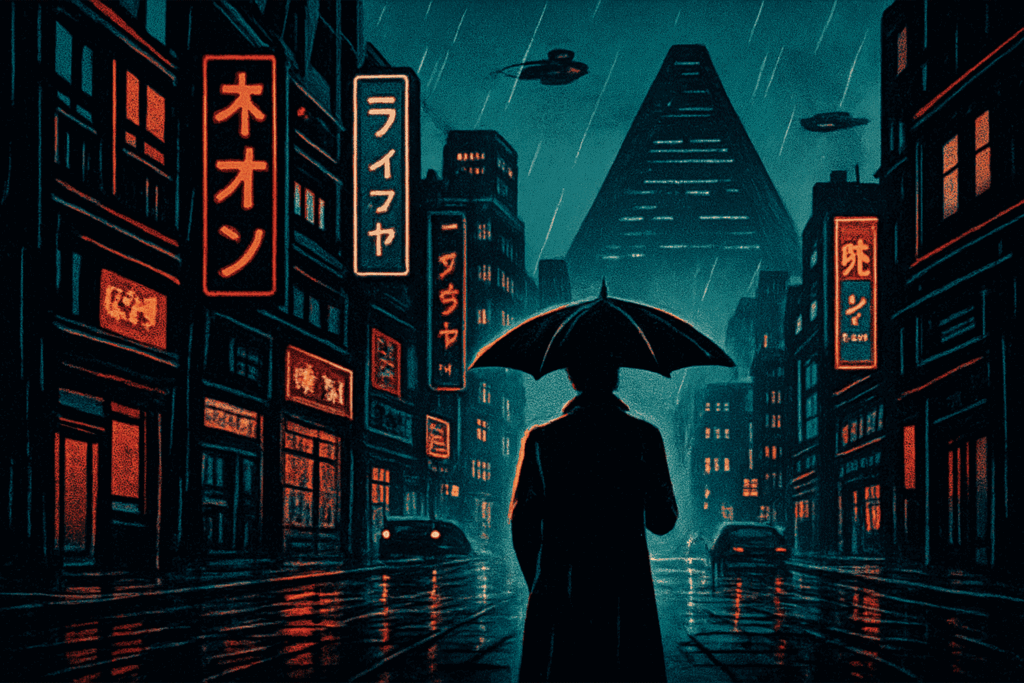
Blade Runner’s chillingly prescient vision of the future
Blade Runner’s neo-noir future still feels uncomfortably close—where corporations shape emotions, memories can be manufactured, and the line between human and machine keeps disappearing.
Marsha Gordon, North Carolina State University
Can corporations become so powerful that they dictate the way we feel? Can machines get mad – like, really mad – at their makers? Can people learn to love machines?
These are a few of the questions raised by Ridley Scott’s influential sci-fi neo-noir film “Blade Runner” (1982), which imagines a corporation whose product tests the limits of the machine-man divide.
Looking back at the original theatrical release of “Blade Runner” – just as its sequel, “Blade Runner 2049” opens in theaters – I’m struck by the original’s ambivalence about technology and its chillingly prescient vision of corporate attempts to control human feelings.
From machine killer to machine lover
Even though the film was tepidly received at the time of its release, its detractors agreed that its imagining of Los Angeles in 2019 was wonderfully atmospheric and artfully disconcerting. Looming over a dingy, rain-soaked City of Angels is Tyrell Corporation, whose namesake, Dr. Tyrell (Joe Turkel), announces, “Commerce is our goal here at Tyrell. More human than human is our motto.”
Tyrell creates robots called replicants, which are difficult to differentiate from humans. They are designed to be worker-slaves – with designations like “combat model” or “pleasure model” – and to expire after four years.
Batty (Rutger Hauer) and Pris (Darryl Hannah) are two members of a small cohort of rebelling replicants who escape their enslavement and hope to extend their lives beyond the four years allotted them by their makers. These replicant models even possess fake memories, which Tyrell implanted as a way to buffer the machine’s anxieties. Instead, the memories create a longing for an unattainable future. The machines want to be treated like people, too.
Deckard (Harrison Ford), a policeman (and maybe a replicant too), is tasked with eliminating the escaped machines. During his search, he meets a special replicant who lacks the corporate safeguard of a four-year lifespan: the beautiful Rachael (Sean Young), who shoots and kills one of her own in order to save Deckard. This opens the door for Deckard to acknowledge growing feelings towards a machine who has developed the will to live and love beyond the existence imagined for her by Tyrell Corp.
The greatest challenge to Deckard comes from combat model Batty, who has demonstrably more passion for existence than the affectless Deckard.
The film’s climax is a duel to the death between Deckard and Batty, in which Batty ends up not just sparing but saving Deckard. As Deckard watches Batty expire, he envies the replicant’s lust for life at the very moment it escapes him. Batty seems more human than the humans in this world, but Tyrell’s motto is both clue and trap.
Deckard’s end-of-film decision to escape with Rachael defies the rules of the corporation and of society. But it’s also an acknowledgment of the successful, seamless integration of machine and human life.
“Blade Runner” imagines a world in which human machines are created to serve people, but Deckard’s interactions with these replicants reveals the thinness of the line: He goes from being on assignment as a machine killer to falling in love with a machine.
A world succumbing to machines
Today, the relationship between corporations, machines and humans defines modern life in ways that Ridley Scott – even in his wildest and most dystopic imagination – couldn’t have forecast in 1982.
In “Blade Runner,” implanted memories are propped up by coveted (but fake) family photos. Yet a world in which memory is fragile and malleable seems all too possible and familiar. Recent studies have shown that people’s memories are increasingly susceptible to being warped by social media misinformation, whether it’s stories of fake terrorist attacks or Muslims celebrating after 9/11. When this misinformation spreads on social media networks, it can create and reinforce false collective memories, fomenting a crisis of reality that can skew election results or whip up small town hysteria.
Meanwhile, Facebook has studied how it can manipulate the way its users feel – and yet over a billion people a day log on to willingly participate in its massive data collection efforts.
Our entrancement with technology might seem less dramatic than the full-blown love affair that Scott imagined, but it’s no less all-consuming. We often prioritize our smartphones over human social interactions, with millennials checking their phones over 150 times a day. In fact, even as people increasingly feel that they cannot live without their smartphones, many say that the devices are ruining their relationships.
And at a time when we’re faced with the likelihood of being unable to differentiate between what’s real and what’s fake – a world of Twitter bots and doctored photographs, trolling and faux-outrage, mechanical pets and plastic surgery – we might be well served by recalling Deckard’s first conversation upon arriving at Tyrell Corp. Spotting an owl, Deckard asks, “It’s artificial?” Rachael replies, not skipping a beat, “Of course it is.”
In “Blade Runner,” reality no longer really matters.
How much longer will it matter to us?
Marsha Gordon, Professor of Film Studies, North Carolina State University
This article is republished from The Conversation under a Creative Commons license. Read the original article.





