

Naturist Blog
Pubic hair, nudism and the censor: the story of the photographic battle to depict the naked body


Annebella Pollen, University of Brighton
I look at nude bodies all the time in my work. Art history is full of them – painted, sculpted and photographed – and they fill the walls of galleries and museums. I stand before them, projected on screens, as I lecture on the subject. Earlier in my career, I posed on the other side of the artist’s easel, as a life model, where I looked at artists looking at me. This dual perspective has given me a privileged position, as both subject and surveyor of the nude.
Contemporary artists might critique the nude’s traditions and ideals, but the naked body is still the ground on which debates play out. Nudes in art can now take a range of forms and styles but one key aspect prevails in art galleries: they are most likely to be of women and created by men.
Feminist activists the Guerilla Girls, who style themselves as the conscience of the art world, have kept a running count of exhibited works by female artists (around 4%) compared to the number of nudes that are female (around 76%) in New York’s Metropolitan Museum of Modern Art for more than 30 years. The disparities remain stark.
The naked body and its visual depiction has always attracted attention and generated heated debate. What and who should be seen and shown, by whom and where, form the basis of the social and moral codes that shape behaviour and belief.
Today, the display of nudity remains contentious, particularly in the context of social media. This is both in relation to photographs of “real nude adults”, as Facebook describes them, and in relation to “artistic or creative” depictions of nudity, which are wholly banned by Instagram and its parent company. https://www.youtube.com/embed/UZq3cVgU5AI?wmode=transparent&start=0 Flanders Tourist Board posted a satirical video on YouTube showing tourists at the Rubens House, in Antwerp, being ushered away from paintings featuring nudity.
While Facebook officially states that it permits nudity in images of paintings and sculptures, there have been famous recent cases where photographs of celebrated artworks, including the 25,000-year-old figurine, the Venus of Willendorf, and 17th century paintings by Peter Paul Rubens have been taken down and described as “pornographic”. To circumnavigate the censor, some museums have even recently opened accounts on OnlyFans, a controversial social media platform most often associated with the promotion and sale of material intended to sexually arouse, rather than the viewing of fine art.
How did we get here? In my new book, Nudism in a Cold Climate, I’ve been examining earlier attitudes to nude bodies, and their photographic depiction, especially in relation to legal restrictions around the representation of nudists (also known as naturists), and the depiction of nudes in photographs produced as art in mid 20th-century Britain. The historic parallels are striking.
Facebook, for example, currently does not permit the depiction of “visible genitalia”, with limited exceptions around birth and health contexts, and even in these cases, it requires photoshopping for nude close-ups. A century ago, photographic “retouching”, as it was called, was also required for male and female genitals to meet the requirements of obscenity law.
What this meant, in practice, was that the emerging nudist movement in Britain, formally founded in the 1920s but achieving popularity from the 1930s, could only depict nude bodies in their publications by photographing members and models in strategic poses that concealed sex organs and pubic hair. Where this was not possible, they needed to manipulate photographic negatives to blur genitals out, visually smooth them over, or even paint on underpants.
For a movement founded on liberation from convention and bodily visibility, this was a core contradiction, and the resulting photographs created a sense of forbidden fruit. This was exactly the message that nudists wished to avoid.
Nude for health
Early nudists insisted that going nude, outdoors, in groups, was good for physical and mental health. They also wanted a clear moral distinction to be made between nude bodies and sexual desire. They argued, in the 1930s, in the pages of their magazine, Sun Bathing Review, that “honest photography would induce mental honesty, and help sweep away the rude idea of sex-secrecy”.
Retouched photographs, on the other hand, were “more likely to create squeamishness, hypocrisy, and misunderstanding, and thus retard the progress we are trying to make towards freedom and sanity”. Retouched bodies were described as “mutilated”, yet nudists acknowledged that the alternative, “a pictorial world where everyone turns his or her back to the spectator”, risked monotony.
Early nudist magazines in Britain met constraints about what they could picture even when they didn’t agree with the law’s assessment of what was obscene. The 1857 Obscene Publications Act had been established to prosecute pornographic works – but as both obscenity and pornography depended on the eye of the beholder, for over a century fresh debate was required in each case.
Lord Chief Justice Cockburn’s 1868 definition of obscenity endured for much of the 20th century: that which could “deprave and corrupt those whose minds are open to such immoral influences and into whose hands a publication of this sort may fall”.
Given its vague premise, obscenity prosecution rested on a range of factors including “circumstances of publication”. Alec Craig, an ardent nudist and vociferous anti-censorship campaigner, advised in the 1930s that “snaps taken in a nudist camp cannot be considered ‘obscene’”.

This story is part of Conversation Insights
The Insights team generates long-form journalism and is working with academics from different backgrounds who have been engaged in projects to tackle societal and scientific challenges.
But he warned: “What may be perfectly innocuous in one set of circumstances may be ‘obscene’ in another. To take an extreme example,” he noted, “nude photographs, quite unobjectionable in normal circumstances, might be held to be ‘obscene’ if circulated in a convent school.” Likewise, outside of the careful framing of the nudist magazine, a nude photograph carried a range of meanings that could prove hard to pin down in a court of law.
Nudist magazines published photographs to show the movement’s ideals but many members did not wish to be depicted for reasons of respectability. Few practitioners were professional photographers. Those who were preferred to use models as subjects.
The emerging imagery of nudism was a mixture of candid photographs of camp life, painterly depictions of young slim bodies in pastoral settings, and action photographs showing athletic bodies exercising. As men’s bodies needed to be doctored with a heavier hand to pass the censor, and as nudism was dominated at the outset by men (as members, photographers, writers, editors and readers), nude women were its central photographic focus.
By the 1930s, female photographic nudes could be found on the walls of photography exhibitions as well as in the pages of art, anatomy and anthropology books, men’s magazines, daily newspapers, photojournalist weeklies and naturist monthlies. In some cases, with adjusted context, the same images could appear in all these locations, challenging nudism’s claims that its publications and its photographs were morally and aesthetically distinct.
The nude photograph on trial
This was the case with photographs by Horace Narbeth, professionally known as “Roye”, whose prolific and commercially adaptable imagery was repurposed for a wide range of audiences and arguments. Roye’s photographs, always of young women, often posed in outdoor settings, simultaneously articulated abstract notions of “beauty” and “womanhood” in art books, and ideas about “freedom” and “nature” in nudist publications. They illustrated technical guidance in photography magazines and offered titillation in pin-up pamphlets.
Roye had long been frustrated with British obscenity regulations and made play with what he perceived to be their hypocrisies in his 1942 publication, Phyllis in Censorland. The cover design showed burlesque dancer Phyllis Dixey, the so-called British queen of striptease, naked on a tiger skin rug, but with her breasts and genitals concealed by the blue pencils of the censor. Its contents comprised nude and near-nude photographs, accompanied by mocking verses. Each poem pilloried those who sought to protect public morals while enjoying privileged pleasures of surveillance.
Roye reissued his book during the mid-1950s when the seizure of printed material on obscenity grounds was at a new high. The 1951 Conservative government oversaw escalating destruction orders and extended punishments in a period when cheap magazines were booming. The desire to contain them led to a protracted legal power struggle.
In 1954, for example, around 167,000 books and magazines were seized, and imprisonments ranged from three to 18 months. In their enthusiasm to uphold public morals, magistrates ordered the destruction of eminent artistic and literary works including Boccaccio’s 14th century the Decameron.
In 1958, Roye went one step further and launched a private subscription series of un-retouched nudes under the title Unique Editions. Repurposing earlier negatives, including those previously included as retouched illustrations in nudist magazines, the buff-covered volumes each comprised photographs of nude female models with visible pubic hair, carefully interleaved between tissue pages that conferred both art value and a sense of revelation.
While the content included naturist-style nudes in rural environments, which could offer some legal protection, the photographs attracted police attention. A thousand copies were seized from Roye’s studio. He was called to court.
Before the jury, Roye positioned himself in the aesthetic avant-garde. Retouching, he argued, was a sacrifice of “artistic integrity”. His defence lawyer argued that:
Standards had changed since 1868, when pictures of Venus, in the Dulwich Gallery, had shocked Londoners; and it would be unrealistic to say that, in 1958, a photograph of a woman without clothing was an obscene thing.
Roye built a case that drew on both his gentlemanly standing and his professional photographer status. He compiled letters of support arguing for the public benefit of viewing nude photographs. His supporters shared arguments with nudists who believed that sex crimes would be eliminated and Victorian prudishness overturned.
In Roye’s case, however, the public need for openness and bodily display seemed only to apply to the viewing of young female models’ flesh. Nonetheless, he was acquitted.
Roye’s prosecution coincided with proposals to revise the Obscene Publications Act. Following public derision when acclaimed cultural works had been seized, 1959 amendments exempted from prosecution material with literary or artistic merit.
The nude was singled out for mention in parliamentary discussions about the problem of definition. The home secretary, Rab Butler, noted that nudes could be used for art historical lectures “to provide inspiration for the painter or photographer or, on the other hand, be degraded for the purposes of the pornographer’s wares”. Although MPs argued that it was “easy to tell the difference between the Song of Solomon and a collection of salacious photographs”, the problem was the evaluation of material in between.
Freedom of vision
Not all nude photographers had such success in court. Ethelred Jean Straker was a Bohemian Soho photographer who ran a busy studio throughout the 1950s and 1960s providing classes for amateurs – mostly male – in the production of “artistic figure studies”, or nude photographs of models – always women. Straker tested the revised obscenity laws, but unlike Roye, he received guilty verdicts.
In 1958, he produced a book of nude photographs featuring pastiches of classical paintings alongside experimental lighting treatments in eclectic settings. It depicted female models amid looming shadows, dustbin lids, cellophane and vegetables.
Published in three languages, Straker’s book secured positive reviews from artistic luminaries but showed only a small, sanitised selection of his nude output, which extended to some 10,000 examples and included close-ups of women’s breasts, buttocks and genitalia.
The full range of Straker’s work could be viewed and ordered for purchase via his Femina gallery, above his Soho studio. In his advertisements for his services, Straker described the female nude rapturously as “a microcosm of the forces which play upon the mind and emotions of the creative person”. He claimed his studies offered “not only a sense of affective perception but also a source of unimpaired anatomical evidence”.
Despite Straker’s artistic, psychological and clinical framing, his nudes repeatedly drew the attention of the police. In 1961 police raided his premises, and seized nearly 2,000 display cards and negatives, of which the majority were deemed obscene.
In 1962, in the High Court, Straker was a thorn in the side of the prosecution. Highly informed about the 1959 Obscene Publications Act, Straker reminded the court of their obligation to “uphold and license the freedoms of expression of the artist”.
Using his trial as a soapbox, he declared that it was “no longer in the power of any magistrate to use a relegated heritage of authoritarian orthodoxy to lay down rules as to how a photographic artist should portray female anatomy or arrange a woman’s limbs”. Despite pleas for the value of his work to art and science, Straker lost the case and was fined £150 (about £5,000 at today’s value).
Undeterred, he continued to sell “unretouched” nudes by mail order until he was prosecuted again in 1965. By this time, Straker was aware of wider shifts in public attitudes to nude bodies, especially among the new generation, and he became a vocal anti-censorship campaigner, calling for “freedom of vision” alongside freedom of speech.
In 1967, he made headlines as Oxford University’s student magazine, Oxymoron, published one of his un-retouched female nudes. Entitled “Sun Worship”, the subject was a stylised studio portrait of a sun bather applying sun lotion under the shadow of a tree. The print had been among material previously seized in a police raid but a decade later it was published with university authorisation and escaped prosecution, illustrating the changing times.
By the end of the 1960s, the battle to show more flesh was complete. Largely fought by male photographers over the bodies of women, the so-called “pink wars” had been won. Un-retouched photographic nudes were openly published in pornographic magazines, naturist periodicals and art books alike.
New nude censorship debates
Whether this led to greater bodily liberation, especially for the young women who are most likely to be depicted, was a question raised by feminists at the time, and it remains open for debate. Even after permissive barriers were broken and greater bodily visibility was enabled, the trajectory of nude depiction has not been straightforward. Campaigns for visibility continue to arise in the present day with new agendas in nude representation.
Free the Nipple, for example, stakes similar claims in its calls for freedom from censorship on social media. Like earlier protests against the photographic retouching of genitals, its campaigners see the characterisation of women’s bodies as sexual and offensive – when male toplessness is considered neutral – as illogical.
But unlike earlier campaigners against retouching, it is now mostly young women leading the charge, creating the philosophies, taking the photographs and controlling consent.
Why has the showing of nudity remained so fraught? The issue remains one of context and intention. Naturists have argued hard that social nudity can be non-sexual, and naturism has fiercely protected legal status.
Photographs of nude bodies, however, naturist or otherwise, can serve a range of purposes and, like all photographs, they are open to a wide range of readings and meanings, reinterpretations and reuse. Photographers and publishers may argue for the value of full-frontal nudes to communicate health, artistry and freedom, but even photographs produced for non-sexual communication can serve sexual ends.
On social media, where photographic quantities are vast and mostly surveyed by machine, it is easier for Facebook to apply blanket bans than engage with individual nude images’ complexities. While it states that its policies have become more nuanced over time, they are still unable to cope with the sometimes subtle borderlines between categories. Facebook recognises that nudes can be used “as a form of protest, to raise awareness about a cause or for educational or medical reasons”, and says they make allowances “where such intent is clear”.
However, many forms of bodily display, including in artistic practice, do not fit Facebook’s frames, and intention is notoriously hard to gauge in a photograph. These were the technical and semantic distinctions on which nude photographers’ court cases were won and lost historically, and issues of intent and use remain today.
At the end of the second world war, nudist Michael Rutherford addressed “historians of the future” in his field guide, entitled British Naturism. He predicted that scholars would consider the practice “among the significant and important happenings of this, the 20th century”. He wrote: “If our grandchildren can say of us, as they grow up to a sane acceptance of their own bodies: ‘What was all that fuss about …?’ we shall have done our part.”
But a century after the founding of nudism as a social movement, and 50 years since non-manipulated nude photographs could be printed without fear of prosecution, the current censorship of nudes on social media seems regressive.
We are Rutherford’s grandchildren, but we certainly do not have the “sane” attitudes to nudity that he predicted.
Editor’s note: This article was amended on December 4. Peter Paul Rubens had been erroneously described as a 15th rather than 17th century artist.

For you: more from our Insights series:
- WitchTok: the rise of the occult on social media has eerie parallels with the 16th century
- The Prestige: the real-life warring Victorian magicians who inspired the film
- ‘We have nothing left’ – the catastrophic consequences of criminalising livelihoods in west Africa
To hear about new Insights articles, join the hundreds of thousands of people who value The Conversation’s evidence-based news. Subscribe to our newsletter.
Annebella Pollen, Reader in the History of Art and Design, University of Brighton
This article is republished from The Conversation under a Creative Commons license. Read the original article.







Naturist Blog
Backyard Naturism in Phoenix: Staying Safe, Private, and Legal — Even When Aircraft Fly Overhead
Backyard Naturism: Arizona’s backyard nudity is generally legal due to privacy features, but homeowners must understand local laws and remain considerate of neighbors.


Arizona’s warm climate and abundance of private, block-walled backyards make outdoor living a way of life. For nudists and naturists, a common concern arises:
Is it legal — and safe — to be nude in your backyard, especially when police helicopters or drones fly overhead?
The answer is reassuring, but there are important details every Arizona homeowner should understand.
Reminder: Always check your municipality or county ordinances to confirm what’s legal in your specific location.
Backyard Nudity in Arizona: The Legal Foundation
Arizona Revised Statutes §13-1402 (Indecent Exposure) focuses on:
- Visibility
- Intent
- Behavior
Outdoor nudity becomes a legal issue when:
- You are visible to others
- The exposure is reckless or intended to offend
- The behavior is sexual in nature
- A minor can see you
Simple, non-sexual nudity on private property is not automatically illegal.
Why Phoenix Backyards Offer Strong Privacy
- Six-to-eight-foot block privacy walls
- Predominantly single-story homes
- Yard designs intended for seclusion
- A culture of backyard-centered living
What Happens If a Police Helicopter Flies Over?
Short Answer: A police helicopter flying overhead does NOT automatically create a legal problem.
Helicopter flyovers are considered incidental aerial visibility, not casual public viewing.
When Risk Could Increase
- Standing nude on a roof
- Being nude in an unfenced yard
- Acting erratically
- Making obscene gestures
- Engaging in sexual behavior outdoors
What About Consumer Drones?
Drones are different from helicopters.
A brief flyover is usually harmless. However, a drone that hovers or records may raise privacy concerns.
Do NOT attempt to damage a drone. Contact authorities if repeated intrusive behavior occurs.
Best Practices for Backyard Naturists
- Stay centered in the yard
- Avoid elevation
- Mind nighttime lighting
- Be aware of nearby children
- Keep noise minimal
- Use shade sails or plants for privacy
- Keep a cover-up nearby
Backyard Naturist Code of Conduct
- Privacy First
- No Sexual Behavior Outdoors
- Respect Neighbors
- Protect Against Visibility to Minors
- Stay Grounded
- Mind Lighting
- Keep Noise Low
- No Photos Without Consent
- Maintain a Cover-Up Nearby
- When in Doubt, Cover Up
Final Thoughts
Phoenix offers one of the most practical environments for backyard naturism thanks to climate and privacy walls. Helicopter flyovers are rarely a concern, while drones only become an issue if behavior is intrusive.
Related Articles & Further Information
🌎 External Resources & Legal References
- Arizona State Legislature – Official Statutes
- Arizona Judicial Branch – Legal Information
- Phoenix Police Department – Community & Legal Resources
- Federal Aviation Administration (FAA)
- American Association for Nude Recreation (AANR)
Disclaimer: Laws and local ordinances vary by city and county. Always verify regulations with your local municipality or a qualified legal professional.
Looking for reliable information and thoughtful discussion about naturism?
Our Naturist Blog features updates, tips, and perspectives on privacy, outdoor living, and navigating naturist-friendly lifestyles.
✨ Start reading: https://stmdailynews.com/naturist-blog/
Naturist Blog
How to Comfortably Accommodate a Nudist or Naturist Guest in Your Home Without Offending Either Party
How to Comfortably Accommodate a Nudist? Learn the best ways to accommodate a nudist or naturist guest with respect and comfort for all. Tips, boundaries, and modern hosting etiquette
Last Updated on January 3, 2026 by Daily News Staff

How to Comfortably Accommodate a Nudist or Naturist Guest in Your Home Without Offending Either Party
“Nudism isn’t the challenge—unclear expectations are. A five-minute conversation can prevent five hours of awkwardness.”
Hosting a guest is usually simple, but when your visitor is a nudist or naturist, it raises a unique question: How do you ensure comfort without compromising anyone’s boundaries?
The truth is, it’s not about changing your lifestyle at all. It’s about communication, clarity, and mutual respect.
1. Talk First — Calmly and Openly
Before the visit, have a simple, respectful conversation:
- “Do you prefer certain spaces for nudity?”
- “Here’s what I’m comfortable with—how does that sound?”
“Most naturists aren’t asking for unlimited nudity—just clarity.”
2. Establish Mutually Comfortable House Zones
Most hosts use a simple setup:
✔ Private Nudity Zones
Allow nudity in the guest bedroom and a designated bathroom.
✔ Clothing in Shared Spaces
It is perfectly acceptable to request a clothing-required rule for shared areas like the kitchen, living room, or hallways.
✔ Optional Heads-Up System
If you’re okay with some nudity but prefer notice: “Just text me before you come out of the room.”
3. Provide Simple, Thoughtful Amenities
- A robe or sarong
- Extra towels
- Clear access to a private or semi-private bathroom
- A secure door lock
4. Consider Everyone Else in the Home
If you live with a partner, kids, roommates, or elderly relatives, their comfort matters too.
5. Stay Respectful and Neutral
Avoid joking or making the guest feel scrutinized. Treat it casually and naturally.
6. The Golden Rule: Mutual Comfort
Nobody should feel pressured—your guest shouldn’t have to hide their lifestyle, and you shouldn’t have to tolerate discomfort. It’s all about balance.
Call to Action
👉 Subscribe to STM Daily News for more practical lifestyle and etiquette insights.
Related Articles
- Modern Etiquette 101: Navigating Social Boundaries in Shared Spaces
- How to Host Overnight Guests Without Stress
- Understanding Body-Positive Lifestyles in Today’s Culture
- Top Tips for Communicating Boundaries With Friends and Family
News For Naturists
Naturist Blog
Backyard Naturism in Arizona: How to Practice Nudism Safely, Legally, and Respectfully
Backyard Naturism? Learn how to practice backyard nudism safely and legally in Phoenix. Privacy tips, Arizona laws, and a backyard naturist code of conduct for guests.
Last Updated on December 6, 2025 by Daily News Staff

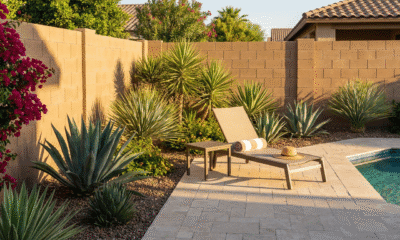
A stylish, modern Arizona backyard featuring smooth concrete, a sleek chase lounge, a turquoise pool, and tall block privacy walls.
Backyard Naturism in Arizona: How to Practice Nudism Safely, Legally, and Respectfully
Outdoor nudity is nothing new in the Southwest. Arizona’s warm climate, abundant sunshine, and block-walled backyards make Phoenix an unexpectedly naturist-friendly city—as long as you understand the law, respect your neighbors, and protect everyone’s privacy.
This guide offers clear advice for anyone practicing backyard nudism or naturism in Phoenix and surrounding cities. It also includes a Backyard Naturist Code of Conduct you can use personally or share with guests.
Important: This is general information. Always check with your city or county to confirm what’s legal in your area.
Is Backyard Nudity Legal in Phoenix?
Arizona law focuses on visibility and intent. Under A.R.S. §13-1402, it becomes illegal if:
- You are visible to the public or neighbors
- Your behavior is sexual or intended to offend
- A minor can see you
- You continue after a neighbor complaint
However, nudity on private property—especially behind Phoenix’s common six-to-eight-foot block privacy walls—is usually not a violation as long as you are not visible from outside your yard.
Remember: If someone can casually see you, it becomes a legal risk.
Why Phoenix Is Especially Naturist-Friendly
- Single-story homes reduce vantage points into backyards.
- Block privacy fences limit visibility.
- The climate makes outdoor living common year-round.
Best Practices for Safe, Legal Backyard Naturism
1. Stay away from the fence line
Maintain a 2–3 foot buffer from walls and corners where accidental visibility is most likely.
2. Avoid elevation
Don’t stand nude on chairs, ladders, pool decks, or raised planters. Height increases visibility.
3. Be mindful when kids are outside
Arizona law is stricter where minors are concerned. Choose quieter times.
4. Check visibility throughout the day
Midday, sunset, and nighttime backlighting can all create surprises.
5. No sexual behavior outdoors
Simple nudity may be fine; sexual behavior is always illegal outdoors.
6. Be considerate with noise
Avoid drawing attention with loud music, yelling, or parties.
7. Add natural privacy boosters
- Shade sails
- Potted bamboo
- Trellises with bougainvillea
- Outdoor curtains
- Patio umbrellas
8. Keep a cover-up nearby
Useful for deliveries, drones, or unexpected activity.
What to Do if a Neighbor Complains
Stay calm. A complaint does not automatically mean you are in trouble.
- Be polite: “Thanks for letting me know. I’ll be more mindful.”
- If police respond: Explain you were in your private yard, not acting sexually, and did not intend to be seen.
- Make small adjustments: Move seating inward or add shade.
Backyard Naturist Code of Conduct
Use this personally or share with guests:
- Privacy First: Stay away from walls and corners.
- No Sexual Behavior Outdoors: Keep it legal and family-friendly.
- Respect Neighbors and Children: Cover up if kids are audible.
- Minimize Noise: Don’t draw attention.
- Stay Grounded: No standing on furniture or elevated surfaces.
- Mind Lighting: Avoid being backlit at night.
- Keep a Cover-Up Accessible: Towel, robe, or wrap.
- Inform Guests of Rules: Especially no photos without consent.
- Keep It Clean: Respect the space.
- When in Doubt, Cover Up: Safety and respect come first.
Final Thoughts
Phoenix offers ideal conditions for backyard naturism, thanks to its climate, architecture, and privacy walls. With awareness and respect, outdoor nudity can be practiced safely, peacefully, and legally.
Always check your municipality or county ordinances, respect your neighbors, and follow the Code of Conduct for a calm, comfortable naturist experience.
Links for Further Information
Arizona Laws & Legal References
- Arizona State Legislature — Indecent Exposure Law (A.R.S. §13-1402)
- Arizona Revised Statutes — Disorderly Conduct (A.R.S. §13-2904)
- Maricopa County Legal Resource Directory
Local Government Codes & Ordinances (Phoenix Metro)
- City of Phoenix — Neighborhood & Property Regulations
- City of Tempe — Neighborhood Standards
- City of Mesa — Code Compliance
- City of Chandler — Neighborhood Resources
- City of Glendale — Code Compliance Services
- City of Scottsdale — Neighborhood Services
- City of Peoria — Code Compliance
Naturist & Nudist Organizations
- The Naturist Society Foundation
- American Association for Nude Recreation (AANR)
- AANR Western Region (Serving Arizona & Southwest)
Privacy & Home Design Resources
- Arizona Landscaping Guide — Privacy Plant Recommendations
- Sunset Magazine — Desert Garden & Privacy Design Ideas
- HomeAdvisor — Backyard Privacy Wall Tips



