Connect with us

astronomy

Scientists found a potential sign of life on a distant planet – an astronomer explains why many are still skeptical

Published

on

distant planet
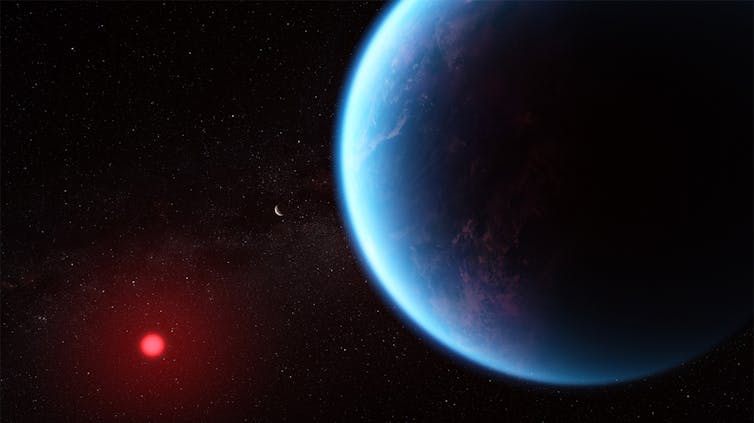
An illustration of the exoplanet K2-18b, which some research suggests may be covered by deep oceans. NASA, ESA, CSA, Joseph Olmsted (STScI)
Daniel Apai, University of Arizona A team of astronomers announced on April 16, 2025, that in the process of studying a planet around another star, they had found evidence for an unexpected atmospheric gas. On Earth, that gas – called dimethyl sulfide – is mostly produced by living organisms. In April 2024, the James Webb Space Telescope stared at the host star of the planet K2-18b for nearly six hours. During that time, the orbiting planet passed in front of the star. Starlight filtered through its atmosphere, carrying the fingerprints of atmospheric molecules to the telescope.
A diagram showing planets and stars emitting light, which goes through JWST detectors, where it's split into different wavelengths to make a spectrum. Each spectrum suggests the presence of a different element.
JWST’s cameras can detect molecules in the atmosphere of a planet by looking at light that passed through that atmosphere. European Space Agency
By comparing those fingerprints to 20 different molecules that they would potentially expect to observe in the atmosphere, the astronomers concluded that the most probable match was a gas that, on Earth, is a good indicator of life. I am an astronomer and astrobiologist who studies planets around other stars and their atmospheres. In my work, I try to understand which nearby planets may be suitable for life.

K2-18b, a mysterious world

To understand what this discovery means, let’s start with the bizarre world it was found in. The planet’s name is K2-18b, meaning it is the first planet in the 18th planetary system found by the extended NASA Kepler mission, K2. Astronomers assign the “b” label to the first planet in the system, not “a,” to avoid possible confusion with the star. K2-18b is a little over 120 light-years from Earth – on a galactic scale, this world is practically in our backyard. Although astronomers know very little about K2-18b, we do know that it is very unlike Earth. To start, it is about eight times more massive than Earth, and it has a volume that’s about 18 times larger. This means that it’s only about half as dense as Earth. In other words, it must have a lot of water, which isn’t very dense, or a very big atmosphere, which is even less dense. Astronomers think that this world could either be a smaller version of our solar system’s ice giant Neptune, called a mini-Neptune, or perhaps a rocky planet with no water but a massive hydrogen atmosphere, called a gas dwarf. Another option, as University of Cambridge astronomer Nikku Madhusudhan recently proposed, is that the planet is a “hycean world.” That term means hydrogen-over-ocean, since astronomers predict that hycean worlds are planets with global oceans many times deeper than Earth’s oceans, and without any continents. These oceans are covered by massive hydrogen atmospheres that are thousands of miles high. Astronomers do not know yet for certain that hycean worlds exist, but models for what those would look like match the limited data JWST and other telescopes have collected on K2-18b. This is where the story becomes exciting. Mini-Neptunes and gas dwarfs are unlikely to be hospitable for life, because they probably don’t have liquid water, and their interior surfaces have enormous pressures. But a hycean planet would have a large and likely temperate ocean. So could the oceans of hycean worlds be habitable – or even inhabited?

Detecting DMS

In 2023, Madhusudhan and his colleagues used the James Webb Space Telescope’s short-wavelength infrared camera to inspect starlight that filtered through K2-18b’s atmosphere for the first time. They found evidence for the presence of two simple carbon-bearing molecules – carbon monoxide and methane – and showed that the planet’s upper atmosphere lacked water vapor. This atmospheric composition supported, but did not prove, the idea that K2-18b could be a hycean world. In a hycean world, water would be trapped in the deeper and warmer atmosphere, closer to the oceans than the upper atmosphere probed by JWST observations. Intriguingly, the data also showed an additional, very weak signal. The team found that this weak signal matched a gas called dimethyl sulfide, or DMS. On Earth, DMS is produced in large quantities by marine algae. It has very few, if any, nonbiological sources. This signal made the initial detection exciting: on a planet that may have a massive ocean, there is likely a gas that is, on Earth, emitted by biological organisms.
An illustration of what scientists imagine K2-18b to look like, which looks a little like Earth, with clouds and a translucent surface.
K2-18b could have a deep ocean spanning the planet, and a hydrogen atmosphere. Amanda Smith, Nikku Madhusudhan (University of Cambridge), CC BY-SA
Scientists had a mixed response to this initial announcement. While the findings were exciting, some astronomers pointed out that the DMS signal seen was weak and that the hycean nature of K2-18b is very uncertain. To address these concerns, Mashusudhan’s team turned JWST back to K2-18b a year later. This time, they used another camera on JWST that looks for another range of wavelengths of light. The new results – announced on April 16, 2025 – supported their initial findings. These new data show a stronger – but still relatively weak – signal that the team attributes to DMS or a very similar molecule. The fact that the DMS signal showed up on another camera during another set of observations made the interpretation of DMS in the atmosphere stronger. Madhusudhan’s team also presented a very detailed analysis of the uncertainties in the data and interpretation. In real-life measurements, there are always some uncertainties. They found that these uncertainties are unlikely to account for the signal in the data, further supporting the DMS interpretation. As an astronomer, I find that analysis exciting.

Is life out there?

Does this mean that scientists have found life on another world? Perhaps – but we still cannot be sure. First, does K2-18b really have an ocean deep beneath its thick atmosphere? Astronomers should test this. Second, is the signal seen in two cameras two years apart really from dimethyl sulfide? Scientists will need more sensitive measurements and more observations of the planet’s atmosphere to be sure. Third, if it is indeed DMS, does this mean that there is life? This may be the most difficult question to answer. Life itself is not detectable with existing technology. Astronomers will need to evaluate and exclude all other potential options to build their confidence in this possibility. The new measurements may lead researchers toward a historic discovery. However, important uncertainties remain. Astrobiologists will need a much deeper understanding of K2-18b and similar worlds before they can be confident in the presence of DMS and its interpretation as a signature of life. Scientists around the world are already scrutinizing the published study and will work on new tests of the findings, since independent verification is at the heart of science. Moving forward, K2-18b is going to be an important target for JWST, the world’s most sensitive telescope. JWST may soon observe other potential hycean worlds to see if the signal appears in the atmospheres of those planets, too. With more data, these tentative conclusions may not stand the test of time. But for now, just the prospect that astronomers may have detected gasses emitted by an alien ecosystem that bubbled up in a dark, blue-hued alien ocean is an incredibly fascinating possibility. Regardless of the true nature of K2-18b, the new results show how using the JWST to survey other worlds for clues of alien life will guarantee that the next years will be thrilling for astrobiologists.The Conversation Daniel Apai, Associate Dean for Research and Professor of Astronomy and Planetary Sciences, University of Arizona This article is republished from The Conversation under a Creative Commons license. Read the original article.
Did James Webb Find Life on a Distant Planet Recently?

Discover more from Daily News

Subscribe to get the latest posts sent to your email.

Continue Reading
Advertisement SodaStream USA, inc

astronomy

Habitable Zone Planets: How Scientists Search for Liquid Water Beyond Earth

Habitable zone planets: Scientists use the habitable zone to find planets that could host liquid water and life. Learn how planetary atmospheres and geology determine true habitability beyond Earth.

Published

on

 Habitable Zone Planets: How Scientists Search for Liquid Water Beyond Earth
Some exoplanets, like the one shown in this illustration, may have atmospheres that could make them potentially suitable for life. NASA/JPL-Caltech via AP

Habitable Zone Planets: How Scientists Search for Liquid Water Beyond Earth

Morgan Underwood, Rice University When astronomers search for planets that could host liquid water on their surface, they start by looking at a star’s habitable zone. Water is a key ingredient for life, and on a planet too close to its star, water on its surface may “boil”; too far, and it could freeze. This zone marks the region in between. But being in this sweet spot doesn’t automatically mean a planet is hospitable to life. Other factors, like whether a planet is geologically active or has processes that regulate gases in its atmosphere, play a role. The habitable zone provides a useful guide to search for signs of life on exoplanets – planets outside our solar system orbiting other stars. But what’s in these planets’ atmospheres holds the next clue about whether liquid water — and possibly life — exists beyond Earth. On Earth, the greenhouse effect, caused by gases like carbon dioxide and water vapor, keeps the planet warm enough for liquid water and life as we know it. Without an atmosphere, Earth’s surface temperature would average around zero degrees Fahrenheit (minus 18 degrees Celsius), far below the freezing point of water. The boundaries of the habitable zone are defined by how much of a “greenhouse effect” is necessary to maintain the surface temperatures that allow for liquid water to persist. It’s a balance between sunlight and atmospheric warming. Many planetary scientists, including me, are seeking to understand if the processes responsible for regulating Earth’s climate are operating on other habitable zone worlds. We use what we know about Earth’s geology and climate to predict how these processes might appear elsewhere, which is where my geoscience expertise comes in.
A diagram showing three planets orbiting a star: The one closes to the star is labeled 'too hot,' the next is labeled 'just right,' and the farthest is labeled 'too cold.'
Picturing the habitable zone of a solar system analog, with Venus- and Mars-like planets outside of the ‘just right’ temperature zone. NASA

Why the habitable zone?

The habitable zone is a simple and powerful idea, and for good reason. It provides a starting point, directing astronomers to where they might expect to find planets with liquid water, without needing to know every detail about the planet’s atmosphere or history. Its definition is partially informed by what scientists know about Earth’s rocky neighbors. Mars, which lies just outside the outer edge of the habitable zone, shows clear evidence of ancient rivers and lakes where liquid water once flowed. Similarly, Venus is currently too close to the Sun to be within the habitable zone. Yet, some geochemical evidence and modeling studies suggest Venus may have had water in its past, though how much and for how long remains uncertain. These examples show that while the habitable zone is not a perfect predictor of habitability, it provides a useful starting point.

Planetary processes can inform habitability

What the habitable zone doesn’t do is determine whether a planet can sustain habitable conditions over long periods of time. On Earth, a stable climate allowed life to emerge and persist. Liquid water could remain on the surface, giving slow chemical reactions enough time to build the molecules of life and let early ecosystems develop resilience to change, which reinforced habitability. Life emerged on Earth, but continued to reshape the environments it evolved in, making them more conducive to life. This stability likely unfolded over hundreds of millions of years, as the planet’s surface, oceans and atmosphere worked together as part of a slow but powerful system to regulate Earth’s temperature. A key part of this system is how Earth recycles inorganic carbon between the atmosphere, surface and oceans over the course of millions of years. Inorganic carbon refers to carbon bound in atmospheric gases, dissolved in seawater or locked in minerals, rather than biological material. This part of the carbon cycle acts like a natural thermostat. When volcanoes release carbon dioxide into the atmosphere, the carbon dioxide molecules trap heat and warm the planet. As temperatures rise, rain and weathering draw carbon out of the air and store it in rocks and oceans. If the planet cools, this process slows down, allowing carbon dioxide, a warming greenhouse gas, to build up in the atmosphere again. This part of the carbon cycle has helped Earth recover from past ice ages and avoid runaway warming. Even as the Sun has gradually brightened, this cycle has contributed to keeping temperatures on Earth within a range where liquid water and life can persist for long spans of time. Now, scientists are asking whether similar geological processes might operate on other planets, and if so, how they might detect them. For example, if researchers could observe enough rocky planets in their stars’ habitable zones, they could look for a pattern connecting the amount of sunlight a planet receives and how much carbon dioxide is in its atmosphere. Finding such a pattern may hint that the same kind of carbon-cycling process could be operating elsewhere. The mix of gases in a planet’s atmosphere is shaped by what’s happening on or below its surface. One study shows that measuring atmospheric carbon dioxide in a number of rocky planets could reveal whether their surfaces are broken into a number of moving plates, like Earth’s, or if their crusts are more rigid. On Earth, these shifting plates drive volcanism and rock weathering, which are key to carbon cycling.
A diagram showing a few small planets orbiting a star.
Simulation of what space telescopes, like the Habitable Worlds Observatory, will capture when looking at distant solar systems. STScI, NASA GSFC

Keeping an eye on distant atmospheres

The next step will be toward gaining a population-level perspective of planets in their stars’ habitable zones. By analyzing atmospheric data from many rocky planets, researchers can look for trends that reveal the influence of underlying planetary processes, such as the carbon cycle. Scientists could then compare these patterns with a planet’s position in the habitable zone. Doing so would allow them to test whether the zone accurately predicts where habitable conditions are possible, or whether some planets maintain conditions suitable for liquid water beyond the zone’s edges. This kind of approach is especially important given the diversity of exoplanets. Many exoplanets fall into categories that don’t exist in our solar system — such as super Earths and mini Neptunes. Others orbit stars smaller and cooler than the Sun. The datasets needed to explore and understand this diversity are just on the horizon. NASA’s upcoming Habitable Worlds Observatory will be the first space telescope designed specifically to search for signs of habitability and life on planets orbiting other stars. It will directly image Earth-sized planets around Sun-like stars to study their atmospheres in detail.
NASA’s planned Habitable Worlds Observatory will look for exoplanets that could potentially host life.
Instruments on the observatory will analyze starlight passing through these atmospheres to detect gases like carbon dioxide, methane, water vapor and oxygen. As starlight filters through a planet’s atmosphere, different molecules absorb specific wavelengths of light, leaving behind a chemical fingerprint that reveals which gases are present. These compounds offer insight into the processes shaping these worlds. The Habitable Worlds Observatory is under active scientific and engineering development, with a potential launch targeted for the 2040s. Combined with today’s telescopes, which are increasingly capable of observing atmospheres of Earth-sized worlds, scientists may soon be able to determine whether the same planetary processes that regulate Earth’s climate are common throughout the galaxy, or uniquely our own. Morgan Underwood, Ph.D. Candidate in Earth, Environmental and Planetary Sciences, Rice University This article is republished from The Conversation under a Creative Commons license. Read the original article.

Dive into “The Knowledge,” where curiosity meets clarity. This playlist, in collaboration with STMDailyNews.com, is designed for viewers who value historical accuracy and insightful learning. Our short videos, ranging from 30 seconds to a minute and a half, make complex subjects easy to grasp in no time. Covering everything from historical events to contemporary processes and entertainment, “The Knowledge” bridges the past with the present. In a world where information is abundant yet often misused, our series aims to guide you through the noise, preserving vital knowledge and truths that shape our lives today. Perfect for curious minds eager to discover the ‘why’ and ‘how’ of everything around us. Subscribe and join in as we explore the facts that matter.  https://stmdailynews.com/the-knowledge/

Author


Discover more from Daily News

Subscribe to get the latest posts sent to your email.

Continue Reading

astronomy

Beyond the habitable zone: Exoplanet atmospheres are the next clue to finding life on planets orbiting distant stars

The habitable zone is just the start. Scientists now focus on exoplanet atmospheres to find signs of life beyond Earth. Discover how carbon cycling, greenhouse gases, and NASA’s upcoming Habitable Worlds Observatory could reveal habitable worlds orbiting distant stars.

Published

on

Beyond the habitable zone: Exoplanet atmospheres are the next clue to finding life on planets orbiting distant stars
Some exoplanets, like the one shown in this illustration, may have atmospheres that could make them potentially suitable for life. NASA/JPL-Caltech via AP

Beyond the habitable zone: Exoplanet atmospheres are the next clue to finding life on planets orbiting distant stars

Morgan Underwood, Rice University When astronomers search for planets that could host liquid water on their surface, they start by looking at a star’s habitable zone. Water is a key ingredient for life, and on a planet too close to its star, water on its surface may “boil”; too far, and it could freeze. This zone marks the region in between. But being in this sweet spot doesn’t automatically mean a planet is hospitable to life. Other factors, like whether a planet is geologically active or has processes that regulate gases in its atmosphere, play a role. The habitable zone provides a useful guide to search for signs of life on exoplanets – planets outside our solar system orbiting other stars. But what’s in these planets’ atmospheres holds the next clue about whether liquid water — and possibly life — exists beyond Earth. On Earth, the greenhouse effect, caused by gases like carbon dioxide and water vapor, keeps the planet warm enough for liquid water and life as we know it. Without an atmosphere, Earth’s surface temperature would average around zero degrees Fahrenheit (minus 18 degrees Celsius), far below the freezing point of water. The boundaries of the habitable zone are defined by how much of a “greenhouse effect” is necessary to maintain the surface temperatures that allow for liquid water to persist. It’s a balance between sunlight and atmospheric warming. Many planetary scientists, including me, are seeking to understand if the processes responsible for regulating Earth’s climate are operating on other habitable zone worlds. We use what we know about Earth’s geology and climate to predict how these processes might appear elsewhere, which is where my geoscience expertise comes in.
A diagram showing three planets orbiting a star: The one closes to the star is labeled 'too hot,' the next is labeled 'just right,' and the farthest is labeled 'too cold.'
Picturing the habitable zone of a solar system analog, with Venus- and Mars-like planets outside of the ‘just right’ temperature zone. NASA

Why the habitable zone?

The habitable zone is a simple and powerful idea, and for good reason. It provides a starting point, directing astronomers to where they might expect to find planets with liquid water, without needing to know every detail about the planet’s atmosphere or history. Its definition is partially informed by what scientists know about Earth’s rocky neighbors. Mars, which lies just outside the outer edge of the habitable zone, shows clear evidence of ancient rivers and lakes where liquid water once flowed. Similarly, Venus is currently too close to the Sun to be within the habitable zone. Yet, some geochemical evidence and modeling studies suggest Venus may have had water in its past, though how much and for how long remains uncertain. These examples show that while the habitable zone is not a perfect predictor of habitability, it provides a useful starting point.

Planetary processes can inform habitability

What the habitable zone doesn’t do is determine whether a planet can sustain habitable conditions over long periods of time. On Earth, a stable climate allowed life to emerge and persist. Liquid water could remain on the surface, giving slow chemical reactions enough time to build the molecules of life and let early ecosystems develop resilience to change, which reinforced habitability. Life emerged on Earth, but continued to reshape the environments it evolved in, making them more conducive to life. This stability likely unfolded over hundreds of millions of years, as the planet’s surface, oceans and atmosphere worked together as part of a slow but powerful system to regulate Earth’s temperature. A key part of this system is how Earth recycles inorganic carbon between the atmosphere, surface and oceans over the course of millions of years. Inorganic carbon refers to carbon bound in atmospheric gases, dissolved in seawater or locked in minerals, rather than biological material. This part of the carbon cycle acts like a natural thermostat. When volcanoes release carbon dioxide into the atmosphere, the carbon dioxide molecules trap heat and warm the planet. As temperatures rise, rain and weathering draw carbon out of the air and store it in rocks and oceans. If the planet cools, this process slows down, allowing carbon dioxide, a warming greenhouse gas, to build up in the atmosphere again. This part of the carbon cycle has helped Earth recover from past ice ages and avoid runaway warming. Even as the Sun has gradually brightened, this cycle has contributed to keeping temperatures on Earth within a range where liquid water and life can persist for long spans of time. Now, scientists are asking whether similar geological processes might operate on other planets, and if so, how they might detect them. For example, if researchers could observe enough rocky planets in their stars’ habitable zones, they could look for a pattern connecting the amount of sunlight a planet receives and how much carbon dioxide is in its atmosphere. Finding such a pattern may hint that the same kind of carbon-cycling process could be operating elsewhere. The mix of gases in a planet’s atmosphere is shaped by what’s happening on or below its surface. One study shows that measuring atmospheric carbon dioxide in a number of rocky planets could reveal whether their surfaces are broken into a number of moving plates, like Earth’s, or if their crusts are more rigid. On Earth, these shifting plates drive volcanism and rock weathering, which are key to carbon cycling.
A diagram showing a few small planets orbiting a star.
Simulation of what space telescopes, like the Habitable Worlds Observatory, will capture when looking at distant solar systems. STScI, NASA GSFC

Keeping an eye on distant atmospheres

The next step will be toward gaining a population-level perspective of planets in their stars’ habitable zones. By analyzing atmospheric data from many rocky planets, researchers can look for trends that reveal the influence of underlying planetary processes, such as the carbon cycle. Scientists could then compare these patterns with a planet’s position in the habitable zone. Doing so would allow them to test whether the zone accurately predicts where habitable conditions are possible, or whether some planets maintain conditions suitable for liquid water beyond the zone’s edges. This kind of approach is especially important given the diversity of exoplanets. Many exoplanets fall into categories that don’t exist in our solar system — such as super Earths and mini Neptunes. Others orbit stars smaller and cooler than the Sun. The datasets needed to explore and understand this diversity are just on the horizon. NASA’s upcoming Habitable Worlds Observatory will be the first space telescope designed specifically to search for signs of habitability and life on planets orbiting other stars. It will directly image Earth-sized planets around Sun-like stars to study their atmospheres in detail.
NASA’s planned Habitable Worlds Observatory will look for exoplanets that could potentially host life.
Instruments on the observatory will analyze starlight passing through these atmospheres to detect gases like carbon dioxide, methane, water vapor and oxygen. As starlight filters through a planet’s atmosphere, different molecules absorb specific wavelengths of light, leaving behind a chemical fingerprint that reveals which gases are present. These compounds offer insight into the processes shaping these worlds. The Habitable Worlds Observatory is under active scientific and engineering development, with a potential launch targeted for the 2040s. Combined with today’s telescopes, which are increasingly capable of observing atmospheres of Earth-sized worlds, scientists may soon be able to determine whether the same planetary processes that regulate Earth’s climate are common throughout the galaxy, or uniquely our own. Morgan Underwood, Ph.D. Candidate in Earth, Environmental and Planetary Sciences, Rice University This article is republished from The Conversation under a Creative Commons license. Read the original article.

The science section of our news blog STM Daily News provides readers with captivating and up-to-date information on the latest scientific discoveries, breakthroughs, and innovations across various fields. We offer engaging and accessible content, ensuring that readers with different levels of scientific knowledge can stay informed. Whether it’s exploring advancements in medicine, astronomy, technology, or environmental sciences, our science section strives to shed light on the intriguing world of scientific exploration and its profound impact on our daily lives. From thought-provoking articles to informative interviews with experts in the field, STM Daily News Science offers a harmonious blend of factual reporting, analysis, and exploration, making it a go-to source for science enthusiasts and curious minds alike. https://stmdailynews.com/category/science/

View recent photos

Unlock fun facts & lost history—get The Knowledge in your inbox!

We don’t spam! Read our privacy policy for more info.


Discover more from Daily News

Subscribe to get the latest posts sent to your email.

Continue Reading

astronomy

Interstellar Comet 3I/ATLAS Surprises Astronomers with Unusual Green Glow and Solar-Pointing Jets

Astronomers are studying interstellar comet 3I/ATLAS, a rare green-glowing visitor with solar-pointing jets and a high carbon dioxide ratio, offering new insights into how comets form beyond our Solar System.

Published

on

🚀 Avi Loeb on 3I/ATLAS: Is This Mysterious Interstellar Comet Something More? 🌌

A blazing interstellar object streaks across the night sky as a telescope looks on, highlighting the growing mystery surrounding 3I/ATLAS.

Astronomers are keeping a close eye on 3I/ATLAS, the third known interstellar comet to pass through our Solar System — and it’s turning out to be one of the most intriguing cosmic visitors yet. New observations reveal that the comet glows a faint green hue and displays several active jets, including one that oddly points toward the Sun, forming a rare “anti-tail” structure.

According to data from NASA’s James Webb Space Telescope, 3I/ATLAS contains an unusually high ratio of carbon dioxide to water vapor, indicating it may have formed in a much colder and more distant environment than our Solar System. Currently drifting through the constellation Virgo, the comet continues to brighten rapidly as it nears its closest approach to Earth in December 2025, though it will remain safely millions of miles away. Scientists say studying 3I/ATLAS could offer valuable clues about how comets form around other stars — and what materials might exist beyond our solar neighborhood.

(Sources: Live Science, Orbital Today, NASA Science)

Sinking Cities: Why Parts of Phoenix—and Much of Urban America—Are Slowly Dropping

Sinking Cities: Why Parts of Phoenix—and Much of Urban America—Are Slowly Dropping

https://stmdailynews.com/science/

Author


Discover more from Daily News

Subscribe to get the latest posts sent to your email.

Continue Reading

Trending