

Lifestyle
Social media before bedtime wreaks havoc on our sleep − a sleep researcher explains why screens alone aren’t the main culprit
Social Media Before Bedtime? A sleep researcher explains why late-night social media disrupts sleep less because of screens and blue light, and more because of emotional engagement—doomscrolling, social comparison, habitual checking and FOMO—that keeps the brain aroused and delays rest.


Brian N. Chin, Trinity College
“Avoid screens before bed” is one of the most common pieces of sleep advice. But what if the real problem isn’t screen time − it’s the way we use social media at night?
Sleep deprivation is one of the most widespread yet overlooked public health issues, especially among young adults and adolescents.
Despite needing eight to 10 hours of sleep, most adolescents fall short, while nearly two-thirds of young adults regularly get less than the recommended seven to nine hours.
Poor sleep isn’t just about feeling tired − it’s linked to worsened mental health, emotion regulation, memory, academic performance and even increased risk for chronic illness and early mortality.
At the same time, social media is nearly universal among young adults, with 84% using at least one platform daily. While research has long focused on screen time as the culprit for poor sleep, growing evidence suggests that how often people check social media − and how emotionally engaged they are − matters even more than how long they spend online.
As a social psychologist and sleep researcher, I study how social behaviors, including social media habits, affect sleep and well-being. Sleep isn’t just an individual behavior; it’s shaped by our social environments and relationships.
And one of the most common yet underestimated factors shaping modern sleep? How we engage with social media before bed.
Emotional investment in social media
Beyond simply measuring time spent on social media, researchers have started looking at how emotionally connected people feel to their social media use.
Some studies suggest that the way people emotionally engage with social media may have a greater impact on sleep quality than the total time they spend online.
In a 2024 study of 830 young adults, my colleagues and I examined how different types of social media engagement predicted sleep problems. We found that frequent social media visits and emotional investment were stronger predictors of poor sleep than total screen time. Additionally, presleep cognitive arousal and social comparison played a key role in linking social media engagement to sleep disruption, suggesting that social media’s effects on sleep extend beyond simple screen exposure.
I believe these findings suggest that cutting screen time alone may not be enough − reducing how often people check social media and how emotionally connected they feel to it may be more effective in promoting healthier sleep habits.
How social media disrupts sleep
If you’ve ever struggled to fall asleep after scrolling through social media, it’s not just the screen keeping you awake. While blue light can delay melatonin production, my team’s research and that of others suggests that the way people interact with social media may play an even bigger role in sleep disruption.
Here are some of the biggest ways social media interferes with your sleep:
- Presleep arousal: Doomscrolling and emotionally charged content on social media keeps your brain in a state of heightened alertness, making it harder to relax and fall asleep. Whether it’s political debates, distressing news or even exciting personal updates, emotionally stimulating content can trigger increased cognitive and physiological arousal that delays sleep onset.
- Social comparison: Viewing idealized social media posts before bed can lead to upward social comparison, increasing stress and making it harder to sleep. People tend to compare themselves to highly curated versions of others’ lives − vacations, fitness progress, career milestones − which can lead to feelings of inadequacy and anxiety that disrupt sleep.
- Habitual checking: Social media use after lights out is a strong predictor of poor sleep, as checking notifications and scrolling before bed can quickly become an automatic habit. Studies have shown that nighttime-specific social media use, especially after lights are out, is linked to shorter sleep duration, later bedtimes and lower sleep quality. This pattern reflects bedtime procrastination, where people delay sleep despite knowing it would be better for their health and well-being.
- Fear of missing out, or FOMO: The urge to stay connected also keeps many people scrolling long past their intended bedtime, making sleep feel secondary to staying updated. Research shows that higher FOMO levels are linked to more frequent nighttime social media use and poorer sleep quality. The anticipation of new messages, posts or updates can create a sense of social pressure to stay online and reinforce the habit of delaying sleep.
Taken together, these factors make social media more than just a passive distraction − it becomes an active barrier to restful sleep. In other words, that late-night scroll isn’t harmless − it’s quietly rewiring your sleep and well-being.
How to use social media without sleep disruption
You don’t need to quit social media, but restructuring how you engage with it at night could help. Research suggests that small behavioral changes to your bedtime routine can make a significant difference in sleep quality. I suggest trying these practical, evidence-backed strategies for improving your sleep:
- Give your brain time to wind down: Avoid emotionally charged content 30 to 60 minutes before bed to help your mind relax and prepare for sleep.
- Create separation between social media and sleep: Set your phone to “Do Not Disturb” or leave it outside the bedroom to avoid the temptation of late-night checking.
- Reduce mindless scrolling: If you catch yourself endlessly refreshing, take a small, mindful pause and ask yourself: “Do I actually want to be on this app right now?”
A brief moment of awareness can help break the habit loop.
Brian N. Chin, Assistant Professor of Psychology, Trinity College
This article is republished from The Conversation under a Creative Commons license. Read the original article.
📰 Enjoying STM Daily News? Join the conversation!
💬 Leave a comment, share your thoughts, and subscribe to our newsletter for the latest stories, updates, and “News You Can Use This Moment!” delivered to your inbox.
Stay connected with STM Daily News!


Consumer Corner
3 Practical Ways to Build Financial Confidence
Financial Confidence: Economic uncertainty, fueled by persistent inflation, stagnant wages and a cooling job market, has led many Americans to feel like they’re falling behind, even when they’re doing many of the “right” things financially. This expert guidance can help you be more intentional with the choices you make so your spending reflects your priorities.


Building Financial Confidence
(Feature Impact) Nearly everyone is carrying some level of insecurity about their financial future, even those who are trying to plan ahead. Economic uncertainty, fueled by persistent inflation, stagnant wages and a cooling job market, has led many Americans to feel like they’re falling behind, even when they’re doing many of the “right” things financially.
Though many are paying down debt, saving for retirement and building an emergency fund, they’re still asking, “Am I doing enough?” In fact, only 21% of Americans are financially prepared and assured in their ability to protect their futures, according to Mutual of Omaha’s 2026 Protection Index Survey – a proprietary research study conducted with quantilope – which shows overall financial confidence has declined.
“Many people believe they need to wait until they have more money, more certainty or the perfect plan before taking action,” said Nate Hobson, vice president of sales, Advisor Network at Mutual of Omaha. “But financial confidence is usually built through consistency rather than perfect timing. Even small steps today can make a meaningful difference over time.”
While being financially secure means different things to different people, according to the survey – such as having little or no debt (34%), owning a home (29%), maintaining emergency savings (27%), saving for retirement (26%) or having insurance coverage (26%) – building financial confidence doesn’t have to translate to cutting out everything you enjoy. Instead, this expert guidance can help you be more intentional with the choices you make so your spending reflects your priorities.
Create a Financial Cushion
Whether it’s a car repair, medical bill or temporary loss of income, unexpected expenses happen.
Having even a modest emergency fund can reduce financial stress and reliance on credit cards or loans. If saving several months of expenses feels overwhelming, start with a smaller milestone. Consistency matters more than the starting amount.
 Put Good Financial Habits on Autopilot
One of the easiest ways to make progress is removing the need to make the same decision every month. Consider setting up automatic contributions to savings and retirement accounts, regular investment deposits and automatic bill payments, which can help you build financial security even during busy or uncertain times.
Taking a look at everyday spending habits can also make a difference. The survey showed small, everyday choices add up over time, such as cutting non-essential spending (57%), using rewards programs (54%), comparing prices or switching providers (39%) and following a monthly budget (38%). That could mean bringing your lunch to work instead of grabbing takeout, taking a few extra minutes to compare prices at the grocery store or using rewards to get more value from the purchases you’re already making.
Protect What You’re Building
Saving and investing are important pieces of financial protection, but they’re only part of the equation. Protecting income, loved ones and other financial assets is equally important.
For families, life insurance can provide financial protection during key earning and caregiving years, helping replace income if the unexpected happens. For those focused on covering final expenses, guaranteed whole life insurance can help cover funeral and other end-of-life costs. If you’re approaching or living in retirement, an annuity may provide a reliable stream of income that can complement other retirement resources and reduce uncertainty.
A financial professional can help determine which options best fit your goals and circumstances. To see how much coverage is right for your situation, Mutual of Omaha’s Life Insurance Calculator can provide a personalized estimate based on your income, financial obligations and long-term goals.
For more practical advice to build financial confidence, visit MutualofOmaha.com.
Taking Action with an Extra $1,000
If you unexpectedly received $1,000, your response with the extra cash may reveal your financial priorities and where additional planning could strengthen financial resilience.
Providing a window into Americans’ financial priorities, respondents in Mutual of Omaha’s 2026 Protection Index Report said they would:
- Pay down debt (25%)
- Add it to savings (21%)
- Use it for everyday expenses (14%)
- Invest it (9%)
Photos courtesy of Shutterstock

SOURCE:
💰 Live well and make your money work smarter! Explore the latest lifestyle tips, personal finance insights, saving strategies, and financial wellness stories on STM Daily News. Share your thoughts in the comments and subscribe to our newsletter for fresh ideas delivered straight to your inbox.
financial wellness
Survey: Credit isn’t a backup plan. For millions of Americans, it’s how they buy groceries.
Credit isn’t a backup plan. Credit cards were once reserved for expensive purchases or for added security in buying online. For households managing debt, they have become a way to cover everyday purchases like groceries.
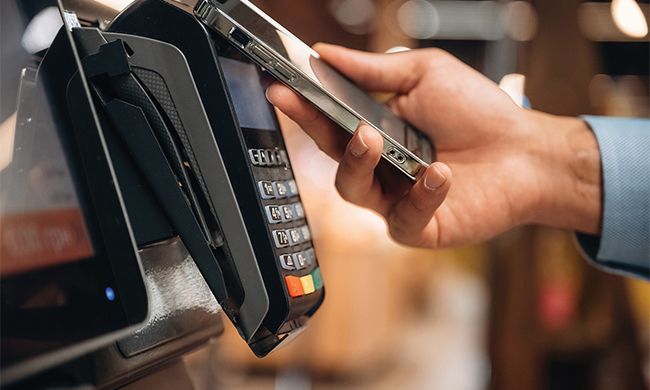
Survey: Credit isn’t a backup plan. For millions of Americans, it’s how they buy groceries.
(Sheeka Sanahori) Sixty-six percent of Americans carrying at least $10,000 in unsecured debt used a credit card to buy groceries in the last year, more than any other essential expense, according to a new survey. Credit cards were once reserved for expensive purchases or for added security in buying online. For households managing debt, they have become a way to cover everyday purchases like groceries.
Accredited Debt Relief, a company specializing in debt relief, commissioned Atomik Research in May 2026 to survey 2,000 U.S. adults with at least $10,000 in unsecured debt. Along with groceries, 47% say they’ve used credit for gas or transportation, 45% for utilities and 33% for rent or housing costs.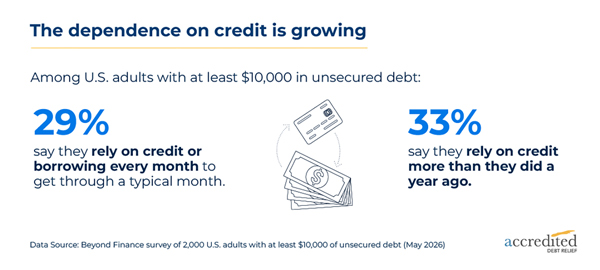
For people struggling with cost-of-living pressures, using unsecured debt can begin as a quick solution to cover household needs for the moment. At first, it’s just milk and eggs. But then an unexpected expense happens: a flat tire, an unusually high electricity bill, a medical cost that was not in the budget. The balance adds up and, according to the survey data, this also creates stress for consumers.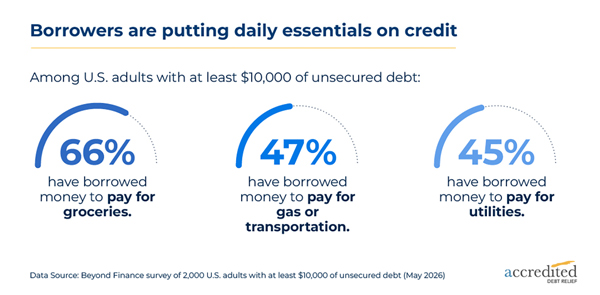
This isn’t discretionary spending. The data reflects a growing reliance on consumer debt to cover basic cost-of-living needs. However, relying on borrowed money without an executable plan for repaying it could mean that one day, the runway for taking care of such expenses runs out.
A significant share of respondents report relying on credit as a routine part of managing their personal finances. This routine could become a long-term debt cycle for many households. Nearly three in ten say that they rely on credit or borrowing to get through a typical month. This reliance appears to be growing, with a third saying they depend on credit more than they did a year ago. For those consumers, what may have once been a stopgap has become an increasingly common and ongoing financial strategy.
The growing debt cycle by unsecured borrowing is taking an emotional toll on these consumers, too. A quarter of respondents are concerned about their financial future and 12% feel a stronger concern that they’re at risk of long-term financial instability.
A lack of savings makes the cycle harder to break. Only 28% of respondents say they can both cover expenses and save. When there is little room between income and expenses, every disruption becomes harder to absorb.
Unexpected expenses, such as medical bills or car repairs, lead 19% of respondents to take on additional debt every time, and 27% most of the time. These are the kinds of costs households are often told to prepare for, but preparation requires room. For many consumers, that room does not exist.
Debt builds over time when credit becomes part of monthly operations. Some of these consumers say they don’t earn enough to make meaningful changes to their current financial situation. Among those surveyed, 45% report that their income is enough to get by but not get ahead. Many report that their financial situation has caused them to put off taking a vacation or begin building savings.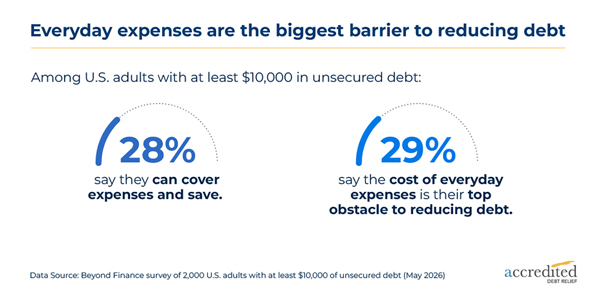
When asked about the biggest barrier to reducing debt, 29% of respondents listed the same obstacle: the cost of everyday expenses. That number connects how debt builds with why it persists.
When everyday expenses become part of ongoing credit card debt, the balance can grow without notice. Even when a consumer gets their next paycheck, if it’s already accounted for, they may not be able to make much progress in paying down their debts. A few recurring costs, spread across months, can become a greater financial weight. The result is debt that builds, because it’s tied to the basic cost of living. It also can create a stressful way to live; more than three in ten people say their current debt situation has affected their mental well-being.
Without meaningful changes, whether through increased income, debt relief or other financial support, these households may continue to rely on consumer debt and unsecured credit as a daily necessity rather than a strategic financial tool or occasional supplement. The risk is that life’s most basic needs become harder to maintain in the long run.
Methodology
Accredited Debt Relief commissioned Atomik Research to conduct an online survey of 2,000 U.S. adults with at least $10,000 in unsecured debt. The margin of error is plus or minus 2 percentage points at a 95 percent confidence level. Fieldwork was conducted between May 11-14, 2026. Atomik Research, part of 4media group, is a creative market research agency.
Photo courtesy of Shutterstock (tap to pay)

SOURCE:
💰 Live well and make your money work smarter! Explore the latest lifestyle tips, personal finance insights, saving strategies, and financial wellness stories on STM Daily News. Share your thoughts in the comments and subscribe to our newsletter for fresh ideas delivered straight to your inbox.
Community
Zum Begins 2026–27 School Year With Expanded Student Transportation Network
Zum is launching the 2026–27 school year with expanded school bus operations in Fresno, Los Angeles and other communities, bringing real-time tracking and modern transportation technology to students and families.

New partnerships in Fresno and Kansas join ongoing operations in Omaha, St. Louis, Santa Barbara and Los Angeles
As millions of students return to classrooms, transportation company Zūm is beginning the 2026–27 school year with new district partnerships, expanded technology deployments and thousands of drivers preparing for what the company calls “the most important commute in America.”
The Redwood City, California-based student mobility company announced that its teams have completed months of driver training, route validation and operational planning ahead of the new academic year.
“There is nothing quite like the first day of school at Zum,” founder and CEO Ritu Narayan said in the company’s announcement. “You see drivers arriving before sunrise, teams making final preparations and buses rolling out of yards across the country—all united around one purpose: getting students safely and reliably to school.”
New buses roll out in Fresno
One of Zūm’s largest new launches is in California’s Fresno Unified School District. According to the company, 168 buses were placed into service just two weeks after its local team moved into a new transportation yard.
The district is also introducing the Zūm Parent App, which allows families to track buses in real time, receive arrival alerts, view scheduled rides and receive notifications when a child boards or exits a bus. Registered students will receive bus cards connected to the transportation system, according to Fresno Unified.
The rollout is part of a broader change in how Fresno Unified manages student transportation. Routes and stops will continue to be evaluated using registration information, actual ridership and family feedback, the district says. Beginning September 28, registered students will generally be required to show a bus pass before boarding. Fresno Unified’s transportation page provides registration instructions and assistance for families.
Technology comes to LAUSD’s in-house fleet
In Los Angeles, Zūm says its CMX technology has been deployed across the Los Angeles Unified School District’s internally operated bus fleet.
The platform is designed to connect routing, dispatch, drivers, schools, transportation officials and families through one operating system. Its tools include real-time vehicle visibility, route planning, operational coordination and family communications.
Rather than replacing the district’s in-house drivers, the Los Angeles deployment focuses on providing the technology used to coordinate district-operated buses.
New partnership in Kansas
Zūm also began a new partnership with the Shawnee Mission School District in Kansas. District leaders, drivers, monitors and school employees marked the start of the program with a launch celebration.
The company said Shawnee Mission’s transition is intended to give the district a more modern and technology-supported approach to student transportation.
Meanwhile, Zūm is returning for a third school year in Omaha and Santa Barbara. Its St. Louis operation is entering its second year.
Drivers remain at the center
Although technology plays a growing role in school transportation, Zūm emphasized that drivers remain essential to the daily experience of students and their families.
“Back to school is when months of preparation come to life,” said Liz Sanchez, Zūm’s executive vice president of student mobility. “Our teams spend months hiring and training drivers, validating routes and working alongside our district partners to prepare.”
Drivers often serve as the first school-related adults students see in the morning and the last they see before returning home. Their work can also determine whether students arrive safely and on time—especially in communities where families have limited transportation choices.
A changing school-bus experience
School transportation has traditionally depended on separate systems for scheduling, dispatching, vehicle tracking and communicating with parents. Zūm CMX is designed to bring those functions together and give school districts a clearer view of their daily operations.
For families, the most visible change may be access to real-time bus locations and arrival notifications. These tools can reduce some of the uncertainty associated with late buses, route changes and missed pickups.
Zūm reports that its technology and transportation services now support more than 6,500 schools across 19 states. As the company expands, the 2026–27 school year will test how effectively its technology, drivers and district partnerships can translate into dependable daily service.
For students, however, the goal remains straightforward: a safe ride to school, a reliable trip home and one less obstacle between them and their education.
This article is based primarily on information provided in an August 21, 2026, Zūm press release. Statements about the company’s national reach, fleet deployments and technology are attributed to Zūm unless independently noted.
Source: Zūm official website
Related links:
- Fresno Unified: Zūm Parent App
- Fresno Unified: New Transportation Model
- Fresno Unified: Bus Routes
- Fresno Unified: Back-to-School Resources
📰 Enjoying STM Daily News? Join the conversation!
💬 Leave a comment, share your thoughts, and subscribe to our newsletter for the latest stories, updates, and “News You Can Use This Moment!” delivered to your inbox.
Stay connected with STM Daily News!






