

Business and Finance
The Benefits of Virtual Document and Image Management
Virtual document and image management provides increased accessibility, improved collaboration, enhanced security, cost-effectiveness, and improved efficiency for businesses. It is a game-changer that streamlines document and image management processes while improving productivity and efficiency.

Virtual document and image management has revolutionized the way businesses handle their important files. With the help of cloud-based storage and advanced software solutions, organizations can now securely store, organize, and access their documents and images from anywhere in the world. In this article, we will discuss the significant benefits of virtual document and image management.
- Increased Accessibility
One of the significant benefits of virtual document and image management is increased accessibility. With virtual management, organizations can store their files on the cloud, making them accessible from anywhere in the world. This means that employees can access the necessary files from their home or while traveling, improving productivity and efficiency.
- Improved Collaboration
Virtual document and image management also improve collaboration between employees. With cloud-based storage, multiple employees can access the same file simultaneously, making it easier to work on projects and collaborate on tasks. This feature is especially beneficial for remote teams that need to work together on a project.
- Enhanced Security
Virtual document and image management provides enhanced security for businesses. Cloud-based storage solutions are designed with advanced security features, such as data encryption and multi-factor authentication, to ensure that sensitive information is protected. Additionally, virtual management reduces the risk of data loss due to natural disasters or hardware failure.
- Cost-Effective
Virtual document and image management is a cost-effective solution for businesses. It eliminates the need for physical storage space, reducing the cost of maintaining a physical storage system. Additionally, cloud-based storage solutions are scalable, allowing businesses to pay for only what they use.
- Improved Efficiency
Virtual document and image management improves efficiency by providing quick and easy access to files. With virtual management, employees can search for and retrieve files in seconds, eliminating the need for time-consuming manual searches. This feature improves productivity and efficiency, allowing employees to focus on more critical tasks.
In conclusion, virtual document and image management is a game-changer for businesses. It provides increased accessibility, improved collaboration, enhanced security, cost-effectiveness, and improved efficiency. By utilizing virtual management solutions, businesses can streamline their document and image management processes while improving their overall productivity and efficiency.
Other links to check out:
https://www.businessnewsdaily.com/8038-best-document-management-software.html
https://www.business.com/articles/what-is-dms/
https://stmdailynews.com/category/lifestyle/
Author


Travel
Tighter Budgets Haven’t Stopped Travel. They’ve Changed How Americans Plan
Tighter Budgets Haven’t Stopped Travel:Tighter budgets are altering American travel plans, but most still prioritize vacations despite financial concerns.
Last Updated on April 12, 2026 by Daily News Staff
Tighter Budgets Haven’t Stopped Travel. They’ve Changed How Americans Plan
(Tiffany Miller for ALG Vacations) The flight search is open, but many travelers are pausing before they book. Prices feel higher than last year, headlines are heavy and budgets are tighter. Still, the question isn’t whether to take a vacation, but how to make it work.
A November 2025 survey from ALG Vacations of U.S. adults planning to travel in 2026 shows that financial pressure is reshaping how people approach vacations, not whether they take them. While 81% say they have at least some concern about their household finances in the months ahead, 92% say they would still travel even if tighter finances required scaling back.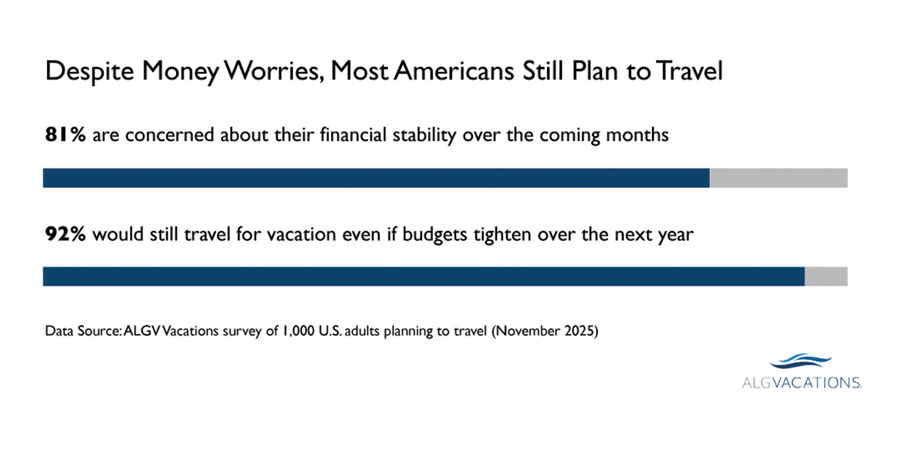
Financial pressure shapes decisions, not demand
That shift shows up in the small moments of planning. Travelers are taking longer to compare prices, reconsidering timing and adjusting expectations before they book.
Inflation and rising prices top the list of concerns, cited by 61% of respondents, reinforcing why travelers are rethinking destinations, trip length and overall costs.
Concerns about global events and safety follow at 39%, with broader political and economic instability close behind at 38%.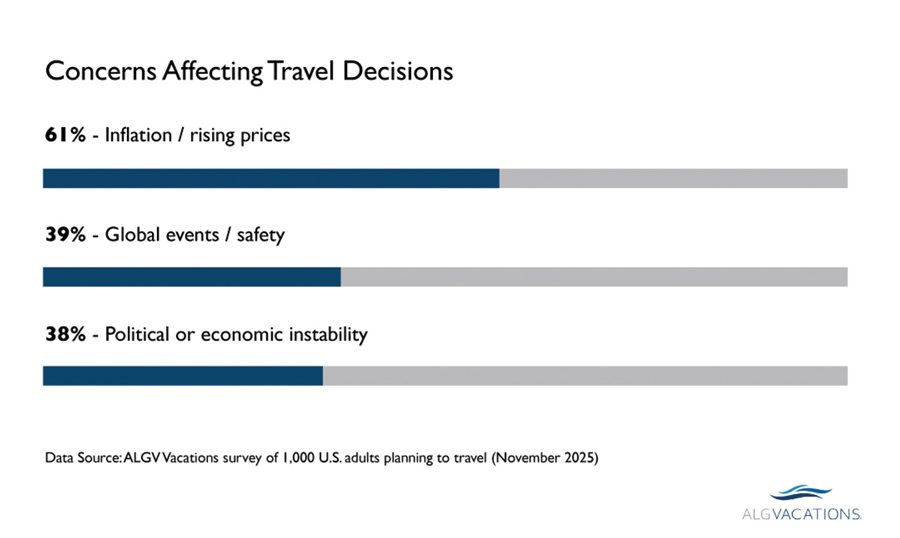
Still, those worries rarely lead travelers to walk away from travel altogether. Instead, many describe pulling back in measured ways, scaling down plans, rethinking details and making trade-offs that keep a trip possible, even if it looks different than originally imagined.
Experience changes how travelers move from planning to booking
Not all travelers navigate those trade-offs the same way. For some, uncertainty slows the process. For others, familiarity helps clear the final hurdle.
Among respondents who have previously booked a packaged vacation through a major vacation brand, 80% say they plan to take an international trip in the next year, compared with 46% of those without that experience.
That confidence carries into spending decisions as well. Sixty-seven percent of packaged-vacation travelers expect to spend more than $2,500 on their next trip, compared with 47% of those who have never booked a packaged vacation.
Taken together, the findings point to a confidence gap, with prior experience linked to greater comfort committing to international travel and higher spending.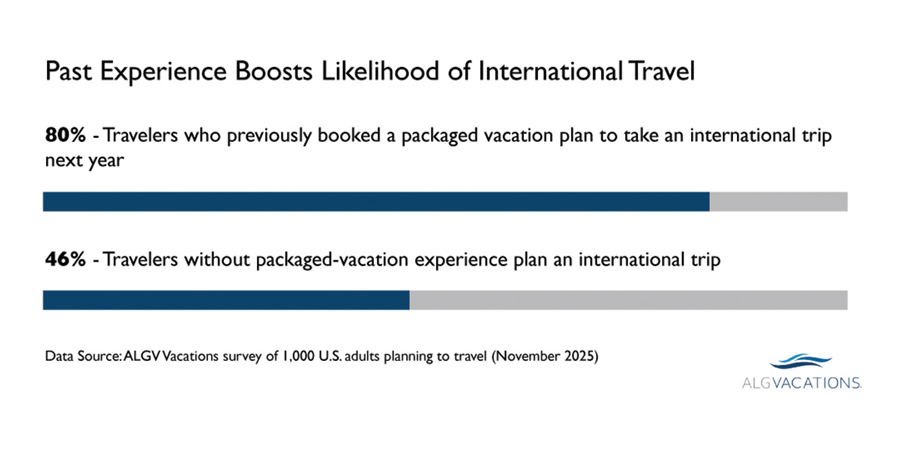
Professional guidance plays a larger role when planning gets complex
For many travelers, planning no longer stops at picking dates and destinations. Rising prices, shifting availability and higher expectations have turned vacation planning into a series of decisions that feel harder to navigate alone.
That complexity shows up most clearly among travelers with prior packaged-vacation experience. Ninety-four percent say they plan to use a travel advisor, compared with 81% of those without prior packaged-vacation experience.
The gap suggests that familiarity with structured travel planning often leads travelers to seek expert guidance. As trips become more layered, getting the details right matters as much as the destination itself.
Travel remains a priority, even as decisions slow
The findings suggest that travel is still very much on the table, even as decisions take longer to make. Travelers are weighing trade-offs, seeking guidance and leaning on experience as they plan, rather than walking away altogether.
The flight search may stay open a little longer this year. But for many Americans, the trip is still happening.
Methodology
ALG Vacations commissioned Atomik Research to conduct an online survey of U.S. adults planning to travel and travelers with prior packaged-vacation experience in the United States.
The survey included 1,000 adults planning to travel and a subsample of 502 respondents who had previously booked a packaged vacation through a major vacation brand.
The margin of error is plus or minus 3 percentage points for the full sample and 4 percentage points for the packaged vacation subsample at a 95 percent confidence level.
Fieldwork was conducted in November 2025. Atomik Research, part of 4media group, is a creative market research agency.
Photo courtesy of Shutterstock

SOURCE:
Author
Community
McDonald’s First Job Confessional Turns Career Stories Into Free Meal Opportunity
McDonald’s is launching First Job Confessional, a campaign inviting fans to share first job stories for a chance to receive a $15 gift card in select cities.


First Job Confessional
McDonald’s is putting first jobs in the spotlight with a new campaign that asks fans to share the real-world skills they gained early in their working lives. Launched on National Employee Appreciation Day, the brand’s First Job Confessional invites people to reflect on how those first roles helped shape their careers — and, in some cases, earn a free meal in the process.
The campaign is built around a simple idea: first jobs often teach lasting skills that deserve more recognition. Whether someone learned problem-solving while babysitting, communication during a lunch rush, or teamwork behind a counter, McDonald’s is framing those experiences as valuable career foundations. The company says those are the same kinds of skills employers continue to prioritize as workplace demands evolve.

How the First Job Confessional Works
In select cities, McDonald’s is setting up confessional booths designed to look like ordering kiosks. But instead of placing a meal order, participants can record a story about their first job and the skills they picked up along the way. Those who take part in person will have the opportunity to receive a $15 McDonald’s gift card, while supplies last.
Fans who cannot attend in person can still join online by posting their stories using #FirstJobConfessional. McDonald’s says selected videos may also be featured on its YouTube channel, extending the campaign beyond the live events.
External Related Links
- McDonald’s corporate article: McDonald’s is Asking Fans to Get Real About Their First Job Skills in Exchange for Free Meals
- McDonald’s 1 in 8: First Job Confessional
- McDonald’s 1 in 8 home page
- Marketing Dive coverage of the campaign
- Parade coverage of the First Job Confessional tour
Source Links
- Original PRNewswire press release from McDonald’s USA, LLC
- McDonald’s official corporate story
- McDonald’s 1 in 8 First Job Confessional page
- McDonald’s 1 in 8 official website
The Bridge is a section of the STM Daily News Blog meant for diversity, offering real news stories about bona fide community efforts to perpetuate a greater good. The purpose of The Bridge is to connect the divides that separate us, fostering understanding and empathy among different groups. By highlighting positive initiatives and inspirational actions, The Bridge aims to create a sense of unity and shared purpose. This section brings to light stories of individuals and organizations working tirelessly to promote inclusivity, equality, and mutual respect. Through these narratives, readers are encouraged to appreciate the richness of diverse perspectives and to participate actively in building stronger, more cohesive communities.
https://stmdailynews.com/the-bridge
Lifestyle
Why the First Year Behind the Wheel is the Most Dangerous: Data Shows Teen Drivers 3 Times More Likely to be in Fatal Crash
Teen drivers are significantly at risk of fatal crashes, with those aged 16-19 being nearly three times more likely to be involved in accidents than older drivers. The first year of driving presents heightened dangers, but with proper preparation, including coaching, technology, and smart insurance, families can mitigate these risks and promote safety.

Why the First Year Behind the Wheel is the Most Dangerous: Data Shows Teen Drivers 3 Times More Likely to be in Fatal Crash
(Feature Impact) The driver’s license photo may be slightly awkward, but the milestone is unforgettable. For families, a newly licensed teen means independence, busy schedules and a new set of responsibilities.
Motor vehicle crashes remain one of the leading causes of death for U.S. teens, according to the Centers for Disease Control and Prevention (CDC). Data from the National Highway Traffic Safety Administration shows drivers ages 16-19 are nearly three times more likely to be involved in a fatal crash than drivers 20 and older, per mile driven.
The statistics are serious, but they’re also manageable.
“With the right preparation, teen driving doesn’t have to feel overwhelming,” said Susan Irace, manager, divisional claims at Mercury Insurance. “Experience is what young drivers are building. Parents can help shorten that learning curve with structure, technology and smart coverage decisions.”
Why the First Year Matters
Federal safety data shows crash risk is highest in a teen’s first year of independent driving. Night driving, teen passengers and distracted driving increase that risk – while seat belts, graduated licensing laws and supervised practice significantly reduce it.
In 2023, more than 2,800 teens ages 13-19 were killed in motor vehicle crashes nationwide, according to the CDC. However, teen crash rates have declined over time thanks to safer vehicles, graduated driver licensing programs and greater awareness of distracted driving.
Ways to Reduce Teen Driving Risk

The experts at Mercury Insurance encourage families to focus on preparation rather than panic.
1. Coach Early and Often
- Log supervised driving time in different conditions – highways, rain, nighttime
- Create a simple written driving agreement outlining expectations
- Limit teen passengers during the first year
- Make seatbelts non-negotiable
2. Let Technology Help
- Choose vehicles with safety features like automatic emergency braking and blind-spot monitoring
- Use telematics or safe-driving feedback tools to reinforce good habits
- Activate smartphone “Do Not Disturb While Driving” settings
3. Review Insurance Before the Keys Change Hands
- Add teens to your insurance policy promptly
- Revisit liability limits to protect family assets
- Ask about good student and driver training discounts
“Insurance is about preparation, not fear,” Irace said. “When families combine active coaching with the right coverage, they’re setting their teen up for safer miles ahead.”
Preparation Turns Risks into Confidence
The first solo drive is a milestone, but preparation determines what comes next. By pairing common-sense coaching with today’s vehicle safety technology and thoughtful insurance planning, families can support independence while managing risk responsibly.
For more teen driver safety tips and coverage guidance, visit MercuryInsurance.com/resources.
Photos courtesy of Shutterstock

SOURCE:
Our Lifestyle section on STM Daily News is a hub of inspiration and practical information, offering a range of articles that touch on various aspects of daily life. From tips on family finances to guides for maintaining health and wellness, we strive to empower our readers with knowledge and resources to enhance their lifestyles. Whether you’re seeking outdoor activity ideas, fashion trends, or travel recommendations, our lifestyle section has got you covered. Visit us today at https://stmdailynews.com/category/lifestyle/ and embark on a journey of discovery and self-improvement.





