Connect with us

Entertainment

The best horror movie you’ve never seen

Published

on

Horror Film
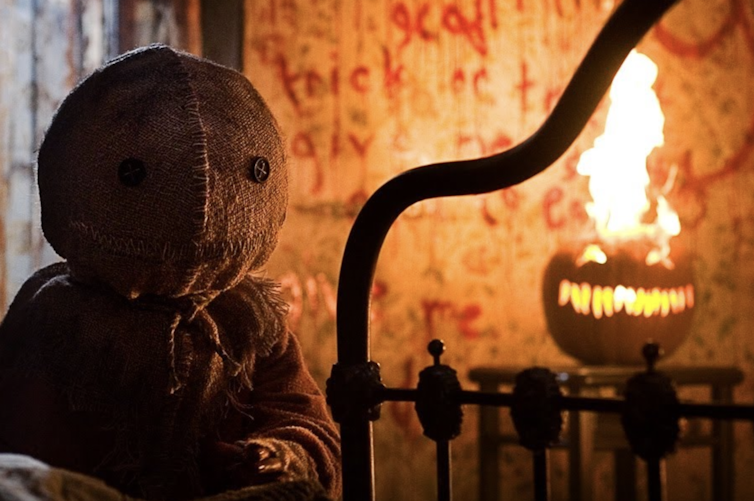
In ‘Trick ‛r Treat,’ Sam wreaks havoc on characters who betray Halloween traditions. Legendary

Scott Malia, College of the Holy Cross

It’s scary movie season, a time when many people watch films about zombies, serial killers, werewolves, magic and mysterious monsters who are impossible to kill.

However, as far as I know, there’s only one film that features all of those elements – and you’ve probably never seen it.

Made in 2007, “Trick ‛r Treat” consists of four interconnected horror stories, each about 15 to 20 minutes long, that all take place on a single Halloween night.

While characters from one story sometimes appear in other segments, the unifying force in the film is Sam, a mysterious creature wearing a burlap mask. He takes umbrage whenever a character disrespects a Halloween tradition, whether it’s by scaring away trick-or-treaters or blowing out a jack-o’-lantern before Halloween is over. Each meets a gruesome end.

Horror buffs eventually discovered the film. Today, it’s hailed as a modern classic. https://www.youtube.com/embed/NJ66Htmmq4M?wmode=transparent&start=0 ‘Trick ‛r Treat’ ended up forgoing a theatrical run.

What went wrong?

“Trick ‛r Treat” was produced by a major studio, Warner Bros. It featured A-list stars, such as Brian Cox and Oscar-winner Anna Paquin. It was produced by Bryan Singer, who was known for churning out hits such as “X-Men” and “The Usual Suspects.” And though its director, Mike Dougherty, was making his directorial debut, he had worked as a screenwriter on films such as “X2: X-Men United” and “Superman Returns.”

Despite all of these credentials, the film’s theatrical release was delayed from fall 2007 to 2008. Then a theater run was canceled altogether, with Warner Bros. finally releasing it on video in 2009.

The studio never gave an official reason for pulling the theatrical release; however, some critics have speculated that the box office success of the “Saw” franchise and Rob Zombie’s “Halloween” remake were factors.

Other reports suggest that the film’s anthology format, its mixture of horror and comedy, and a plot featuring murdered children made it too hard a sell.

Given the cost of marketing and promoting “Trick ‛r Treat” to a nationwide audience, perhaps the risk wasn’t worth it for a film with a relatively small US$5 million budget. Dougherty himself said these hang-ups constituted a “perfect storm,” suggesting that no one development sealed the film’s fate.

Advertisement
Get More From A Face Cleanser And Spa-like Massage
Young man with closely cropped hair wears black suit and black tie.
Michael Dougherty’s film included a number of elements that became mainstays of the genre – he was just a bit early to the game. Robyn Beck/AFP via Getty Images

Bypassing the box office

As recently as a decade ago, films released directly to DVD were viewed as flops or cash grabs. In fact, there’s an entire subgenre called “mockbusters” – low-budget rip-offs of studio films, such as “Transmorphers,” which tried to piggyback the success of the “Transformers” franchise, and “Atlantic Rim,” which attempted to do the same for the 2013 blockbuster “Pacific Rim.”

Then there are direct-to-video sequels meant to capitalize off hits. Disney made a lot of money in the late 1990s and early 2000s producing widely panned, direct-to-video animated features such as “The Return of Jafar” and “Pocahontas II: Journey to a New World.”

But second lives for films that were initially snubbed or ignored are nothing new.

The Boondock Saints” was briefly screened in a handful of theaters for a single week in 1999 before being dumped into the video market. Only then did viewers find it, and it became a cult favorite that eventually begat a sequel.

The stigma of direct-to-video release has diminished over the past decade thanks to the rise of streaming, in which content made directly for home viewing can receive critical acclaim and attract subscribers.

Actor Nicolas Cage has made a cottage industry of this format. While some have attributed his massive output in the past decade to his financial difficulties, Cage’s films “Joe” (2013), “Mandy” (2018) and “Pig” (2021) have all received critical acclaim, despite sometimes only running in a handful of theaters for a week before their release into streaming markets and video on demand.

It’s this sort of tradition that led to the rediscovery of “Trick ‛r Treat.”

Man with beard poses while wearing a gold jacket and aviator sunglasses.
Nicolas Cage attends the special screening of ‘Mandy’ in 2018. Paul Archuleta/FilmMagic via Getty Images.

Hipster horror

The appeal of “Trick ‛r Treat” is rooted in its subversion of horror tropes.

For example, women and children, who’ve historically served as victims in the genre, have a lot more agency in Dougherty’s Halloween tale. In fact, the mysterious Sam was played by Quinn Lord, who was only 8 years old when the film was shot. In the film, the character’s origin, age and gender remain undefined since Sam is masked or covered in prosthetics for the entire film, blurring the line between human and monster.

In addition, the film’s complex structure, which some speculated might have hurt its chances for commercial success, helped fuel the film’s critical praise. Dougherty called it “‘Pulp Fiction’ meets ‘Halloween,’” a nod to the interlocking structure of Quentin Tarantino’s breakout film and the setting of John Carpenter’s horror staple, which also unfolds over one Halloween night.

It has become somewhat of a cliché to say that esteemed art, initially overlooked, was “ahead of its time.”

Still, it would be fair to say that “Trick ‘r Treat” arrived on the cusp of what has been called a “horror renaissance” in the past 15 years. Directors like Jordan Peele, Ari Aster, Robert Eggers and Mike Flanagan have found critical and commercial success by branding themselves as horror auteurs.

Advertisement
Get More From A Face Cleanser And Spa-like Massage

In addition, Peele and directors like Nia Dacosta, who helmed 2021’s “Candyman,” have opened up a brand of horror that deals with social issues and identity. Dougherty’s film also anticipated a trend of horror films with a darkly humorous streak, including Peele’s “Get Out” and David Gordon Green’s reimagined “Halloween” sequels.

Despite the film’s rocky beginnings, “Trick ‛r Treat” received a belated theatrical release in 2022, which has spurred talk of a potential sequel.

Dougherty even acknowledges that the film may owe its current popularity to its botched release. While some mainstream films disappear quickly, “Trick ‛r Treat” – currently streaming on Max – reappears every Halloween. Just like Sam.

Scott Malia, Associate Professor of Theatre, College of the Holy Cross

This article is republished from The Conversation under a Creative Commons license. Read the original article.

Looking for an entertainment experience that transcends the ordinary? Look no further than STM Daily News Blog’s vibrant Entertainment section. Immerse yourself in the captivating world of indie films, streaming and podcasts, movie reviews, music, expos, venues, and theme and amusement parks. Discover hidden cinematic gems, binge-worthy series and addictive podcasts, gain insights into the latest releases with our movie reviews, explore the latest trends in music, dive into the vibrant atmosphere of expos, and embark on thrilling adventures in breathtaking venues and theme parks. Join us at STM Entertainment and let your entertainment journey begin! https://stmdailynews.com/category/entertainment/

and let your entertainment journey begin!

Advertisement
Get More From A Face Cleanser And Spa-like Massage

Author


Discover more from Daily News

Subscribe to get the latest posts sent to your email.

Continue Reading
Advertisement Sports Research

Entertainment

Brigitte Bardot defined the modern woman and defied social norms

Published

on

Brigitte Bardot defined the modern woman and defied social norms
Herbert Dorfman/Corbis via Getty Image

Brigitte Bardot defined the modern woman and defied social norms

Ben McCann, University of Adelaide Brigitte Bardot’s death, at the age of 91, brings to a close one of the most extraordinary careers in post-war French cultural life. Best known as an actress, she was also a singer, a fashion icon, an animal rights activist and a symbol of France’s sexual liberation. Famous enough to be known by her initials, B.B. symbolised a certain vision of French femininity – rebellious and sensual, yet vulnerable. Her impact on beauty standards and French national identity was profound. At her peak, she rivalled Marilyn Monroe in global fame and recognition. Simone de Beauvoir, France’s leading feminist writer, famously wrote in 1959 that Bardot “appears as a force of nature, dangerous so long as she remains untamed”.

A star is born

Bardot was born in 1934 to a well-off Parisian family. Raised in a strict Catholic household, she studied ballet at the Conservatoire de Paris with hopes of becoming a professional dancer.
Bardot en pointe.
Brigitte Bardot, pictured here in 1946, studied ballet as a child. Roger Viollet via Getty Images
Her striking looks led her to modelling. By 14, she was appearing in Elle magazine, catching the eye of director Roger Vadim, whom she married in 1952. She began acting in the early 1950s and her appearance as Juliette in Vadim’s And God Created Woman (Et Dieu… créa la femme, 1956) put her on the map. Bardot was instantly catapulted to international stardom. Vadim presented his wife as the ultimate expression of youthful, erotic freedom that both shocked and captivated French audiences. Watching this relatively tame film today, it’s difficult to imagine just how taboo-breaking Bardot’s performance was. But in sleepy Catholic, conservative 1950s France, it set new norms for on-screen sexuality. The film became a global phenomenon. Critics loved it, but censors and religious groups grew nervous.

An 60s icon

Bardot’s lack of formal training as an actress paradoxically became part of her appeal: she adopted a spontaneous acting approach, as much physical as verbal. She was stunning in Contempt (Le Mépris, 1963), Jean-Luc Godard’s masterpiece about a crumbling marriage. Godard used her beauty and fame both as spectacle and critique. The film’s most famous sequence was a 31-minute conversation between Bardot and her co-star Michel Piccoli. Bardot was never better. In Henri-Georges Clouzot’s intense courtroom drama The Truth (La Vérité, 1960), she showcased her dramatic range playing a young woman on trial for the murder of her lover.
Bardot in a bed.
Bardot in a poster for The Truth, 1960. LMPC via Getty Images
In 1965, she co-starred with Jeanne Moreau in Louis Malle’s Long Live Maria (Viva Maria), a rare female buddy film that blended comedy and political satire. Bardot’s anarchic energy remains a dazzling feat. A Very Private Affair (Vie privée, 1962) saw her portray a woman consumed by fame and chased by the media. The plotline was eerily predictive of Bardot’s own future. She popularised fashion trends like the choucroute hairstyle and ballet flats. The Bardot neckline – off-the-shoulder tops and dresses – was named after her. She even wore pink gingham at her 1959 wedding.

Allure and provocation

Bardot’s star appeal lay in her contradictions. She appeared simultaneously natural and provocative, spontaneous and calculated. Her dishevelled glamour and effortless sexuality helped construct the archetype of the modern “sex kitten”. She famously said “it is better to be unfaithful than to be faithful without wanting to be”. Throwing off the shackles of bourgeois morality, Bardot epitomised a commitment to emotional and sexual freedom. Her turbulent love life was a case in point. She was married four times, with dozens of stormy relationships and extra-marital affairs along the way. Forever immortalised as a free-spirited ingénue, Bardot was a muse for filmmakers, artists and musicians, from Andy Warhol to Serge Gainsbourg. Later on, Kate Moss, Amy Winehouse and Elle Fanning mentioned Bardot as an inspiration. Famously, Bardot never succumbed to cosmetic surgery. As she once noted:
Women should embrace ageing because, at the end of the day, it’s much more beautiful to have a grandmother with white hair who looks like an elderly lady than to have a grandmother who’s bleached, dyed, and […] who looks much older but also really unhappy.

Life after the movies

Bardot retired from acting in 1973, aged only 39, citing disillusionment with fame. “It suffocated and destroyed me”, she said, about the film industry. She shifted her attention to animal rights, founding the Brigitte Bardot Foundation in 1986. She became an uncompromising, vocal activist, campaigning against animal cruelty, fur farming, whaling and bullfighting. But Bardot courted controversy from the mid-1990s for her far-right political views, remarks about Islam and immigration and repeated convictions for inciting racial hatred. She publicly defended disgraced actor Gérard Depardieu and pushed back on the #MeToo movement in France. Such statements damaged her reputation, especially outside France, and created a troubling image: the once-liberating sex symbol now associated with nationalist conservatism. While she never identified as a feminist, her unapologetic autonomy, early retirement and outspoken views led some to re-evaluate her as a figure of proto-feminist rebellion. France gradually began to turn against Bardot, bothered by her outspoken views. But some applauded her couldn’t-care-less attitude and unwillingness to play by the rules. Ultimately, by rejecting fame on her own terms, she parlayed her 50s free-spiritedness into a bold stand against conformity and societal norms. Late in life, she told Danièle Thompson, the writer-director of the 2023 mini-series about her career, “I don’t understand why the whole world is still talking about me”. The answer is simple – Bardot continues to fascinate us, flaws and all. Ben McCann, Associate Professor of French Studies, University of Adelaide This article is republished from The Conversation under a Creative Commons license. Read the original article.
Hollywood to Pickleball: Joseph’s Inspiring Journey!
Link: https://stmdailynews.com/hollywood-to-pickleball-josephs-inspiring-journey/

Author


Discover more from Daily News

Subscribe to get the latest posts sent to your email.

Continue Reading

Entertainment

The dystopian Pottersville in ‘It’s a Wonderful Life’ is starting to feel less like fiction

A fresh look at It’s a Wonderful Life through the film’s darkest detour—Pottersville—and why its greed, corruption, and desensitization to cruelty feels uncomfortably familiar in America today.

Published

on

file 20251209 56 ruqe19.png?ixlib=rb 4.1
To many Americans, George Bailey’s dystopian nightmare is disquietingly familiar. Paramount

The dystopian Pottersville in ‘It’s a Wonderful Life’ is starting to feel less like fiction

Nora Gilbert, University of North Texas Along with millions of others, I’ll soon be taking 2 hours and 10 minutes out of my busy holiday schedule to sit down and watch a movie I’ve seen countless times before: Frank Capra’sIt’s a Wonderful Life,” which tells the story of a man’s existential crisis one Christmas Eve in the fictional town of Bedford Falls. There are lots of reasons why this eight-decade-old film still resonates, from its nostalgic pleasures to its cultural critiques. But when I watch it this year, the sequence where Bedford Falls transforms into the dark and dystopian “Pottersville” will resonate the most. In the film, protagonist George Bailey, who’s played by Jimmy Stewart, is on the brink of suicide. He seems to have achieved the hallmarks of the American dream: He’s taken over his father’s loan business, married the love of his life and fathered four excessively adorable children. But George feels stifled and beaten down. His Uncle Billy has misplaced US$8,000 of the company’s money, and the town’s resident tyrant, Mr. Potter, is using the mishap to try to ruin George, who’s his last remaining business competitor. An angel named Clarence is tasked with pulling George back from the brink. To stop him from attempting suicide, Clarence decides to show George what life would have been like if he’d never been born. In this alternate reality, Bedford Falls is called Pottersville, a place Mr. Potter runs as a ruthless banker and slumlord.
Movie still of young man walking through a dark, snowy town and passing by a bright sign reading 'Pottersville.'
Pottersville, the dark, dystopian version of Bedford Falls, is a place characterized by vice and moral decay. Paramount
Having previously written about “It’s a Wonderful Life” in my book on literary and film censorship, I can’t help but see parallels between Pottersville and the U.S. today. Think about it: In Pottersville, one man hoards all the financial profits and political power. In Pottersville, greed, corruption and cynicism reign supreme. In Pottersville, hard-working immigrants like Giuseppe Martini who were able to build a life and run a business in Bedford Falls have vanished. In Pottersville, homeless addicts like Mr. Gower and nonconformist “pixies” like Clarence are scorned and ostracized, then booted out of the local watering hole. In Pottersville, cops arrest people like Violet Bick while they’re at work and haul them away, kicking and screaming.
Black-and-white movie still of a young women being dragged away by the police as a worried young man looks on.
Violet Bick gets dragged away by the Pottersville police as George looks on. Paramount
But what horrifies George the most about Pottersville is how desensitized the people living in it seem to be to its harshness and cruelty – how they treat him like he’s the crazy, deranged one for wanting and expecting things to be different and better. This is what the current political moment feels like to me. There are days when the latest headlines feel so jarringly unprecedented that I find myself thinking, “Can this be happening? Can this be real?” If you think these comparisons are a bit of a stretch, consider when “It’s a Wonderful Life” was made, and the frame of mind Capra was in when he made it.

Frank Capra, anti-fascist

In 1946, Capra was just returning to Hollywood filmmaking after serving for four years in the U.S. Army, where the Office of War Information had tasked him with producing a series of documentary films about World War II and the lead-up to it. Even though Capra hadn’t been on the front lines, he’d been immersed in the sounds and images of war for years on end, and he had become acutely familiar with Germany, Italy and Japan’s respective rises to fascism.
Young man posing and smiling while wearing a military uniform.
Frank Capra served in the U.S. Army during World War II. Keystone/Hulton Archive via Getty Images
When deciding on his first postwar film, Capra recalled in his autobiography that he specifically “knew one thing – it would not be about war.” Instead, he chose to adapt a short story by Philip Van Doren Stern, “The Greatest Gift,” that Stern had originally sent to friends and family as a Christmas card in 1943. Stern’s story is certainly not about war. But it’s not exactly about Christmas, either. As Stern writes in his opening lines:
“The little town straggling up the hill was bright with colored Christmas lights. But George Pratt did not see them. He was leaning over the railing of the iron bridge, staring down moodily at the black water.”
The protagonist contemplates suicide because he’s “sick of everything” in the small-town “mudhole” he’s stuck in – until, that is, a “strange little man” gives him the chance to see what life would be like if he’d never been born. It was Capra and his team of screenwriters who added the sinister Henry F. Potter to Stern’s short, simple tale. The Potter subplot encapsulates the film’s most trenchant, still-resonant themes: the unfairness of socioeconomic injustices; the pervasiveness of corporate and political corruption; the threat of monopolized power; the need for affordable housing. These themes had, of course, run through many of Capra’s prewar films as well: “Mr. Deeds Goes to Town,” “You Can’t Take It with You,” “Meet John Doe” and “Mr. Smith Goes to Washington,” the last of which also starred Jimmy Stewart. But they take on a different kind of weight in “It’s a Wonderful Life” – a weight that’s especially visible on the weathered face of Stewart, who himself had just returned from a harrowing four-year tour of duty as a bomber pilot in Europe. The idealistic vigor with which Stewart had fought crooked politicians and oligarchs as Mr. Smith is replaced by the bitterness, exhaustion, frustration and desperation with which he battles against Mr. Potter as George Bailey.
Black-and-white movie still of a distraught man with snow on his jacket.
George Bailey feels helpless in the face of corruption and cruelty. Paramount

Life after Pottersville

By the time George has begged and pleaded his way out of Pottersville, the lost $8,000 is no longer top of mind. He’s mainly just relieved to find Bedford Falls as he had left it, warts and all. And yet, the Bedford Falls that George returns to isn’t quite the same as the one he left behind. In this Bedford Falls, the community rallies together to figure out a way to recoup George’s missing money. Their pre-digital version of a GoFundMe page saves George from what he’d feared most: bankruptcy, scandal and prison. And even though his wife, Mary, tries to attribute this sudden wave of collectivist, activist energy to some sort of divine intervention – “George, it’s a miracle; it’s a miracle!” – Uncle Billy points out that it really came about through more earthly organizing means: “Mary did it, George; Mary did it! She told some people you were in trouble, and they scattered all over town collecting money!”
A group of smiling people dump a large basket of cash on a desk.
The residents of Bedford Falls come together to save George from financial ruin. Paramount
But the question of whether George actually wins his battle against Potter is a murky one. While the typical Capra protagonist triumphs by defeating vice and exposing subterfuge, George never even realizes that Potter is the one who got hold of his money and tried to ruin his life. Potter is never held accountable for his crimes. On the other hand, George is able to learn, from his time in Pottersville, what a crucial role he plays in his community. George’s victory over Potter, then, lies not in some grand final act of retribution, but in the incremental ways he has stood up to Potter throughout his life: not capitulating to Potter’s bullying or intimidation tactics; speaking truth to power; and running a community-centered business rather than one guided by greed and exploitation. In recent months, there have been similar acts of protest, large and small, in the form of rallies, boycotts, immigrant aid efforts, subscription cancellations, food bank donations and more. That doesn’t mean the U.S. has made it out of Pottersville, however. Each day, more head-spinning headlines appear, whether they’re about masked agents terrorizing immigrant communities, the dismantling of anti-corruption oversights, the consolidation of executive power or the naked display of political grift. Zuzu’s petals are still missing. Clarence still hasn’t gotten his wings. But this holiday season, I’m hoping it will feel helpfully cathartic to go with George Bailey, for the umpteenth time, through the dark abyss of his dystopian nightmare – and come out with him, stronger and wiser, on the other side. Nora Gilbert, Professor of Literary and Film Studies, University of North Texas This article is republished from The Conversation under a Creative Commons license. Read the original article.
Dreambreaker: A Pickleball Story — A Closer Look at the Documentary and Its Uncredited Voice
Link: https://stmdailynews.com/dreambreaker-a-pickleball-story-a-closer-look-at-the-documentary-and-its-uncredited-voice/

Discover more from Daily News

Subscribe to get the latest posts sent to your email.

Continue Reading

Entertainment

Bad Bunny Set to Make History at Apple Music Super Bowl LX Halftime Show

Bad Bunny will headline the Apple Music Super Bowl LX Halftime Show on February 8, 2026, at Levi’s Stadium, marking a historic moment for Latin music. Industry leaders praise his cultural impact and global influence. The event promises to deliver an unforgettable performance, celebrating Bad Bunny’s significance in today’s music scene.

Published

on

Last Updated on January 2, 2026 by Daily News Staff

Global superstar will take center stage at Levi’s Stadium in February 2026

Bad Bunny
Global Sensation Bad Bunny to Perform at Apple Music Super Bowl LX Halftime Show

The NFL, Apple Music, and Roc Nation dropped major news this week that’s sending shockwaves through the music and sports worlds: three-time GRAMMY® Award-winning artist Bad Bunny will headline the Apple Music Super Bowl LX Halftime Show on February 8, 2026, at Levi’s Stadium in Santa Clara, California.

A Historic Moment for Latin Music

For Bad Bunny, this isn’t just another performance—it’s a cultural milestone. The Puerto Rican sensation expressed the profound significance of this opportunity in his own words:

“What I’m feeling goes beyond myself. It’s for those who came before me and ran countless yards so I could come in and score a touchdown… this is for my people, my culture, and our history. Ve y dile a tu abuela, que seremos el HALFTIME SHOW DEL SUPER BOWL.”

The announcement represents a watershed moment for Latin music on the world’s biggest stage, with Bad Bunny becoming one of the first Latin artists to solo headline the Super Bowl Halftime Show.

Industry Leaders Weigh In

Shawn “JAY-Z” Carter, whose Roc Nation serves as strategic entertainment advisor for the performance, praised Bad Bunny’s impact: “What Benito has done and continues to do for Puerto Rico is truly inspiring. We are honored to have him on the world’s biggest stage.”

Jon Barker, the NFL’s SVP of Global Event Production, highlighted why Bad Bunny is the perfect fit for this moment: “Bad Bunny represents the global energy and cultural vibrancy that define today’s music scene. As one of the most influential and streamed artists in the world, his unique ability to bridge genres, languages, and audiences makes him an exciting and natural choice.”

Oliver Schusser, Apple’s Vice President of Music, Sports and Beats, emphasized the artist’s cultural impact: “Few artists embody that intersection [of music and culture] more perfectly and authentically than Bad Bunny. His music has not only broken records but has elevated Latin music to the center of pop-culture.”

Tune In to the Special Announcement

Apple Music Radio is celebrating the news with a special Halftime Headliner broadcast featuring Zane Lowe, Ebro Darden, and surprise guests. The show aired Monday, September 29th at 9:30am ET across Apple Music Radio platforms.

What to Expect

The Apple Music Super Bowl LX Halftime Show will be produced by DPS, with Roc Nation and Jesse Collins serving as executive producers and Hamish Hamilton directing. The performance will air on NBC during Super Bowl LX, bringing Bad Bunny’s explosive stage presence and genre-defying music to an audience of millions.

Advertisement
Get More From A Face Cleanser And Spa-like Massage

A Winning Tradition

The Apple Music Super Bowl Halftime Show has become synonymous with excellence, racking up multiple Emmy wins in recent years. The Apple Music Super Bowl LIX Halftime Show starring Kendrick Lamar became the most-watched Super Bowl Halftime Show ever, earning four Emmy nominations and winning Outstanding Music Direction. Previous shows featuring Usher, Rihanna, and the legendary lineup of Dr. Dre, Snoop Dogg, Eminem, Mary J. Blige, and Kendrick Lamar have collectively earned dozens of nominations and awards.

With Bad Bunny’s proven track record of delivering unforgettable performances and his massive global fanbase, the Apple Music Super Bowl LX Halftime Show is shaping up to be one of the most anticipated musical events of 2026.

Mark your calendars for February 8, 2026—this is one performance you won’t want to miss.


What are your thoughts on Bad Bunny headlining the Super Bowl? Will you be tuning in? Let us know in the comments below, and follow Apple Music on social media for more updates as we get closer to game day.

Related Links

Official Announcements & Streaming:

Follow the Conversation:

More Super Bowl Halftime Content:

Explore Bad Bunny:

Looking for an entertainment experience that transcends the ordinary? Look no further than STM Daily News Blog’s vibrant Entertainment section. Immerse yourself in the captivating world of indie films, streaming and podcasts, movie reviews, music, expos, venues, and theme and amusement parks. Discover hidden cinematic gems, binge-worthy series and addictive podcasts, gain insights into the latest releases with our movie reviews, explore the latest trends in music, dive into the vibrant atmosphere of expos, and embark on thrilling adventures in breathtaking venues and theme parks. Join us at STM Entertainment and let your entertainment journey begin! https://stmdailynews.com/category/entertainment/

and let your entertainment journey begin!


Discover more from Daily News

Subscribe to get the latest posts sent to your email.

Continue Reading

Trending