Connect with us

News

The Hong Kong high-rise fire shows how difficult it is to evacuate in an emergency

Hong Kong High-Rise Fire: The deadly Hong Kong fire exposes critical challenges in evacuating tall buildings. Learn why stair descent is slower than expected, how human behavior causes delays, and what modern safety features can save lives.

Published

on

Hong Kong High-Rise Fire Reveals Why Evacuating Tall Buildings Is So Dangerous
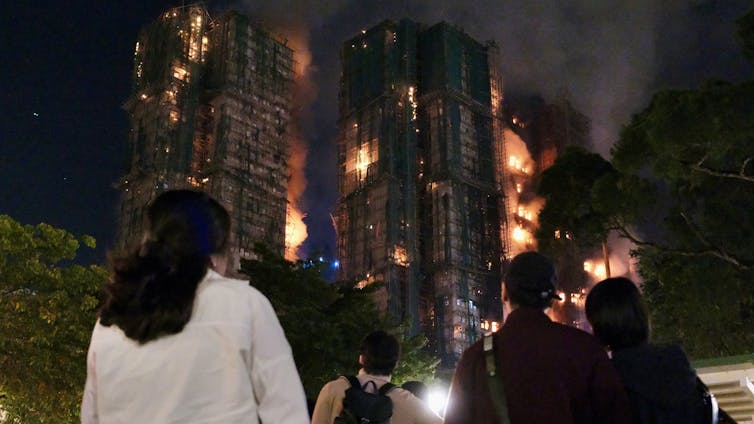
Tommy Wang/Getty

The Hong Kong high-rise fire shows how difficult it is to evacuate in an emergency

Milad Haghani, The University of Melbourne; Erica Kuligowski, RMIT University, and Ruggiero Lovreglio, Te Kunenga ki Pūrehuroa – Massey University

The Hong Kong high-rise fire, which spread across multiple buildings in a large residential complex, has killed dozens, with hundreds reported missing.

The confirmed death toll is now 44, with close to 300 people still unaccounted for and dozens in hospital with serious injuries.

This makes it one of Hong Kong’s deadliest building fires in living memory, and already the worst since the Garley Building fire in 1996.

Although more than 900 people have been reportedly evacuated from the Wang Fuk Court, it’s not clear how many residents remain trapped.

This catastrophic fire – which is thought to have spread from building to building via burning bamboo scaffolding and fanned by strong winds – highlights how difficult it is to evacuate high-rise buildings in an emergency.

When the stakes are highest

Evacuations of high-rises don’t happen every day, but occur often enough. And when they do, the consequences are almost always severe. The stakes are highest in the buildings that are full at predictable times: residential towers at night, office towers in the day.

We’ve seen this in the biggest modern examples, from the World Trade Center in the United States to Grenfell Tower in the United Kingdom.

The patterns repeat: once a fire takes hold, getting thousands of people safely down dozens of storeys becomes a race against time.

But what actually makes evacuating a high-rise building so challenging?

It isn’t just a matter of “getting people out”. It’s a collision between the physical limits of the building and the realities of human behaviour under stress.

Advertisement
Get More From A Face Cleanser And Spa-like Massage

It’s a long way down to safety

The biggest barrier is simply vertical distance. Stairwells are the only reliable escape route in most buildings.

Stair descent in real evacuations is far slower than most people expect. Under controlled or drill conditions people move down at around 0.4–0.7 metres per second. But in an actual emergency, especially in high-rise fires, this can drop sharply.

During 9/11, documented speeds at which survivors went down stairs were often slower than 0.3 m/s. These slow-downs accumulate dramatically over long vertical distances.

Fatigue is a major factor. Prolonged walking significantly reduces the speed of descent. Surveys conducted after incidents confirm that a large majority of high-rise evacuees stop at least once. During the 2010 fire of a high-rise in Shanghai, nearly half of older survivors reported slowing down significantly.

Long stairwells, landings, and the geometry of high-rise stairs all contribute to congestion, especially when flows from multiple floors merge into a single shaft.

Slower movers include older adults, people with physical or mobility issues and groups evacuating together. These reduce the overall pace of descent compared with the speeds typically assumed for able-bodied individuals. This can create bottlenecks. Slow movers are especially relevant in residential buildings, where diverse occupants mean movement speeds vary widely.

Visibility matters too. Experimental studies show that reduced lighting significantly slows down people going down stairs. This suggests that when smoke reduces visibility in real events, movement can slow even further as people hesitate, misjudge steps, or adjust their speed.

Human behaviour can lead to delays

Human behaviour is one of the biggest sources of delay in high-rise evacuations. People rarely act immediately when an alarm sounds. They pause, look for confirmation, check conditions, gather belongings, or coordinate with family members.

These early minutes are consistently some of the costliest when evacuating from tall buildings.

Studies of the World Trade Center evacuations show the more cues people saw – smoke, shaking, noise – the more they sought extra information before moving. That search for meaning adds delay. People talk to colleagues, look outside windows, phone family, or wait for an announcement. Ambiguous cues slow them even further.

Advertisement
Get More From A Face Cleanser And Spa-like Massage

In residential towers, families, neighbours and friend-groups naturally try to evacuate together. Groups tend to form wider steps, or group together in shapes that reduce overall flow. But our research shows when a group moves in a “snake” formation – one behind the other – they travel faster, occupy less space, and allow others to pass more easily.

These patterns matter in high-rise housing, where varied household types and mixed abilities make moving in groups the norm.

Why stairs aren’t enough

As high-rises grow taller and populations age, the old assumption that “everyone can take the stairs” simply no longer holds. A full building evacuation can take too long, and for many residents (older adults, people with mobility limitations, families evacuating together) long stair descents are sometimes impossible.

This is why many countries have turned to refuge floors: fire- and smoke-protected levels built into towers as safe staging points. These can reduce bottlenecks and prevent long queues. They give people somewhere safe to rest, transfer across to a clearer stair, or wait for firefighters. Essentially, they make vertical movement more manageable in buildings where continuous descent isn’t realistic.

Alongside them are evacuation elevators. These are lifts engineered to operate during a fire with pressurised shafts, protected lobbies and backup power. The most efficient evacuations use a mix of stairs and elevators, with ratios adjusted to the building height, density and demographics.

The lesson is clear: high-rise evacuation cannot rely on one tool. Stairs, refuge floors and protected elevators should all be made part of ensuring vertical living is safer.The Conversation

Milad Haghani, Associate Professor and Principal Fellow in Urban Risk and Resilience, The University of Melbourne; Erica Kuligowski, Principal Research Fellow, School of Engineering, RMIT University, and Ruggiero Lovreglio, Professor in Digital Construction and Fire Engineering, Te Kunenga ki Pūrehuroa – Massey University

This article is republished from The Conversation under a Creative Commons license. Read the original article.

STM Daily News is a vibrant news blog dedicated to sharing the brighter side of human experiences. Emphasizing positive, uplifting stories, the site focuses on delivering inspiring, informative, and well-researched content. With a commitment to accurate, fair, and responsible journalism, STM Daily News aims to foster a community of readers passionate about positive change and engaged in meaningful conversations. Join the movement and explore stories that celebrate the positive impacts shaping our world.

https://stmdailynews.com/

Advertisement
Get More From A Face Cleanser And Spa-like Massage

Want more stories 👋
“Your morning jolt of Inspiring & Interesting Stories!”

Sign up to receive awesome articles directly to your inbox.

STM Coffee Newsletter 1

We don’t spam! Read our privacy policy for more info.


Discover more from Daily News

Subscribe to get the latest posts sent to your email.

Continue Reading
Advertisement Sports Research
Click to comment

Leave a Reply

Your email address will not be published. Required fields are marked *

The Knowledge

How to avoid seeing disturbing video on social media and protect your peace of mind

How to avoid seeing disturbing video on social media and protect your peace of mind

Published

on

Last Updated on January 29, 2026 by Daily News Staff

How to avoid seeing disturbing video on social media and protect your peace of mind
Social media often serves up disturbing images but you can minimize your exposure. Jacob Wackerhausen/iStock via Getty Images

Annie Margaret, University of Colorado Boulder

How to avoid seeing disturbing video on social media and protect your peace of mind

When graphic videos like those of the recent shooting of a protester by federal agents in Minneapolis go viral, it can feel impossible to protect yourself from seeing things you did not consent to see. But there are steps you can take.

Social media platforms are designed to maximize engagement, not protect your peace of mind. The major platforms have also reduced their content moderation efforts over the past year or so. That means upsetting content can reach you even when you never chose to watch it.

You do not have to watch every piece of content that crosses your screen, however. Protecting your own mental state is not avoidance or denial. As a researcher who studies ways to counteract the negative effects of social media on mental health and well-being, I believe it’s a way of safeguarding the bandwidth you need to stay engaged, compassionate and effective.

Why this matters

Research shows that repeated exposure to violent or disturbing media can increase stress, heighten anxiety and contribute to feelings of helplessness. These effects are not just short-term. Over time, they erode the emotional resources you rely on to care for yourself and others.

Protecting your attention is a form of care. Liberating your attention from harmful content is not withdrawal. It is reclaiming your most powerful creative force: your consciousness.

Just as with food, not everything on the table is meant to be eaten. You wouldn’t eat something spoiled or toxic simply because it was served to you. In the same way, not every piece of media laid out in your feed deserves your attention. Choosing what to consume is a matter of health.

And while you can choose what you keep in your own kitchen cabinets, you often have less control over what shows up in your feeds. That is why it helps to take intentional steps to filter, block and set boundaries.

Practical steps you can take

Fortunately, there are straightforward ways to reduce your chances of being confronted with violent or disturbing videos. Here are four that I recommend:

Advertisement
Get More From A Face Cleanser And Spa-like Massage
  • Turn off autoplay or limit sensitive content. Note that these settings can vary depending on device, operating system and app version, and can change.

https://datawrapper.dwcdn.net/d1deR/2

  • Use keyword filters. Most platforms allow you to mute or block specific words, phrases or hashtags. This reduces the chance that graphic or violent content slips into your feed.
  • Curate your feed. Unfollow accounts that regularly share disturbing images. Follow accounts that bring you knowledge, connection or joy instead.
  • Set boundaries. Reserve phone-free time during meals or before bed. Research shows that intentional breaks reduce stress and improve well-being.
a settings screen with a red rectangle around one option
Where to turn off autoplay in your account on Facebook’s website. Screen capture by The Conversation, CC BY-ND

Reclaim your agency

Social media is not neutral. Its algorithms are engineered to hold your attention, even when that means amplifying harmful or sensational material. Watching passively only serves the interests of the social media companies. Choosing to protect your attention is a way to reclaim your agency.

The urge to follow along in real time can be strong, especially during crises. But choosing not to watch every disturbing image is not neglect; it is self-preservation. Looking away protects your ability to act with purpose. When your attention is hijacked, your energy goes into shock and outrage. When your attention is steady, you can choose where to invest it.

You are not powerless. Every boundary you set – whether it is turning off autoplay, filtering content or curating your feed – is a way of taking control over what enters your mind. These actions are the foundation for being able to connect with others, help people and work for meaningful change.

More resources

I’m the executive director of the Post-Internet Project, a nonprofit dedicated to helping people navigate the psychological and social challenges of life online. With my team, I designed the evidence-backed PRISM intervention to help people manage their social media use.

Our research-based program emphasizes agency, intention and values alignment as the keys to developing healthier patterns of media consumption. You can try the PRISM process for yourself with an online class I launched through Coursera in October 2025. You can find the course, Values Aligned Media Consumption, on Coursera. The course is aimed at anyone 18 and over, and the videos are free to watch.

This story was updated on Jan. 25, 2026 to include reference to the recent shooting in Minneapolis.

Annie Margaret, Teaching Assistant Professor of Creative Technology & Design, ATLAS Institute, University of Colorado Boulder

This article is republished from The Conversation under a Creative Commons license. Read the original article.


Discover more from Daily News

Subscribe to get the latest posts sent to your email.

Continue Reading

News

Greenland’s Inuit have spent decades fighting for self-determination

The article highlights the Inuit communities in Greenland amid global discussions about the island’s ownership, particularly regarding U.S. President Trump’s interest. It chronicles the Inuit’s historical presence, their traditional lifestyles, and the ongoing struggle for self-determination. Despite colonial influences, modern Kalaallit strive for recognition and independence.

Published

on

The article highlights the Inuit communities in Greenland amid global discussions about the island's ownership, particularly regarding U.S. President Trump's interest. It chronicles the Inuit's historical presence, their traditional lifestyles, and the ongoing struggle for self-determination. Despite colonial influences, modern Kalaallit strive for recognition and independence.
People walk along a street in Nuuk, the capital of Greenland. Ina Fassbender/AFP via Getty Images

Susan A. Kaplan, Bowdoin College and Genevieve LeMoine, Bowdoin College

Amid the discussion between U.S. President Donald Trump and Danish and European leaders about who should own Greenland, the Inuit who live there and call it home aren’t getting much attention.

The Kalaallit (Inuit of West Greenland), the Tunumi (Inuit of East Greenland) and the Inughuit (Inuit of North Greenland) together represent nearly 90% of the population of Greenland, which totals about 57,000 people across 830,000 square miles (2.1 million square kilometers).

We are Arctic anthropologists who work in a museum focused on the Arctic and its people. One of the areas we study is a land whose inhabitants call it Kalaallit Nunaat, or land of the Kalaallit. Known in English as Greenland, it is an Indigenous nation whose relatively few people have been working for decades to reclaim their right to self-determination.

https://datawrapper.dwcdn.net/WqWx2/1

Arrivals from the west

For nearly 5,000 years, northwestern Greenland – including the area that is now the U.S. Space Force’s Pituffik Space Base, formerly known as Thule Air Force Base – was the island’s main entry point. A succession of Indigenous groups moved eastward from the Bering Strait region and settled in Siberia, Alaska, Canada and Greenland.

Approximately 1,000 years ago, the ancestors of the Inuit living in Greenland today arrived in that area with sophisticated technologies that allowed them to thrive in a dynamic Arctic environment where minor mishaps can have serious consequences. They hunted animals using specialized technologies and tools, including kayaks, dog-drawn sleds, complex harpoons, and snow goggles made from wood or bone with slits cut into them. They dressed in highly engineered garments made from animal fur that kept them warm and dry in all conditions.

Their tools and clothing were imbued with symbolic meanings that reflected their worldview, in which humans and animals are interdependent. Inughuit families who live in the region today continue to hunt and fish, while navigating a warming climate.

file 20260127 56 2dj9qg.jpg?ixlib=rb 4.1
Local people fish from a small boat by an iceberg with an ice cave, near Ilulissat, in 2008. Bryan Alexander, courtesy of the Peary-MacMillan Arctic Museum, Bowdoin College, CC BY-NC-ND

Arrivals from the east

At Qassiarsuk in south Greenland, around the time Inuit arrived in the north, Erik the Red established the first Norse farm, Brattahlíð, in 986, and sent word back to Iceland to encourage others to join him, as described in an online exhibit at the Greenland National Museum. Numerous Norse families followed and established pastoral farms in the region.

As Inuit expanded southward, they encountered the Norse farmers. Inuit and Norse traded, but relations were sometimes tense: Inuit oral histories and Norse sagas describe some violent interactions. The two groups maintained distinctly different approaches to living on the land that rims Greenland’s massive ice sheet. The Norse were very place-based, while the Inuit moved seasonally, hunting around islands, bays and fjords.

As the Little Ice Age set in early in the 14th century, and temperatures dropped in the Northern Hemisphere, the Norse were not equipped to adjust to the changing conditions. Their colonies faltered and by 1500 had disappeared. By contrast, the mobile Inuit took a more flexible approach and hunted both land and marine mammals according to their availability. They continued living in the region without much change to their lifestyle.

A center of activity

In Nuuk, the modern capital of Greenland, an imposing and controversial statue of missionary Hans Egede commemorates his arrival in 1721 to establish a Lutheran mission in a place he called Godthåb.

Advertisement
Get More From A Face Cleanser And Spa-like Massage

In 1776, as trade became more important, the Danish government established the Royal Greenland Trading Department, a trading monopoly that administered the communities on the west coast of Greenland as a closed colony for the next 150 years.

By the 19th century some Kalaallit families who lived in Nuuk/Godthåb had formed an educated, urban class of ministers, educators, artists and writers, although Danish colonists continued to rule.

Meanwhile, Kalaallit families in small coastal communities continued to engage in traditional economic and social activities, based on respect of animals and sharing of resources.

On the more remote east coast and in the far north, colonization took root more slowly, leaving explorers such as American Robert Peary and traders such as Danish-Greenlandic Knud Rasmussen a free hand to employ and trade with local people.

The U.S. formally recognized Denmark’s claim to the island in 1916 when the Americans purchased the Danish West Indies, which are now the U.S. Virgin Islands. And in 1921, Denmark declared sovereignty over the whole of Greenland, a claim upheld in 1933 by the Permanent Court of International Justice. But Greenlanders were not consulted about these decisions.

People gather outdoors carrying red and white flags.
People protest President Donald Trump’s desire to own Greenland outside the U.S. consulate in Nuuk, Greenland, in January 2026. AP Photo/Evgeniy Maloletka

The world arrives

file 20260127 56 l931il.jpg?ixlib=rb 4.1
A 1944 ad urging U.S. customers to buy shortwave radios touts contact with the people of Greenland as one benefit. Courtesy of the Peary-MacMillan Arctic Museum, Bowdoin College, CC BY-NC-ND

World War II brought the outside world to Greenland’s door. With Denmark under Nazi control, the U.S. took responsibility for protecting the strategically important island of Greenland and built military bases on both the east and west coasts. The U.S. made efforts to keep military personnel and Kalaallit apart but were not entirely successful, and some visiting and trading went on. Radios and broadcast news also spread, and Kalaallit began to gain a sense of the world beyond their borders.

The Cold War brought more changes, including the forced relocation of 27 Inughuit families living near the newly constructed U.S. Air Force base at Thule to Qaanaaq, where they lived in tents until small wooden homes were built.

In 1953, Denmark revised parts of its constitution, including changing the status of Greenland from a colony to one of the nation’s counties, thereby making all Kalaallit residents of Greenland also full-fledged citizens of Denmark. For the first time, Kalaallit had elected representatives in the Danish parliament.

Denmark also increased assimilation efforts, promoting the Danish language and culture at the expense of Kalaallisut, the Greenlandic language. Among other projects, the Danish authorities sent Greenlandic children to residential schools in Denmark.

In Nuuk in the 1970s, a new generation of young Kalaallit politicians emerged, eager to protect and promote the use of Kalaallisut and gain greater control over Greenland’s affairs. The rock band Sumé, singing protest songs in Kalaallisut, contributed to the political awakening. https://www.youtube.com/embed/qe-f6jleXFs?wmode=transparent&start=0 Sumé, a rock band singing in Kalaallisut, the Greenlandic language, helped galvanize a political movement for self-determination in the 1970s.

In a 1979 Greenland-wide referendum, a substantial majority of Kalaallit voters opted for what was called “home rule” within the Danish Kingdom. That meant a parliament of elected Kalaallit representatives handled internal affairs, such as education and social welfare, while Denmark retained control of foreign affairs and mineral rights.

Advertisement
Get More From A Face Cleanser And Spa-like Massage

However, the push for full independence from Denmark continued: In 2009, home rule was replaced by a policy of self-government, which outlines a clear path to independence from Denmark, based on negotiations following a potential future referendum vote by Greenlanders. Self-government also allows Greenland to assert and benefit from control over its mineral resources, but not to manage foreign affairs.

Today, Nuuk is a busy, vibrant, modern city. Life is quieter in smaller settlements, where hunting and fishing are still a way of life. While contemporary Greenland encompasses this range of lifestyles, Kalaallit are unified in their desire for self-determination. Greenland’s leaders have delivered this message clearly to the public and to the White House directly.

Susan A. Kaplan, Professor of Anthropology, Director of Peary-MacMillan Arctic Museum and Arctic Studies Center, Bowdoin College and Genevieve LeMoine, Curator, Peary-MacMillan Arctic Museum and Arctic Studies Center, Bowdoin College

This article is republished from The Conversation under a Creative Commons license. Read the original article.
STM Daily News is a vibrant news blog dedicated to sharing the brighter side of human experiences. Emphasizing positive, uplifting stories, the site focuses on delivering inspiring, informative, and well-researched content. With a commitment to accurate, fair, and responsible journalism, STM Daily News aims to foster a community of readers passionate about positive change and engaged in meaningful conversations. Join the movement and explore stories that celebrate the positive impacts shaping our world. 

https://stmdailynews.com/


Discover more from Daily News

Subscribe to get the latest posts sent to your email.

Continue Reading

Local News

Why Arizona Republicans Are Pushing Back on Light Rail to the State Capitol — and What It Means for the West Valley

Arizona’s debate over a proposed light rail extension to the State Capitol has intensified. Supporters argue it promotes connectivity and equity, while Republicans oppose it due to cost concerns and a preference for car-centric infrastructure. The outcome will impact future west-side transit expansions and shape regional transportation priorities.

Published

on

Arizona Republicans are opposing a proposed Valley Metro light rail extension toward the State Capitol, citing concerns over cost, ridership, and long-term value, while supporters argue the project would improve access, equity, and connectivity for west Phoenix.
Image credit: Valley Metro

Arizona’s long-running debate over public transit has flared up again, this time over a proposed Valley Metro light rail extension that would bring rail service closer to the Arizona State Capitol complex. While Phoenix and Valley Metro leaders argue the project is a logical next step in regional mobility, Republican leaders at the state Capitol have mounted strong opposition — creating uncertainty not just for this segment, but for future west-side expansions.

The Case for the Capitol Light Rail Extension

Supporters of the project, including Valley Metro officials, Phoenix city leaders, transit advocates, and many west Phoenix residents, argue that extending light rail toward the Capitol area is both practical and symbolic.

From a planning standpoint, the Capitol is a major employment center that draws thousands of workers, visitors, and students. Transit planners say rail access would reduce congestion, improve air quality, and provide reliable transportation for residents who already depend heavily on public transit.

Proponents also emphasize equity. West Phoenix has historically received fewer infrastructure investments than other parts of the metro area, despite strong transit ridership. For supporters, extending rail service westward is about connecting communities to jobs, education, and government services — not politics.

Why is Arizona fighting over a light rail line to the State Capitol?

There is also a broader regional argument: light rail lines function best as part of a connected network. Leaving a gap near a central civic destination, supporters say, undermines long-term system efficiency.

Why Republican Lawmakers Are Opposed

Republican leaders in the Arizona Legislature see the project very differently.

One major issue is cost. GOP lawmakers frequently point to the rising price of light rail construction, which has increased significantly over the past decade. They argue that rail projects deliver limited benefit compared to their expense and that bus service or roadway improvements could move more people at lower cost.

Usage is another concern. Critics note that light rail serves a relatively small percentage of total commuters in the Phoenix metro area and requires ongoing public subsidies to operate. From this perspective, expanding rail further — especially into politically sensitive areas like the Capitol — is viewed as fiscally irresponsible.

There is also a political and legal dimension. In recent years, Republican lawmakers passed legislation restricting light rail construction near the Capitol complex. While framed as a land-use and security issue, critics argue it reflects deeper ideological opposition to rail transit and urban-oriented infrastructure.

Finally, some GOP leaders simply prefer different transportation priorities. Arizona remains a car-centric state, and many Republican officials believe future investments should focus on highways, autonomous vehicle technology, or flexible transit options rather than fixed rail.

A Political Standoff with Real Transit Consequences

The dispute has become a high-stakes standoff between the Republican-controlled Legislature and Democratic leaders at the city and regional level. While lawmakers may not be able to directly cancel the project, they have significant leverage through funding approvals, oversight committees, and future legislation.

Advertisement
Get More From A Face Cleanser And Spa-like Massage

This uncertainty creates challenges for Valley Metro, which relies on long-term planning, federal funding commitments, and voter-approved local taxes. Transit systems work best with predictability — and political volatility can drive up costs or delay construction.

What This Means for West Valley Light Rail Expansion

The biggest question is what happens next for west Phoenix and the broader West Valley.

If the Capitol-area extension is altered or blocked, Valley Metro may be forced to redesign routes that avoid the restricted area, potentially making service less direct or less useful. That could weaken the case for future westward expansions toward areas like Maryvale or even farther west.

On the other hand, the controversy has also drawn renewed attention to west-side transit needs. Some advocates believe the political fight could energize local support, leading to stronger community backing and clearer messaging about why rail matters in west Phoenix.

Long term, the outcome may set a precedent. If state lawmakers successfully limit rail construction through legislative action, it could signal tighter constraints on future expansions. If cities push forward despite opposition, it may reaffirm local control over transportation planning.

The Bigger Picture

At its core, the debate over light rail to the Arizona State Capitol reflects a broader clash of visions for the region’s future: one focused on dense, transit-oriented growth, and another centered on fiscal restraint and automobile mobility.

For residents of the West Valley, the stakes are tangible. The decision will shape access to jobs, education, and public services for decades. Whether the project moves forward as planned, is rerouted, or delayed entirely, it will leave a lasting imprint on how — and for whom — the Valley’s transit system grows.

As Phoenix continues to expand westward, the question remains unresolved: will light rail be allowed to follow?

Further Reading & Context


Daily News Logo 2 3

Authors

  • Rod Washington

    Rod: A creative force, blending words, images, and flavors. Blogger, writer, filmmaker, and photographer. Cooking enthusiast with a sci-fi vision. Passionate about his upcoming series and dedicated to TNC Network. Partnered with Rebecca Washington for a shared journey of love and art. View all posts

Advertisement
Get More From A Face Cleanser And Spa-like Massage

Discover more from Daily News

Subscribe to get the latest posts sent to your email.

Continue Reading

Trending