Connect with us

STM Blog

Turbulent research landscape imperils US brain gain − and ultimately American prosperity

Turbulent research landscape threatens US brain gain and ultimately American prosperity, warns Marc Zimmer from Connecticut College.

Published

on

US brain gain
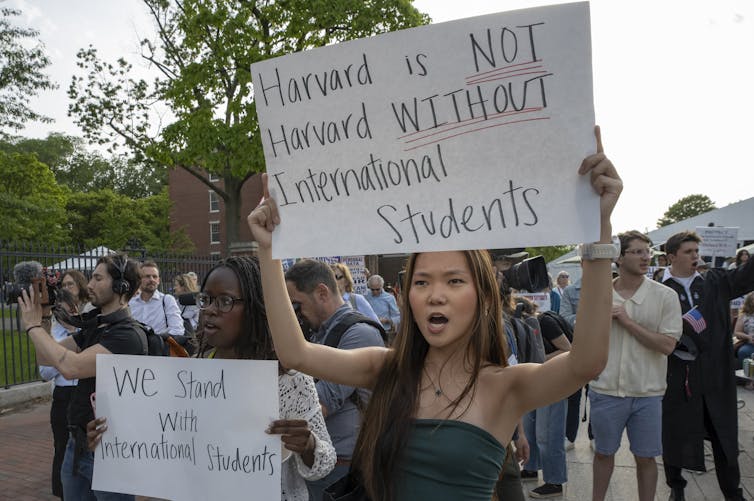
International students have been a big part of American STEM.
Rick Friedman/AFP via Getty Images

Marc Zimmer, Connecticut College

Turbulent research landscape imperils US brain gain − and ultimately American prosperity

Despite representing only 4% of the world’s population, the United States accounts for over half of science Nobel Prizes awarded since 2000, hosts seven of The Times Higher Education Top 10 science universities, and incubates firms such as Alphabet (Google), Meta and Pfizer that turn federally funded discoveries into billion-dollar markets.

The domestic STEM talent pool alone cannot sustain this research output. The U.S. is reliant on a steady and strong influx of foreign scientists – a brain gain. In 2021, foreign-born people constituted 43% of doctorate-level scientists and engineers in the U.S. They make up a significant share of America’s elite researchers: Since 2000, 37 of the 104 U.S. Nobel laureates in the hard sciences, more than a third, were born outside the country.

China, the U.S.’s largest competitor in science, technology, engineering and math endeavors, has a population that is 4.1 times larger than that of the U.S. and so has a larger pool of homegrown talent. Each year, three times as many Chinese citizens (77,000) are awarded STEM Ph.D.s as American citizens (23,000).

To remain preeminent, the U.S. will need to keep attracting exceptional foreign graduate students, budding entrepreneurs and established scientific leaders.

Funding and visa policies could flip gain to drain

This scientific brain gain is being threatened by the Trump administration, which is using federal research funding, scholarships and fellowships as leverage against universities, freezing billions of dollars in grants and contracts to force compliance with its ideological agenda. Its ad hoc approach has been described by higher education leaders as “unprecedented and deeply disturbing,” and a Reagan-appointed judge ruled that 400 National Institutes of Health grants be reinstated because their terminations were “bereft of reasoning, virtually in their entirety.”

Experts caution that these moves not only risk immediate harm to scientific progress and academic freedom but also erode the public’s trust in science and education, with long-term implications for the nation’s prosperity and security.

Citing national security concerns, the White House has also targeted visas for Harvard University’s international students and instructed embassies worldwide to halt visa interviews for all international students, citing national security and alleged institutional misconduct. Against a backdrop of court injunctions and legal appeals, the government continues its heightened “national-security” vetting, so thousands of international scholars remain in limbo.

These measures, combined with travel bans, intensified scrutiny and revocations of existing visas, have disrupted research collaborations and threaten the nation’s continued status as a global leader in science and innovation.

What US misses with fewer foreign scientists

The U.S. research brain gain starts with the 281,000 foreign STEM graduate students and 38,000 foreign STEM postdoctoral scholars who annually come to the U.S. I am one of them. After earning my bachelor’s and master’s degrees in South Africa, I left in 1986 to avoid the apartheid‑era military service, completed my chemistry doctorate and postdoc in the U.S., and joined the United States’ brain gain. It’s an opportunity today’s visa climate might have denied me.

poster announcing 'Safe Place For Science'
Some other countries are eager to scoop up STEM talent that is unwelcome or unfunded in the U.S.
Clement Mahoudeau/AFP via Getty Images

Incentives for the best and brightest foreign science students to come to the U.S. are diminishing at the same time its competitors are increasing their efforts to attract the strongest STEM researchers. For instance, the University of Hong Kong is courting stranded Harvard students with dedicated scholarships, housing and credit-transfer help. A French university program, Safe Place for Science, drew so many American job applicants that it had to shut the portal early. And a Portuguese institute reports a tenfold surge in inquiries from U.S.-based junior faculty.

Immigrants import new ways of thinking to their research labs. They come from other cultures and have learned their science in different educational systems, which place different emphases on rote learning, historical understanding and interdisciplinary research. They often bring an alternative perspective that a homogeneous scientific community cannot match.

Advertisement
Get More From A Face Cleanser And Spa-like Massage

Immigrants also help move discoveries from the lab to the marketplace. Foreign-born inventors file patents at a higher per‑capita rate than their domestic peers and are 80% more likely to launch a company. Such firms create roughly 50% more jobs than enterprises founded by native-born entrepreneurs and pay wages that are, on average, one percentage point higher.

The economic stakes are high. Growth models suggest that scientific advances now account for a majority of productivity gains in high‑income countries.

L. Rafael Reif, the former president of MIT, called international talent the “oxygen” of U.S. innovation; restricting visas chokes that supply. Ongoing cuts and uncertainties in federal funding and visa policy now jeopardize America’s scientific leadership and with it the nation’s long‑term economic growth.

Marc Zimmer, Professor of Chemistry, Connecticut College

This article is republished from The Conversation under a Creative Commons license. Read the original article.

Want more stories 👋
“Your morning jolt of Inspiring & Interesting Stories!”

Sign up to receive awesome articles directly to your inbox.

STM Coffee Newsletter 1

We don’t spam! Read our privacy policy for more info.


Discover more from Daily News

Subscribe to get the latest posts sent to your email.

Continue Reading
Advertisement Tool Tickets

Entertainment

Hollywood vs. Reality: How LA’s Wilshire Subway Was Really Built

Wilshire Subway: Did LA blast subway tunnels under Wilshire Boulevard? Hollywood says yes — engineers say no. Here’s how Metro safely tunneled beneath Miracle Mile.

Published

on

envato labs image edit

When the 1997 disaster film Volcano depicted lava erupting along Wilshire Boulevard and referenced blasting during Red Line subway construction, it delivered gripping cinema — but not accurate engineering.

In reality, Los Angeles Metro did not rely on large-scale blasting to construct subway tunnels beneath Wilshire Boulevard and the Miracle Mile. Instead, engineers used tunnel boring machines (TBMs) specifically to avoid the very risks Hollywood dramatized.

Why Blasting Was Avoided

The Wilshire Corridor sits atop historic oil fields, making methane gas pockets a known and serious concern. A deadly methane explosion near Fairfax Avenue in 1985 led to heightened scrutiny of underground construction in the area. Blasting in such conditions could have caused unpredictable gas releases, ground instability, or damage to surface structures.

As a result, Metro engineers chose pressurized, closed-face tunnel boring machines, which allow for:

  • Controlled excavation in dense urban environments

  • Continuous ground support to prevent settlement

  • Integrated gas detection and ventilation systems

These machines grind slowly through soil and rock while installing precast concrete tunnel linings, creating a sealed, gas-resistant structure as they advance. envato labs image edit

The Real Engineering Feat

Although Volcano took creative liberties for dramatic effect, the true story of tunneling under Wilshire is no less impressive. Advances in TBM technology and methane mitigation ultimately allowed the Metro D Line (formerly the Red Line/Purple Line) to safely pass through one of Los Angeles’ most geologically complex corridors — without explosions, collapsing streets, or cinematic chaos.

Bottom Line

Volcano remains a memorable piece of 1990s disaster cinema, but its portrayal of subway construction is fiction. The real achievement lies in decades of careful planning, modern tunneling technology, and engineering solutions that quietly reshaped Los Angeles beneath its busiest boulevard.

Related Links:

Dreambreaker: A Pickleball Story — A Closer Look at the Documentary and Its Uncredited Voice
Link: https://stmdailynews.com/dreambreaker-a-pickleball-story-a-closer-look-at-the-documentary-and-its-uncredited-voice/

Discover more from Daily News

Subscribe to get the latest posts sent to your email.

Continue Reading

Blog

Glad and Oscar the Grouch Team Up for a Trashy, Toe-Tapping Campaign

Glad teams up with Oscar the Grouch for a playful revival of the “Don’t Get Mad. Get Glad.” campaign, featuring a musical number, limited-edition Oscar-inspired trash bags, and a fresh take on making trash day fun for all ages.

Published

on

Oscar the Grouch and Glad trash bags featured in a colorful musical campaign, celebrating their playful collaboration with limited-edition green Oscar-inspired totes.

Glad revives its most popular, decades-long, star-studded ad campaign, “Don’t Get Mad. Get Glad.”

What happens when the world’s most iconic grouch meets the nation’s go-to name in trash bags? You get a campaign that’s equal parts nostalgia, Broadway-style fun, and a reminder that even trash can bring a little joy to your day.

A Classic Campaign Gets a Grouchy Remix

Glad has officially revived its legendary “Don’t Get Mad. Get Glad.” campaign, but this time, they’re ditching the usual celebrity faces for a true original: Oscar the Grouch. For the first time, the campaign’s star is none other than Sesame Street’s resident trash enthusiast himself, and he’s bringing his signature tune “I Love Trash” back with a contemporary twist.
The musical number, directed by the award-winning duo Will Speck and Josh Gordon, opens with Oscar in his element—surrounded by trash and a little bit of grumpiness. But the real magic happens when Oscar imagines a world where everyone else shares his passion for trash. The result? A joyful, Broadway-inspired remix that transforms everyday frustration into a celebration of Glad’s dependable trash solutions.

Why Oscar? Why Now?

According to Glad’s Marketing Director, Kellie Li, the choice was simple: “No one feels more strongly about trash than Oscar the Grouch.” The campaign aims to flip the script on how we think about trash—turning a dreaded chore into something a little more lighthearted. With Glad’s reliable bags, there’s less to get mad about, and maybe, just maybe, a little more to sing about.

Nostalgia Meets New Audiences

If “Don’t Get Mad. Get Glad.” sounds familiar, you’re not imagining things. The campaign has been a staple since 1987, featuring everyone from TV stars to athletes. But this new chapter, featuring Oscar and a cast of trash-loving co-stars, is designed to connect with both longtime fans and a new generation discovering Sesame Street on Netflix and PBS KIDS.

Limited-Edition Oscar Goodies and Where to Find Them

To celebrate the campaign, Glad is releasing limited-edition Oscar-inspired trash bag totes—complete with green fur, of course. Fans can snag these playful bags through a social media giveaway this December (follow @gladproducts on Instagram and TikTok for details). And if you miss out, don’t worry: special Oscar-branded Glad ForceFlex with Gain bags will hit Walmart shelves this April, just in time for spring cleaning.

Where to Watch

The campaign is rolling out across the U.S. and Canada, with full-length videos, bite-sized social teasers, and everything in between. Look for it on TikTok, Instagram, Facebook, and Reddit (for our friends up north). Featured products include Glad ForceFlex with Gain and Glad Cherry Blossom.

Bringing the Campaign Home: Phoenix Community Clean-Up

Here in Phoenix, we know the value of coming together to keep our neighborhoods clean and vibrant. Glad’s collaboration with Oscar the Grouch isn’t just a fun national campaign—it’s a reminder that tackling trash can be a community effort, too.
With spring cleaning right around the corner and special Oscar-branded Glad bags hitting Walmart shelves this April, it’s the perfect time for local groups, schools, and neighbors to organize clean-up events across the Valley. Whether you’re sprucing up a park, refreshing a neighborhood, or just making your own block a little brighter, every bag makes a difference.
Ready to join the movement? Rally your friends, family, or local organization and plan a Phoenix clean-up day this spring. Snap a photo of your crew with your Glad or Oscar-inspired trash bags and share it on social media using #GladToCleanPHX and #OscarLovesTrash. Let’s show how Phoenix turns trash day into a reason to celebrate!
  • “Phoenix, let’s get grouchy about litter and Glad about clean streets! Join our community clean-up and share your photos with #GladToCleanPHX.”
  • “Spotted: Oscar the Grouch in Phoenix! Grab your Glad bags, clean up your neighborhood, and tag #OscarLovesTrash for a chance to be featured.”
  • “Spring cleaning in Phoenix just got a lot more fun—thanks to Glad and Oscar! Who’s joining our next clean-up day? #GladToCleanPHX”

About the Brands

Glad, a member of The Clorox Company, has long been a leader in household waste solutions, while Sesame Workshop continues to inspire and educate families worldwide. This collaboration is a perfect blend of dependable products and beloved characters—reminding us all that even the messiest moments can spark a little joy.
The collaboration between Glad and Sesame Workshop for the “Don’t Get Mad. Get Glad.” campaign marks a creative partnership that blends household dependability with beloved children’s entertainment. By bringing Oscar the Grouch into the spotlight, Glad not only revives a classic campaign but also highlights the importance of making everyday chores more enjoyable for families. This partnership leverages Glad’s reputation as the nation’s leading provider of kitchen and outdoor trash bags and food protection products—trusted solutions designed to handle life’s messes with ease (Glad.com). Sesame Workshop, the nonprofit behind Sesame Street, has spent over 50 years enriching families worldwide through educational media and community outreach, helping children grow smarter, stronger, and kinder (Sesame.org). Together, their collaboration aims to inspire a new generation to see the positive side of cleaning up, all while celebrating the joy of community and play.
Sources:
High Demand Marks “Veggies for Veterans” Event Amid SNAP Delays

Discover more from Daily News

Subscribe to get the latest posts sent to your email.

Continue Reading

Artificial Intelligence

More than half of new articles on the internet are being written by AI – is human writing headed for extinction?

A new study finds over 50% of online articles are now AI-generated, raising questions about the future of human writing. Discover why formulaic content is most at risk, and why authentic, creative voices may become more valuable than ever.

Published

on

Is AI Replacing Human Writers? Why Over Half of Online Articles Are Now AI-Generated
Preserving the value of real human voices will likely depend on how people adapt to artificial intelligence and collaborate with it. BlackJack3D/E+ via Getty Images

More than half of new articles on the internet are being written by AI – is human writing headed for extinction?

Francesco Agnellini, Binghamton University, State University of New York The line between human and machine authorship is blurring, particularly as it’s become increasingly difficult to tell whether something was written by a person or AI. Now, in what may seem like a tipping point, the digital marketing firm Graphite recently published a study showing that more than 50% of articles on the web are being generated by artificial intelligence. As a scholar who explores how AI is built, how people are using it in their everyday lives, and how it’s affecting culture, I’ve thought a lot about what this technology can do and where it falls short. If you’re more likely to read something written by AI than by a human on the internet, is it only a matter of time before human writing becomes obsolete? Or is this simply another technological development that humans will adapt to?

It isn’t all or nothing

Thinking about these questions reminded me of Umberto Eco’s essay “Apocalyptic and Integrated,” which was originally written in the early 1960s. Parts of it were later included in an anthology titled “Apocalypse Postponed,” which I first read as a college student in Italy. In it, Eco draws a contrast between two attitudes toward mass media. There are the “apocalyptics” who fear cultural degradation and moral collapse. Then there are the “integrated” who champion new media technologies as a democratizing force for culture.
An older man with a beard, glasses and a suit poses while holding a cigarette.
Italian philosopher, cultural critic and novelist Umberto Eco cautioned against overreacting to the impact of new technologies. Leonardo Cendamo/Getty Images
Back then, Eco was writing about the proliferation of TV and radio. Today, you’ll often see similar reactions to AI. Yet Eco argued that both positions were too extreme. It isn’t helpful, he wrote, to see new media as either a dire threat or a miracle. Instead, he urged readers to look at how people and communities use these new tools, what risks and opportunities they create, and how they shape – and sometimes reinforce – power structures. While I was teaching a course on deepfakes during the 2024 election, Eco’s lesson also came back to me. Those were days when some scholars and media outlets were regularly warning of an imminent “deepfake apocalypse.” Would deepfakes be used to mimic major political figures and push targeted disinformation? What if, on the eve of an election, generative AI was used to mimic the voice of a candidate on a robocall telling voters to stay home? Those fears weren’t groundless: Research shows that people aren’t especially good at identifying deepfakes. At the same time, they consistently overestimate their ability to do so. In the end, though, the apocalypse was postponed. Post-election analyses found that deepfakes did seem to intensify some ongoing political trends, such as the erosion of trust and polarization, but there’s no evidence that they affected the final outcome of the election.

Listicles, news updates and how-to guides

Of course, the fears that AI raises for supporters of democracy are not the same as those it creates for writers and artists. For them, the core concerns are about authorship: How can one person compete with a system trained on millions of voices that can produce text at hyper-speed? And if this becomes the norm, what will it do to creative work, both as an occupation and as a source of meaning? It’s important to clarify what’s meant by “online content,” the phrase used in the Graphite study, which analyzed over 65,000 randomly selected articles of at least 100 words on the web. These can include anything from peer-reviewed research to promotional copy for miracle supplements. A closer reading of the Graphite study shows that the AI-generated articles consist largely of general-interest writing: news updates, how-to guides, lifestyle posts, reviews and product explainers. https://stmdailynews.com/wp-admin/post-new.php#visibility The primary economic purpose of this content is to persuade or inform, not to express originality or creativity. Put differently, AI appears to be most useful when the writing in question is low-stakes and formulaic: the weekend-in-Rome listicle, the standard cover letter, the text produced to market a business. A whole industry of writers – mostly freelance, including many translators – has relied on precisely this kind of work, producing blog posts, how-to material, search engine optimization text and social media copy. The rapid adoption of large language models has already displaced many of the gigs that once sustained them.

Collaborating with AI

The dramatic loss of this work points toward another issue raised by the Graphite study: the question of authenticity, not only in identifying who or what produced a text, but also in understanding the value that humans attach to creative activity. How can you distinguish a human-written article from a machine-generated one? And does that ability even matter? Over time, that distinction is likely to grow less significant, particularly as more writing emerges from interactions between humans and AI. A writer might draft a few lines, let an AI expand them and then reshape that output into the final text. This article is no exception. As a non-native English speaker, I often rely on AI to refine my language before sending drafts to an editor. At times the system attempts to reshape what I mean. But once its stylistic tendencies become familiar, it becomes possible to avoid them and maintain a personal tone. Also, artificial intelligence is not entirely artificial, since it is trained on human-made material. It’s worth noting that even before AI, human writing has never been entirely human, either. Every technology, from parchment and stylus paper to the typewriter and now AI, has shaped how people write and how readers make sense of it. Another important point: AI models are increasingly trained on datasets that include not only human writing but also AI-generated and human–AI co-produced text. This has raised concerns about their ability to continue improving over time. Some commentators have already described a sense of disillusionment following the release of newer large models, with companies struggling to deliver on their promises.

Human voices may matter even more

But what happens when people become overly reliant on AI in their writing? Some studies show that writers may feel more creative when they use artificial intelligence for brainstorming, yet the range of ideas often becomes narrower. This uniformity affects style as well: These systems tend to pull users toward similar patterns of wording, which reduces the differences that usually mark an individual voice. Researchers also note a shift toward Western – and especially English-speaking – norms in the writing of people from other cultures, raising concerns about a new form of AI colonialism. In this context, texts that display originality, voice and stylistic intention are likely to become even more meaningful within the media landscape, and they may play a crucial role in training the next generations of models. If you set aside the more apocalyptic scenarios and assume that AI will continue to advance – perhaps at a slower pace than in the recent past – it’s quite possible that thoughtful, original, human-generated writing will become even more valuable. Put another way: The work of writers, journalists and intellectuals will not become superfluous simply because much of the web is no longer written by humans. Francesco Agnellini, Lecturer in Digital and Data Studies, Binghamton University, State University of New York This article is republished from The Conversation under a Creative Commons license. Read the original article.
 

Dive into “The Knowledge,” where curiosity meets clarity. This playlist, in collaboration with STMDailyNews.com, is designed for viewers who value historical accuracy and insightful learning. Our short videos, ranging from 30 seconds to a minute and a half, make complex subjects easy to grasp in no time. Covering everything from historical events to contemporary processes and entertainment, “The Knowledge” bridges the past with the present. In a world where information is abundant yet often misused, our series aims to guide you through the noise, preserving vital knowledge and truths that shape our lives today. Perfect for curious minds eager to discover the ‘why’ and ‘how’ of everything around us. Subscribe and join in as we explore the facts that matter.  https://stmdailynews.com/the-knowledge/


Discover more from Daily News

Subscribe to get the latest posts sent to your email.

Continue Reading

Trending


