Connect with us

Science

Why the meteorites that hit Earth have less water than the asteroid bits brought back by space probes

Published

on

 A planetary scientist explains new research

meteorites
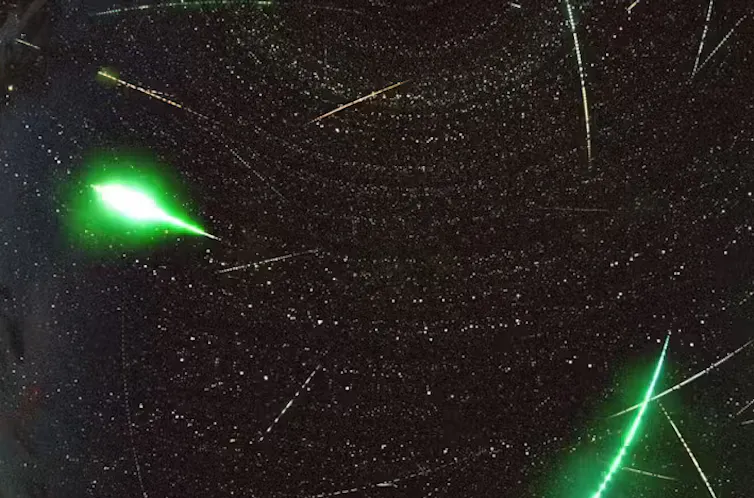
This image overlays over 100 fireball images recorded between 2016 and 2020. The streaks are fireballs; the dots are star positions at different times. Desert Fireball Network
Patrick M. Shober, NASA Much of what scientists know about the early solar system comes from meteorites – ancient rocks that travel through space and survive a fiery plunge through Earth’s atmosphere. Among meteorites, one type – called carbonaceous chondrites – stands out as the most primitive and provides a unique glimpse into the solar system’s infancy. The carbonaceous chondrites are rich in water, carbon and organic compounds. They’re “hydrated,” which means they contain water bound within minerals in the rock. The components of the water are locked into crystal structures. Many researchers believe these ancient rocks played a crucial role in delivering water to early Earth. Before hitting the Earth, rocks traveling through space are generally referred to as asteroids, meteoroids or comets, depending on their size and composition. If a piece of one of these objects makes it all the way to Earth, it becomes a “meteorite.” From observing asteroids with telescopes, scientists know that most asteroids have water-rich, carbonaceous compositions. Models predict that most meteorites – over half – should also be carbonaceous. But less than 4% of all the meteorites found on Earth are carbonaceous. So why is there such a mismatch? In a study published in the journal Nature Astronomy on April 14, 2025, my planetary scientist colleagues and I tried to answer an age-old question: Where are all the carbonaceous chondrites?

Sample-return missions

Scientists’ desire to study these ancient rocks has driven recent sample-return space missions. NASA’s OSIRIS‑REx and JAXA’s Hayabusa2 missions have transformed what researchers know about primitive, carbon‑rich asteroids. Meteorites found sitting on the ground are exposed to rain, snow and plants, which can significantly change them and make analysis more difficult. So, the OSIRIS‑REx mission ventured to the asteroid Bennu to retrieve an unaltered sample. Retrieving this sample allowed scientists to examine the asteroid’s composition in detail. Similarly, Hayabusa2’s journey to the asteroid Ryugu provided pristine samples of another, similarly water-rich asteroid. Together these missions have let planetary scientists like me study pristine, fragile carbonaceous material from asteroids. These asteroids are a direct window into the building blocks of our solar system and the origins of life.
A dusty, rocky asteroid against a dark backdrop.
Carbonaceous near-Earth asteroid Bennu as seen from NASA’s OSIRIS-REx sample-return spacecraft. NASA

The carbonaceous chondrite puzzle

For a long time, scientists assumed that the Earth’s atmosphere filtered out carbonaceous debris. When an object hits Earth’s atmosphere, it has to survive significant pressures and high temperatures. Carbonaceous chondrites tend to be weaker and more crumbly than other meteorites, so these objects just don’t stand as much of a chance. Meteorites usually start their journey when two asteroids collide. These collisions create a bunch of centimeter- to meter-size rock fragments. These cosmic crumbs streak through the solar system and can, eventually, fall to Earth. When they’re smaller than a meter, scientists call them meteoroids. Meteoroids are far too small for researchers to see with a telescope, unless they’re about to hit the Earth, and astronomers get lucky. But there is another way scientists can study this population, and, in turn, understand why meteorites have such different compositions.

Meteor and fireball observation networks

Our research team used the Earth’s atmosphere as our detector. Most of the meteoroids that reach Earth are tiny, sand-sized particles, but occasionally, bodies up to a couple of meters in diameter hit. Researchers estimate that about 5,000 metric tons of micrometeorites land on Earth annually. And, each year, between 4,000 and 10,000 large meteorites – golf ball-sized or larger – land on Earth. That’s more than 20 each day.
A fireball observed by the FRIPON network in Normandy, France, in 2019.
Today, digital cameras have rendered round-the-clock observations of the night sky both practical and affordable. Low-cost, high-sensitivity sensors and automated detection software allow researchers to monitor large sections of the night sky for bright flashes, which signal a meteoroid hitting the atmosphere. Research teams can sift through these real-time observations using automated analysis techniques – or a very dedicated Ph.D. student – to find invaluable information. Our team manages two global systems: FRIPON, a French-led network with stations in 15 countries; and the Global Fireball Observatory, a collaboration started by the team behind the Desert Fireball Network in Australia. Together with other open-access datasets, my colleagues and I used the trajectories of nearly 8,000 impacts observed by 19 observation networks spread across 39 countries.
A camera, which looks like a glass sphere, attached to a metal stand on a railing overlooking mountains.
FRIPON camera installed at the Pic du Midi Observatory in the French Pyrenees. FRIPON
By comparing all meteoroid impacts recorded in Earth’s atmosphere with those that successfully reach the surface as meteorites, we can pinpoint which asteroids produce fragments that are strong enough to survive the journey. Or, conversely, we can also pinpoint which asteroids produce weak material that do not show up as often on Earth as meteorites.
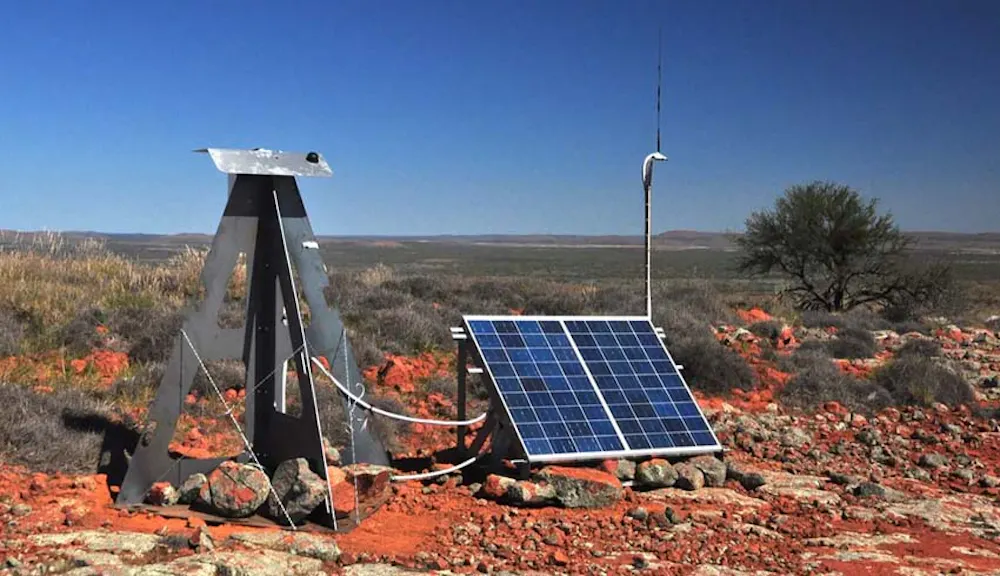
A mechanical panel sitting in a desert in Australia
Desert Fireball Network automated remote observatory in South Australia. The Desert Fireball Network

The Sun is baking the rocks too much

Surprisingly, we found that many asteroid pieces don’t even make it to Earth. Something starts removing the weak stuff while the fragment is still in space. The carbonaceous material, which isn’t very durable, likely gets broken down through heat stress when its orbit takes it close to the Sun. As carbonaceous chondrites orbit close, and then away from the Sun, the temperature swings form cracks in their material. This process effectively fragments and removes weak, hydrated boulders from the population of objects near the Earth. Anything left over after this thermal cracking then has to survive the atmosphere. Only 30%-50% of the remaining objects survive the atmospheric passage and become meteorites. The debris pieces whose orbits bring them closer to the Sun tend to be significantly more durable, making them far more likely to survive the difficult passage through Earth’s atmosphere. We call this a survival bias. For decades, scientists have presumed that Earth’s atmosphere alone explains the scarcity of carbonaceous meteorites, but our work indicates that much of the removal occurs beforehand in space. Going forward, new scientific advances can help confirm these findings and better identify meteoroid compositions. Scientists need to get better at using telescopes to detect objects right before they hit the Earth. More detailed modeling of how these objects break up in the atmosphere can also help researchers study them. Lastly, future studies can come up with better methods to identify what these fireballs are made of using the colors of the meteors. Patrick M. Shober, Postdoctoral Fellow in Planetary Sciences, NASA This article is republished from The Conversation under a Creative Commons license. Read the original article.

Discover more from Daily News

Subscribe to get the latest posts sent to your email.

Continue Reading
Advertisement Winter Super Sale – Enjoy 25% Off Your Entire Purchase + Free Shipping. Use Code: BPWARM25

News

Did Obama Say Aliens Are Real? Context, Clarification, and Trump’s Response

Published

on

Former President Barack Obama recently sparked headlines, social media debates, and a fresh wave of UFO chatter after a brief remark during a podcast interview. The comment quickly ricocheted across news outlets, with many asking: Did Obama just confirm aliens exist? And just as quickly, Donald Trump weighed in.

Did Barack Obama Say Aliens Are Real? Context, Clarification, and Trump’s Response

Let’s unpack what was actually said — and what it means.


🎙️ The Comment That Ignited the Conversation

During a rapid-fire question segment on a podcast hosted by Brian Tyler Cohen, Obama was asked directly:

“Are aliens real?”

Obama’s response:

“They’re real, but I haven’t seen them.”

That short answer fueled immediate speculation. Clips spread online, often stripped of context, with some interpreting the statement as a bombshell confirmation of extraterrestrial life.


🧠 What Obama Meant

Soon after the comment gained traction, Obama clarified his meaning.

His explanation aligned with a position he’s expressed before:

✔ He was referring to the statistical likelihood of life elsewhere in the universe

✔ He was not claiming evidence of alien visitation

✔ He emphasized that during his presidency he saw no proof of extraterrestrial contact

Advertisement
Get More From A Face Cleanser And Spa-like Massage

In other words:

Obama was speaking philosophically and scientifically — not revealing classified information.

This interpretation matches mainstream scientific thinking: given the size of the universe, life beyond Earth is plausible, but confirmed evidence remains elusive.


🛸 Why the Comment Resonated

The remark landed in a cultural moment where:

• Interest in UAPs (Unidentified Aerial Phenomena) is high

• Government transparency around UFO reports has increased

• Space exploration discoveries (exoplanets, water worlds) dominate science news

Even a casual statement from a former president can ignite intense discussion.


🇺🇸 Trump’s Reaction

Former (and current political figure) Donald Trump responded critically.

Trump characterized Obama’s comment as:

• A “mistake”

Advertisement
Get More From A Face Cleanser And Spa-like Massage

• Potentially involving “classified information”

He also reiterated his own stance:

He does not know whether aliens are real.

Trump pivoted the conversation toward disclosure, suggesting he would support or consider declassifying UFO/UAP-related files — a theme that has periodically surfaced in political rhetoric.


⚖️ Politics vs Interpretation

Trump’s reaction highlights how statements about extraterrestrial life often become political flashpoints, even when the original comment is speculative or philosophical.

Key distinction:

Obama’s ClarificationPublic Interpretation
Life elsewhere is likely“Obama confirmed aliens”
No evidence of contact“Government disclosure”

🔬 The Scientific Reality

Organizations like NASA and the broader research community maintain:

✅ Life beyond Earth → statistically plausible

❓ Intelligent civilizations → unknown

❌ Confirmed alien contact → no verified evidence

Investigations into UAPs consistently conclude:

Advertisement
Get More From A Face Cleanser And Spa-like Massage

• Most sightings have conventional explanations

• Some remain unresolved due to limited data

• None confirmed as extraterrestrial craft


🌌 Why These Stories Keep Captivating Us

Conversations about aliens sit at the intersection of:

✨ Science

🧠 Curiosity

🛸 Mystery

🎭 Pop culture

🏛️ Politics

When a former president comments, the intrigue multiplies.

Advertisement
Get More From A Face Cleanser And Spa-like Massage

📌 Bottom Line

Did Obama say aliens are real?

Yes — but in the sense that life elsewhere in the universe is likely, not that aliens are visiting Earth.

Did he claim evidence?

No.

Trump’s response?

Critical, skeptical, and framed around classification and disclosure.


If you’re fascinated by this topic, you might also enjoy exploring:

• How scientists search for alien life

• What counts as real “evidence”

• Why UFO sightings are so often misinterpreted

Advertisement
Get More From A Face Cleanser And Spa-like Massage

Want me to craft a follow-up article like “How Close Are We to Discovering Alien Life?” 🚀👽

Related Links & Further Reading

Dive into “The Knowledge,” where curiosity meets clarity. This playlist, in collaboration with STMDailyNews.com, is designed for viewers who value historical accuracy and insightful learning. Our short videos, ranging from 30 seconds to a minute and a half, make complex subjects easy to grasp in no time. Covering everything from historical events to contemporary processes and entertainment, “The Knowledge” bridges the past with the present. In a world where information is abundant yet often misused, our series aims to guide you through the noise, preserving vital knowledge and truths that shape our lives today. Perfect for curious minds eager to discover the ‘why’ and ‘how’ of everything around us. Subscribe and join in as we explore the facts that matter.  https://stmdailynews.com/the-knowledge/

Authors

  • Rod Washington

    Rod: A creative force, blending words, images, and flavors. Blogger, writer, filmmaker, and photographer. Cooking enthusiast with a sci-fi vision. Passionate about his upcoming series and dedicated to TNC Network. Partnered with Rebecca Washington for a shared journey of love and art. View all posts

View recent photos

Unlock fun facts & lost history—get The Knowledge in your inbox!

We don’t spam! Read our privacy policy for more info.


Discover more from Daily News

Subscribe to get the latest posts sent to your email.

Continue Reading

Forgotten Genius Fridays

Valerie Thomas: NASA Engineer, Inventor, and STEM Trailblazer

Published

on

Last Updated on February 10, 2026 by Daily News StaffValerie Thomas

Valerie Thomas is a true pioneer in the world of science and technology. A NASA engineer and physicist, she is best known for inventing the illusion transmitter, a groundbreaking device that creates 3D images using concave mirrors. This invention laid the foundation for modern 3D imaging and virtual reality technologies.

Beyond her inventions, Thomas broke barriers as an African American woman in STEM, mentoring countless young scientists and advocating for diversity in science and engineering. Her work at NASA’s Goddard Space Flight Center helped advance satellite technology and data visualization, making her contributions both innovative and enduring.

In our latest short video, we highlight Valerie Thomas’ remarkable journey—from her early passion for science to her groundbreaking work at NASA. Watch and be inspired by a true STEM pioneer whose legacy continues to shape the future of space and technology.

🎥 Watch the video here: https://youtu.be/P5XTgpcAoHw

Dive into “The Knowledge,” where curiosity meets clarity. This playlist, in collaboration with STMDailyNews.com, is designed for viewers who value historical accuracy and insightful learning. Our short videos, ranging from 30 seconds to a minute and a half, make complex subjects easy to grasp in no time. Covering everything from historical events to contemporary processes and entertainment, “The Knowledge” bridges the past with the present. In a world where information is abundant yet often misused, our series aims to guide you through the noise, preserving vital knowledge and truths that shape our lives today. Perfect for curious minds eager to discover the ‘why’ and ‘how’ of everything around us. Subscribe and join in as we explore the facts that matter.  https://stmdailynews.com/the-knowledge/

Forgotten Genius Fridays

https://stmdailynews.com/the-knowledge-2/forgotten-genius-fridays/

🧠 Forgotten Genius Fridays

A Short-Form Series from The Knowledge by STM Daily News

Every Friday, STM Daily News shines a light on brilliant minds history overlooked.

Advertisement
Get More From A Face Cleanser And Spa-like Massage

Forgotten Genius Fridays is a weekly collection of short videos and articles dedicated to inventors, innovators, scientists, and creators whose impact changed the world—but whose names were often left out of the textbooks.

From life-saving inventions and cultural breakthroughs to game-changing ideas buried by bias, our series digs up the truth behind the minds that mattered.

Each episode of The Knowledge runs 30–90 seconds, designed for curious minds on the go—perfect for YouTube Shorts, TikTok, Reels, and quick reads.

Because remembering these stories isn’t just about the past—it’s about restoring credit where it’s long overdue.

 🔔 New episodes every Friday

📺 Watch now at: stmdailynews.com/the-knowledge

 🧠 Now you know.  

Author

  • Rod Washington

    Rod: A creative force, blending words, images, and flavors. Blogger, writer, filmmaker, and photographer. Cooking enthusiast with a sci-fi vision. Passionate about his upcoming series and dedicated to TNC Network. Partnered with Rebecca Washington for a shared journey of love and art. View all posts


Discover more from Daily News

Subscribe to get the latest posts sent to your email.

Continue Reading

The Knowledge

Beneath the Waves: The Global Push to Build Undersea Railways

Undersea railways are transforming transportation, turning oceans from barriers into gateways. Proven by tunnels like the Channel and Seikan, these innovations offer cleaner, reliable connections for passengers and freight. Ongoing projects in China and Europe, alongside future proposals, signal a new era of global mobility beneath the waves.

Published

on

Train traveling through underwater tunnel
Trains beneath the ocean are no longer science fiction—they’re already in operation.

For most of modern history, oceans have acted as natural barriers—dividing nations, slowing trade, and shaping how cities grow. But beneath the waves, a quiet transportation revolution is underway. Infrastructure once limited by geography is now being reimagined through undersea railways.

Undersea rail tunnels—like the Channel Tunnel and Japan’s Seikan Tunnel—proved decades ago that trains could reliably travel beneath the ocean floor. Today, new projects are expanding that vision even further.

Around the world, engineers and governments are investing in undersea railways—tunnels that allow high-speed trains to travel beneath oceans and seas. Once considered science fiction, these projects are now operational, under construction, or actively being planned.

image 3

Undersea Rail Is Already a Reality

Japan’s Seikan Tunnel and the Channel Tunnel between the United Kingdom and France proved decades ago that undersea railways are not only possible, but reliable. These tunnels carry passengers and freight beneath the sea every day, reshaping regional connectivity.

Undersea railways are cleaner than short-haul flights, more resilient than bridges, and capable of lasting more than a century. As climate pressures and congestion increase, rail beneath the sea is emerging as a practical solution for future mobility.

What’s Being Built Right Now

China is currently constructing the Jintang Undersea Railway Tunnel as part of the Ningbo–Zhoushan high-speed rail line, while Europe’s Fehmarnbelt Fixed Link will soon connect Denmark and Germany beneath the Baltic Sea. These projects highlight how transportation and technology are converging to solve modern mobility challenges.

The Mega-Projects Still on the Drawing Board

Looking ahead, proposals such as the Helsinki–Tallinn Tunnel and the long-studied Strait of Gibraltar rail tunnel could reshape global affairs by linking regions—and even continents—once separated by water.

Why Undersea Rail Matters

The future of transportation may not rise above the ocean—but run quietly beneath it.


Discover more from Daily News

Subscribe to get the latest posts sent to your email.

Continue Reading

Trending