

hobbies and craft
7 Ways to Creatively Display Favorite Photos

Last Updated on October 30, 2025 by Daily News Staff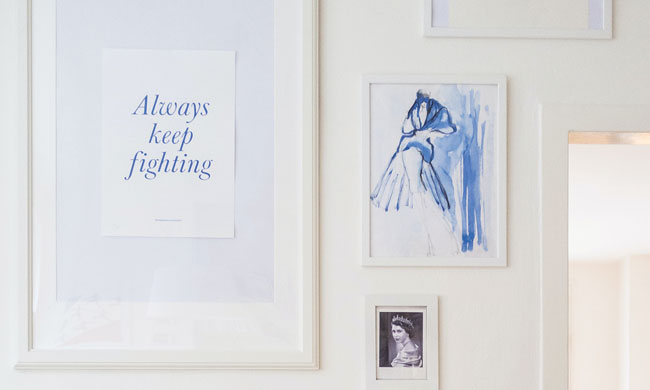
(Family Features) Family photos, vacation pictures, candid snapshots of friends and family – they’re often visual representations of some of your most treasured moments, so it’s likely you’ll want to give them some special treatment.
Consider these easy and affordable ways to showcase some of your favorite photos.
Variations on a theme – You don’t have to have a whole set of matching frames to create a unified look. Gather frames of different sizes, shapes and textures then paint them all the same color. White, cream or black are colors that let the eye focus on the photograph. Then when you group them together, you’ve got a cohesive display without everything being the same.
Location, location, location – Photos don’t always need to be on a wall or shelf. Try hanging a series of related photos on the back of a door or between windows.
A new use for old frames – Take a large frame with no back and paint it. Then take two pieces of ribbon or wire and attach them to the back of the frame, dividing it into three sections. Attach small photos to the ribbon or wire with mini clothes pins or other small clips.
New frames out of old windows – Fit a photo mat inside each pane of an old window. Attach photos to the backs of the mats and you have a vintage frame.
Map it out – Showcase favorite travel photos by covering a mat with a map from one of your vacation spots. Just trim the map to fit your mat, tape it to the back and insert your picture.
Get it on canvas – Treat your photos like the works of art they are by having them printed on artist canvas. There are a variety of online vendors that let you choose the size and photo treatment to create a unique piece for your personal gallery.
Put it all on the table – Add to your stylish decor and protect your furniture all at the same time by making your own photo coasters.
Find more ideas for creatively displaying your favorite photos at eLivingtoday.com.
Photo courtesy of Unsplash
SOURCE:
Family Features




Rotem Rozental, University of Southern California
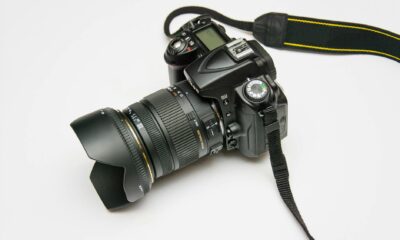
Film photography is experiencing a resurrection, summoned by unlikely conjurers: Gen Z.
It wasn’t too long ago that analog photography – which uses photographic film and chemical processing – was declared all but dead, relegated to the province of niche hobbyists and professional artists.
Digital cameras had taken over nearly all areas of photographic production. Film industry titans like Polaroid and Kodak had shrunk dramatically from their heyday, becoming shells of their former selves. Darkrooms, where students learned how to manually develop and print film, shuttered at high schools and college campuses across the country, replaced by digital labs. For most people, the spirit of analog photography was mainly channeled through Instagram filters.
But within the past five years, younger people have been increasingly drawn to the old way of doing photography.
In 2025, 35% of the 42 million active film camera users worldwide were reported to be between the ages of 18 and 30. The year prior, online searches for analog photography saw a 41% rise.
Disposable camera sales have been steadily increasing since 2023. The photography journal PetaPixel went a step further and announced 2024 as “film’s best year in decades,” as major brands have introduced new cameras in response to renewed demand and revived classic models. More than 30% of respondents to a 2024 Ilford Photo survey on film photography were in the 25-34 age group.
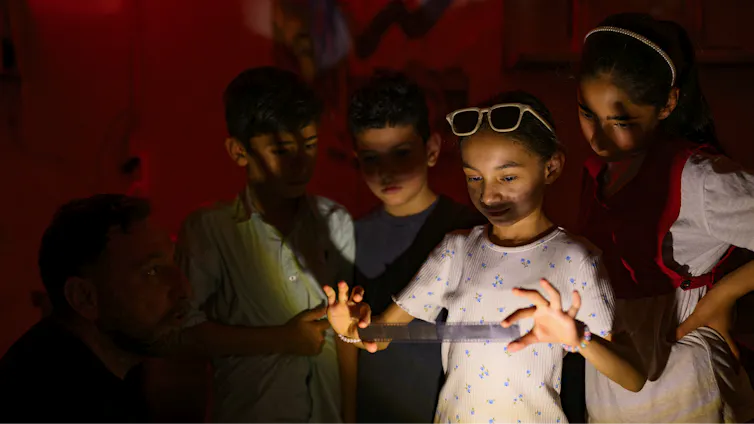
As I’ve witnessed more and more of my undergraduate art and design students embrace analog photography, I’m not seeing this as a trend rooted in a nostalgic yearning for the past. Instead, I’m seeing it as young people rejecting algorithms, breaking free from the alienation of social media and reacting to childhoods spent on Zoom and TikTok – a deliberate move to redefine the future of art, social connection and engagement with the world.
Pining for a ‘third place’
In my work as a historian of photography and lecturer at the University of Southern California, I’ll often ask my students about how they take photos – whether they’re using digital cameras their smartphones or analog devices.
This year, for the first time, some of my students discussed images they’d printed and the physical photography albums they’d put together of their friends and family. They talked about how they’d also been sending postcards, writing letters and tacking photographs to their bedroom walls.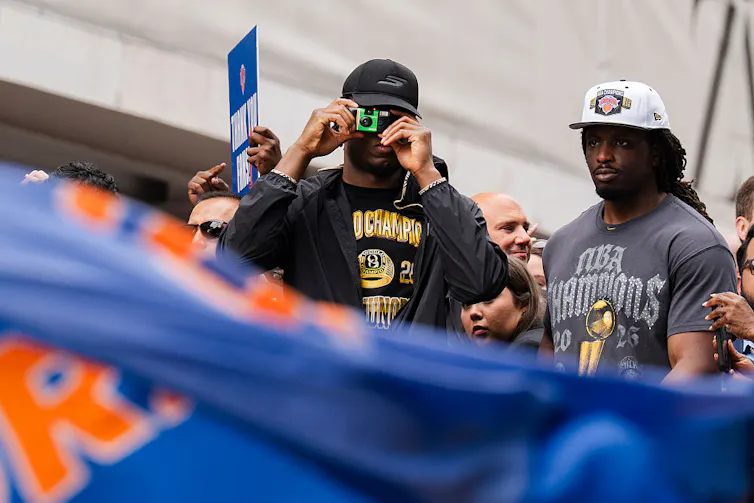
I couldn’t help but think about how so much of the language tied to early social media seemed to refashion physical gestures for a virtual world – “posting” on a “wall,” “poking,” “tagging” and “bookmarking,” not to mention “friending.”
This was a rhetorical move by social media companies, likely designed to help people feel as though they were in a familiar terrain of social connection. Yet the underlying business model of these platforms depended more on maximizing engagement and advertising revenue than on nurturing authentic relationships.
Everyone knows what happened next: The more connected young people became online, the more isolated and detached they started to feel. The COVID-19 lockdown pushed social life online even further, and researchers are only now starting to see how the combination of increased screen time and isolation negatively affected adolescents’ mental health. By 2023, 51% of American teenagers reported they spend at least four hours a day on social media.
I see the attraction of analog photography as a response to life lived through screens, a pathway toward community engagement and the desire for what sociologists call “a third place.”
Coined by sociologist Ray Oldenburg in his 1989 book “The Great Good Place,” third places are meant as a space separate from home and work. They offer a reprieve for the in-between, generating the conditions needed for creative cross-pollination. They might include a local cafe, a neighborhood writing group, a weekly Magic: The Gathering game or a college fraternity – any space that allows for social interaction and personal growth.
These spaces also combat loneliness. They get people out of their heads and into a community. Oldenburg also referred to them as “havens of sociability,” places or gatherings where people can arrive alone to join others, and the atmosphere is “democratic and festive.”
Analog communities IRL
In April 2026, the inaugural AnalogCon took place in Los Angeles. Organized by the Los Angeles Center of Photography, where I serve as executive director and chief curator, it was a festival for all things analog photography. It didn’t just serve as a third place for photography enthusiasts; it also showed how analog photography – as a practice, ritual and community – is flourishing.
Vendors, industry leaders, artists and teachers participated in the two-day event, which included exhibitions, panels, demonstrations and guided photography tours around Little Tokyo. The excitement and thirst for similar events was palpable.
Photography now joins a broader trend of a generational preoccupation with physical cultural objects and media. Although music streaming represents 82% of revenues generated in the music industry, vinyl records sales have been rising for over a decade, crossing the US$1 billion threshold in the U.S. in 2025.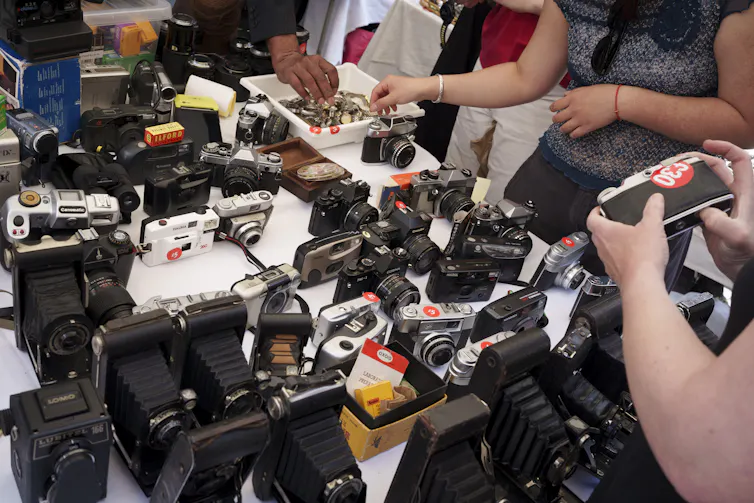
Nearly 60% of Gen Z are now purchasing records. VHS tapes and VCR players are also making a strange comeback, with stores like Be Kind Video and Videotheque in California offering VHS, DVDs and Blu-ray rentals.
But beyond that, record stores and video rental shops have become third places in their own right. There’s a big difference between selecting a film to stream from your bed and getting out of the house, going to a store and talking about movies with a clerk and fellow film enthusiasts.
Think about the sound a tape cassette makes when you open and close it, or the vibrant graphics on the covers of DVDs or VHS tapes. Think about rewinding or making a mixtape for your recent crush. These are objects of belonging that signal specific cultural moments, rituals and aesthetics, and many young people today are starting to experience them for the first time.
Now, think about gently inserting a roll of film into a camera. Think about choosing an angle carefully when snapping a photo, because the number of frames is limited and you want to make them count. Think about the thrill of discovery when the pictures finally emerge as objects on paper.
To me, these are more than fleeting trends. They signal a push against a digital culture that is designed to cultivate envy and reward outrage, insults and humiliation.
Instead, armed with rolls of film, more and more Gen Zers appear to be opting out of their algorithmic feeds in favor of experiencing life in ways that feel more deliberate, personal and tangible.
Rotem Rozental, Lecturer in Critical Studies, Roski School of Art and Design, University of Southern California
This article is republished from The Conversation under a Creative Commons license. Read the original article.
📰 Enjoying STM Daily News? Join the conversation!
💬 Leave a comment, share your thoughts, and subscribe to our newsletter for the latest stories, updates, and “News You Can Use This Moment!” delivered to your inbox.
Stay connected with STM Daily News!

Consumer Corner
Lowe’s Is Calling on Creators to Help Design—and Launch—New Products
Lowe’s announced Creator: Into the Blue, a new program letting creators pitch product ideas and work with Lowe’s teams to develop and potentially launch items in retail. Applications are open through Sept. 1, 2026.
Lowe’s is taking its creator strategy beyond sponsored posts and curated storefronts. On June 23, 2026, the home improvement retailer announced Lowe’s Creator: Into the Blue, a new program that invites creators to pitch product ideas and, if selected, work with Lowe’s teams to develop and potentially bring those products to retail shelves.
The announcement arrives as the Lowe’s Creator Network hits its one-year milestone—an initiative Lowe’s launched in 2025 and billed as the first creator network in the home improvement industry. Now, Lowe’s says it’s expanding the pathway for creators: from making content about products to creating products themselves.

From content to creation: what “Creator: Into the Blue” is
Lowe’s Creator: Into the Blue is designed as a forum for creators—both current members of the Lowe’s Creator Network and newcomers—to submit innovative product concepts for consideration. Selected creators could receive support from Lowe’s internal teams across product development, product design, sourcing, and merchandising, with the goal of turning audience-inspired ideas into real-world items that can scale.
In other words: creators aren’t just being asked to promote what already exists. They’re being invited to help shape what comes next.
How this fits into Lowe’s bigger strategy
Lowe’s positioned the new program as a natural next step that builds on two existing pillars:
- Lowe’s Creator Network (launched 2025): A program connecting creators with Lowe’s to share DIY projects, home improvement inspiration, and product recommendations. It also includes personalized Lowes.com storefronts so creators can curate product selections for their audiences.
- Lowe’s Into the Blue (launched 2022): A separate initiative focused on helping entrepreneurs bring innovative products to Lowe’s customers.
Now, Lowe’s is essentially merging the momentum of both worlds—creator-led influence and entrepreneur-led product innovation—into a single on-ramp for creators who want to build businesses through product development.
MrBeast is the proof-of-concept
Lowe’s also pointed to its recent collaboration with global creator MrBeast as an example of how creator partnerships can evolve beyond content and curation. The collaboration included a collectible toy kitdeveloped with Lowe’s—showing how a creator’s audience and brand can translate into physical products that connect with customers in new ways.
That collaboration is now being used as a signal: if a creator with a massive following can co-create a product with Lowe’s, the company wants to open similar opportunities to creators of all sizes.
What creators can submit
According to Lowe’s, creators can submit a range of ideas, including:
- Existing products seeking distribution, scale, and retail exposure
- Product ideas that need development and sourcing support
- Collaborations tied to an existing Lowe’s product line
The message is clear: you don’t have to show up with a fully manufactured item. You can show up with a concept—especially one shaped by what your audience keeps asking for.
Application window and where to apply
Applications are open now through Sept. 1, 2026 at Lowes.com/CreateWithLowes. Lowe’s will review submissions after the application period and announce selected creators at a later date.
Creators interested in applying should also review the full terms and conditions on the application page.
Why this matters for the creator economy—and retail
Creator-led product lines aren’t new, but Lowe’s move is notable because it’s coming from a major home improvement retailer with deep sourcing and distribution infrastructure. If executed well, Creator: Into the Blue could become a meaningful bridge between:
- Audience-driven product demand (what communities want)
- Retail-grade execution (design, sourcing, merchandising)
- Shelf-level distribution (scale and visibility)
For creators, it’s another sign that the creator economy is maturing: the next phase isn’t only about views and engagement—it’s about IP, product development, and scalable revenue.
The bottom line
With Lowe’s Creator: Into the Blue, the company is betting that creators can do more than inspire projects—they can help design the tools, kits, and products people use to complete them. And for creators looking to turn their audience into a business, Lowe’s is offering a new route: pitch an idea, build it with support, and potentially launch it at retail scale.
For more details and application terms, visit Lowes.com/CreateWithLowes.
Related Links
- Apply / program page: https://www.lowes.com/createwithlowes
- Lowe’s main site (company + newsroom gateway): https://www.lowes.com/
- Lowe’s corporate site (investor/corporate info): https://www.lowes.com/corporate
📰 Enjoying STM Daily News? Join the conversation!
💬 Leave a comment, share your thoughts, and subscribe to our newsletter for the latest stories, updates, and “News You Can Use This Moment!” delivered to your inbox.
Stay connected with STM Daily News!
Last Updated on March 13, 2026 by Daily News Staff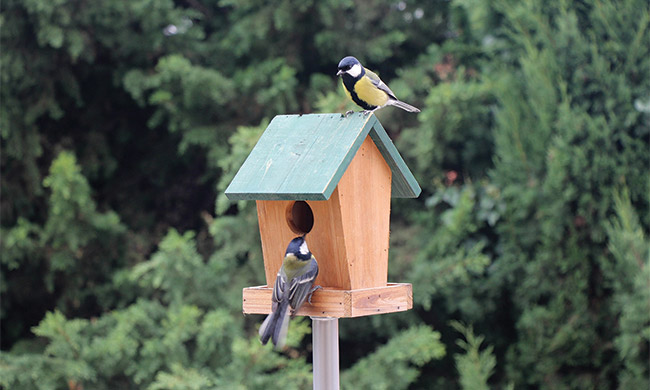
(Feature Impact) To add charm to your yard, encourage local wildlife and give you a front-row seat to nature, building a birdhouse is a simple weekend project that checks all of those boxes.
Building a Birdhouse
Seasoned DIYers and first-timers alike can follow this step-by-step guide to create a functional, welcoming birdhouse.
Step 1: Choose the Right Design
Start by deciding what type of birds you’d like to attract. Different birds prefer different house sizes and entrance types. A simple, classic birdhouse design makes the project beginner-friendly and works well for common backyard birds like wrens, chickadees and bluebirds. In general, plan for at least a 1-1 2/2-inch entrance hole, a 5-by-5-inch interior space and 2 inches or more of roof overhang.
Step 2: Gather Materials and Tools
Most DIY birdhouses can be built with basic materials and tools you may already have at home, including untreated cedar or pine wood, screws or nails, wood glue, sandpaper and exterior-safe paint as well as a measuring tape, pencil, saw and drill.
Step 3: Measure and Cut Wood
Measure and cut wood to make the front panel, back panel, two side panels, floor and roof. Then sand all edges for smooth assembly.
Step 4: Drill Holes
Using a hole-saw bit, drill the entrance hole into the front panel. Position it a few inches below the roofline to keep predators out. Next, drill 2-3 small drainage holes in the floor piece to prevent water buildup and help keep the birdhouse dry.
Step 5: Assemble the Birdhouse
Attach the side panels to the back panel using screws or nails. Add the front panel then secure the floor piece, slightly recessed, so rainwater can drain. Attach the roof last, making sure it slopes slightly to allow water to run off.
Step 6: Paint the Exterior
If you plan to paint your birdhouse, stick to neutral, nature-inspired colors. Light browns, soft greens or white help regulate temperature and blend into the environment.
Step 7: Mount Your Birdhouse
Once dry, place your birdhouse in a quiet, sheltered spot away from heavy foot traffic. Mount or hang it 5-10 feet off the ground, facing away from prevailing winds.
Visit eLivingtoday.com for more DIY project inspiration.
Photo courtesy of Shutterstock
SOURCE:

Our Lifestyle section on STM Daily News is a hub of inspiration and practical information, offering a range of articles that touch on various aspects of daily life. From tips on family finances to guides for maintaining health and wellness, we strive to empower our readers with knowledge and resources to enhance their lifestyles. Whether you’re seeking outdoor activity ideas, fashion trends, or travel recommendations, our lifestyle section has got you covered. Visit us today at https://stmdailynews.com/category/lifestyle/ and embark on a journey of discovery and self-improvement.




