

astronomy
C/2023 P1 (Nishimura) Comet: A Spectacular Celestial Visitor
Don’t miss the awe-inspiring C/2023 P1 (Nishimura) comet as it approaches Earth—a celestial spectacle to behold!

Last Updated on June 29, 2024 by Daily News Staff
Exciting news for astronomy enthusiasts! On August 11, Japanese amateur astronomer Hideo Nishimura made a remarkable discovery—a bright object near the Sun that turned out to be a brand-new comet. Officially named C/2023 P1 (Nishimura) by the Minor Planet Center on August 15, this comet has been gradually brightening and captivating stargazers worldwide. Let’s explore what we know about this celestial visitor and how you can catch a glimpse of its awe-inspiring journey.
Current Appearance and Observation:
Presently located in the constellation Gemini, C/2023 P1 has reached a magnitude of 10.8 and is steadily growing brighter. The comet boasts an impressive tail, stretching nearly 8′ in length. With an amateur 6-inch telescope, you can observe C/2023 P1 for a few hours before dawn, adding a touch of celestial wonder to your stargazing experience.
Decoding the Name:
The name C/2023 P1 (Nishimura) provides valuable information about the comet’s discovery:
- The letter C signifies that it is a non-periodic comet originating from the Oort cloud and may pass through the Solar System only once or take hundreds to thousands of years to complete an orbit around the Sun.
- “2023 P1” indicates the year and time of discovery—August in this case—and signifies that it was the first such object discovered during that period.
- “Nishimura” pays tribute to the Japanese astronomer Hideo Nishimura, who made this remarkable find.
Finding C/2023 P1 (Nishimura) in the Sky:
Locating the comet is made easier with astronomy apps like Star Walk 2 and Sky Tonight. By following these simple steps, you can track its position:
- Launch the app and tap the magnifying glass icon.
- Enter “C/2023 P1” in the search field and select the appropriate result.
- Utilize the compass button or point your device at the sky to align the screen with your surroundings.
- Follow the arrow on the screen to locate the comet in the real sky, as directed by the app.
Path and Best Viewing Time:
Here are some upcoming milestones in the comet’s path:
- August 26: C/2023 P1 (mag 9.2) enters the constellation Cancer.
- September 5: C/2023 P1 (mag 6.9) enters the constellation Leo.
- September 7: C/2023 P1 (mag 6.3) passes 0°16′ away from the star Ras Elased Australis (mag 3.0) in the constellation Leo.
- September 9: C/2023 P1 (mag 5.6) passes 0°20′ away from the star Adhafera (mag 3.4) in the constellation Leo.
- September 15: C/2023 P1 (mag 3.7) passes 0°10′ away from the star Denebola (mag 2.1) in the constellation Leo.
The comet is expected to reach its brightest magnitude, 4.9, on September 11, making it visible to the naked eye. However, as it approaches perihelion, it will be closer to the Sun in the sky, which may pose a challenge in spotting it.
Perihelion and Beyond:
On September 18, C/2023 P1 will reach perihelion, its closest point to the Sun. As it approaches, the comet may shine as bright as 3.2 magnitude, becoming visible without the aid of telescopes. However, it will also be located only around 12° away from the Sun, limiting the observation window. While there is a possibility the comet may disintegrate during this phase, continued tracking is advised.
Don’t miss the opportunity to witness the stunning C/2023 P1 (Nishimura) comet as it approaches Earth. Utilize stargazing apps like Star Walk 2 or Sky Tonight to locate this celestial spectacle in the night sky. With its anticipated brightness, the comet may captivate viewers until mid-September before gradually fading from naked-eye visibility. Stay tuned for more astronomical wonders, as another bright comet, C/2023 A3 (Tsuchinshan-ATLAS), is expected to grace our skies in the coming months. Happy stargazing!
Click the link to find out more: https://starwalk.space/en/news/new-comet-c2023-p1
Visit our astronomy section: https://stmdailynews.com/category/science/astronomy/
Source: Skywalk
https://stmdailynews.com/category/science


Science
Sonic booms from meteors can release the energy of hundreds of tons of TNT – here’s how they work

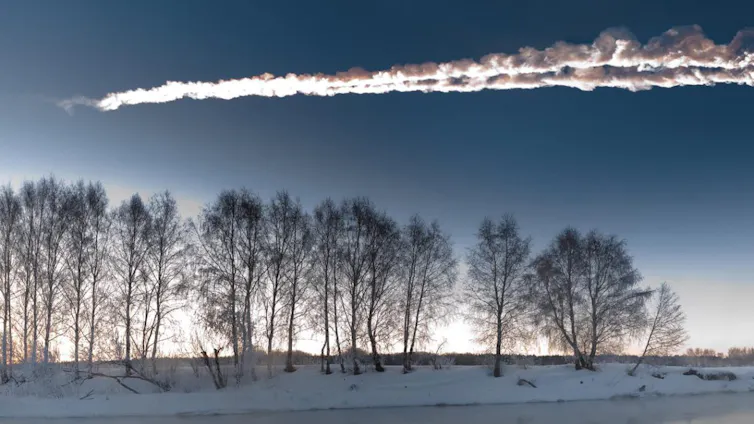
Shawn Laatsch, University of Maine
Sonic booms from meteors can release the energy of hundreds of tons of TNT – here’s how they work
As humans, we live out our lives on a planet that is constantly sweeping through a cosmic ocean littered with ancient debris from the formation of the solar system. For the most part, our world glides silently through space, shielded by Earth’s thin atmosphere.
Occasionally, however, the rest of the universe reminds us of its presence with stunning, visceral clarity.
Residents along the Massachusetts–New Hampshire border were startled by a sudden sonic boom on the afternoon of May 30, 2026. A large number of people up and down the Eastern Seaboard witnessed it.
After NASA analyzed imagery from weather satellites, they identified the culprit as a small meteor measuring roughly 3 to 5 feet (1 to 2 meters) across. It was screaming through space at an astonishing 42,000 miles per hour (68,000 kilometers per hour) when it plunged into Earth’s upper atmosphere.
Friction between the meteor and the increasingly dense air quickly turned the kinetic energy of the rock shooting through the sky into blistering heat. At an altitude of roughly 40 miles (60 kilometers), the immense heat and pressure overcame the structural integrity of the meteor, causing it to fragment in a brilliant flash.
The breakup released a staggering burst of energy equivalent to 300 tons of TNT. When an object travels through the air at speeds faster than sound, which is 761 mph (1,225 kph), it creates a shock wave creating a thunderous clap, or sonic boom. While the majority of the rock vaporized, the remaining fragments rained down harmlessly into the waters of Cape Cod Bay.
In the past, such an event might have passed as an unverified sighting in the daytime sky. Today, however, our planet is wired with an accidental network of planetary defense sensors: dashboard cameras, security systems and digital doorbells.
Because meteor entries like this one last only a few fleeting seconds, they were easily missed in the past. Now, our collective digital eyes capture these spontaneous cosmic intrusions almost instantly, bringing the universe directly into our daily news feeds. While dramatic, these events are more common than most people imagine.
As someone who has worked as a planetarium director and astronomy educator for over four decades, I often get emails, social media messages and phone calls about such objects and sightings. While hearing a sonic boom can be a bit unsettling or even shocking, it reminds us we live in an active universe and may want to occasionally look up instead of down at our devices.
A meteoric spring
The Cape Cod fireball was the latest sighting in an active season of meteoritic arrivals. Just months earlier, the solar system seemed to be sending a parade of rocky objects down to Earth.
From March 8-11, observers in Northern Europe witnessed large, slow-moving fireballs in their skies. Enthusiasts and scientists successfully recovered several fragments. Lab analysis of these specimens revealed their place in a fascinating lineage – scientists determined that they had originated from Vesta, a massive, pristine asteroid orbiting between Mars and Jupiter.
On March 17, a 7-ton asteroid measuring roughly 6 feet across entered the atmosphere directly over Lake Erie. Traveling at 45,000 mph (72,400 kph), it generated a brilliant daytime flash and a powerful sonic boom, unloading an energy equivalent to 250 tons of TNT. NASA scientists published data about its trajectory, allowing meteorite hunters to recover pristine fragments in Valley City, just a short drive from Cleveland, Ohio.
Only four days later, on March 21, another cosmic fragment blazed across the skies of Texas. This object was about 3 feet wide, and it traveled at 35,000 mph (56,300 kph), releasing the energy of roughly 26 tons of TNT.
Outside of Houston, homeowner Sherri James was startled by a sudden crash, only to discover a 6-inch (15-cm) hole in her roof and a small piece of the solar system resting on her floor.
Thank goodness for Earth’s atmospheric shield
The benchmark for modern atmospheric impacts is the Chelyabinsk meteor, which exploded over Russia on Feb. 15, 2013.
That object was significantly larger than any of the meteors researchers have observed in 2026, measuring 60 feet (18 m) across and weighing roughly 10,000 tons. When it shattered 18 miles (29 km) above the ground, it produced an airburst with an explosive force 30 times greater than the Hiroshima atomic bomb.
The resulting shock wave shattered glass across hundreds of square miles, injuring nearly 1,500 people and registering as a seismic event between 2.7 and 3.7 on the Richter scale. The incident was a stark reminder that while Earth’s atmosphere is an incredibly effective shield, absorbing the lion’s share of cosmic impacts, a large enough kinetic punch can still reach the surface below.
Despite the dramatic stories around these meteor impacts, history shows that the cosmic lottery rarely targets humans directly. In all of recorded history, there is only one universally confirmed case of a person being directly struck by a space rock.
In 1954, an 8.5-pound (3.8 kg) meteorite crashed through the roof of a house in Sylacauga, Alabama, ricocheted off a heavy wooden radio and struck a sleeping woman named Ann Hodges. Though it left a severe bruise on her hip, the radio absorbed the brunt of the impact. Had it not been for the radio, there is a chance she could have been seriously injured or killed by this object.
Living with the cosmos
So, are you in any imminent danger from meteors? The mathematics of the cosmos provide profound reassurance. The statistical odds of being struck by a meteorite are vanishingly small. You stand a better chance of winning a multimillion-dollar lottery jackpot 10 times in a row than ever being hit by a meteorite.
The vast majority of the tons of space debris that bombard Earth daily arrive as harmless dust grains, burning up as elegant meteors or shooting stars. But when the larger pieces do break through and land on our planet, they offer a rare, tangible connection to the beginning of the solar system.
If you ever happen to witness one of these magnificent fireballs ripping open the sky, consider reporting your observation to the American Meteor Society. The organization keeps track of sightings and falls from around the globe. Recovered fragments provide a way for scientists to gain valuable information about the origin of our solar system, and of our home planet.
Shawn Laatsch, Director of the Versant Power Astronomy Center, University of Maine
This article is republished from The Conversation under a Creative Commons license. Read the original article.
📰 Thanks for reading STM Daily News – your source for News You Can Use This Moment!
We love hearing from our readers. Share your thoughts in the comments section and join the conversation with our growing community. Your feedback helps us create the stories and features that matter most to you.
Don’t miss the latest news, inspiring stories, lifestyle tips, food and drink features, and exclusive updates. Subscribe to the STM Daily News newsletter and get our top stories delivered directly to your inbox.
💬 Leave a comment.
📧 Subscribe to our newsletter.
📢 Share your favorite stories with friends and family.
Stay informed, stay connected, and be part of the STM Daily News community at STMDailyNews.com.
The Knowledge
Potential signs of life on distant planets sound exciting – but confirmation can take years
The prospect of detecting signs of life on distant planets is indeed exhilarating; however, confirming such findings often requires an extensive timeframe, potentially spanning several years.

Olivia Harper Wilkins, Dickinson College
Astronomers can use telescopes to find specific molecules in the atmospheres of neighboring planets, in nebulae – clouds of interstellar dust and gas – hundreds or thousands of light-years away, or in galaxies beyond the far reaches of the Milky Way.
So far, astronomers have found more than 350 molecules in the spaces between and around stars in just under a hundred years – the first such molecule was reported in 1937. Each year, the cosmic chemical stockroom grows by anywhere from a handful to a couple of dozen new finds. Many of these molecules are precursors to biomolecules, meaning they might provide hints about life’s origins elsewhere in the cosmos.
As an astrochemist, my research is all about chemicals found in space, especially in distant cosmic clouds where infant stars are born. Even so, the precise observations captured by these telescopes never cease to amaze me.
With this ongoing boom in astrochemical census data, there is a lot to be excited about. Sometimes, however, this excitement can be premature. Finding molecules in places people will likely never visit is no simple task, so vetting and sometimes correcting these observations is a continual process – especially for molecules whose signals aren’t as strong.
‘Seeing’ molecules in space
Astronomers can’t visit neighboring planets, let alone distant star-forming regions. So, how do they see what is out there?
Astronomers observe the cosmos with telescopes that collect all different wavelengths of electromagnetic energy. For astrochemistry, they typically use radio telescopes. These satellite-dishlike instruments are used to “see” radio waves, which have wavelengths much longer than the human eye can perceive.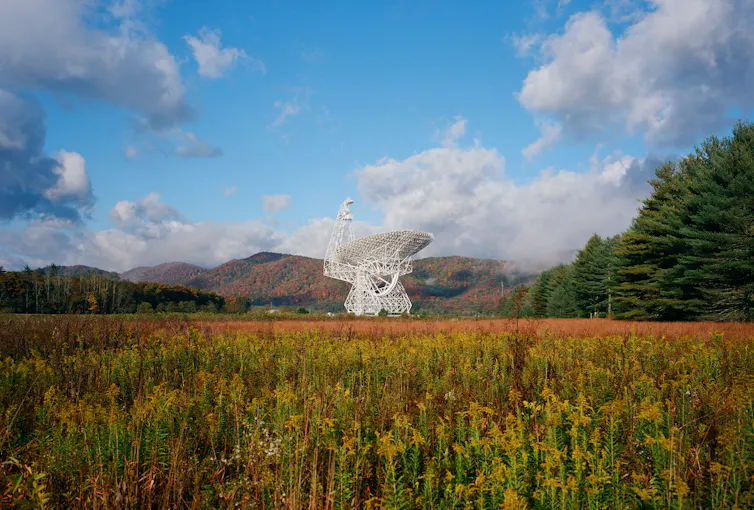
When molecules freely tumble around as gases in space, they rotate, and this motion releases energy in the form of photons, or electromagnetic particles. Different types of rotations require different levels of energy. Each photon carries that energy with it to a telescope, which records its signal. The more photons of a given energy, the stronger that signal.
If a radio telescope records all of the expected signals for a given molecule – its spectrum – then astronomers can confidently say that they have detected that molecule.
Infrared telescopes, such as the James Webb Space Telescope, or telescopes that detect visible light, such as the Hubble Space Telescope, can also be used for astrochemistry. Both kinds of telescopes, however, collect chemical signals, which are often more difficult to distinguish from one another.
Knowing what to look for
Behind every discovery of a new molecule in space is months or even years of work to capture a chemical’s “fingerprints,” or its spectrum.
I spent about a year doing this kind of work at the University of Cologne in Germany as a Fulbright research fellow. There, I used computer models of astrophysically interesting chemicals to predict what their spectra would look like.
In the lab, I injected the chemicals into a glass tube held under vacuum to mimic conditions in space. Using sensitive instruments, I recorded what a radio telescope would see if it were looking at only that molecule.
Astronomers had already found some of these molecules in space, and my colleagues and I were reexamining them, but we were also looking at molecules that we predicted might exist somewhere in space.
I worked with a team of scientists to adjust the computer inputs over and over until the simulated spectra matched the experimental data. When simulated spectra matched the experiments, that meant that the simulated spectra reliably modeled what a molecule’s fingerprint looks like in space. Reliable model spectra allow astronomers to detect chemical features at frequencies beyond what they can measure in the laboratory.
While my contributions to the Cologne team didn’t lead to a discovery of a new molecule in space, I gained an appreciation for the work behind the scenes of molecule discovery. The laboratory measurements are done precisely so that astronomers can be confident in their detections.
When detections get cloudy
Even with powerful radio telescopes and thorough experiments, some detections aren’t quite as clear as astronomers would like them to be. Sometimes, the signals are too faint for astronomers to be totally confident that they represent the molecules they think they do. Other times, there are too many molecule signals crowded together, causing different signals to blend.
Scientists have detected molecules relevant to biological processes back on Earth in comets and the atmospheres of other planets. These detections are exciting, but most scientists exercise caution to avoid jumping to conclusions because those molecules generally can exist outside of living things.
Sometimes, however, the excitement overshadows the caution and leads to premature conclusions.
Scientists often get excited when new molecules, especially biologically relevant molecules, are potentially present, and they want to share those findings with the world. Some researchers are also concerned about being the first to publish a new result, especially because a lot of telescope data is publicly available after a brief proprietary period.
Perhaps one of the most exciting nondiscoveries in astrochemistry was that of glycine in interstellar space more than 20 years ago. Glycine is the simplest amino acid, a type of molecule essential for life as we know it. Finding this molecule in a nebula would change how scientists think about the evolution of life’s ingredients.
Follow-up studies showed that key signals were missing in the initial report of glycine. As a result, astrochemists now generally agree that glycine had not been found in star-forming nebulae.
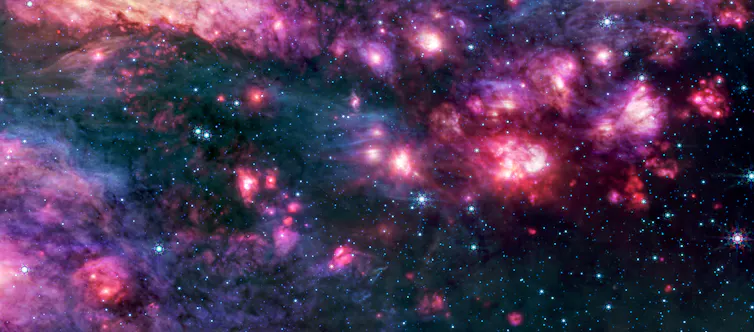
More recently, another molecular discovery has been scrutinized: the potential detection of phosphine in Venus’ atmosphere. Unlike with glycine, scientists have not yet agreed on whether phosphine, which is associated with some biological processes on Earth, is indeed present on Venus.
Initial reports of phosphine on Venus spurred chatter about biosignatures and evidence of potential life on Earth’s much hotter sister planet. However, follow-up studies by other scientists couldn’t confirm the initial results.
Over the past five years, scientists have continued to try to confirm or definitively refute Venusian phosphine.
Vetting claims
When reading about discoveries of new molecules in interstellar space or on other planets, how can you be confident in the detections you are reading about? It’s important to watch out for flashy headlines that claim signs of life have been found elsewhere in the universe. Molecule discoveries that rely on only one or two signals being detected are generally less reliable than those based on five or more signals.
For discoveries that tease hints of life on other worlds, other scientists are almost certainly going to try to reproduce the results. If you wait a few months for the initial fanfare to die down, you can do a web search to see what new results have come out to support – or refute – the original claim.
Olivia Harper Wilkins, Assistant Professor of Chemistry, Dickinson College
This article is republished from The Conversation under a Creative Commons license. Read the original article.
MORE NEWS. MORE STORIES. MORE DAILY.
STMDailyNews.com

Science
Seeing an eclipse from Earth is awe‑inspiring – for astronauts seeing one from space, the scene was even more grand
Discover the stunning eclipse seen by Artemis II astronauts during their 2026 Moon mission. A truly extraordinary spectacle awaits.
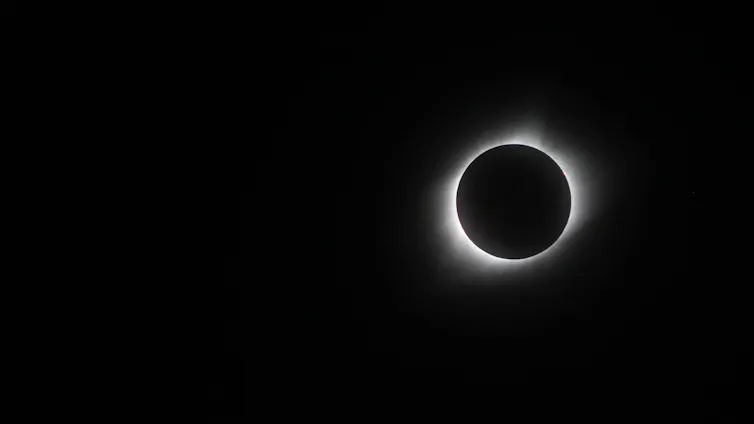
Deana L. Weibel, Grand Valley State University
The astronauts on Artemis II’s trip to the Moon in April 2026 didn’t just have an amazing journey through space. They also saw something extraordinary. They were the first humans to see a total solar eclipse from space.
A solar eclipse happens when the Moon moves in front of the Sun. In a total eclipse, the Sun’s central disc is covered completely.
From Earth, the circle of the Sun is about the same size as the circle of the Moon. With the bright circle blocked, you can see the undulating rays of the Sun’s corona, or outer atmosphere, that are normally too dim to be observed.
I’m a cultural anthropologist who studies awe-inspiring aspects of space exploration. I have been lucky enough to have seen two total solar eclipses. The first one was in Nebraska in 2017, the second in Indiana in 2024.
During my second total eclipse, the period of totality – that short span when you can remove your protective glasses and look directly at the eclipse – lasted close to 4 minutes. I saw waves of diffuse light snaking around an ink-black hole in the sky. It looked very wrong – almost alien.
On Aug. 12, 2026, there will be another total solar eclipse, visible only from Greenland, Iceland, Spain and the Balearic Islands of the Mediterranean. Some fortunate viewers in Spain and nearby islands may see the eclipse just before sunset, low on the horizon. The Moon illusion, a phenomenon where the Moon looks bigger when it’s near the horizon, might make this eclipse look unusually large.
Unusual eclipse perspectives
Astronauts will occasionally also have less common eclipse experiences. I interviewed one I call by the pseudonym “Jackie” in my research about astronauts’ experiences of awe. She was part of an astronaut training group that did a flight exercise during a total solar eclipse.
Jackie and her squad flew their jets in the shadow of the Moon. This lengthened their time in totality because they could follow and stay within the shadow. Jackie was most impressed with how the Sun’s corona seemed to shift and ripple.
“It’s not static … it’s alive,” she told me.
On April 6, 2026, the astronauts of NASA’s Artemis II mission saw another kind of unusual eclipse as they flew around the Moon. At one point during their flight, the Moon and the spacecraft aligned so that the Moon was directly between them and the Sun, blocking the Sun’s disk in a way that looks very different from what we see on Earth.
Astronaut Victor Glover said it felt like they “just went sci-fi.” https://www.youtube.com/embed/YLjPci5bo1k?wmode=transparent&start=0 ‘An impressive sight’: The Artemis II crew were the first humans to observe a solar eclipse from near the Moon.
The astronauts were so close to the Moon that the Moon looked bigger than the Sun and hid more of its bright circle. Earth was also in view, and sunlight reflected from the Earth onto the Moon in a phenomenon NASA calls “earthshine.” This dim light is very similar to the moonlight that shines on the Earth at night.
Imagine the Sun hidden behind the Moon, creating a hazy halo around the Moon’s edges. At the same time, faint light reflected from Earth softly illuminates the Moon, revealing mountains and craters in a dim twilight. Now imagine this striking scene lasting 54 minutes.
This sight was, without a doubt, one of the most unusual eclipses ever seen by human eyes.
Although Artemis’ astronauts are trained to think scientifically, this experience propelled them into a state of awe. They talked openly about how their brains were “not processing” what they observed. While NASA kept them busy with a variety of tasks, the sound of emotion and excitement in their voices as they broadcast live from their lunar flyby was unmistakable.
The psychology of awe
Researchers have studied the effects of awe on the human brain, including awe felt during solar eclipses. Moments of wonder like these can transform how you feel and even how you think, making you more thoughtful and open-minded.
In my own work I’ve found these experiences can change how astronauts understand their own place in the universe.
One astronaut said she gained an awareness of the fragility of our planet that now shapes everything she does, while another described becoming more curious after returning to Earth. A third said the awe he experienced in lunar orbit changed his understanding of time and infinity.
Space travel creates many opportunities for awe, but a solar eclipse from behind the Moon, as Mission Commander Reid Wiseman put it, required “20 new superlatives.”
It’s an experience most of the earthbound eclipse-chasers heading to Greenland or Iceland or Spain this summer will only dream about. Whether eclipses happen in space or on Earth, though, close encounters with the grandeur of our universe can make you feel profoundly human.
Deana L. Weibel, Professor of Anthropology, Grand Valley State University
This article is republished from The Conversation under a Creative Commons license. Read the original article.
Dive into “The Knowledge,” where curiosity meets clarity. This playlist, in collaboration with STMDailyNews.com, is designed for viewers who value historical accuracy and insightful learning. Our short videos, ranging from 30 seconds to a minute and a half, make complex subjects easy to grasp in no time. Covering everything from historical events to contemporary processes and entertainment, “The Knowledge” bridges the past with the present. In a world where information is abundant yet often misused, our series aims to guide you through the noise, preserving vital knowledge and truths that shape our lives today. Perfect for curious minds eager to discover the ‘why’ and ‘how’ of everything around us. Subscribe and join in as we explore the facts that matter. https://stmdailynews.com/the-knowledge/





