Trump’s Project 2025 agenda caps decades-long resistance to 20th century progressive reform
The content discusses the ideological struggle in U.S. governance, highlighting conservative backlash against progressive reforms like the New Deal and Great Society, culminating in Project 2025’s agenda for Trump’s potential administration.
For much of the 20th century, efforts to remake government were driven by a progressive desire to make the government work for regular Americans, including the New Deal and the Great Society reforms.
But they also met a conservative backlash seeking to rein back government as a source of security for working Americans and realign it with the interests of private business. That backlash is the central thread of the Heritage Foundation’s “Project 2025” blueprint for a second Trump Administration.
But Project 2025 does so with particular detail and urgency, hoping to galvanize dramatic change before the midterm elections in 2026. As its foreword warns: “Conservatives have just two years and one shot to get this right.”
The standard for a transformational “100 days” – a much-used reference point for evaluating an administration – belongs to the first administration of Franklin D. Roosevelt.President Franklin D. Roosevelt signs the Social Security Bill in Washington on Aug. 14, 1935. AP Photo, file
Social reforms and FDR
In 1933, in the depths of the Great Depression, Roosevelt faced a nation in which business activity had stalled, nearly a third of the workforce was unemployed, and economic misery and unrest were widespread.
But Roosevelt’s so-called “New Deal” unfolded less as a grand plan to combat the Depression than as a scramble of policy experimentation.
Roosevelt did not campaign on what would become the New Deal’s singular achievements, which included expansive relief programs, subsidies for farmers, financial reforms, the Social Security system, the minimum wage and federal protection of workers’ rights.
A generation later, another wave of social reforms unfolded in similar fashion. This time it was not general economic misery that spurred actions, but the persistence of inequality – especially racial inequality – in an otherwise prosperous time.
LBJ’s Great Society
President Lyndon B. Johnson’s Great Society programs declared a war on poverty and, toward that end, introduced a raft of new federal initiatives in urban, education and civil rights.
As with the New Deal, the substance of these policies rested less with national policy designs than with the aspirations and mobilization of the era’s social movements.
Resistance to policy change
Since the 1930s, conservative policy agendas have largely taken the form of reactions to the New Deal and the Great Society.
The central message has routinely been that “big government” has overstepped its bounds and trampled individual rights, and that the architects of those reforms are not just misguided but treasonous. Project 2025, in this respect, promises not just a political right turn but to “defeat the anti-American left.”
After the 1946 midterm elections, congressional Republicans struck back at the New Deal. Drawing on business opposition to the New Deal, popular discontent with postwar inflation, and common cause with Southern Democrats, they stemmed efforts to expand the New Deal, gutting a full employment proposal and defeating national health insurance.
They struck back at organized labor with the 1947 Taft-Hartley Act, which undercut federal law by allowing states to pass anti-union “right to work” laws. And they launched an infamous anti-communist purge of the civil service, which forced nearly 15,000 people out of government jobs.
In 1971, the U.S. Chamber of Commerce commissioned Lewis Powell – who would be appointed by Republican President Richard Nixon to the Supreme Court the next year – to assess the political landscape. Powell’s memorandum characterized the political climate at the dawn of the 1970s – including both Great Society programs and the anti-war and Civil Rights movements of the 1960s – as nothing less than an “attack on the free enterprise system.”
In a preview of current U.S. politics, Powell’s memorandum devoted special attention to a disquieting “chorus of criticism” coming from “the perfectly respectable elements of society: from the college campus, the pulpit, the media, the intellectual and literary journals, the arts and sciences, and from politicians.”
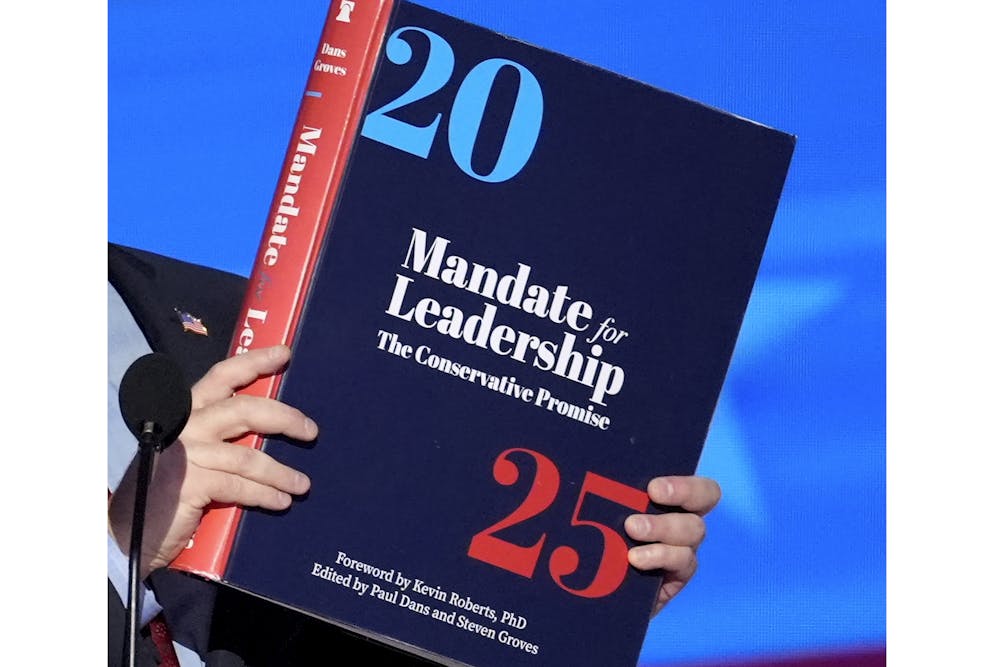
Powell characterized the social policies of the New Deal and Great Society as “socialism or some sort of statism” and advocated the elevation of business interests and business priorities to the center of American political life.A copy of Project 2025 is held during the Democratic National Convention on Aug. 21, 2024, in Chicago. AP Photo/J. Scott Applewhite
Building a conservative infrastructure
Powell captured the conservative zeitgeist at the onset of what would become a long and decisive right turn in American politics. More importantly, it helped galvanize the creation of a conservative infrastructure – in the courts, in the policy world, in universities and in the media – to push back against that “chorus of criticism.”
In national politics, the conservative resurgence achieved full expression in President Ronald Reagan’s 1980 campaign. The “Reagan Revolution” united economic and social conservatives around the central goal of dismantling what was left of the New Deal and Great Society.
Publicly, the Reagan administration argued that tax cuts would pay for themselves, with the lower rates offset by economic growth. Privately, it didn’t matter: Either growth would sustain revenues, or the resulting budgetary hole could be used to “starve the beast” and justify further program cuts.
Project 2025, the latest in this series of blueprints for dramatic change, draws most deeply on two of those plans.
As in the congressional purges of 1940s, it takes aim not just at policy but at the civil servants – Trump’s “deep state” – who administer it.
In the wake of World War II, the charge was that feckless bureaucrats served Soviet masters. Today, Project 2025 aims to “bring the Administrative State to heel, and in the process defang and defund the woke culture warriors who have infiltrated every last institution in America.”
Whatever their source – party platforms, congressional bomb-throwers, think tanks, private interests – the success or failure of these blueprints rested not on their vision or popular appeal but on the political power that accompanied them. The New Deal and Great Society gained momentum and meaning from the social movements that shaped their agendas and held them to account.
Advertisement
The lineage of conservative responses has been largely an assertion of business power. Whatever populist trappings the second Trump administration may possess, the bottom line of the conservative cultural and political agenda in 2025 is to dismantle what is left of the New Deal or the Great Society, and to defend unfettered “free enterprise” against critics and alternatives.
A Legacy of Service: How family stories shape service
Legacy of Service: Discover how military service creates lasting family legacies across generations. Explore powerful veteran stories from the Veterans History Project, including Pearl Harbor survivors and Code Talkers, and learn how to preserve your family’s service history.
A Legacy of Service: How family stories shape service
(Family Features) Major historical events like war or military service make a lasting impact on family identity, values and traditions, often reverberating across multiple generations. Veterans frequently speak about their military units as if they were family, given the unbreakable bonds that develop between comrades. However, for some veterans, “brothers in arms” is more than a figurative turn of phrase. Throughout the 20th century, entire families felt the firsthand effects of war, with multiple generations serving. Brothers enlisted together. A father’s military legacy inspired his children to join up. Sweethearts met and married while in uniform. These stories not only illustrate the experiences of individual veterans but also provide an intimate glimpse into family legacies of military service. Consider the Veterans History Project, a program overseen by the Library of Congress, which collects and preserves the firsthand remembrances of U.S. military veterans and makes them accessible for future generations to better understand veterans’ service and sacrifice. These personal stories encompass original correspondence, memoirs, diaries, photographs and oral history interviews, all offering deeper insight into the long-term impact of military service. Veterans’ narratives are collected by volunteers, and anyone who served from World War I to today can submit their personal story, regardless of whether or not they saw combat. The collections frequently shed light on the importance of family in military experiences. Whether expressed through heartfelt letters home, enduring family legacies of service or the experience of serving alongside loved ones, these stories reflect profound connections. Family Identity During the Cold War, Jennifer McNeill rose from Army Dental Assistant to Command Sergeant Major at the Army Eisenhower Medical Center in Fort Gordon, Georgia. Her collection includes a poignant photograph of her mother sharing images of her four military daughters in uniform, underscoring how family identity and military service are closely connected. Values Military service makes a lasting impression on veterans, shaping the experiences and the values that guide them through life. Ray Chavez is one such example. He was the oldest known Pearl Harbor survivor before his passing in 2018. For most of his life, he remained silent about his experiences, but in 1991, his daughter, Kathleen Chavez, who served in the U.S. Navy during Desert Storm, convinced him to return to Pearl Harbor. That trip marked the first time he spoke openly about his service. Kathleen shared their family’s deep military legacy in her oral history for the Veterans History Project. Traditions Across Generations Serving in the military is a deeply personal journey, but for many veterans, it’s an experience that transcends generations. Bill Toledo enlisted in the Marine Corps in October 1942 at the age of 18. Along with his uncle, Frank Toledo, and cousin, Preston Toledo, he served as a Code Talker transmitting military messages through secret codes. In his oral history, Bill vividly recalled both the challenges of combat during the invasion of Iwo Jima in February 1945, and the treasured moments spent with his uncle. These and many other family stories of military service and remembrance are available to the public at loc.gov/vets. Photo courtesy of Shutterstock (men looking at scrapbook)
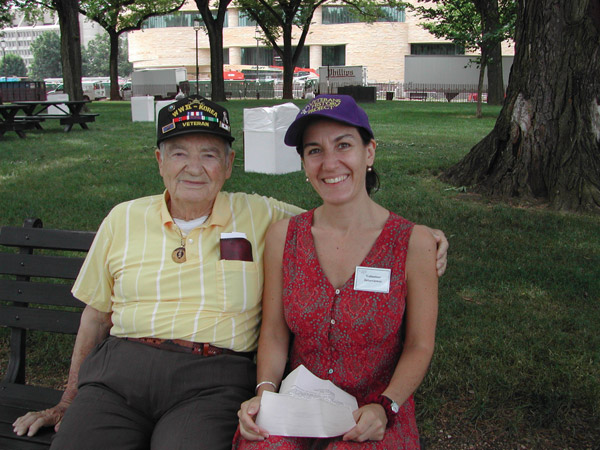
Photo courtesy of the Library of Congress (man and woman on park bench) SOURCE:Library of Congress
Senior Assist Day Marks Four Years of Supporting Seniors in South Phoenix
Senior Assist Day celebrates four years of serving seniors at Tanner Gardens in South Phoenix, led by Assistory Outreach Services and founder Jon Taylor.
Senior Assist Day Marks Four Years of Supporting Seniors in South Phoenix
PHOENIX, AZ — Senior Assist Day reached a meaningful milestone this year, marking four years of service to seniors living at Tanner Gardens in South Phoenix. Hosted by Assistory Outreach Services, the annual event continues to provide dignity, connection, and practical support to an often-overlooked population.
A Personal Beginning
The origins of Senior Assist Day are deeply personal for Assistory Outreach Services founder and CEO Jon Taylor.
“The origin of me going to Tanner Gardens was when I was with the 100 Black Men of Phoenix. We used to do a luncheon for seniors around December.”
That early connection took on new meaning as Taylor’s mother began showing signs of dementia, inspiring him to create an event rooted in empathy and care.
“I got a great feeling from being around those senior citizens. Senior Assist Day is roughly based on my mother.”
An Event That Continues to Grow
What began as a small gathering has grown into a full community experience. Seniors now enjoy catered meals, live music, personal care services, and gifts tailored to their needs. This year’s event included authentic Mexican food, live holiday music, haircuts provided by AJ’s Barbershop, and the donation of new shoes — a moment that stood out for many attendees.
“Seeing the excitement and how they were reacting to the new shoes was incredible,” Taylor said.
Beyond a Single Day
Senior Assist Day also helps build trust between Assistory Outreach Services and the residents of Tanner Gardens, opening the door to additional programs throughout the year. Through initiatives like the Digital Access Program for Seniors (DAPs), the organization helps seniors develop basic phone and computer skills, empowering them to stay connected and informed.
Challenges and Purpose
Keeping the event going year after year requires dedication and resources. Taylor personally raises funds and helps purchase gifts for more than 130 residents annually. Despite the challenges, his motivation remains strong.
“I do feel as though this is my ministry. I’m providing services, and I’m being fulfilled at the same time.”
Looking Ahead
Looking to the future, Taylor envisions Senior Assist Day becoming an all-day celebration, offering expanded services, entertainment, and meals — all focused exclusively on the residents of Tanner Gardens. As the event enters its fifth year, Senior Assist Day stands as a testament to what consistent community engagement and compassion can achieve. About Assistory Outreach ServicesAssistory Outreach Services is a community-based nonprofit organization dedicated to empowering seniors, low-income residents, and individuals experiencing homelessness. Assistory helps senior citizens embrace technology by teaching basic cell phone and computer skills, using a formula rooted in education, love, and patience to remove fear and build confidence. In addition to senior programming, the organization focuses on serving low-income and homeless populations by providing food boxes, holiday meals, and homeless care packages known as Assist Packs. This year, Assistory Outreach Services is expanding its impact by partnering with other nonprofits and religious organizations to coordinate food distribution through its community food pantry. Coverage by STM Daily News.
STM Daily News is a multifaceted podcast that explores a wide range of topics, from life and consumer issues to the latest in food and beverage trends. Our discussions dive into the realms of science, covering everything from space and Earth to nature, artificial intelligence, and astronomy. We also celebrate the amateur sports scene, highlighting local athletes and events, including our special segment on senior Pickleball, where we report on the latest happenings in this exciting community. With our diverse content, STM Daily News aims to inform, entertain, and engage listeners, providing a comprehensive look at the issues that matter most in our daily lives. https://stories-this-moment.castos.com/
Rod: A creative force, blending words, images, and flavors. Blogger, writer, filmmaker, and photographer. Cooking enthusiast with a sci-fi vision. Passionate about his upcoming series and dedicated to TNC Network. Partnered with Rebecca Washington for a shared journey of love and art.
Brigitte Bardot defined the modern woman and defied social norms
Ben McCann, University of Adelaide Brigitte Bardot’s death, at the age of 91, brings to a close one of the most extraordinary careers in post-war French cultural life. Best known as an actress, she was also a singer, a fashion icon, an animal rights activist and a symbol of France’s sexual liberation. Famous enough to be known by her initials, B.B. symbolised a certain vision of French femininity – rebellious and sensual, yet vulnerable. Her impact on beauty standards and French national identity was profound. At her peak, she rivalled Marilyn Monroe in global fame and recognition. Simone de Beauvoir, France’s leading feminist writer, famously wrote in 1959 that Bardot “appears as a force of nature, dangerous so long as she remains untamed”.
A star is born
Bardot was born in 1934 to a well-off Parisian family. Raised in a strict Catholic household, she studied ballet at the Conservatoire de Paris with hopes of becoming a professional dancer.Brigitte Bardot, pictured here in 1946, studied ballet as a child.Roger Viollet via Getty Images Her striking looks led her to modelling. By 14, she was appearing in Elle magazine, catching the eye of director Roger Vadim, whom she married in 1952. She began acting in the early 1950s and her appearance as Juliette in Vadim’s And God Created Woman (Et Dieu… créa la femme, 1956) put her on the map. Bardot was instantly catapulted to international stardom. Vadim presented his wife as the ultimate expression of youthful, erotic freedom that both shocked and captivated French audiences. Watching this relatively tame film today, it’s difficult to imagine just how taboo-breaking Bardot’s performance was. But in sleepy Catholic, conservative 1950s France, it set new norms for on-screen sexuality. The film became a global phenomenon. Critics loved it, but censors and religious groups grew nervous.
An 60s icon
Bardot’s lack of formal training as an actress paradoxically became part of her appeal: she adopted a spontaneous acting approach, as much physical as verbal. She was stunning in Contempt (Le Mépris, 1963), Jean-Luc Godard’s masterpiece about a crumbling marriage. Godard used her beauty and fame both as spectacle and critique. The film’s most famous sequence was a 31-minute conversation between Bardot and her co-star Michel Piccoli. Bardot was never better. In Henri-Georges Clouzot’s intense courtroom drama The Truth (La Vérité, 1960), she showcased her dramatic range playing a young woman on trial for the murder of her lover.Bardot in a poster for The Truth, 1960.LMPC via Getty Images In 1965, she co-starred with Jeanne Moreau in Louis Malle’s Long Live Maria (Viva Maria), a rare female buddy film that blended comedy and political satire. Bardot’s anarchic energy remains a dazzling feat. A Very Private Affair (Vie privée, 1962) saw her portray a woman consumed by fame and chased by the media. The plotline was eerily predictive of Bardot’s own future. She popularised fashion trends like the choucroute hairstyle and ballet flats. The Bardot neckline – off-the-shoulder tops and dresses – was named after her. She even wore pink gingham at her 1959 wedding.
Allure and provocation
Bardot’s star appeal lay in her contradictions. She appeared simultaneously natural and provocative, spontaneous and calculated. Her dishevelled glamour and effortless sexuality helped construct the archetype of the modern “sex kitten”. She famously said “it is better to be unfaithful than to be faithful without wanting to be”. Throwing off the shackles of bourgeois morality, Bardot epitomised a commitment to emotional and sexual freedom. Her turbulent love life was a case in point. She was married four times, with dozens of stormy relationships and extra-marital affairs along the way. Forever immortalised as a free-spirited ingénue, Bardot was a muse for filmmakers, artists and musicians, from Andy Warhol to Serge Gainsbourg. Later on, Kate Moss, Amy Winehouse and Elle Fanning mentioned Bardot as an inspiration. Famously, Bardot never succumbed to cosmetic surgery. As she once noted:
Women should embrace ageing because, at the end of the day, it’s much more beautiful to have a grandmother with white hair who looks like an elderly lady than to have a grandmother who’s bleached, dyed, and […] who looks much older but also really unhappy.
Life after the movies
Bardot retired from acting in 1973, aged only 39, citing disillusionment with fame. “It suffocated and destroyed me”, she said, about the film industry. She shifted her attention to animal rights, founding the Brigitte Bardot Foundation in 1986. She became an uncompromising, vocal activist, campaigning against animal cruelty, fur farming, whaling and bullfighting. But Bardot courted controversy from the mid-1990s for her far-right political views, remarks about Islam and immigration and repeated convictions for inciting racial hatred. She publicly defended disgraced actor Gérard Depardieu and pushed back on the #MeToo movement in France. Such statements damaged her reputation, especially outside France, and created a troubling image: the once-liberating sex symbol now associated with nationalist conservatism. While she never identified as a feminist, her unapologetic autonomy, early retirement and outspoken views led some to re-evaluate her as a figure of proto-feminist rebellion. France gradually began to turn against Bardot, bothered by her outspoken views. But some applauded her couldn’t-care-less attitude and unwillingness to play by the rules. Ultimately, by rejecting fame on her own terms, she parlayed her 50s free-spiritedness into a bold stand against conformity and societal norms. Late in life, she told Danièle Thompson, the writer-director of the 2023 mini-series about her career, “I don’t understand why the whole world is still talking about me”. The answer is simple – Bardot continues to fascinate us, flaws and all. Ben McCann, Associate Professor of French Studies, University of Adelaide This article is republished from The Conversation under a Creative Commons license. Read the original article.





 Family Identity During the Cold War, Jennifer McNeill rose from Army Dental Assistant to Command Sergeant Major at the Army Eisenhower Medical Center in Fort Gordon, Georgia. Her collection includes a poignant photograph of her mother sharing images of her four military daughters in uniform, underscoring how family identity and military service are closely connected. Values Military service makes a lasting impression on veterans, shaping the experiences and the values that guide them through life. Ray Chavez is one such example. He was the oldest known Pearl Harbor survivor before his passing in 2018. For most of his life, he remained silent about his experiences, but in 1991, his daughter, Kathleen Chavez, who served in the U.S. Navy during Desert Storm, convinced him to return to Pearl Harbor. That trip marked the first time he spoke openly about his service. Kathleen shared their family’s deep military legacy in her oral history for the Veterans History Project. Traditions Across Generations Serving in the military is a deeply personal journey, but for many veterans, it’s an experience that transcends generations. Bill Toledo enlisted in the Marine Corps in October 1942 at the age of 18. Along with his uncle, Frank Toledo, and cousin, Preston Toledo, he served as a Code Talker transmitting military messages through secret codes. In his oral history, Bill vividly recalled both the challenges of combat during the invasion of Iwo Jima in February 1945, and the treasured moments spent with his uncle. These and many other family stories of military service and remembrance are available to the public at