Connect with us

Science

Early visions of Mars: Meet the 19th-century astronomer who used science fiction to imagine the red planet

Published

on

Last Updated on June 10, 2025 by Daily News Staff

file 20250603 56 ts6if9.jpg?ixlib=rb 4.1
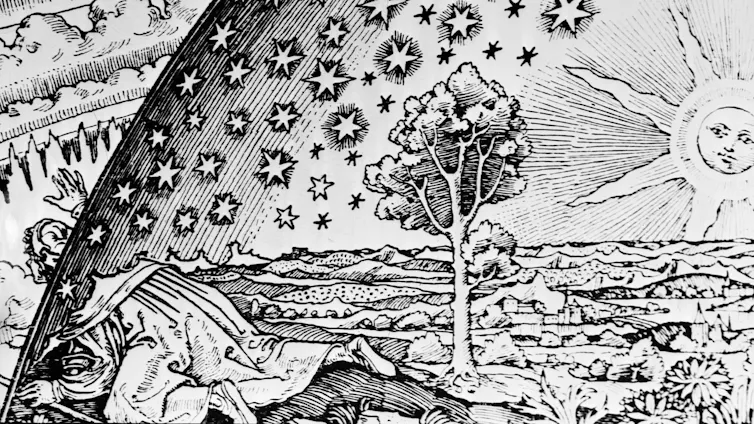
Camille Flammarion’s work imagined what might exist beyond Earth in the universe. Three Lions/Hulton Archive via Getty Images
Matthew Shindell, Smithsonian Institution Living in today’s age of ambitious robotic exploration of Mars, with an eventual human mission to the red planet likely to happen one day, it is hard to imagine a time when Mars was a mysterious and unreachable world. And yet, before the invention of the rocket, astronomers who wanted to explore Mars beyond what they could see through their telescopes had to use their imaginations. As a space historian and author of the book “For the Love of Mars: A Human History of the Red Planet,” I’ve worked to understand how people in different times and places imagined Mars. The second half of the 19th century was a particularly interesting time to imagine Mars. This was a period during which the red planet seemed to be ready to give up some of its mystery. Astronomers were learning more about Mars, but they still didn’t have enough information to know whether it hosted life, and if so, what kind. With more powerful telescopes and new printing technologies, astronomers began applying the cartographic tools of geographers to create the first detailed maps of the planet’s surface, filling it in with continents and seas, and in some cases features that could have been produced by life. Because it was still difficult to see the actual surface features of Mars, these maps varied considerably. During this period, one prominent scientist and popularizer brought together science and imagination to explore the possibilities that life on another world could hold.

Camille Flammarion

A black-and-white portrait of a man with bushy hair and a beard.
The 19th-century astronomer and writer Camille Flammarion. Av Ukjent/The New York Public Library Digital Collections
One imaginative thinker whose attention was drawn to Mars during this period was the Parisian astronomer Camille Flammarion. In 1892, Flammarion published “The Planet Mars,” which remains to this day a definitive history of Mars observation up through the 19th century. It summarized all the published literature about Mars since the time of Galileo in the 17th century. This work, he reported, required him to review 572 drawings of Mars. Like many of his contemporaries, Flammarion concluded that Mars, an older world that had gone through the same evolutionary stages as Earth, must be a living world. Unlike his contemporaries, he insisted that Mars, while it might be the most Earth-like planet in our solar system, was distinctly its own world. It was the differences that made Mars interesting to Flammarion, not the similarities. Any life found there would be evolutionarily adapted to its particular conditions – an idea that appealed to the author H.G. Wells when he imagined invading Martians in “The War of the Worlds.”
A vintage map showing oceans and continents on Mars.
An illustrated plate from ‘Astronomie Populaire – Description Generale du Ciel’ by Camille Flammarion. This map of Mars shows continents and oceans. In this, his best-selling epic work, Flammarion speculated that Mars was ‘an earth almost similar to ours [with] water, air, showers, brooks and fountains. This is certainly a place little different from that which we inhabit.’ Science & Society Picture Library via Getty Images
But Flammarion also admitted that it was difficult to pin down these differences, as “the distance is too great, our atmosphere is too dense, and our instruments are not perfect enough.” None of the maps he reviewed could be taken literally, he lamented, because everyone had seen and drawn Mars differently. Given this uncertainty about what had actually been seen on Mars’ surface, Flammarion took an agnostic stance in “The Planet Mars” as to the specific nature of life on Mars. He did, however, consider that if intelligent life did exist on Mars, it would be more ancient than human life on Earth. Logically, that life would be more perfect — akin to the peaceful, unified and technologically advanced civilization he predicted would come into being on Earth in the coming century. “We can however hope,” he wrote, “that since the world of Mars is older than our own, its inhabitants may be wiser and more advanced than we are. Undoubtedly it is the spirit of peace which has animated this neighboring world.”
A vintage photo of rocky terrain intersected by canals.
A plate from ‘Les Terres du Ciel’ (The Worlds of the Sky) written by Camille Flammarion. The plate is an artist’s impression of how canals on Mars might have looked. Science & Society Picture Library via Getty Images
But as Flammarion informed his readers, “the Known is a tiny island in the midst of the ocean of the Unknown,” a point he often underscored in the more than 70 books he published in his lifetime. It was the “Unknown” that he found particularly tantalizing. Historians often describe Flammarion more as a popularizer than a serious scientist, but this should not diminish his accomplishments. For Flammarion, science wasn’t a method or a body of established knowledge. It was the nascent core of a new philosophy waiting to be born. He took his popular writing very seriously and hoped it could turn people’s minds toward the heavens.

Imaginative novels

Without resolving the planet’s surface or somehow communicating with its inhabitants, it was premature to speculate about what forms of life might exist on Mars. And yet, Flammarion did speculate — not so much in his scientific work, but in a series of novels he wrote over the course of his career. In these imaginative works, he was able to visit Mars and see its surface for himself. Unlike his contemporary, the science fiction author Jules Verne, who imagined a technologically facilitated journey to the Moon, Flammarion preferred a type of spiritual journey.
A vintage photograph of a man looking through a large telescope.
Camille Flammarion looking through the telescope at the Observatory at Juvisy-sur-Orge. duncan1890/iStock via Getty Images Plus
Based on his belief that human souls after death can travel through space in a way that the living body cannot, Flammarion’s novels include dream journeys as well as the accounts of deceased friends or fictional characters. In his novel “Urania” (1889), Flammarion’s soul visits Mars in a dream. Upon arrival, he encounters a deceased friend, George Spero, who has been reincarnated as a winged, luminous, six-limbed being. “Organisms can no more be earthly on Mars than they could be aerial at the bottom of the sea,” Flammarion writes. Later in the same novel, Spero’s soul visits Flammarion on Earth. He reveals that Martian civilization and science have progressed well beyond Earth, not only because Mars is an older world, but because the atmosphere is thinner and more suitable for astronomy. Flammarion imagined that practicing and popularizing astronomy, along with the other sciences, had helped advance Martian society. Flammarion’s imagined Martians lived intellectual lives untroubled by war, hunger and other earthly concerns. This was the life Flammarion wanted for his fellow Parisians, who had lived through the devastation of the Franco-Prussian war and suffered starvation and deprivation during the Siege of Paris and its aftermath. Today, Flammarion’s Mars is a reminder that imagining a future on Mars is as much about understanding ourselves and our societal aspirations as it is about developing the technologies to take us there. Flammarion’s popularization of science was his means of helping his fellow Earth-bound humans understand their place in the universe. They could one day join his imagined Martians, which weren’t meant to be taken any more literally than the maps of Mars he analyzed for “The Planet Mars.” His world was an example of what life could become under the right conditions. Matthew Shindell, Curator, Planetary Science and Exploration, Smithsonian Institution This article is republished from The Conversation under a Creative Commons license. Read the original article.

Discover more from Daily News

Subscribe to get the latest posts sent to your email.

Science

Why can’t I wiggle my toes one at a time, like my fingers?

why can’t I wiggle my toes? Ever wondered why you can’t wiggle your toes one at a time like your fingers? Learn how evolution, muscles, and your brain all play a part in making fingers more independent than toes—and why that’s key for walking and balance.

Published

on

Why can’t I wiggle my toes one at a time, like my fingers?
A baby chimp can grab a stick equally well with its fingers and its toes. Anup Shah/Stone via Getty Images

Why Can’t You Wiggle Your Toes Like Your Fingers? The Science Behind Toe and Finger Movement

Steven Lautzenheiser, University of Tennessee Curious Kids is a series for children of all ages. If you have a question you’d like an expert to answer, send it to curiouskidsus@theconversation.com.
Why can’t I wiggle my toes individually, like I can with my fingers? – Vincent, age 15, Arlington, Virginia

One of my favorite activities is going to the zoo where I live in Knoxville when it first opens and the animals are most active. On one recent weekend, I headed to the chimpanzees first. Their breakfast was still scattered around their enclosure for them to find. Ripley, one of the male chimpanzees, quickly gathered up some fruits and vegetables, sometimes using his feet almost like hands. After he ate, he used his feet to grab the fire hoses hanging around the enclosure and even held pieces of straw and other toys in his toes. I found myself feeling a bit envious. Why can’t people use our feet like this, quickly and easily grasping things with our toes just as easily as we do with our fingers? I’m a biological anthropologist who studies the biomechanics of the modern human foot and ankle, using mechanical principles of movement to understand how forces affect the shape of our bodies and how humans have changed over time. Your muscles, brain and how human feet evolved all play a part in why you can’t wiggle individual toes one by one.
young chimp running on all fours
Chimpanzee hands and feet do similar jobs. Manoj Shah/Stone via Getty Images

Comparing humans to a close relative

Humans are primates, which means we belong to the same group of animals that includes apes like Riley the chimp. In fact, chimpanzees are our closest genetic relatives, sharing almost 98.8% of our DNA. Evolution is part of the answer to why chimpanzees have such dexterous toes while ours seem much more clumsy. Our very ancient ancestors probably moved around the way chimpanzees do, using both their arms and legs. But over time our lineage started walking on two legs. Human feet needed to change to help us stay balanced and to support our bodies as we walk upright. It became less important for our toes to move individually than to keep us from toppling over as we moved through the world in this new way.
bare feet walking across sandy surface toward camera
Feet adapted so we could walk and balance on just two legs. Karina Mansfield/Moment via Getty Images
Human hands became more important for things such as using tools, one of the hallmark skills of human beings. Over time, our fingers became better at moving on their own. People use their hands to do lots of things, such as drawing, texting or playing a musical instrument. Even typing this article is possible only because my fingers can make small, careful and controlled movements. People’s feet and hands evolved for different purposes.

Muscles that move your fingers or toes

Evolution brought these differences about by physically adapting our muscles, bones and tendons to better support walking and balance. Hands and feet have similar anatomy; both have five fingers or toes that are moved by muscles and tendons. The human foot contains 29 muscles that all work to help you walk and stay balanced when you stand. In comparison, a hand has 34 muscles. Most of the muscles of your foot let you point your toes down, like when you stand on tiptoes, or lift them up, like when you walk on your heels. These muscles also help feet roll slightly inward or outward, which lets you keep your balance on uneven ground. All these movements work together to help you walk and run safely. The big toe on each foot is special because it helps push your body forward when you walk and has extra muscles just for its movement. The other four toes don’t have their own separate muscles. A few main muscles in the bottom of your foot and in your calf move all four toes at once. Because they share muscles, those toes can wiggle, but not very independently like your fingers can. The calf muscles also have long tendons that reach into the foot; they’re better at keeping you steady and helping you walk than at making tiny, precise movements.
a pen and ink drawing of the interior anatomy of a human hand
Your hand is capable of delicate movements thanks to the muscles and ligaments that control its bones. Henry Gray, ‘Anatomy of the Human Body’/Wikimedia Commons, CC BY
In contrast, six main muscle groups help move each finger. The fingers share these muscles, which sit mostly in the forearm and connect to the fingers by tendons. The thumb and pinky have extra muscles that let you grip and hold objects more easily. All of these muscles are specialized to allow careful, controlled movements, such as writing. So, yes, I have more muscles dedicated to moving my fingers, but that is not the only reason I can’t wiggle my toes one by one.

Divvying up brain power

You also need to look inside your brain to understand why toes and fingers work differently. Part of your brain called the motor cortex tells your body how to move. It’s made of cells called neurons that act like tiny messengers, sending signals to the rest of your body. Your motor cortex devotes many more neurons to controlling your fingers than your toes, so it can send much more detailed instructions to your fingers. Because of the way your motor cortex is organized, it takes more “brain power,” meaning more signals and more activity, to move your fingers than your toes.
illustration of a brain looking down at the top of the head with one section highlighted orange
The motor cortex of your brain sends orders to move parts of your body. Kateryna Kon/Science Photo Library via Getty Images
Even though you can’t grab things with your feet like Ripley the chimp can, you can understand why.
Hello, curious kids! Do you have a question you’d like an expert to answer? Ask an adult to send your question to CuriousKidsUS@theconversation.com. Please tell us your name, age and the city where you live. And since curiosity has no age limit – adults, let us know what you’re wondering, too. We won’t be able to answer every question, but we will do our best. Steven Lautzenheiser, Assistant Professor of Biological Anthropology, University of Tennessee This article is republished from The Conversation under a Creative Commons license. Read the original article.
❄️ The Man Who Made Air Conditioning Cool
Link: https://stmdailynews.com/%e2%9d%84%ef%b8%8f-the-man-who-made-air-conditioning-cool/
View recent photos

Unlock fun facts & lost history—get The Knowledge in your inbox!

We don’t spam! Read our privacy policy for more info.


Discover more from Daily News

Subscribe to get the latest posts sent to your email.

Continue Reading

health and wellness

Why do people get headaches and migraines? A child neurologist explains the science of head pain and how to treat it

Published

on

Why do people get headaches and migraines? A child neurologist explains the science of head pain and how to treat it
There are steps you can take to relieve headache pain and prevent future attacks. Thai Liang Lim/E+ via Getty Images

Why do people get headaches and migraines? A child neurologist explains the science of head pain and how to treat it

Katherine Cobb-Pitstick, University of Pittsburgh Curious Kids is a series for children of all ages. If you have a question you’d like an expert to answer, send it to CuriousKidsUS@theconversation.com.
Why do people get headaches? – Evie V., age 10, Corpus Christi, Texas

Whether sharp and stabbing or dull and throbbing, a headache can ruin your day. But your brain doesn’t actually feel pain. So what is going on when it feels like your head is in a vise or about to explode? I am a child neurologist – that is, a doctor who specializes in diseases of the brain in kids. Most of my patients are kids and adolescents who are struggling with headaches. Head pain is complicated, and there is still a lot to learn about what causes it and how it can be treated. But researchers know there are a few key players that take part in generating pain.

What are headaches?

Nerves communicate information like pain through electrical signals between the body and the brain. While the brain itself doesn’t have any nerve sensors to feel pain, blood vessels in the head and structures that protect and surround the brain do sense pain. When these tissues detect injury or damage, they release chemicals that trigger transmission of electrical signals through nerves to tell the brain the head is hurting. The brain will also use nerves to signal the body to respond to pain with symptoms like feeling tired, teary eyes, runny nose, upset stomach and discomfort in bright or loud environments. It’s not clear why humans evolved to feel these symptoms, but some scientists theorize that this can lead to healthier lifestyle choices to decrease the chance of future headache attacks.
Weather changes are one of the most commonly reported migraine triggers. Danielle Wilhour, a neurologist and headache specialist at University of Colorado Anschutz Medical Campus, explains why shifts in weather can bring on migraines — and what you can do to ease the pain.

What causes headaches?

Often, headaches are a sign that the body is under some kind of stress. That stress triggers chemical and physical changes to the nerves and blood vessels around your brain, head and neck that can cause headaches. Many types of stresses can cause headaches, including an infection, allergies, hormone changes during puberty and menstrual cycles, not getting enough sleep, not drinking enough water, skipping meals or drinking too much caffeine or alcohol. Sometimes, headaches happen with emotional stress, like feeling anxious or depressed. Even pressure in your sinuses due to changes in the weather can cause your head to hurt. One in 11 kids have had a type of severe headache called a migraine. They feel like a pulsing and pounding pain in your head and come with other symptoms, including nausea or being sensitive to lights and sounds. During a migraine, it can be hard to do everyday activities because they can make the pain worse. It is also very common to feel unwell or irritable before the head pain starts and after the pain is gone.
Person curled up on couch beneath a blanket, hand over head
Migraines and chronic headaches can be debilitating. Viktoriya Skorikova/Moment via Getty Images
Migraines occur when the nerves and other structures used in signaling and interpreting pain aren’t working properly, leading to pain and discomfort from stimulation that wouldn’t normally provoke this. There are many environmental and genetic factors that contribute to this dysfunction. Some people are born with a higher risk of developing migraines. Most people with migraines have someone in their family who also experiences them.

What can treat and prevent headaches?

Identifying what type of headache you’re experiencing is crucial to making sure it is treated properly. Because migraines can be severe, they’re the type of headache that most often leads to doctor’s visits for both kids and adults. There are several ways to reduce your chances of having headaches, such as drinking plenty of water and limiting caffeine. Eating, sleeping and exercising regularly are other ways you can help prevent headaches.
Person with head resting on forearms on top of a pile of books in a library
Sleep deprivation can worsen headaches. DjelicS/iStock via Getty Images Plus
While painkillers like ibuprofen are often enough to relieve a headache, prescription medications are sometimes necessary to make head pain more bearable. Some medications can also help control or prevent headache episodes. Physical therapy to exercise the body or behavioral therapy to work on the mind can also help you manage headache pain. There are even electronic devices to treat headaches by stimulating different parts of the nervous system. It is important to talk with a doctor about headaches, especially if it’s a new problem or you experience a change in how they usually feel. Sometimes, brain imaging or blood tests are needed to rule out another health issue. Recognizing a headache problem early will help your doctor get started on helping you figure out the best way to treat it.
Hello, curious kids! Do you have a question you’d like an expert to answer? Ask an adult to send your question to CuriousKidsUS@theconversation.com. Please tell us your name, age and the city where you live. And since curiosity has no age limit – adults, let us know what you’re wondering, too. We won’t be able to answer every question, but we will do our best. Katherine Cobb-Pitstick, Assistant Professor of Child Neurology, University of Pittsburgh This article is republished from The Conversation under a Creative Commons license. Read the original article.
📜 Who Created Blogging? A Look Back at the Birth of the Blog
Link: https://stmdailynews.com/%f0%9f%93%9c-who-created-blogging-a-look-back-at-the-birth-of-the-blog/

Discover more from Daily News

Subscribe to get the latest posts sent to your email.

Continue Reading

unknown

Fact Check: Did Mike Rogers Admit the Travis Walton UFO Case Was a Hoax?

A fact check of viral claims that Mike Rogers admitted the Travis Walton UFO case was a hoax. We examine the evidence, the spotlight theory, and what the record actually shows.

Published

on

Last Updated on December 26, 2025 by Daily News Staff

A fact check of viral claims that Mike Rogers admitted the Travis Walton UFO case was a hoax. We examine the evidence, the spotlight theory, and what the record actually shows.

In recent years, viral YouTube videos and podcast commentary have revived claims that the 1975 Travis Walton UFO abduction case was an admitted hoax. One of the most widely repeated allegations asserts that Mike Rogers, the logging crew’s foreman, supposedly confessed that he and Walton staged the entire event using a spotlight from a ranger tower to fool their coworkers.

So, is there any truth to this claim?

After reviewing decades of interviews, skeptical investigations, and public records, the answer is clear:

There is no verified evidence that Mike Rogers ever admitted the Travis Walton incident was a hoax.


Where the Viral Claim Comes From

The “confession” story has circulated for years in online forums and was recently amplified by commentary-style YouTube and podcast content, including popular personality-driven shows. These versions often claim:

  • Rogers and Walton planned the incident in advance

  • A spotlight from a ranger or observation tower simulated the UFO

  • The rest of the crew was unaware of the hoax

  • Rogers later “admitted” this publicly

However, none of these claims are supported by primary documentation.


What the Documented Record Shows

No Recorded Confession Exists

  • There is no audio, video, affidavit, court record, or signed statement in which Mike Rogers admits staging the incident.

  • Rogers has repeatedly denied hoax allegations in interviews spanning decades.

  • Even prominent skeptical organizations do not cite any confession by Rogers.

If such an admission existed, it would be widely referenced in skeptical literature and would have effectively closed the case. It has not.


The “Ranger Tower Spotlight” Theory Lacks Evidence

  • No confirmed ranger tower or spotlight installation matching the claim has been documented at the location.

  • No ranger, third party, or equipment operator has ever come forward.

  • No physical evidence or corroborating testimony supports this explanation.

Even professional skeptics typically label this idea as speculative, not factual.


Why Skepticism Still Exists (Legitimately)

While the viral claim lacks evidence, skepticism about the Walton case is not unfounded. Common, well-documented critiques include:

  • Financial pressure tied to a logging contract

  • The limitations and inconsistency of polygraph testing

  • Walton’s later use of hypnosis, which is controversial in memory recall

  • Possible cultural influence from 1970s UFO media

Importantly, none of these critiques rely on a confession by Mike Rogers, because none exists.

Advertisement
Get More From A Face Cleanser And Spa-like Massage

Updates & Current Status of the Case

As of today:

  • No new witnesses have come forward to confirm a hoax

  • No participant has recanted their core testimony

  • No physical evidence has conclusively proven or disproven the event

  • Walton and Rogers have both continued to deny hoax allegations

The case remains unresolved, not debunked.


Why Viral Misinformation Persists

Online commentary formats often compress nuance into dramatic statements. Over time:

  • Speculation becomes repeated as “fact”

  • Hypothetical explanations are presented as admissions

  • Entertainment content is mistaken for investigative reporting

This is especially common with long-standing mysteries like the Walton case, where ambiguity invites exaggeration.


Viral Claims vs. Verified Facts

Viral Claim:

Mike Rogers admitted he and Travis Walton staged the UFO incident.

Verified Fact:

No documented confession exists. Rogers has consistently denied hoax claims.


Viral Claim:

A ranger tower spotlight was used to fake the UFO.

Advertisement
Get More From A Face Cleanser And Spa-like Massage

Verified Fact:

No evidence confirms a tower, spotlight, or third-party involvement.


Viral Claim:

The case was “officially debunked.”

Verified Fact:

No authoritative body has conclusively debunked or confirmed the incident.


Viral Claim:

All skeptics agree it was a hoax.

Verified Fact:

Even skeptical researchers acknowledge the absence of definitive proof.

Advertisement
Get More From A Face Cleanser And Spa-like Massage

Viral Claim:

Hollywood exposed the truth in Fire in the Sky.

Verified Fact:

The film significantly fictionalized Walton’s testimony for dramatic effect.


Bottom Line

  • ❌ There is no verified admission by Mike Rogers

  • ❌ There is no evidence of a ranger tower spotlight hoax

  • ✅ There are legitimate unanswered questions about the case

  • ✅ The incident remains debated, not solved

The Travis Walton story persists not because it has been proven — but because it has never been conclusively explained.  

Related External Reading

Dive into “The Knowledge,” where curiosity meets clarity. This playlist, in collaboration with STMDailyNews.com, is designed for viewers who value historical accuracy and insightful learning. Our short videos, ranging from 30 seconds to a minute and a half, make complex subjects easy to grasp in no time. Covering everything from historical events to contemporary processes and entertainment, “The Knowledge” bridges the past with the present. In a world where information is abundant yet often misused, our series aims to guide you through the noise, preserving vital knowledge and truths that shape our lives today. Perfect for curious minds eager to discover the ‘why’ and ‘how’ of everything around us. Subscribe and join in as we explore the facts that matter.  https://stmdailynews.com/the-knowledge/

Author

  • Rod Washington

    Rod: A creative force, blending words, images, and flavors. Blogger, writer, filmmaker, and photographer. Cooking enthusiast with a sci-fi vision. Passionate about his upcoming series and dedicated to TNC Network. Partnered with Rebecca Washington for a shared journey of love and art. View all posts


Discover more from Daily News

Subscribe to get the latest posts sent to your email.

Continue Reading

Trending