Connect with us

Food and Beverage

3 basic ingredients, a million possibilities: How small pizzerias succeed with uniqueness in an age of chain restaurants

Published

on

pizzerias
Variety is the sauce of life. Suzanne Kreiter/Boston Globe via Getty Images
Paula de la Cruz-Fernández, University of Florida and Avi Ackerman, University of Florida At its heart, pizza is deceptively simple. Made from just a few humble ingredients – baked dough, tangy sauce, melted cheese and maybe a few toppings – it might seem like a perfect candidate for the kind of mass-produced standardization that defines many global food chains, where predictable menus reign supreme. Yet, visit two pizzerias in different towns – or even on different blocks of the same town – and you’ll find that pizza stubbornly refuses to be homogenized. We are researchers working on a local business history project that documents the commercial landscape of Gainesville, Florida, in the 20th and 21st centuries. As part of that project, we’ve spent a great many hours over the past two years interviewing local restaurant owners, especially those behind Gainesville’s independent pizzerias. What we’ve found reaffirms a powerful truth: Pizza resists sameness – and small pizzerias are a big reason why.

Why standardized pizza rose but didn’t conquer

While tomatoes were unknown in Italy until the mid-16th century, they have since become synonymous with Italian cuisine – especially through pizza. Pizza arrived in the U.S. from Naples in the early 20th century, when Italian immigration was at its peak. Two of the biggest destinations for Italian immigrants were New York City and Chicago, and today each has a distinctive pizza style. A New York slice can easily be identified by its thin, soft, foldable crust, while Chicago pies are known for deep, thick, buttery crusts. After World War II, other regions developed their own types of pizza, including the famed New Haven and Detroit styles. The New Haven style is known for being thin, crispy and charred in a coal-fired oven, while the Detroit style has a rectangular, deep-dish shape and thick, buttery crust. By the latter half of the 20th century, pizza had become a staple of the American diet. And as its popularity grew, so did demand for consistent, affordable pizza joints. Chains such as Pizza Hut, founded in 1958, and Papa John’s, established in 1984, applied the model pioneered by McDonalds in the late 1940s, adopting limited menus, assembly line kitchens and franchise models built for consistency and scale. New technologies such as point-of-sale systems and inventory management software made things even more efficient. As food historian Carol Helstosky explains in “Pizza: A Global History,” the transformation involved simplifying recipes, ensuring consistent quality and developing formats optimized for rapid expansion and franchising. What began as a handcrafted, regional dish became a highly replicable product suited to global mass markets. Today, more than 20,000 Pizza Huts operate worldwide. Papa John’s, which runs about 6,000 pizzerias, built its brand explicitly on a promise rooted in standardization. In this model, success means making pizza the same way, everywhere, every time. So, what happened to the independent pizzerias? Did they get swallowed up by efficiency? Not quite. Chain restaurants don’t necessarily suffocate small competitors, recent research shows. In fact, in the case of pizza, they often coexist, sometimes even fueling creativity and opportunity. Independent pizzerias – there are more than 44,000 nationwide – lean into what makes them unique, carving out a niche. Rather than focusing only on speed or price, they compete by offering character, inventive toppings, personal service and a sense of place that chains just can’t replicate.

A local pizza scene: Creativity in a corporate age

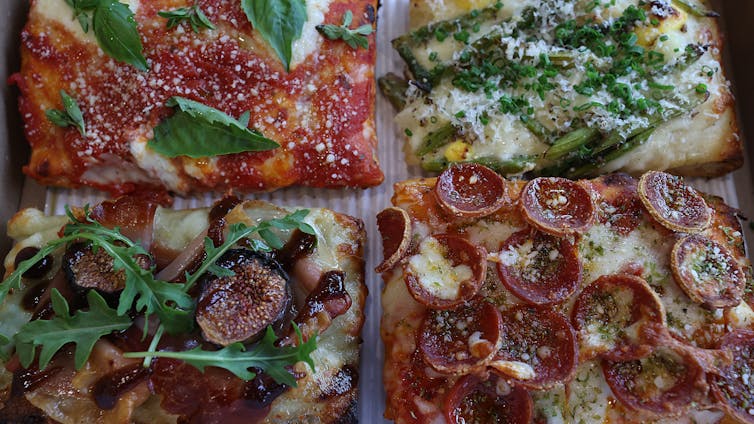
For an example, look no farther than Gainesville. A college town with fewer than 150,000 residents, Gainesville doesn’t have the same culinary cache as New York or Chicago, but it has developed a very unique pizza scene. With 13 independent pizzerias serving Neapolitan, Detroit, New York and Mediterranean styles and more, hungry Gators have a plethora of options when craving a slice. What makes Gainesville’s pizza scene especially interesting is the range of backgrounds its proprietors have. Through interviews with pizzeria owners, we found that some had started as artists and musicians, while others had worked in engineering or education – and each had their own unique approach to making pizzas. The owner of Strega Nona’s Oven, for example, uses his engineering background to turn dough-making into a science, altering the proportions of ingredients by as little as half of a percent based on the season or even the weather. Satchel’s Pizza, on the other hand, is filled with works made by its artist owner, including mosaic windows, paintings, sculptures and fountains. Gainesville’s independent pizzerias often serve as what sociologists call “third places”: spaces for gathering that aren’t home or work. And their owners think carefully about how to create a welcoming environment. For example, the owner of Scuola Pizza insisted the restaurant be free of TVs, so diners can focus on their food. Squarehouse Pizza features a large outdoor space; an old, now repurposed school bus outfitted with tables and chairs to dine in, and a stage for live music. Squarehouse also is known for its unusual toppings on square, Detroit-style pies – for example, the Mariah Curry, topped with curry chicken or cauliflower and coconut curry sauce. It refreshes its specialty menus every semester or two. While the American pizza landscape may be shaped by big brands and standardized menus, small pizzerias continue to shine. Gainesville is a perfect example of how a local pizza scene in a small Southern college town can be so unique, even in a globalized industry. Small pizzerias don’t just offer food – they offer a flavorful reminder that the marketplace rewards distinctiveness and local character, too. Paula de la Cruz-Fernández, Cultural Digital Collections Manager, University of Florida and Avi Ackerman, Researcher, Inquire Capitalism UF, University of Florida This article is republished from The Conversation under a Creative Commons license. Read the original article.

Discover more from Daily News

Subscribe to get the latest posts sent to your email.

Continue Reading
Advertisement Sports Research

recipes

Easy Bites for the Big Game

Easy Bites: Whether you’re tailgating with friends or hosting a watch party at home, every football fan needs a game plan to crunch, dip and cheer their way through opening kickoff, halftime and right down to the final play of the game. These Burger Bowls feature all the classic ingredients of a great burger, just without the bun. Pulled pork, another tailgating treasure, gets an instant upgrade with the crunch of a fresh coleslaw topper and zesty pickled celery and jalapenos on the side.

Published

on

Last Updated on January 15, 2026 by Daily News Staff

Easy Bites for the Big Game

Easy Bites for the Big Game

(Family Features) Whether you’re tailgating with friends or hosting a watch party at home, every football fan needs a game plan to crunch, dip and cheer their way through opening kickoff, halftime and right down to the final play of the game. Some of the best game day grub is hearty and savory but adding layers of flavor and texture can take recipes to the next level. For example, these Burger Bowls feature all the classic ingredients of a great burger, just without the bun. A tasty option for gluten-free guests or those who are cutting carbs, the bowls are made with Dandy Iceberg Lettuce from Duda Farm Fresh Foods, which boasts a legacy of quality, innovation and consistency in fresh produce cultivation since 1926. Pulled pork, another tailgating treasure, gets an instant upgrade with the crunch of a fresh coleslaw topper and zesty pickled celery and jalapenos on the side. The winning play is to use crisp, fresh celery for the best flavors and a satisfying crunch with every bite. Since celery is 95% water and high in fiber, it leaves fans feeling comfortably full and ready to root for their favorite team. This season, keep your snacks fresh and healthy while winning prizes like product coupons and gift cards to stock up for the next game through the Dip It to Win It Sweepstakes. Visit dudafresh.com to learn more and find additional game day recipes. 17761 detail embed1

Pulled Pork Sandwiches with Pickled Celery and Jalapenos

Recipe courtesy of The Adventure Bite Prep time: 10 minutes Cook time: 10 hours Servings: 9-10
  • 4 1/2    pounds pork shoulder or Boston butt
  • 26        ounces sweet and spicy barbecue sauce
  • 1/2       tablespoon garlic
  • 1/2       tablespoon fresh cracked black pepper
  •             fresh sandwich buns
  •             Dandy Celery, cut and pickled
  •             jalapenos
  •             coleslaw (optional)
  •             potato salad (optional)
  •             baked beans (optional)
  1. Place pork in slow cooker.
  2. Mix barbecue sauce, garlic and pepper. Pour over pork shoulder.
  3. Cook on low 8 1/2-10 hours or high 6-7 hours.
  4. Shred meat and serve on buns with pickled celery and jalapenos. Top with coleslaw, if desired. Serve with potato salad or baked beans, if desired.
17761 detal embed2

Burger Bowls

Recipe courtesy of Casa de Crews Prep time: 10 minutes Cook time: 10 minutes Servings: 4 Burger Bowls:
  • 2          cups French fries, homemade or frozen
  • 2          tablespoons olive oil
  • 1          small yellow onion, diced
  • 1          pound ground beef or ground turkey
  • 1          teaspoon Worcestershire sauce
  • 1          teaspoon garlic powder
  • 1/2       teaspoon smoked paprika
  • 1/2       teaspoon salt
  • 1/2       teaspoon black pepper
  • Dandy Iceberg Lettuce, shredded
  • 2-3       Roma tomatoes, diced
  • pickle chips or spears, chopped
  • cheddar cheese, shredded
Burger Sauce:
  • 1/3       cup mayonnaise
  • 2          tablespoons ketchup
  • 1          tablespoon Dijon mustard or yellow mustard
  • 1          tablespoon pickle juice
  • 1          teaspoon Worcestershire sauce
  • 1          teaspoon onion powder
  • 1          teaspoon garlic powder
  • 1/2       teaspoon smoked paprika
  1. To make burger bowls: Cook French fries according to package directions.
  2. In medium skillet over medium-high heat, heat olive oil. Add onion and saute until translucent, 5-7 minutes. Add ground beef to skillet, breaking up meat with spatula. Add Worcestershire sauce, garlic powder, paprika, salt and pepper; brown until cooked through. Drain and discard excess liquid and grease.
  3. To make burger sauce: In jar, mix mayonnaise, ketchup, mustard, pickle juice, Worcestershire sauce, onion powder, garlic powder and paprika well to combine.
  4. Assemble bowls with layer of shredded lettuce, 3-4 ounces ground beef, diced tomatoes, pickles, cheddar cheese and 1/2 cup fries.
  5. Drizzle with burger sauce and mix well.
  6. Tip: Burger sauce can be made in advance and stored in refrigerator in jar with airtight lid.

Easy Bites for the Big Game

SOURCE: Duda Farm Fresh Foods

Culver’s Thank You Farmers® Project Hits $8 Million Donation Milestone
Link: https://stmdailynews.com/culvers-thank-you-farmers-project-hits-8-million-donation-milestone/  

Discover more from Daily News

Subscribe to get the latest posts sent to your email.

Continue Reading

Food and Beverage

Papa Johns and Google Cloud Reimagine the Future of Food Ordering to Better Serve Customers

Papa Johns is partnering with Google Cloud to roll out an AI-powered omnichannel ordering system using Gemini Enterprise for Customer Experience, bringing voice and text ordering to apps, web, phone, kiosks and in-car systems.

Published

on

 
Papa Johns is partnering with Google Cloud to roll out an AI-powered omnichannel ordering system using Gemini Enterprise for Customer Experience, bringing voice and text ordering to apps, web, phone, kiosks and in-car systems.

american pepperoni pizza with chilli pepper and parmesan cheese

Papa Johns and Google Cloud Reimagine the Future of Food Ordering to Better Serve Customers

Papa Johns is betting big on AI-powered convenience.

At NRF 2026 in New York, the pizza chain announced a major transformation of its digital ordering experience—aimed at delivering faster ordering, improved accuracy, and real-time personalization for its 150 million-plus customers worldwide. The update is powered by Google Cloud’s newly expanded AI solution, the Food Ordering agent, part of Gemini Enterprise for Customer Experience. The key takeaway: Papa Johns is the first restaurant brand to bring these new omnichannel ordering capabilities to market—moving beyond basic chatbots and into what Google Cloud calls the era of agentic commerce, where AI doesn’t just answer questions, it actively completes tasks and improves outcomes.

From chatbot to “agentic” ordering

Food Ordering agent is designed to unify voice and text ordering across the places customers already interact with the brand—without forcing them to repeat themselves or start over when they switch channels. Instead of treating app ordering, phone ordering, kiosks, and in-car systems as separate experiences, the platform supports high-quality voice AI agents across:
  • Mobile apps
  • Websites
  • Telephones
  • Kiosks
  • In-car systems
This is a notable shift from earlier AI deployments that focused heavily on drive-thru automation. Here, the goal is a single, consistent ordering experience where customers can order how they want, where they want, with less friction.

What Papa Johns is building with Google Cloud

Papa Johns says the new system is designed to make ordering “faster, smarter, and more seamless than ever before.” The company’s Chief Digital and Technology Officer, Kevin Vasconi, framed it as more than a product refresh.
“Papa Johns is a digitally-driven business and, as such, one of our strategic priorities is investing in our technology to deliver a more seamless experience across our assets and owned channels, better connect with our customers, and support greater efficiency across our operations by leveraging data and AI,” Vasconi said. “We’re using Google Cloud’s Food Ordering agent to reimagine what’s possible for our customers. This isn’t just an app update; it’s a fundamental shift in how our customers interact with our brand digitally, making it faster, smarter, and more seamless than ever before.”
The new capabilities focus on three areas that tend to create the most friction in food ordering: deals, complex orders, and repeat purchases.

Intelligent Deal Wizard: fewer abandoned carts, more confidence

One of the most common reasons customers abandon carts is uncertainty—Did I pick the best deal? Is there a better promo code? Papa Johns’ Intelligent Deal Wizard is positioned as a personal concierge that automatically applies the best value combinations. The benefit is twofold:
  • Customers spend less time hunting for discounts
  • Papa Johns reduces cart abandonment and builds loyalty through instant value
In short: the system is designed to help customers feel like they’re getting the best price without extra steps.

Advanced Voice & Group Ordering: making complex orders easier

Group orders are where ordering systems often break down: multiple people, multiple changes, special instructions, and constant edits. Papa Johns’ Advanced Voice & Group Ordering is built to capture that revenue without requiring human intervention. By handling natural language nuances and real-time modifications, the system aims to improve order accuracy even when the request is complicated—exactly the kind of scenario where mistakes can lead to refunds, remakes, and lost customers.

No-tap reordering for Papa Rewards customers

Pizza ordering is often habitual. Many customers reorder the same items, especially loyal customers. With the new experience, the agent can identify returning Papa Rewards members and proactively ask if they want to reorder their most recent purchase. That no-tap flow matters because it shortens the distance between intent and checkout—turning a routine craving into a completed order in seconds.

Why it matters: omnichannel is now the expectation

Google Cloud’s Carrie Tharp, vice president of global solutions and industries, described the shift as a move beyond the chatbot era.
“The retail industry is entering the era of agentic commerce, where AI is an engine for business value,” Tharp said. “By being the first to deploy our omnichannel Food Ordering agent, Papa Johns is moving beyond the chatbot era to create a fluid, intelligent experience that meets hungry customers wherever they are, whether they are in their car, on an app, or at a kiosk.”
That’s the core point: customers don’t think in channels. They think in outcomes.
  • Ordering hands-free while driving
  • Reordering in one step from the couch
  • Using a kiosk quickly while picking up
If the experience is inconsistent, slow, or confusing, customers bounce. If it’s fast and accurate, they come back.

What’s next

Papa Johns will showcase the technology at the Google Cloud booth 5507 at NRF 2026: Retail’s Big Show in NYC, offering live demos to attendees. The company expects to roll out these capabilities to customers nationwide by the end of 2026.

About Papa Johns

Papa John’s International, Inc. (Nasdaq: PZZA) opened in 1984 with one goal: BETTER INGREDIENTS. BETTER PIZZA. Papa Johns says it uses high-quality ingredients, including fresh, never frozen original dough made with six ingredients, real mozzarella cheese, and vine-ripened tomato sauce. The company operates more than 6,000 restaurants across approximately 50 countries and territories.

About Google Cloud

Google Cloud provides AI, infrastructure, developer, data, security, and collaboration tools, offering an integrated AI stack built on planet-scale infrastructure and custom-built chips. Organizations in more than 200 countries and territories use Google Cloud as a technology partner.

Resources

STM Daily News is a vibrant news blog dedicated to sharing the brighter side of human experiences. Emphasizing positive, uplifting stories, the site focuses on delivering inspiring, informative, and well-researched content. With a commitment to accurate, fair, and responsible journalism, STM Daily News aims to foster a community of readers passionate about positive change and engaged in meaningful conversations. Join the movement and explore stories that celebrate the positive impacts shaping our world.

https://stmdailynews.com/


Discover more from Daily News

Subscribe to get the latest posts sent to your email.

Continue Reading

Food and Beverage

Put the Grill to Work In 2026

Transitioning from high-yield meals that serve a crowd to easy, homemade dinners can be a bit of a shock after the festivities are over. Save yourself the time and hassle of cooking after a season of gifts and gatherings with this Grilled Chicken Bundt recipe that lets the grill do the work for you.

Published

on

 homemade dinners can be a bit of a shock after the festivities are over. Save yourself the time and hassle of cooking after a season of gifts and gatherings with this Grilled Chicken Bundt recipe that lets the grill do the work for you.   (Family Features) Transitioning from high-yield meals that serve a crowd to easy, homemade dinners can be a bit of a shock after the festivities are over. Save yourself the time and hassle of cooking after a season of gifts and gatherings with this Grilled Chicken Bundt recipe that lets the grill do the work for you. For more time-saving family dinner ideas, visit Culinary.net.  homemade dinners can be a bit of a shock after the festivities are over. Save yourself the time and hassle of cooking after a season of gifts and gatherings with this Grilled Chicken Bundt recipe that lets the grill do the work for you.

Grilled Chicken Bundt

Recipe courtesy of “Cookin’ Savvy” Servings: 4-6
  • 4          potatoes
  • 2          carrots
  • 8          Brussel’s sprouts
  • oil
  • 2          tablespoons garlic powder, divided
  • 2          tablespoons onion powder, divided
  • 2          teaspoons salt, divided
  • 1          whole chicken (4-5 pounds)
  • 1/2       stick butter, softened
  1. Heat grill to 350 F with one burner off for indirect heat.
  2. Cut potatoes, carrots and Brussel’s sprouts into bite-sized pieces. Drizzle with oil and mix in 1 tablespoon garlic powder, 1 tablespoon onion powder and 1 teaspoon salt; set aside.
  3. Rub chicken with softened butter, remaining garlic powder, remaining onion powder and remaining salt.
  4. Place some veggies in bottom of bundt pan. Place chicken on top of chimney or tube of bundt pan. Fill pan with remaining veggies.
  5. Place pan over indirect heat and grill 1 hour, 30 minutes, or until chicken reaches internal temperature of 165 F.
collect?v=1&tid=UA 482330 7&cid=1955551e 1975 5e52 0cdb 8516071094cd&sc=start&t=pageview&dl=http%3A%2F%2Ftrack.familyfeatures SOURCE:

At our core, we at STM Daily News, strive to keep you informed and inspired with the freshest content on all things food and beverage. From mouthwatering recipes to intriguing articles, we’re here to satisfy your appetite for culinary knowledge.

Visit our Food & Drink section to get the latest on Foodie News and recipes, offering a delightful blend of culinary inspiration and gastronomic trends to elevate your dining experience. https://stmdailynews.com/food-and-drink/

Author


Discover more from Daily News

Subscribe to get the latest posts sent to your email.

Continue Reading

Trending