

Food and Beverage
La Brea Bakery Closes Flagship Los Angeles and Downtown Disney Café locations

Last Updated on January 12, 2025 by Daily News Staff
La Brea Bakery Café locations closed permanently on January 9th; the company is supporting employees through the transition process and turning business focus to grocery stores.
LOS ANGELES /PRNewswire/ — La Brea Bakery Café locations in Los Angeles and Downtown Disney District in Anaheim closed permanently this morning. The company has made the strategic decision to exit the restaurant business and continue its focus on growing the La Brea Bakery business through retail grocery and foodservice locations. Employees at the Los Angeles and Downtown Disney Café locations were informed of the closures on January 9th, 2023, while the Aspire Bakeries Human Resources team began working directly with employees that are impacted by the closures to ease the transition.


“We are so thankful and hold a tremendous amount of appreciation for our employees, and for our customers who have frequented La Brea Bakery Café over the years. Our flagship Café location on La Brea Avenue in Los Angeles is where the La Brea Bakery magic started 34 years ago. These humble beginnings are an integral part of the brand history, and we will forever be grateful to the local community for their support over the years,” said Tyson Yu, CEO of Aspire Bakeries, which owns La Brea Bakery. “While we will no longer be operating the Cafés in Los Angeles or at Disneyland Resort, you can still find our delicious La Brea Bakery artisan breads in your local grocery in-store bakery and at other locations that serve artisan breads.” The franchised La Brea Bakery kiosks in the Reno International Airport (Nevada) and JFK Airport (New York) will remain open.
A local favorite in the Los Angeles community since 1989, La Brea Bakery artisan breads are the cornerstone of Aspire Bakeries’ thriving artisan bread business. La Brea Bakery has a long history that started at a restaurant on La Brea Avenue in Los Angeles, evolving into the #1 artisan bread brand nationally. Still crafted using our original custom sourdough starter, the La Brea Bakery recipe has not changed in 34 years. In fact, our bread makers have maintained the same artisan techniques since 1989, with no compromises. Our quality ingredients and processes give our breads the hallmark flavor, texture and crust expected from authentic artisan bread, continuing the brand legacy.
La Brea Bakery artisan practices are our commitment to our loyal customers and our community. With our headquarters in Los Angeles, we bake artisan bread every day at our bakeries in California and New Jersey to meet needs across the country, and we look forward to the continued growth of our thriving grocery and foodservice business.
Impacted Locations:
- La Brea Bakery Café (Flagship), 468 La Brea Avenue, Los Angeles, California
- La Brea Bakery Café at Downtown Disney District, 1556 Disneyland Drive, Anaheim, California
About La Brea Bakery
La Brea Bakery is North America’s No.1 artisan bread brand. Since 1989, La Brea Bakery has focused on crafting true artisan bread with its original recipe, high quality ingredients and dedication to the artisan process. Based in Los Angeles, the brand has revolutionized the modern artisan bread movement, enabling the culinary community and consumers to share the joy that hearth-baked, hand-crafted bread brings to their experiences. La Brea Bakery foods are sold at grocery stores, online retailers and restaurant channels across the country. Find La Brea Bakery breads near you: www.labreabakery.com/where-to-buy and follow us on Instagram and Facebook.
SOURCE La Brea Bakery
https://stmdailynews.com/category/food-and-beverage/
Author

Discover more from Daily News
Subscribe to get the latest posts sent to your email.


Food and Beverage
Why eating cheap chocolate can feel embarrassing – even though no one else cares
Cheap Chocolates: The concept of “consumption stigma” describes how societal judgments influence individuals’ everyday consumption choices, leading to feelings of embarrassment and anxiety. People may alter their behaviors to avoid stigma, sometimes opting for more expensive products. Reclaiming the narrative around consumption can help reduce stigma, fostering a more accepting marketplace.

Last Updated on March 10, 2026 by Daily News Staff

Siti Nuraisyah Suwanda, West Virginia University; Emily Tanner, West Virginia University, and M. Paula Fitzgerald, West Virginia University
It’s February, and you grab a box of cheap Valentine’s chocolate from the grocery store on your lunch break. Later, you’re eating it at your office desk when you realize someone else is watching. Suddenly, you feel a flicker of embarrassment. You hide the box away, make a joke or quietly wish they hadn’t noticed – not because the chocolate tastes bad, but because you don’t want to be judged for choosing it.
If the scenario above feels familiar, you’re not alone. Many people experience subtle embarrassment or self-consciousness about everyday consumption choices, from eating cheap Valentine’s chocolate to accepting free lunch from a school food program or having visible tattoos.
We are social marketing researchers who study stigma in marketing. In our research, we coined the term “consumption stigma” to describe how people can be judged or looked down on by others, or by themselves, simply for using certain products – even when there’s nothing objectively wrong with them.
Living with consumption stigma
When people feel judged for what they consume, or choose not to consume, the effects can be mentally exhausting. Feeling stigmatized can quietly erode self-esteem, increase anxiety and change how people behave in everyday settings. What starts as a small moment of embarrassment can grow into a persistent concern about being seen the “wrong” way.
In reviewing 50 studies about stigma in marketing, we found that people respond to consumption stigma along a continuum. Some try to avoid stigma altogether by hiding their consumption or staying away from certain products. Others adjust their behavior to reduce the risk of being judged. At the far end of the spectrum, some people actively push back, helping to destigmatize certain forms of consumption for themselves and for others.
The research we reviewed found that to avoid stigma, people may deliberately consume more expensive or socially approved alternatives, even when those choices strain their finances. Imagine someone who switches to a premium chocolate brand at the office, not because she prefers the taste, but because she wants to avoid feeling embarrassed.
Over time, this kind of adjustment could pull people into spending patterns that are beyond their means, feeding a cycle of consumption driven more by social pressure than genuine need or enjoyment. We suggest that the ramifications can be even more stark in other contexts – for example, when a child skips a free school lunch to avoid being teased, or when a veteran turns down mental health support because they fear being judged by others.
From a business perspective, when consumers avoid or abandon products to escape stigma, companies may see declining demand that has little to do with quality or value. We suggest that if consumption stigma spreads at scale, the cumulative effect can translate into lost revenue and weakened brand value.
Understanding consumption stigma, then, isn’t just about consumer well-being; it’s also critical for businesses trying to understand why people buy, hide or walk away from certain products.
Take back the narrative
Stigma often feels powerful because it masquerades as reality. But at its core, consumption stigma is a social judgment, a shared story people tell about what certain choices supposedly say about someone. When that story goes unchallenged, stigma sticks. When it’s questioned, its power starts to fade.
One way people reduce stigma is by reclaiming the narrative around their consumption. Instead of hiding, explaining or compensating, they openly own their choices. This shift from avoidance to acceptance can strip stigma of its force.
Imagine a shopper who embraces buying cheaper store brands at the grocery store, seeing it not as a compromise but as a sign of being savvy to pay less for the same thing. When people wear their choices like armor, whether it’s cheap chocolate, secondhand clothing or specialized physical or mental health services, those choices lose their sting. When a behavior is no longer treated as something shameful, it becomes harder for others to use it as a basis for judging or looking down on people.
Of course, stigma doesn’t disappear overnight. But research shows that when enough people stop treating a behavior as something to hide, the social meaning around it begins to change. What feels embarrassing in one moment can become normalized in the next. For example, research on fashion consumption has shown how wearing a veil, once widely stigmatized in urban and secular settings, gradually became seen as ordinary and even fashionable as more women openly adopted it.
Enjoying cheap chocolate shouldn’t require justification. Cold water tastes just as good out of an unbranded travel mug as it does from a Stanley tumbler. A generic sweatshirt keeps you just as cozy as Aritzia. And yet, many people feel the need to explain, deflect or upgrade their choices to avoid being judged. Understanding consumption stigma helps explain why and underscores that these feelings aren’t personal failures, but social constructions.
Sometimes, the most effective response isn’t to consume differently, but to think differently. When people stop treating everyday choices as moral signals, they make room for a more humane – and hopefully honest – marketplace.
Siti Nuraisyah Suwanda, Doctoral Student and Graduate Researcher in Marketing, West Virginia University; Emily Tanner, Associate Professor of Marketing, West Virginia University, and M. Paula Fitzgerald, Professor of Business Administration, West Virginia University
This article is republished from The Conversation under a Creative Commons license. Read the original article.
Author

Discover more from Daily News
Subscribe to get the latest posts sent to your email.

Last Updated on March 10, 2026 by Daily News Staff
We present two recipes for tomato soup, one quick recipe and one for the slow cooker. There are two choices for a delicious time at the dining table.
Savory Tomato Soup: A Simple Recipe!
Ingredients:
- Crushed Tomatoes
- Onions
- Butter or Olive Oil
- Garlic
- Vegetable Broth
Cook the onions in the butter
- If you prefer vegan, use oil instead.
- Don’t brown the onions
- Wait until bubbles form
Add the garlic and tomatoes
- Add garlic first
- Soften it a bit
- Then add a can of crushed tomatoes
Add the vegetable broth
- Leave the pot uncovered
- Cook for 30 minutes
- Use a blender to make it smooth
Slow Cooker Recipe
Ingredients:
-2 (14.5 ounce) cans diced tomatoes
-1 (14.5 ounce) can chicken broth
-1 (14.5 ounce) can vegetable broth
-1/2 cup diced onion
-1/2 teaspoon garlic powder
-1/2 teaspoon dried basil
-1/2 teaspoon dried oregano
-1/2 teaspoon ground black pepper
-1/4 teaspoon red pepper flakes
-1/4 cup heavy cream
Instructions:
- Combine the diced tomatoes, chicken broth, vegetable broth, onion, garlic powder, basil, oregano, black pepper, and red pepper flakes in a slow cooker.
- Cover and cook on low heat for 6-8 hours.
- Once the soup is cooked, stir in the heavy cream.
- Serve with your favorite toppings. Enjoy!
- Check out these recipes for Savory Tomato Soup:
- https://www.food.com/recipe/savoury-tomato-soup-414409
- https://www.thissavoryvegan.com/roasted-garlic-tomato-soup/
For more recipes and information on Food and Drinks, visit https://stmdailynews.com/category/food-and-beverage/recipes/ for the latest articles.
Discover more from Daily News
Subscribe to get the latest posts sent to your email.
Food and Beverage
A Convenient Homecooked Solution Without the Slow Cooker
For a quick and easy version of the comfort food classic, consider this Quick Homecooked Chili that’s made in a skillet and ready in half an hour. Just brown ground beef with a chopped onion, stir in beans, tomato sauce, cubed sweet potato and a few simple seasonings and you’re well on your way to a winter warmup.
Last Updated on March 10, 2026 by Daily News Staff
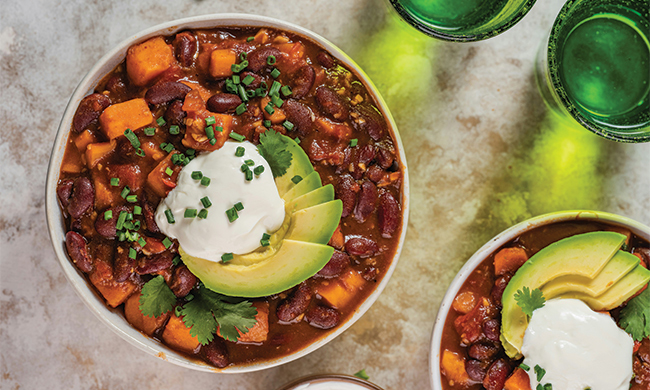
Homecooked Chili
(Family Features) Walking in the door to the smell of homemade chili is sure to warm you up from the inside-out, but if you forgot to set up the slow cooker before heading out the door in the morning, don’t fret – a hearty bowl of beans, beef and stewed goodness can still await.
For a quick and easy version of the comfort food classic, consider this Quick Homecooked Chili that’s made in a skillet and ready in half an hour. Just brown ground beef with a chopped onion, stir in beans, tomato sauce, cubed sweet potato and a few simple seasonings and you’re well on your way to a winter warmup.
Find more easy ways to feed your family by visiting Culinary.net.
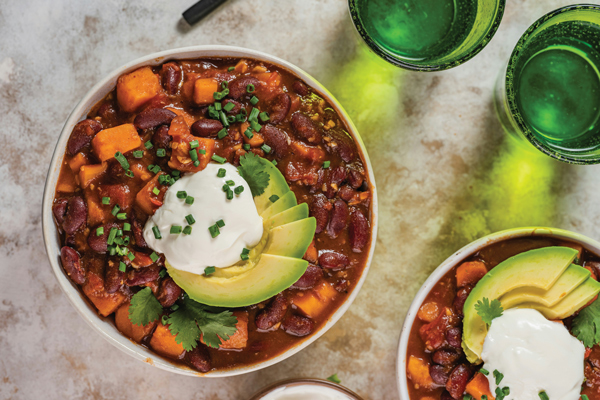
Quick Homecooked Chili
Recipe adapted from Allrecipes
Prep time: 10 minutes
Cook time: 20 minutes
Servings: 6
- 1 pound ground beef
- 1 onion, chopped
- 1 can (15 ounces) tomato sauce
- 1 can (15 ounces) kidney beans
- 1 can (14 1/2 ounces) stewed tomatoes
- 1 can (10 ounces) diced tomatoes with green chilies
- 1 sweet potato, cubed
- water (optional)
- 1 teaspoon chili powder
- 1 pinch garlic powder
- salt, to taste
- pepper, to taste
- sour cream (optional)
- sliced avocado (optional)
- In large saucepan over medium heat, cook ground beef and onion until meat is browned and onion is tender, 5-7 minutes.
- Stir in tomato sauce, kidney beans, stewed tomatoes with juices, diced tomatoes with green chilies and cubed sweet potato. Add water to reach desired consistency.
- Season with chili powder and garlic powder. Add salt and pepper, to taste.
- Bring to boil then reduce heat to low. Cover and simmer 15 minutes.
- Serve with sour cream and sliced avocado, if desired.
Photo courtesy of Unsplash
SOURCE:
Discover more from Daily News
Subscribe to get the latest posts sent to your email.





