

The Knowledge
Aliens Visiting Earth? The Case for Studying UAP Like a Real Science Problem

Last Updated on February 28, 2026 by Daily News Staff
For decades, the idea of aliens visiting Earth has lived in a cultural no-man’s-land: too fascinating to ignore, too stigmatized to study seriously, and too easy to dismiss with a joke. But that posture has shifted in a measurable way over the past several years.
Physicist Kevin Knuth (University at Albany, SUNY) argued in a 2018 essay for The Conversation that the question of whether some UFO reports could represent something truly unknown is worthy of serious scientific study — not because we have proof of extraterrestrials, but because a small portion of cases appear to resist easy explanation and involve trained observers, multiple sensors, or unusual performance claims.
Article: https://theconversation.com/are-we-alone-the-question-is-worthy-of-serious-scientific-study-98843
That argument gained new oxygen in late 2017, when The New York Times reported that the U.S. Department of Defense had funded a program known as the Advanced Aerospace Threat Identification Program (AATIP). The reporting described roughly $22 million spent to examine military reports of unusual aerial incidents. Former Pentagon official Luis Elizondo became a central public figure in the story, saying he left his role amid frustration over secrecy and limited support for deeper investigation.
Around the same time, the Pentagon confirmed and released several now-famous military videos showing encounters recorded on forward-looking infrared (FLIR) systems from Navy aircraft — clips that reignited public debate and pushed the topic out of late-night-TV territory and into mainstream news.
What we’ve learned since (2018–2026)
The biggest “update” since your original post isn’t a single smoking gun. It’s the fact that the U.S. government and scientific institutions have increasingly treated the issue as a data and airspace-safety problem—and, potentially, a national security one.
A few key developments:
- The language changed: “UFO” has increasingly been replaced by UAP (Unidentified Anomalous Phenomena), a term meant to reduce stigma and widen the scope beyond “flying saucers.”
- Regular reporting became normalized: The Office of the Director of National Intelligence (ODNI) has issued public-facing UAP reporting in recent years, and the Department of Defense has continued formal tracking through dedicated offices.
- NASA stepped in: NASA convened an independent UAP study team, releasing a final report in 2023 that emphasized something simple but important: if you want answers, you need better data, consistent reporting standards, and transparent methods. (NASA’s stance was not “aliens confirmed,” but “this is a legitimate area for structured inquiry.”)
The Carl Sagan test still applies
Carl Sagan’s line remains the guardrail here:
“Extraordinary claims require extraordinary evidence.”
In other words: eyewitness testimony alone — even sincere testimony — isn’t enough. A personal story, a viral clip, or even a dramatic encounter doesn’t automatically equal proof of extraterrestrial visitation. If the claim is “non-human intelligence is visiting Earth,” the evidence has to be strong enough to survive serious scrutiny: repeatable analysis, multi-sensor confirmation, chain-of-custody, and independent review.
So where does that leave us?
If you strip away the hype, the most reasonable position in 2026 looks something like this:
- Something is being observed in a small percentage of cases that isn’t immediately identifiable.
- That does not automatically mean “aliens.”
- But it does mean the topic is no longer intellectually off-limits the way it once was.
After leaving AATIP-related work, Elizondo became associated with To The Stars Academy of Arts & Science, a group founded by musician Tom DeLonge that aimed to blend public interest, aerospace ideas, and advocacy for further investigation. Whether you view that effort as serious research, public outreach, or a media-adjacent project, it reflects the broader reality: the conversation has moved from fringe forums into public institutions.
The next step shouldn’t be louder claims. It should be better instrumentation, better reporting, and better science—because if there’s a prosaic explanation, rigorous study will reveal it. And if there’s something genuinely novel in the data, that’s exactly what science is for.
More STM Daily News science coverage: https://stmdailynews.com/category/science/
Authors







The Knowledge
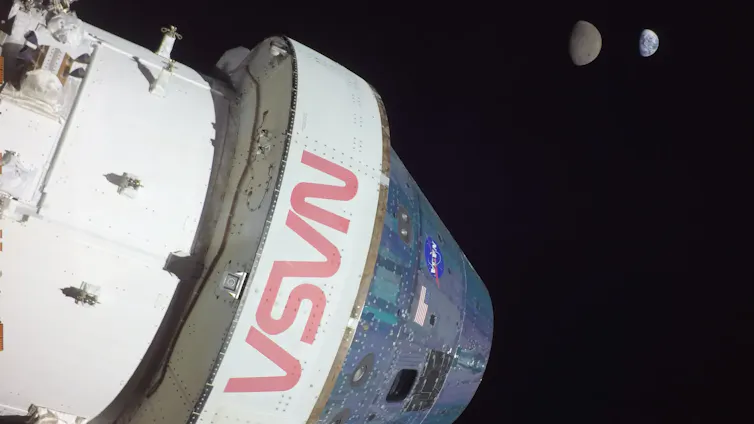
Artemis II’s long countdown – a space historian explains why it has taken over 50 years to return to the Moon
Why has it taken 50+ years to return to the Moon? A space historian explains the technical, political, and financial complexities behind Artemis II’s long journey.

Emily A. Margolis, Smithsonian Institution
While I was leading a tour of the National Air and Space Museum in January 2026, a visitor posed this insightful question: “Why has it taken so long to return to the Moon?”
After all, NASA had the know-how and technology to send humans to the lunar surface more than 50 years ago as part of the Apollo program. And, as another tour guest reminded us, computers today can do so much more than they could back then, as evidenced by the smartphones most of us carry in our pockets. Shouldn’t it be easier to get to the Moon than ever before?
The truth is that sending humans into space safely continues to be difficult, especially as missions increase in complexity.
New technologies require years of study, development and testing before they can be certified for flight. And even then, systems and materials can behave in ways that surprise and worry engineers and mission planners; look no further than Boeing’s Starliner CFT mission or the performance of the Orion heat shield on Artemis I.
Issues with Starliner’s thrusters led NASA to return the spacecraft from the International Space Station without its crew. Unanticipated chipping of the Orion heat shield resulted in years of research, culminating in NASA altering the atmospheric reentry plans for the Artemis II mission.
NASA’s programs also require sustained political will and financial support across multiple presidential administrations, Congresses and fiscal years. As a historian of human spaceflight, I have studied the space agency’s efforts to engage the broader public to convince American taxpayers that their programs hold value for the nation.
NASA is now on the eve of the first crewed flight to the Moon since the Apollo era: Artemis II. A crew of four will conduct a lunar flyby, laying the groundwork, the agency hopes, for a landing on the Artemis IV mission.
The story of NASA’s effort to return humans to the Moon is long and winding, demonstrating the complexities of turning grand ambitions into real missions.
Post-Apollo
In early 1970, with two successful Moon landings on the books, President Richard Nixon sought to reduce NASA’s budget to better align with his administration’s priorities. This decision put the space agency in a difficult position, which ultimately led to the cancellation of three planned Apollo missions to conserve funding for its plans for long-term human activity in low Earth orbit.
NASA repurposed the third stage of a Saturn V rocket to create the first U.S. space station, Skylab, which operated from 1973 to 1974. The space agency used leftover Saturn IB rockets and Apollo command and service modules to send crews to the station.
Over the next three decades, NASA developed and operated the space shuttle. The fleet of space shuttle orbiters supported satellite deployment and microgravity research on orbital missions of up to 17 days. This work was meant to enable future long-duration human missions and provide benefits to people on Earth. For example, data from protein crystal growth experiments have informed the development of medicines.
The space shuttle program facilitated the construction, maintenance and staffing of a continuously inhabited research platform in orbit, the International Space Station. The first modules launched in late 1998.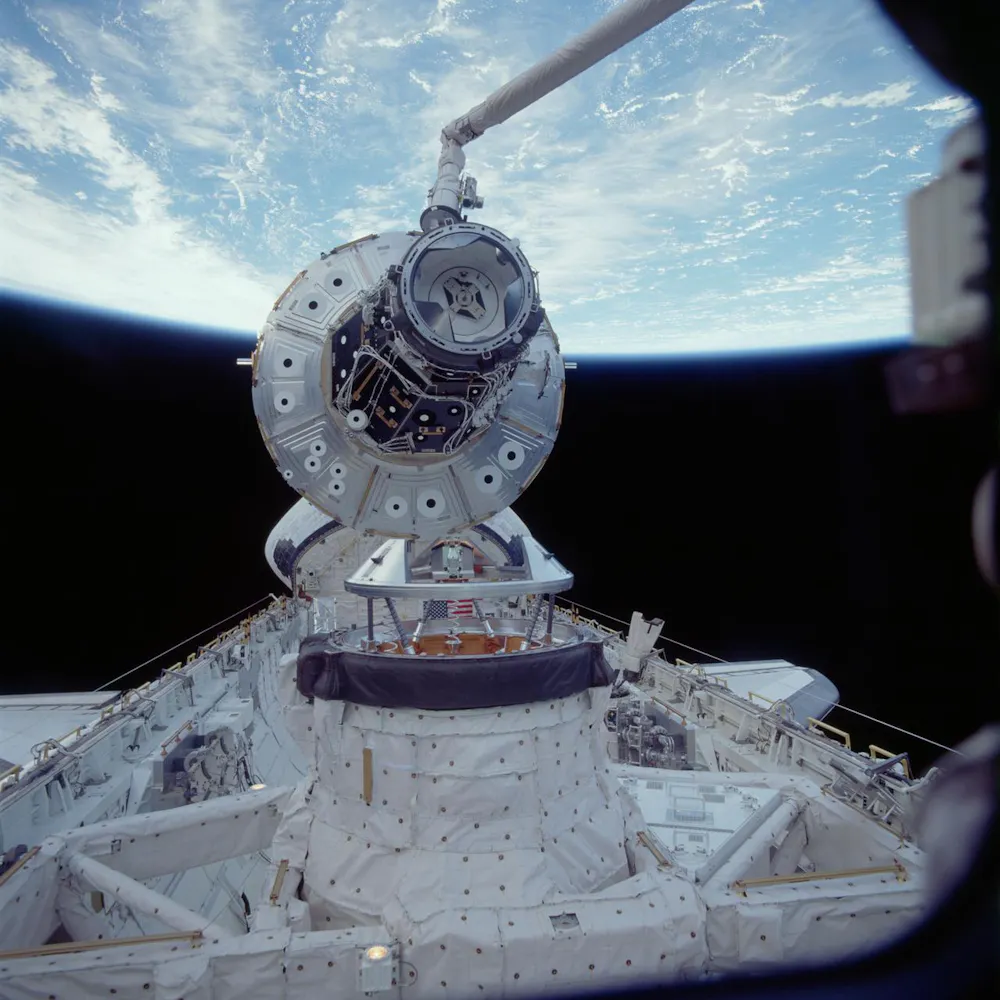
Where to next?
As the new millennium approached, the Clinton administration tasked NASA to think beyond the space station. What could robots and humans do next in space? And where could they do it? Notably, the White House expressed an interest in locations beyond low Earth orbit.
NASA, it turned out, was well positioned to meet the administration’s request. NASA Administrator Daniel Goldin was already thinking about preparing proposals for the next presidential administration and had recently sponsored a human lunar return study. In 1999, he established a team to investigate new technologies, missions and destinations for the 21st century.
This work took on new significance following the tragic loss of the space shuttle Columbia crew in February 2003. Many people, including those in the new George W. Bush White House, wondered whether the human spaceflight program should continue – and, if so, how.
Administration discussions culminated in Bush’s Vision for Space Exploration in 2004, which directed NASA to retire the space shuttle after the completion of the space station. It called for returning humans to the Moon on a crew exploration vehicle designed for destinations beyond low Earth orbit.
It also called for continuing robotic exploration of Mars and engaging companies and international partners in space. Fifteen years earlier, President George H. W. Bush had also announced a Moon and Mars exploration program, but congressional concerns about cost kept space travelers close to home.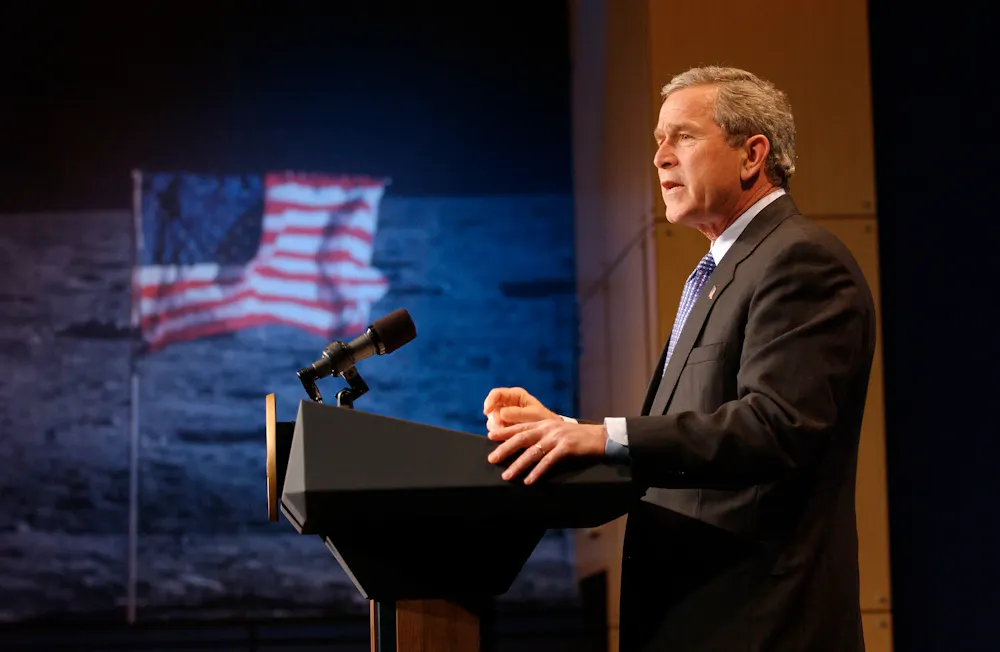
The Constellation program’s legacy
In December 2004, NASA began the process of finding a manufacturer for the crew exploration vehicle. By August 2006, the space agency awarded Lockheed Martin the contract to build the capsule, which it had named Orion – the same Orion planned to carry Artemis astronauts to the Moon.
Years of research, development and testing followed for Orion as well as the Ares I crew and Ares V cargo launch vehicles. Together, these technologies made up the Constellation program.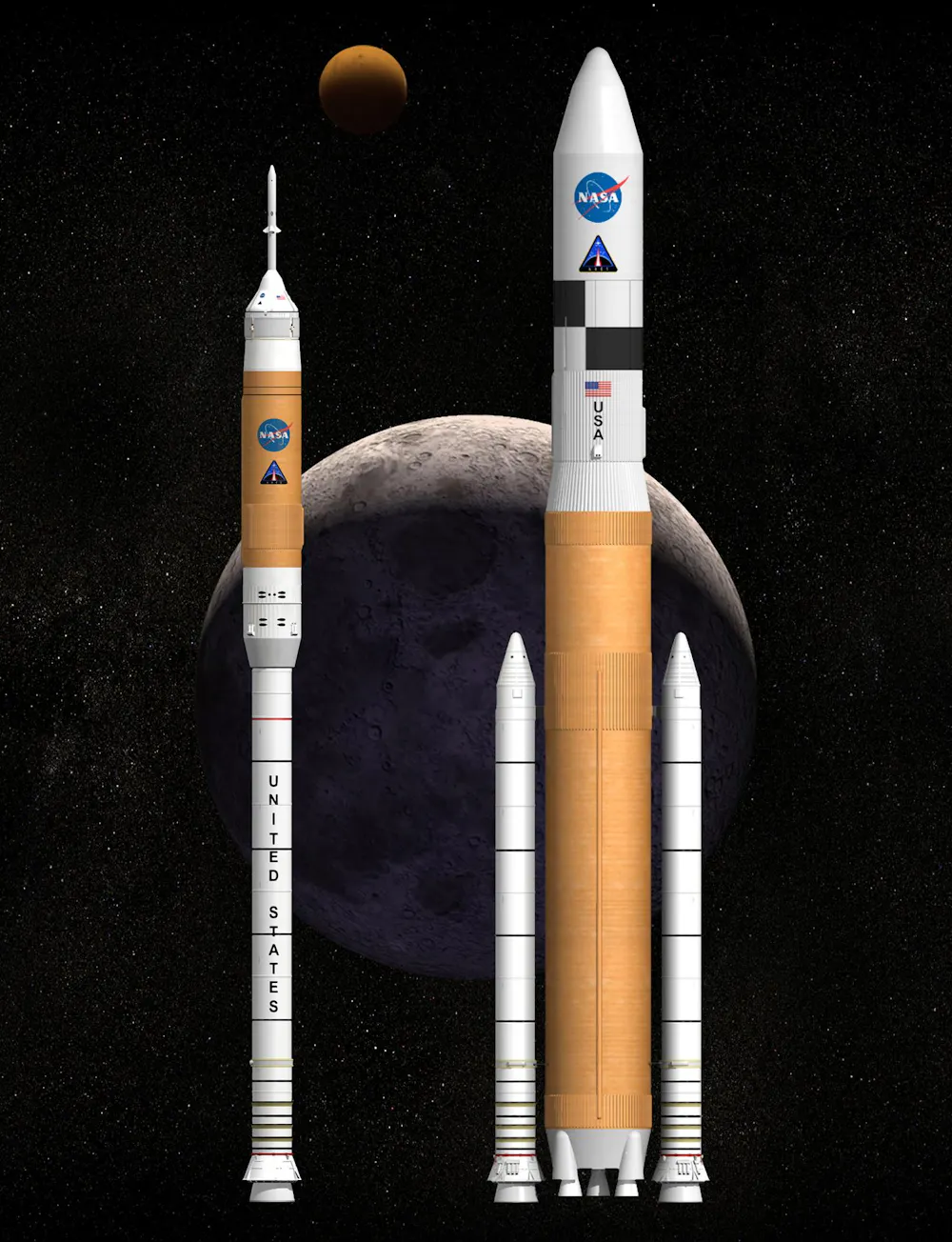
Constellation had two primary objectives: in the near term, to help transport crew to and from the space station after the space shuttle program ended; in the long term, to enable human lunar exploration.
Building systems that could work in both Earth orbit and around the Moon was supposed to save the time and cost of developing two vehicles. Similarly, adapting space shuttle program hardware could supposedly cut costs.
During the first months of Barack Obama’s presidency in 2009, the administration initiated an independent review of NASA’s human spaceflight plans. The Augustine Committee, chaired by retired aerospace executive Norman Augustine, found that the agency’s ambitions outstripped its limited budget, leading to significant delays. The first Orion spacecraft was likely to arrive after the space station ceased operations.
The committee proposed several paths forward at the current funding level, which prioritized space shuttle and space station programs. An additional annual investment of US$3 billion would allow for human exploration beyond low Earth orbit.
Ultimately, the Obama administration canceled Constellation, but two of its technologies lived on, thanks to U.S. senators from states that would have been affected by cuts.
The NASA Authorization Act of 2010 funded Orion’s continued development, shifting responsibility for space station crew transportation to commercial vehicles. It also directed NASA to develop the space launch system, a redesigned Ares V heavy booster, to send Orion to the Moon. The technical strategy had political benefits, too, preserving jobs in numerous congressional districts by providing continuity for aerospace contractors.
In December 2014, a Delta IV heavy rocket launched the first Orion capsule on a test flight, providing engineers with data on spacecraft systems and the heat shield. By October 2015, the space launch system had completed a critical design review, the last step before manufacturing could begin.
Introducing Artemis
In December 2017, the new Trump administration issued a policy directive shifting the focus of NASA’s human spaceflight program back to the Moon. The space agency would use Orion and the space launch system in a race to meet an ambitious 2024 landing date. NASA officially named the program Artemis in May 2019.
The 25-day Artemis I mission, launched in November 2022, was a major milestone for the program. This uncrewed flight was the first flight of the space launch system and the first to integrate SLS and Orion. It laid the groundwork for Artemis II, which will be the first crewed flight of the SLS.
Over more than 50 years, each new presidential administration has reassessed the place of spaceflight among its priorities, either encouraging or curtailing NASA’s efforts to return humans to the lunar surface.
Each crewed flight requires the alignment of technical expertise, political will and financial support over years if not decades. For the space fans who plan to watch the Artemis II launch, the wait for countdown may feel long. But it’s just a blink in NASA’s long journey back to the Moon.
Emily A. Margolis, Curator of Contemporary Spaceflight, National Air and Space Museum, Smithsonian Institution
This article is republished from The Conversation under a Creative Commons license. Read the original article.
Dive into “The Knowledge,” where curiosity meets clarity. This playlist, in collaboration with STMDailyNews.com, is designed for viewers who value historical accuracy and insightful learning. Our short videos, ranging from 30 seconds to a minute and a half, make complex subjects easy to grasp in no time. Covering everything from historical events to contemporary processes and entertainment, “The Knowledge” bridges the past with the present. In a world where information is abundant yet often misused, our series aims to guide you through the noise, preserving vital knowledge and truths that shape our lives today. Perfect for curious minds eager to discover the ‘why’ and ‘how’ of everything around us. Subscribe and join in as we explore the facts that matter. https://stmdailynews.com/the-knowledge/
News
Children can be systematic problem-solvers at younger ages than psychologists had thought – new research
Child psychologists: Celeste Kidd’s research challenges long-standing ideas from Jean Piaget about children’s problem-solving abilities. Her findings show that children as young as four can independently utilize algorithmic strategies to solve complex tasks, contradicting the belief that systematic logical thinking develops only after age seven. This insight highlights the importance of nurturing algorithmic thinking in early education.
Last Updated on March 16, 2026 by Daily News Staff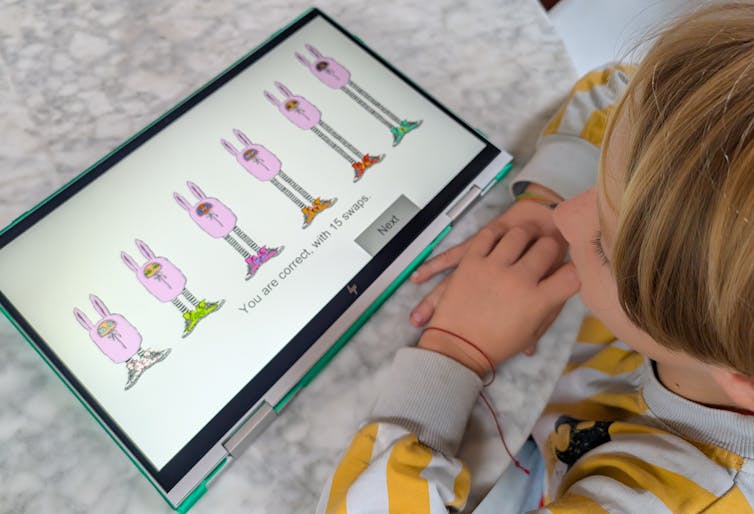
Celeste Kidd, University of California, Berkeley
I’m in a coffee shop when a young child dumps out his mother’s bag in search of fruit snacks. The contents spill onto the table, bench and floor. It’s a chaotic – but functional – solution to the problem.
Children have a penchant for unconventional thinking that, at first glance, can look disordered. This kind of apparently chaotic behavior served as the inspiration for developmental psychologist Jean Piaget’s best-known theory: that children construct their knowledge through experience and must pass through four sequential stages, the first two of which lack the ability to use structured logic.
Piaget remains the GOAT of developmental psychology. He fundamentally and forever changed the world’s view of children by showing that kids do not enter the world with the same conceptual building blocks as adults, but must construct them through experience. No one before or since has amassed such a catalog of quirky child behaviors that researchers even today can replicate within individual children.
While Piaget was certainly correct in observing that children engage in a host of unusual behaviors, my lab recently uncovered evidence that upends some long-standing assumptions about the limits of children’s logical capabilities that originated with his work. Our new paper in the journal Nature Human Behaviour describes how young children are capable of finding systematic solutions to complex problems without any instruction. https://www.youtube.com/embed/Qb4TPj1pxzQ?wmode=transparent&start=0 Jean Piaget describes how children of different ages tackle a sorting task, with varying success.
Putting things in order
Throughout the 1960s, Piaget observed that young children rely on clunky trial-and-error methods rather than systematic strategies when attempting to order objects according to some continuous quantitative dimension, like length. For instance, a 4-year-old child asked to organize sticks from shortest to longest will move them around randomly and usually not achieve the desired final order.
Psychologists have interpreted young children’s inefficient behavior in this kind of ordering task – what we call a seriation task – as an indicator that kids can’t use systematic strategies in problem-solving until at least age 7.
Somewhat counterintuitively, my colleagues and I found that increasing the difficulty and cognitive demands of the seriation task actually prompted young children to discover and use algorithmic solutions to solve it.
Piaget’s classic study asked children to put some visible items like wooden sticks in order by height. Huiwen Alex Yang, a psychology Ph.D. candidate who works on computational models of learning in my lab, cranked up the difficulty for our version of the task. With advice from our collaborator Bill Thompson, Yang designed a computer game that required children to use feedback clues to infer the height order of items hidden behind a wall, .
The game asked children to order bunnylike creatures from shortest to tallest by clicking on their sneakers to swap their places. The creatures only changed places if they were in the wrong order; otherwise they stayed put. Because they could only see the bunnies’ shoes and not their heights, children had to rely on logical inference rather than direct observation to solve the task. Yang tested 123 children between the ages of 4 and 10. https://www.youtube.com/embed/GlsbcE6nOxk?wmode=transparent&start=0 Researcher Huiwen Alex Yang tests 8-year-old Miro on the bunny sorting task. The bunnies are hidden behind a wall with only their sneakers visible. Miro’s selections exemplify use of selection sort, a classic efficient sorting algorithm from computer science. Kidd Lab at UC Berkeley.
Figuring out a strategy
We found that children independently discovered and applied at least two well-known sorting algorithms. These strategies – called selection sort and shaker sort – are typically studied in computer science.
More than half the children we tested demonstrated evidence of structured algorithmic thinking, and at ages as young as 4 years old. While older kids were more likely to use algorithmic strategies, our finding contrasts with Piaget’s belief that children were incapable of this kind of systematic strategizing before 7 years of age. He thought kids needed to reach what he called the concrete operational stage of development first.
Our results suggest that children are actually capable of spontaneous logical strategy discovery much earlier when circumstances require it. In our task, a trial-and-error strategy could not work because the objects to be ordered were not directly observable; children could not rely on perceptual feedback.
Explaining our results requires a more nuanced interpretation of Piaget’s original data. While children may still favor apparently less logical solutions to problems during the first two Piagetian stages, it’s not because they are incapable of doing otherwise if the situation requires it.
A systematic approach to life
Algorithmic thinking is crucial not only in high-level math classes, but also in everyday life. Imagine that you need to bake two dozen cookies, but your go-to recipe yields only one. You could go through all the steps of making the recipe twice, washing the bowl in between, but you’d never do that because you know that would be inefficient. Instead, you’d double the ingredients and perform each step only once. Algorithmic thinking allows you to identify a systematic way of approaching the need for twice as many cookies that improves the efficiency of your baking.
Algorithmic thinking is an important capacity that’s useful to children as they learn to move and operate in the world – and we now know they have access to these abilities far earlier than psychologists had believed.
That children can engage with algorithmic thinking before formal instruction has important implications for STEM – science, technology, engineering and math –education. Caregivers and educators now need to reconsider when and how they give children the opportunity to tackle more abstract problems and concepts. Knowing that children’s minds are ready for structured problems as early as preschool means we can nurture these abilities earlier in support of stronger math and computational skills.
And have some patience next time you encounter children interacting with the world in ways that are perhaps not super convenient. As you pick up your belongings from a café floor, remember that it’s all part of how children construct their knowledge. Those seemingly chaotic kids are on their way to more obviously logical behavior soon.
Celeste Kidd, Professor of Psychology, University of California, Berkeley
This article is republished from The Conversation under a Creative Commons license. Read the original article.
Dive into “The Knowledge,” where curiosity meets clarity. This playlist, in collaboration with STMDailyNews.com, is designed for viewers who value historical accuracy and insightful learning. Our short videos, ranging from 30 seconds to a minute and a half, make complex subjects easy to grasp in no time. Covering everything from historical events to contemporary processes and entertainment, “The Knowledge” bridges the past with the present. In a world where information is abundant yet often misused, our series aims to guide you through the noise, preserving vital knowledge and truths that shape our lives today. Perfect for curious minds eager to discover the ‘why’ and ‘how’ of everything around us. Subscribe and join in as we explore the facts that matter. https://stmdailynews.com/the-knowledge/
Entertainment
Byron Allen’s Starz Stake Signals Bigger Moves in the Streaming Industry
Byron Allen’s Starz: Byron Allen has acquired a 10.7% stake in Starz Entertainment for approximately $25 million, signaling his long-term media strategy amidst industry consolidation. This investment positions him influentially in the evolving streaming market despite intense competition.

Byron Allen’s Starz investment
Media entrepreneur Byron Allen has taken another step toward expanding his growing media empire. Through his family office, Allen recently acquired a 10.7% stake in Starz Entertainment, purchasing the shares from a fund managed by former U.S. Treasury Secretary Steven Mnuchin.
The transaction, valued at approximately $25 million, gives Allen a significant minority position in the premium cable and streaming platform. While the investment itself may seem modest compared to the billion-dollar deals common in Hollywood, analysts say the move could signal a larger strategy unfolding in the rapidly evolving streaming industry.
Why the Starz Deal Matters
The shares were sold by Mnuchin’s Liberty 77 Capital fund, which previously invested in the company when Starz was still connected to its former parent, Lionsgate.
In 2025, Lionsgate completed a corporate restructuring that separated its operations into two distinct companies:
- Lionsgate Studios – responsible for film and television production
- Starz – focused on premium cable and streaming services
Following the spin-off, Starz became an independent publicly traded company. As a result, investors are still determining the platform’s long-term value in an increasingly crowded streaming marketplace.
A Streaming Platform With Loyal Audiences
Despite facing intense competition from larger platforms such as Netflix, Disney+, and Amazon Prime Video, Starz continues to maintain a strong subscriber base and recognizable content franchises.
- Outlander – historical drama series
- The Power franchise created by Courtney A. Kemp and executive produced by 50 Cent
Byron Allen’s Long-Term Media Strategy
Allen’s investment strategy has long focused on owning media distribution and infrastructure rather than simply producing content.
- The Weather Channel
- Dozens of local television stations across the United States
- Multiple niche cable networks and digital platforms
Over the past several years, Allen has also pursued larger acquisitions, reportedly exploring deals involving companies such as Paramount Global and BET Media Group. While those deals did not materialize, they signaled his ambition to expand Allen Media Group into a major force in global media ownership.
The Bigger Picture: Industry Consolidation
Allen’s investment arrives during a time of significant disruption in the entertainment business. Traditional cable television continues to decline as audiences migrate toward streaming platforms. At the same time, major studios and media companies are struggling to make streaming services consistently profitable.
Industry observers believe these pressures could lead to a new wave of consolidation across Hollywood and the streaming sector. Smaller platforms like Starz could become attractive acquisition targets for larger companies seeking additional subscribers and content libraries.
A Potential Hidden Opportunity
For now, Allen’s 10.7% stake does not give him control of Starz. However, it does provide influence as one of the company’s larger shareholders and leaves open the possibility of increasing his ownership in the future.
If consolidation accelerates and streaming platforms begin merging or forming partnerships, assets like Starz could become significantly more valuable. For Byron Allen—whose career began as a stand-up comedian before evolving into one of the most prominent independent media owners in America—the investment may represent another calculated step in a decades-long strategy built around media ownership and long-term growth.
Related Coverage
- Byron Allen Acquires Stake in Starz – Hollywood Reporter
- Starz Spin-Off from Lionsgate: What It Means for Streaming – Variety
- Byron Allen’s Media Acquisitions: Building a Modern Empire – Forbes
- Starz in the Streaming Wars: How It Compares – CNBC
- Why Byron Allen is Betting on Streaming Platforms – Deadline
Dive into “The Knowledge,” where curiosity meets clarity. This playlist, in collaboration with STMDailyNews.com, is designed for viewers who value historical accuracy and insightful learning. Our short videos, ranging from 30 seconds to a minute and a half, make complex subjects easy to grasp in no time. Covering everything from historical events to contemporary processes and entertainment, “The Knowledge” bridges the past with the present. In a world where information is abundant yet often misused, our series aims to guide you through the noise, preserving vital knowledge and truths that shape our lives today. Perfect for curious minds eager to discover the ‘why’ and ‘how’ of everything around us. Subscribe and join in as we explore the facts that matter. https://stmdailynews.com/the-knowledge/





