Connect with us

News

Black Student Unions Under Pressure: How They Support Community on Campus

Black student unions face funding cuts and policy pressure, but remain vital for Black college students’ sense of belonging, community, and advocacy on campus.

Published

on

Black student unions are under pressure – here’s what they do and how they help Black students find community
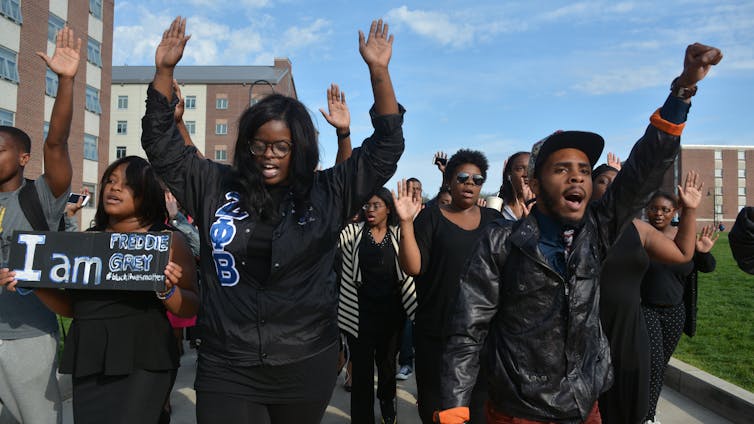
Members of the Black Student Union at Kutztown University in Kutztown, Pa., march in a protest in April 2015.
Ben Hasty/MediaNews Group/Reading Eagle via Getty Images

Black student unions are under pressure – here’s what they do and how they help Black students find community

Antar A. Tichavakunda, University of California, Santa Barbara

Black student unions have been a vital part of many Black college students’ lives for more than 60 years. But since 2024, Black student unions have lost their institutional support, campus space and funding with the rise of anti-diversity, equity and inclusion laws in Utah and Alabama.

Black student unions now face a new wave of pressure, as more than 400 colleges and universities under the Trump administration have rebranded or eliminated programs and centers that promote diversity, equity and inclusion.

Amy Lieberman, education editor at The Conversation U.S., spoke with Antar A. Tichavakunda, a scholar of race and higher education, to better understand what Black student unions are and how they influence Black students’ experiences in higher education.

A large group of young people dressed in formal clothing all pose together and smile.
Members of the Black Student Union at Johns Hopkins University pose for a portrait in Baltimore in 2004.
JHU Sheridan Libraries/Gado/Getty Images

Why are Black student unions important, particularly for Black students?

Aside from Black fraternities and sororities, Black student unions were among the first ethnic student organizations at colleges to be established. A group of students started the first Black student union in 1968 at San Francisco State University. This happened during the Black Campus Movement, when Black college students advocated for themselves, making demands for resources, respect, spaces and programs to support Black student life. At the time, Mariana Waddy, a student at San Francisco State University and the first president of a Black student union, said, “This college had done little for Black students except try to whitewash them.”

Black students wanted to make the school more engaging and responsive to their needs.

Today, these student unions are essential for Black student life on college campuses. They offer a place of belonging, where Black students can figuratively exhale from a predominately white campus or student environment. Black student life on campus isn’t a given – just because there are Black students, it doesn’t mean there is a Black student community. These unions allow Black students to come together as a community.

What do these unions look like and do, day to day?

Black student unions largely operate independently. They have various events, like cookouts and parties. If a campus is dealing with an issue or some kind of racist occurrence, for example, Black student union leaders will come to the forefront to be an advocate for Black students. They try to engage with students and university leaders on whatever is happening.

How are political pressure and policy shifts influencing these unions?

The University of Utah and the University of Alabama announced in 2024 that they would no longer fund or support their schools’ Black student unions. Universities typically give these unions a certain amount of money, as they do with other student-led groups. With this funding pulled, it is going to make it harder for Black student unions to exist. Where are they going to meet? Will they have to pay for a place to meet off campus?

Advertisement
Get More From A Face Cleanser And Spa-like Massage

And if you want to encourage students to come to Black student events, you will likely want to have food for them. If you want to arrange a trip to a conference or host a movie night, those things cost money and require space.

These cuts have drained time, energy and resources from Black student unions.

Now, Black student leaders are filling gaps where funding, staff, spaces and infrastructure used to exist to support and meet the needs of Black student life.

The Trump administration’s attempts to remove funding from and shut down diversity, equity and inclusion programs could lead Black student union leaders to act as unpaid diversity workers if and when these positions at universities are eliminated.

This work also involves organizing social events and support services for Black students. It means continuing to creatively advocate for Black student needs.

Full-time students leading Black student unions now find themselves doing unpaid labor that helps sustain Black communities and the universities that profit from them.

How exactly are universities profiting from Black student unions’ work?

Here’s one example: I observed a university tapping student leaders from a Black engineering group to represent the university’s school of engineering at public events. These leaders might have had to skip class or lose study time to be available for this event. But the university wanted other people, including prospective Black students, to know that there were already Black students at this school.

Black students in these positions have mentioned to me that sometimes administrators will pressure them to show up for panels and other events as a form of marketing. I think most of these requests are well-meaning. But I also know that Black student representatives and leaders place pressure on themselves to also show up for their community and school.

Their presence and visibility help universities have a more welcoming environment. They have an active, vibrant community because of Black student unions and leaders. Organizations like this create community and lead to more positive experiences for students. This joy can lead to more students staying in school.

Advertisement
Get More From A Face Cleanser And Spa-like Massage

If I am a Black parent touring a college with my child and don’t see any Black students participating in the tour or on campus, that sends a message to a prospective Black student – will I, or my child, belong here?

What message are Black student unions receiving with these policy shifts?

I think the message to Black student unions is that you all have to fend for yourselves. That is what inequality is all about, having different expectations for different students.

Cuts to diversity, equity and inclusion work signals to Black students that they are not valued and that, if they want to have meaningful experiences as a Black student community, they will have to do this work themselves. You can discern an institution’s values in their budget priorities. If there is nothing being materially invested in Black students, how can you say you support them?

My research shows that Black students act independently to achieve their goals. They create places of joy and belonging for themselves and others, navigating institutions to create full, dynamic lives.

Black students have historically played the cards they were dealt, even if they were inequitable. They have worked to create traditions and lives within and outside of higher education’s campus walls. Some Black student unions may look different going forward, but I have full faith they will continue.

Antar A. Tichavakunda, Associate Professor of Education, University of California, Santa Barbara

This article is republished from The Conversation under a Creative Commons license. Read the original article.

The Bridge is a section of the STM Daily News Blog meant for diversity, offering real news stories about bona fide community efforts to perpetuate a greater good. The purpose of The Bridge is to connect the divides that separate us, fostering understanding and empathy among different groups. By highlighting positive initiatives and inspirational actions, The Bridge aims to create a sense of unity and shared purpose. This section brings to light stories of individuals and organizations working tirelessly to promote inclusivity, equality, and mutual respect. Through these narratives, readers are encouraged to appreciate the richness of diverse perspectives and to participate actively in building stronger, more cohesive communities.

Advertisement
Get More From A Face Cleanser And Spa-like Massage

https://stmdailynews.com/the-bridge


Discover more from Daily News

Subscribe to get the latest posts sent to your email.

Continue Reading
Advertisement Sports Research
Click to comment

Leave a Reply

Your email address will not be published. Required fields are marked *

STM Daily News

Chinamaxxing: The Viral Trend Turning Geopolitics Into Aesthetic Fantasy

A viral social media trend called “Chinamaxxing” is turning geopolitics into aesthetic comparison—revealing more about generational frustration than China itself.

Published

on

Last Updated on February 11, 2026 by Daily News Staff

Chinamaxxing: Crowded subway station with train. A deep dive into “Chinamaxxing,” the viral social media trend blending aesthetics, politics, and generational disillusionment.

At first glance, the videos seem harmless enough.

Clean subways gliding into spotless stations. Neon skylines glowing at night. Clips of high-speed trains, cashless stores, orderly crowds. Overlaid text reads something like, “Meanwhile in China…” or “They figured it out.”

This is “Chinamaxxing,” a loosely defined but increasingly visible social media trend where mostly young users frame China as a model of efficiency, stability, and modernity—often in contrast to life in the West.

What makes the trend notable isn’t just its subject, but its tone. Chinamaxxing is rarely explicit political advocacy. It’s not a manifesto. It’s a mood. Aesthetic admiration blended with subtle critique, delivered through short, visually compelling clips that invite comparison without context.

And that’s precisely why it has sparked debate.

What Is “Chinamaxxing,” Really?

Despite the provocative name, Chinamaxxing isn’t a coordinated movement or ideology. It’s better understood as an algorithm-driven pattern—a recurring style of content that rewards certain visuals and emotional cues.

Most Chinamaxxing content emphasizes:

  • Infrastructure and urban design
  • Technology embedded in daily life
  • Perceived order and efficiency
  • Implicit contrast with Western dysfunction

What it typically omits:

  • Political repression and censorship
  • State surveillance
  • Limits on speech and dissent
  • The lived diversity of Chinese experiences

The result is a highly curated portrayal—less about China as a nation, and more about what viewers want to believe is possible somewhere else.

Why It’s Gaining Traction Now

The rise of Chinamaxxing says as much about the West as it does about China.

For many young users, particularly Gen Z, the backdrop is familiar: rising housing costs, student debt, healthcare anxiety, political polarization, and a growing sense that institutions no longer function as promised.

In that environment, visually persuasive content showing order and functionality carries emotional weight. It offers relief from chaos—real or perceived.

Advertisement
Get More From A Face Cleanser And Spa-like Massage

Social platforms amplify this effect. Short-form video rewards clarity, contrast, and immediacy. A clean subway platform communicates more in five seconds than a policy analysis ever could. Nuance does not trend well. Aesthetics do.

The Social and Political Criticism

Critics argue Chinamaxxing crosses a line from curiosity into distortion.

By focusing exclusively on infrastructure and surface-level efficiency, the trend risks:

  • Normalizing authoritarian governance through lifestyle framing
  • Reducing political systems to consumer experiences
  • Ignoring the tradeoffs that make such systems possible

Supporters counter that Western media has long flattened China into a single negative narrative, and that admiration for specific aspects of another society is not the same as endorsing its government.

Both perspectives, however, miss something important.

What the Trend Actually Reveals

Chinamaxxing isn’t primarily about China. It’s about disillusionment.

It reflects a generation that:

  • Feels let down by existing systems
  • Engages politics emotionally rather than institutionally
  • Uses visual culture to express dissatisfaction indirectly

In this context, China becomes a projection surface—not because it is perfect, but because it appears functional.

That distinction matters.

Why This Matters

Chinamaxxing highlights how political understanding is evolving in the digital age. Governance is increasingly consumed not through debate or civic participation, but through comparison clips, memes, and aesthetics.

The risk isn’t admiration. It’s oversimplification.

When complex societies are reduced to visuals alone, public discourse loses depth. But when those visuals resonate, they also signal real unmet needs: stability, competence, and trust in institutions.

Advertisement
Get More From A Face Cleanser And Spa-like Massage

Ignoring that signal would be a mistake.

The STM Daily News Perspective

Chinamaxxing is not an endorsement, a conspiracy, or a joke. It is a cultural artifact—one that reflects generational anxiety, algorithmic storytelling, and the widening gap between expectations and reality.

The question it raises isn’t whether China is better.

It’s why so many people feel their own systems are no longer working.

Related Reading


More on This Topic from STM Daily News

Stay tuned to STM Daily News for more stories exploring internet culture, social media trends, and how digital platforms shape public perception. We’ll be publishing in-depth pieces that break down the societal impact of viral phenomena like Chinamaxxing, the psychology behind online political trends, and the evolving language of Gen Z culture.

Want alerts? Be sure to subscribe to our newsletter for the latest insights and analysis.

Author

  • Rod Washington

    Rod: A creative force, blending words, images, and flavors. Blogger, writer, filmmaker, and photographer. Cooking enthusiast with a sci-fi vision. Passionate about his upcoming series and dedicated to TNC Network. Partnered with Rebecca Washington for a shared journey of love and art. View all posts

Want more stories 👋
“Your morning jolt of Inspiring & Interesting Stories!”

Sign up to receive awesome articles directly to your inbox.

STM Coffee Newsletter 1

We don’t spam! Read our privacy policy for more info.

Advertisement
Get More From A Face Cleanser And Spa-like Massage

Discover more from Daily News

Subscribe to get the latest posts sent to your email.

Continue Reading

family fun

Jurassic Quest Brings Life-Size Dinosaurs to Phoenix in February 2026

Jurassic Quest is roaring back into Phoenix in February 2026 with towering life-size dinosaurs, interactive exhibits, and hands-on activities for kids and families at the Arizona State Fairgrounds.

Published

on

Last Updated on February 9, 2026 by Daily News Staff

Jurassic Quest: Giant dinosaur in amusement park.

Phoenix, AZ — Jurassic Quest, billed as North America’s largest traveling dinosaur experience, is set to return to Arizona with a limited engagement at the Arizona State Fairgrounds from February 6–8, 2026.

The family-friendly attraction features life-size animatronic dinosaurs, immersive walk-through exhibits, and hands-on activities designed to blend entertainment with education. Guests will encounter towering recreations of iconic species such as Tyrannosaurus rex and Spinosaurus, along with interactive fossil digs, dinosaur rides, inflatables, and meet-and-greet opportunities with baby dinosaurs.

Jurassic Quest has become a popular touring event across the United States, particularly among families with young children. The experience combines museum-style displays with high-energy attractions, allowing visitors to explore at their own pace. Most attendees spend one to two hours navigating the exhibit.

The event will take place at the Arizona State Fairgrounds, located at 1826 W. McDowell Road in Phoenix, with multiple daily sessions scheduled throughout the weekend.

Tickets and additional event details are available through the official Jurassic Quest website.


Discover more from Daily News

Subscribe to get the latest posts sent to your email.

Continue Reading

Community

What if universal rental assistance were implemented to deal with the housing crisis?

A significant number of American families facing unaffordable rents are living in motels. While many believe a housing shortage causes high rents, experts suggest that expanding rental assistance is more effective. Making subsidies available to all eligible low-income households could tackle this affordability crisis significantly.

Published

on

Two people in a cluttered room.What if universal rental assistance were implemented to deal with the housing crisis?
Thousands of American families that can’t find affordable apartments are stuck living in extended-stay motels. Michael S. Williamson/The Washington Post via Getty Images

What if universal rental assistance were implemented to deal with the housing crisis?

Alex Schwartz, The New School and Kirk McClure, University of Kansas

If there’s one thing that U.S. politicians and activists from across the political spectrum can agree on, it’s that rents are far too high.

Many experts believe that this crisis is fueled by a shortage of housing, caused principally by restrictive regulations.

Rents and home prices would fall, the argument goes, if rules such as minimum lot- and house-size requirements and prohibitions against apartment complexes were relaxed. This, in turn, would make it easier to build more housing.

As experts on housing policy, we’re concerned about housing affordability. But our research shows little connection between a shortfall of housing and rental affordability problems. Even a massive infusion of new housing would not shrink housing costs enough to solve the crisis, as rents would likely remain out of reach for many households.

However, there are already subsidies in place that ensure that some renters in the U.S. pay no more than 30% of their income on housing costs. The most effective solution, in our view, is to make these subsidies much more widely available.

A financial sinkhole

Just how expensive are rents in the U.S.?

According to the U.S. Department of Housing and Urban Development, a household that spends more than 30% of its income on housing is deemed to be cost-burdened. If it spends more than 50%, it’s considered severely burdened. In 2023, 54% of all renters spent more than 30% of their pretax income on housing. That’s up from 43% of renters in 1999. And 28% of all renters spent more than half their income on housing in 2023.

Renters with low incomes are especially unlikely to afford their housing: 81% of renters making less than $30,000 spent more than 30% of their income on housing, and 60% spent more than 50%.

Estimates of the nation’s housing shortage vary widely, reaching up to 20 million units, depending on analytic approach and the time period covered. Yet our research, which compares growth in the housing stock from 2000 to the present, finds no evidence of an overall shortage of housing units. Rather, we see a gap between the number of low-income households and the number of affordable housing units available to them; more affluent renters face no such shortage. This is true in the nation as a whole and in nearly all large and small metropolitan areas.

Would lower rents help? Certainly. But they wouldn’t fix everything.

Advertisement
Get More From A Face Cleanser And Spa-like Massage

We ran a simulation to test an admittedly unlikely scenario: What if rents dropped 25% across the board? We found it would reduce the number of cost-burdened renters – but not by as much as you might think.

Even with the reduction, nearly one-third of all renters would still spend more than 30% of their income on housing. Moreover, reducing rents would help affluent renters much more than those with lower incomes – the households that face the most severe affordability challenges.

The proportion of cost-burdened renters earning more than $75,000 would fall from 16% to 4%, while the share of similarly burdened renters earning less than $15,000 would drop from 89% to just 80%. Even with a rent rollback of 25%, the majority of renters earning less than $30,000 would remain cost-burdened.

Vouchers offer more breathing room

Meanwhile, there’s a proven way of making housing more affordable: rental subsidies.

In 2024, the U.S. provided what are known as “deep” housing subsidies to about 5 million households, meaning that rent payments are capped at 30% of their income.

These subsidies take three forms: Housing Choice Vouchers that enable people to rent homes in the private market; public housing; and project-based rental assistance, in which the federal government subsidizes the rents for all or some of the units in properties under private and nonprofit ownership.

The number of households participating in these three programs has increased by less than 2% since 2014, and they constitute only 25% of all eligible households. Households earning less than 50% of their area’s median family income are eligible for rental assistance. But unlike Social Security, Medicare or food stamps, rental assistance is not an entitlement available to all who qualify. The number of recipients is limited by the amount of funding appropriated each year by Congress, and this funding has never been sufficient to meet the need.

By expanding rental assistance to all eligible low-income households, the government could make huge headway in solving the rental affordability crisis. The most obvious option would be to expand the existing Housing Choice Voucher program, also known as Section 8.

The program helps pay the rent up to a specified “payment standard” determined by each local public housing authority, which can set this standard at between 80% and 120% of the HUD-designated fair market rent. To be eligible for the program, units must also satisfy HUD’s physical quality standards.

Unfortunately, about 43% of voucher recipients are unable to use it. They are either unable to find an apartment that rents for less than the payment standard, meets the physical quality standard, or has a landlord willing to accept vouchers.

Advertisement
Get More From A Face Cleanser And Spa-like Massage

Renters are more likely to find housing using vouchers in cities and states where it’s illegal for landlords to discriminate against voucher holders. Programs that provide housing counseling and landlord outreach and support have also improved outcomes for voucher recipients.

However, it might be more effective to forgo the voucher program altogether and simply give eligible households cash to cover their housing costs. The Philadelphia Housing Authority is currently testing out this approach.

The idea is that landlords would be less likely to reject applicants receiving government support if the bureaucratic hurdles were eliminated. The downside of this approach is that it would not prevent landlords from renting out deficient units that the voucher program would normally reject.

Homeowners get subsidies – why not renters?

Expanding rental assistance to all eligible low-income households would be costly.

The Urban Institute, a nonpartisan think tank, estimates it would cost about $118 billion a year.

However, Congress has spent similar sums on housing subsidies before. But they involve tax breaks for homeowners, not low-income renters. Congress forgoes billions of dollars annually in tax revenue it would otherwise collect were it not for tax deductions, credits, exclusions and exemptions. These are known as tax expenditures. A tax not collected is equivalent to a subsidy payment.

Silhouette of older man standing at sliding glass door.
Only about 25% of eligiblge households receive rental assistance from the federal government. Luis Sinco/Los Angeles Times via Getty Images

For example, from 1998 through 2017 – prior to the tax changes enacted by the first Trump administration in 2017 – the federal government annually sacrificed $187 billion on average, after inflation, in revenue due to mortgage interest deductions, deductions for state and local taxes, and for the exemption of proceeds from the sale of one’s home from capital gains taxes. In fiscal year 2025, these tax expenditures totaled $95.4 billion.

Moreover, tax expenditures on behalf of homeowners flow mostly to higher-income households. In 2024, for example, over 70% of all mortgage-interest tax deductions went to homeowners earning at least $200,000.

Broadening the availability of rental subsidies would have other benefits. It would save federal, state and local governments billions of dollars in homeless services. Moreover, automatic provision of rental subsidies would reduce the need for additional subsidies to finance new affordable housing. Universal rental assistance, by guaranteeing sufficient rental income, would allow builders to more easily obtain loans to cover development costs.

Of course, sharply raising federal expenditures for low-income rental assistance flies in the face of the Trump administration’s priorities. Its budget proposal for the next fiscal year calls for a 44% cut of more than $27 billion in rental assistance and public housing.

On the other hand, if the government supported rental assistance in amounts commensurate with the tax benefits given to homeowners, it would go a long way toward resolving the rental housing affordability crisis.

Advertisement
Get More From A Face Cleanser And Spa-like Massage

This article is part of a series centered on envisioning ways to deal with the housing crisis.

Alex Schwartz, Professor of Urban Policy, The New School and Kirk McClure, Professor of Urban Planning, University of Kansas

This article is republished from The Conversation under a Creative Commons license. Read the original article.


Discover more from Daily News

Subscribe to get the latest posts sent to your email.

Continue Reading

Trending


