
Connect with us

Economy

Fed rate cut is attempt to prevent recession without sending prices soaring

Published

on

Fed rate cut
The Fed’s job can seem like a balancing act.
Dimitri Otis/DigitalVision via Getty Images

Fed rate cut is attempt to prevent recession without sending prices soaring

Ryan Herzog, Gonzaga University

The Federal Reserve on Sept. 17, 2025, cut its target interest rate as it shifts focus from fighting inflation to supporting the choppy labor market.

As financial markets expected, the Fed lowered rates a quarter point to a range of 4% to 4.25%, its first cut since December 2024.

The Fed’s decision to begin cutting rates comes as evidence mounts that the U.S. labor market is losing momentum. The headline unemployment rate has stayed steady at near record lows, but the underlying trends are more concerning.

At the same time, the fight against inflation is not over yet. While a cooling jobs market could lead to a recession, cutting rates too much could drive inflation higher.

So if you’re the Fed, what do you do?

I’m an economist who tracks labor market data and monetary policy, examining how changes in hiring, wages and unemployment influence the Federal Reserve’s efforts to steer the economy. There’s an incredibly large amount of data the Fed, investors, economists like me and many others use to understand the state of the economy – and much of it often tells conflicting stories.

Here are some the data points I’ve been following most closely to better understand where the U.S. economy might go from here – and the tough choices the Fed has to make.
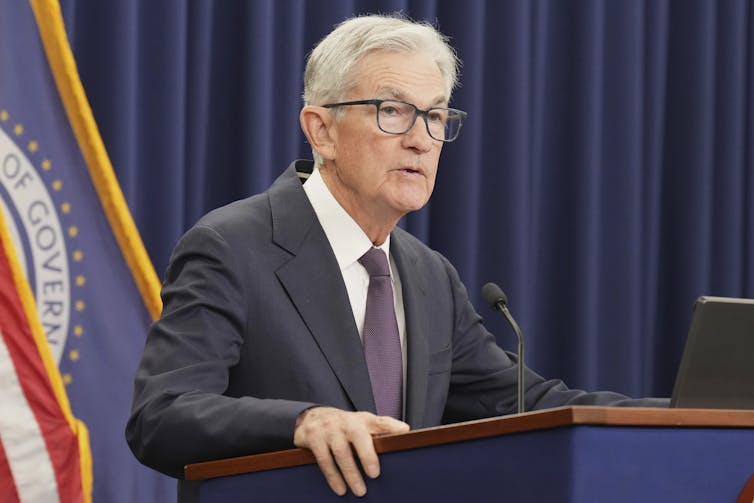
a bespectacled white man in a suit stands before a podium with a micrphone
Fed Chairman Jerome Powell speaks during a news conference after the rate-cut decision.
AP Photo/Jacquelyn Martin

Underlying trouble in the labor market

The labor market looks stable on the surface, but more granular data tells a different story.

The unemployment rate has remained close to historic lows at 4.3% as of August 2025, according to the U.S. Bureau of Labor Statistics.

But the number of long-term unemployed – people out of work for 27 weeks or longer – rose to 1.9 million in August, up 385,000 from a year earlier. These workers now make up 25.7% of all unemployed people, the highest share since February 2022. Persistent long-term joblessness often signals deeper cracks forming in the labor market.

At the same time, new claims for unemployment benefits are spiking. Initial claims for unemployment insurance – a leading indicator of labor market stress – jumped by 27,000 to 263,000 for the week ending Sept. 6, according to the U.S. Department of Labor. That’s the sharpest increase in months and well above economists’ forecasts. It suggests layoffs are becoming more common.

Advertisement
Reveal Your Skin's Youthful Radiance with FOREO's LUNA 2 Facial Massager. Shop Now For $199

We also got news that past payroll growth was overstated. In a process the Bureau of Labor Statistics undertakes annually to double-check its data, the bureau recently revised its jobs data downward from April 2024 through March 2025 by 911,000. In other words, the economy created roughly 75,000 fewer jobs per month than previously reported. This implies the labor market was weaker than it appeared all along.

Finally, workers are losing confidence. The Federal Reserve Bank of New York reported in August that the confidence of people who lost their jobs in finding another fell to its lowest level – 44.9% – since it started surveying consumers in June 2013. That’s another sign workers are feeling less secure about their prospects.

Taken together, these data points paint a clear picture: The labor market is not collapsing, but it is softening. That helps explain why the Fed is beginning to cut rates now – hoping to stimulate spending – before the job market breaks more sharply.
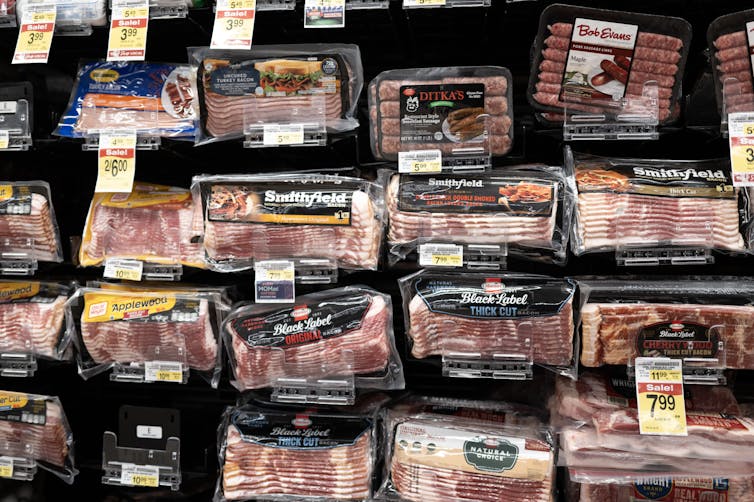
packages of bacon and other meat are on display in a grocery store
Prices of meat and other groceries have been on the rise recently.
Scott Olson/Getty Images

Tariffs are complicating the inflation data

Even as the labor market softens, tariffs are pushing certain prices higher than they otherwise would be, complicating the Federal Reserve’s effort to bring inflation down.

Government data shows that businesses have begun passing the costs of President Donald Trump’s new import tariffs to consumers. In August, clothing prices rose 0.5% and grocery prices rose 0.6%, with especially strong gains for tariff-sensitive items such as coffee.

Lower-income households are getting hit hardest because they spend more of their budget on imported goods, which tend to be the lower-cost items most affected by tariffs. A report from the Yale Budget Lab found that core goods prices are about 1.9% above pre-2025 trends as tariffs raise costs for basic items such as appliances and electronics.

Phillip Swagel, director of the Congressional Budget Office, said recently that Trump’s tariffs have pushed inflation higher than CBO analysts had expected, even as overall economic activity has weakened since January.

Typically, a slowdown in the labor market is met with slower inflation. But while the CBO now projects that the tariffs will reduce the federal budget deficit by about US$4 trillion over the next decade – roughly $3.3 trillion in new revenue and $700 billion in lower debt service costs – but it will come at the cost of near-term upward pressure on prices.

This creates a difficult balancing act for the Fed: Cut rates too quickly, and tariff-driven price pressures could reignite inflation; move too slowly, and the softening labor market could tip into recession.
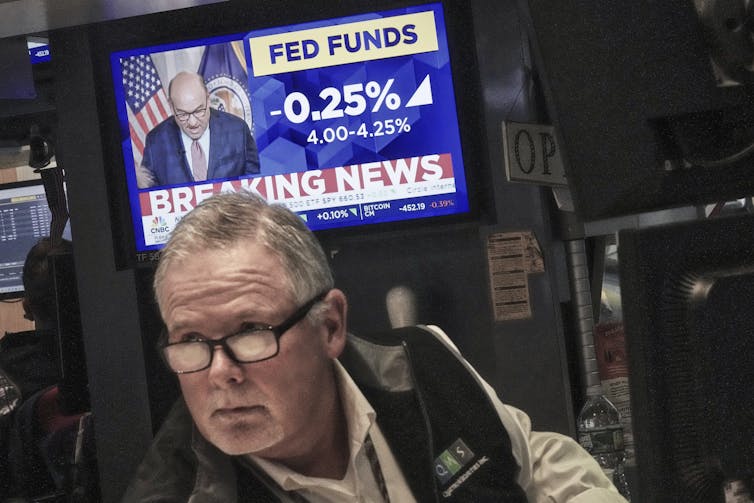
a bespectacled white man in a vest look on as a tv screen shows news of fed rate cut behind him
Traders react to the Fed news.
AP Photo/Richard Drew

A narrow path to a soft landing

As it resumes cutting rates, the Federal Reserve is trying to thread a narrow needle – easing policy enough to keep the labor market from cracking while not reigniting inflation, which is proving stickier in part because of tariffs.

Markets are betting the Fed will keep cutting. The futures market is betting the Fed will cut rates by another half point by the end of the year. And the one-year Treasury yield has dropped about 150 basis points (1.5%) since June, signaling that investors expect a series of rate cuts through 2025 and into 2026.

At its latest meeting, the Fed signaled two more rate cuts in 2025 and at least one rate cut in 2026.

Advertisement
Reveal Your Skin's Youthful Radiance with FOREO's LUNA 2 Facial Massager. Shop Now For $199

Such cuts would ultimately bring the federal funds rate closer to 3% and hopefully reduce 30-year mortgage rates to around 5% – from an average of 6.35% as of Sept. 11. If the labor market continues to weaken – with jobless claims climbing, payrolls revised down and more workers stuck in long-term unemployment – that expectation will likely harden into consensus.

But the path is far from certain. Cutting rates too quickly could cause inflation to spike, while going too slow could lead to further deterioration in the labor market. Either outcome would jeopardize the Fed’s credibility – whether by appearing unable to control prices or by allowing unemployment to rise unnecessarily. That would undermine its ability to influence markets and enforce its dual mandate of maximum employment and stable prices.

Another tricky issue is Trump’s public campaign to push the Fed to cut rates – appearing to do his bidding could also undercut Fed credibility. For what it’s worth, the Sept. 17 rate cut appears driven less by politics than by economic data. The Fed itself was projecting a year ago that rates would be much lower today than they actually are, suggesting it’s been following the data.

The economy appears to be slowing but remains resilient, which is why the Fed is likely to move gradually. The risk is that the window for a soft landing is closing. The coming months will determine whether the Fed can ease early enough to avoid recession, or whether it has already waited too long.

Ryan Herzog, Associate Professor of Economics, Gonzaga University

This article is republished from The Conversation under a Creative Commons license. Read the original article.

Continue Reading
Advertisement Simply Wholesale

Community

McDonald’s First Job Confessional Turns Career Stories Into Free Meal Opportunity

McDonald’s is launching First Job Confessional, a campaign inviting fans to share first job stories for a chance to receive a $15 gift card in select cities.

Published

on

McDonald’s is launching First Job Confessional, a campaign inviting fans to share first job stories for a chance to receive a $15 gift card in select cities.
McDonald’s is Asking Fans to Get Real About Their First Job Skills in Exchange for Free Meals

First Job Confessional

McDonald’s is putting first jobs in the spotlight with a new campaign that asks fans to share the real-world skills they gained early in their working lives. Launched on National Employee Appreciation Day, the brand’s First Job Confessional invites people to reflect on how those first roles helped shape their careers — and, in some cases, earn a free meal in the process.

The campaign is built around a simple idea: first jobs often teach lasting skills that deserve more recognition. Whether someone learned problem-solving while babysitting, communication during a lunch rush, or teamwork behind a counter, McDonald’s is framing those experiences as valuable career foundations. The company says those are the same kinds of skills employers continue to prioritize as workplace demands evolve.

McDonald’s is launching First Job Confessional, a campaign inviting fans to share first job stories for a chance to receive a $15 gift card in select cities.
McDonald’s is Asking Fans to Get Real About Their First Job Skills in Exchange for Free Meals

How the First Job Confessional Works

In select cities, McDonald’s is setting up confessional booths designed to look like ordering kiosks. But instead of placing a meal order, participants can record a story about their first job and the skills they picked up along the way. Those who take part in person will have the opportunity to receive a $15 McDonald’s gift card, while supplies last.

Fans who cannot attend in person can still join online by posting their stories using #FirstJobConfessional. McDonald’s says selected videos may also be featured on its YouTube channel, extending the campaign beyond the live events.

External Related Links

Source Links

The Bridge is a section of the STM Daily News Blog meant for diversity, offering real news stories about bona fide community efforts to perpetuate a greater good. The purpose of The Bridge is to connect the divides that separate us, fostering understanding and empathy among different groups. By highlighting positive initiatives and inspirational actions, The Bridge aims to create a sense of unity and shared purpose. This section brings to light stories of individuals and organizations working tirelessly to promote inclusivity, equality, and mutual respect. Through these narratives, readers are encouraged to appreciate the richness of diverse perspectives and to participate actively in building stronger, more cohesive communities.

https://stmdailynews.com/the-bridge

Continue Reading

News

Jay Leno Test Drives the Slate Truck as Startup Pushes Toward 2026 Launch

The affordable electric pickup from Slate Auto is gaining attention after Jay Leno test drove the prototype on Jay Leno’s Garage. Here’s the latest update on pricing, features, reservations, and the planned 2026 production launch.

Published

on

Two modern vehicles in industrial setting. Slate Truck

Testing the Slate Truck

The affordable electric pickup from Slate Auto is continuing to gain attention as the startup moves closer to production. One of the most visible recent developments came when legendary car collector and TV host Jay Leno featured the truck on his popular YouTube series Jay Leno’s Garage.

The episode offered one of the most detailed looks yet at the upcoming Slate Truck, including a real-world test drive, design insights, and a closer look at the company’s philosophy behind building what could become one of America’s most affordable electric vehicles.

Watch the Jay Leno Test Drive

The $25K EV Truck You Can Repair Yourself: Meet The Slate Truck | Jay Leno’s Garage

What Jay Leno Revealed About the Slate Truck

During the episode, Leno drove a pre-production prototype of the truck while engineers from Slate Auto explained the design approach.

Unlike many modern EVs packed with luxury features, the Slate Truck is intentionally simple.

Key highlights from the test drive include:

A Focus on Simplicity and Repairability

One of the most notable ideas behind the truck is that it is designed to be easy to repair and modify. Instead of relying on proprietary parts or complex electronics, the vehicle uses a more straightforward architecture that could allow owners or independent mechanics to work on it.

This approach contrasts with many EVs that require dealership service or specialized tools.

Advertisement
Reveal Your Skin's Youthful Radiance with FOREO's LUNA 2 Facial Massager. Shop Now For $199

Modular Body Panels and Customization

The Slate Truck is built around a modular platform with removable exterior panels and optional accessory kits.

According to the company, owners will be able to customize the vehicle with:

Different body panel styles Accessory racks and cargo options A potential conversion kit that can transform the pickup into a small SUV

The idea is to allow the vehicle to evolve with the owner’s needs over time.

Minimalist Interior

Inside the prototype shown to Leno, the truck features a very basic interior layout.

Instead of a large infotainment system, the vehicle relies heavily on smartphone integration and simpler controls to keep costs down. This minimalist philosophy is part of the company’s effort to build a lower-cost EV.

Pricing and the “Affordable EV” Promise

When the truck was first revealed in 2025, Slate Auto suggested the vehicle could cost under $20,000 after incentives.

Advertisement
Reveal Your Skin's Youthful Radiance with FOREO's LUNA 2 Facial Massager. Shop Now For $199

However, with changes to federal EV incentives and updated pricing expectations, analysts now estimate the truck will likely start around the mid-$20,000 range.

Even at that price, the vehicle could still become one of the most affordable electric trucks available in the United States.

Production Plans in Indiana

The company plans to manufacture the truck in Warsaw, Indiana, where a large former industrial facility is being converted into an EV factory.

Production targets include:

Production start: Late 2026 Early deliveries: Possibly 2027 Potential capacity: Up to about 150,000 vehicles per year once fully ramped

Strong early interest has also been reported, with more than 100,000 reservations placed for the truck shortly after its reveal.

A Different Kind of Electric Truck

The Slate Truck is entering a market where most electric pickups—such as the Ford F-150 Lightning and Rivian R1T—sit at much higher price points.

Rather than competing on luxury or performance, the Slate Truck is aiming to fill a different niche: a practical, customizable, and relatively affordable electric work vehicle.

If the company can deliver on its promises, it could open the door to a new category of budget-friendly EVs.

Advertisement
Reveal Your Skin's Youthful Radiance with FOREO's LUNA 2 Facial Massager. Shop Now For $199

For now, the test drive on Jay Leno’s Garage provides one of the clearest glimpses yet at how the truck might perform in the real world.

Related Coverage on STM Daily News

Further Reading and Information

Welcome to the Consumer Corner section of STM Daily News, your ultimate destination for savvy shopping and informed decision-making! Dive into a treasure trove of insights and reviews covering everything from the hottest toys that spark joy in your little ones to the latest electronic gadgets that simplify your life. Explore our comprehensive guides on stylish home furnishings, discover smart tips for buying a home or enhancing your living space with creative improvement ideas, and get the lowdown on the best cars through our detailed auto reviews. Whether you’re making a major purchase or simply seeking inspiration, the Consumer Corner is here to empower you every step of the way—unlock the keys to becoming a smarter consumer today!

https://stmdailynews.com/category/consumer-corner

Author

  • Rod Washington

    Rod: A creative force, blending words, images, and flavors. Blogger, writer, filmmaker, and photographer. Cooking enthusiast with a sci-fi vision. Passionate about his upcoming series and dedicated to TNC Network. Partnered with Rebecca Washington for a shared journey of love and art.

    View all posts
Continue Reading

Economy

US Consumer Confidence Fell Sharply in January: What the Latest Conference Board Data Signals

In January 2026, U.S. consumer confidence plummeted to its lowest level since 2014, as the Consumer Confidence Index fell by 9.7 points to 84.5. Concerns about inflation, employment, and economic stability led to decreased optimism across all demographics and a cautious approach to major purchases, signaling potential recession ahead.

Published

on

woman wearing gray coat.  consumer confidence
Photo by Andrea Piacquadio on Pexels.com

US consumers started 2026 on a noticeably more cautious note. New data from The Conference Board shows its Consumer Confidence Index® fell sharply in January, wiping out a brief December rebound and pushing overall sentiment to its weakest level in more than a decade.

Confidence drops to the lowest level since 2014

The Conference Board Consumer Confidence Index® fell 9.7 points in January to 84.5 (1985=100), down from an upwardly revised 94.2 in December. The organization noted that December’s figure was revised up by 5.1 points, meaning what initially looked like a decline last month was actually a small uptick—before January’s slide reasserted the broader downward trend.

The cutoff for the preliminary January results was January 16, 2026.

Both “right now” and “what’s next” got worse

The decline wasn’t isolated to one part of the survey. Both consumers’ views of current conditions and their expectations for the months ahead weakened.

  • Present Situation Index: down 9.9 points to 113.7
  • Expectations Index: down 9.5 points to 65.1

That Expectations reading matters because it’s well below 80, a level The Conference Board says “usually signals a recession ahead.”

Dana M. Peterson, Chief Economist at The Conference Board, summed it up bluntly: confidence “collapsed” in January, with all five components deteriorating. The overall Index hit its lowest level since May 2014.

What consumers are worried about (and what’s showing up in write-ins)

The Conference Board said consumers’ write-in responses continued to skew pessimistic. The biggest themes weren’t hard to guess:

  • Prices and inflation
  • Oil and gas prices
  • Food and grocery prices

Mentions of tariffs and tradepolitics, and the labor market also rose in January. References to health/insuranceand war edged higher.

In other words: consumers aren’t just feeling uneasy—they’re pointing to specific pressure points that affect day-to-day costs and long-term stability.

Labor market perceptions softened

Consumers’ views of employment conditions weakened, with fewer respondents saying jobs are plentiful and more saying jobs are hard to get.

  • 23.9% said jobs were “plentiful,” down from 27.5% in December
  • 20.8% said jobs were “hard to get,” up from 19.1%

That shift matters because consumer confidence often follows the labor market. When people feel less secure about job availability, they tend to pull back on big purchases and discretionary spending.

Expectations for business conditions and jobs turned more negative

Looking six months out, pessimism increased:

  • 15.6% expected business conditions to improve (down from 18.7%)
  • 22.9% expected business conditions to worsen (up from 21.3%)

On jobs:

  • 13.9% expected more jobs to be available (down from 17.4%)
  • 28.5% anticipated fewer jobs (up from 26.0%)

Income expectations cooled too:

  • 15.7% expected incomes to increase (down from 18.8%)
  • 12.6% expected incomes to decline (down slightly from 13.0%)

So while fewer people expected their income to fall, the bigger story is that optimism about income growth faded.

Who’s feeling it most: age, income, and politics

On a six-month moving average basis, confidence dipped across:

  • All age groups (though under 35 remained more confident than older consumers)
  • All generations (with Gen Z still the most optimistic)
  • All income brackets (with those earning under $15K the least optimistic)
  • All political affiliations (with the sharpest decline among Independents)

This broad-based decline suggests the shift isn’t confined to one demographic pocket—it’s spreading.

Big-ticket buying plans: more “maybe,” less “yes”

The survey also pointed to increased caution around major purchases.

Advertisement
Reveal Your Skin's Youthful Radiance with FOREO's LUNA 2 Facial Massager. Shop Now For $199

Consumers saying “yes” to buying big-ticket items declined in January, while “maybe” responses rose and “no” edged higher.

  • Auto buying plans were flat overall, though expectations for new cars continued to falter and plans to buy used cars climbed.
  • Homebuying expectations continued to retreat.
  • Plans to purchase appliances, furniture, and TVs decreased.
  • Electronics purchase intentions dipped in most categories—except smartphones, which continued trending upward on a six-month moving average basis.

Services spending softened—but restaurants and travel stayed interesting

Planned spending on services over the next six months weakened in January, with fewer consumers saying “yes” and more shifting into “maybe.”

Still, a few categories stood out:

  • Restaurants, bars, and take-out remained the top planned services spending category and continued to rise.
  • Consumers also intended to spend more on hotels/motels for personal travelairfare/trains, and motor vehicle services.

The Conference Board noted this was surprising given the plunge in vacation plans—especially for domestic travel—also recorded in the survey.

What to watch next

January’s report paints a clear picture: consumers are feeling squeezed by costs, less confident about the labor market, and more hesitant about major purchases. The Expectations Index dropping deeper below the “recession signal” threshold will likely keep economists, businesses, and policymakers watching the next few releases closely.

The Conference Board publishes the Consumer Confidence Index® at 10 a.m. ET on the last Tuesday of every month.

Source: The Conference Board, January 2026 Consumer Confidence Survey® (PRNewswire release, Jan. 27, 2026).

Continue Reading

Trending

