Connect with us

Science

Fleeting fireflies illuminate Colorado summer nights − and researchers are watching

Published

on

Last Updated on May 25, 2025 by Daily News Staff

fireflies
Fireflies in Boulder, Colo., during the summer of 2023. Radim Schreiber/Firefly Experience, CC BY
Orit Peleg, University of Colorado Boulder and Owen Martin, University of Colorado Boulder The Colorado June air was thick with summer heat. Mosquitoes rose in clouds around us, testing our resolve while we gathered our cameras and sensors. We walked into the wetland, down the unmarked path until the cattails rose shoulder-high. The sounds of frogs and crickets filled the air as we set up our cameras and waited. Then we spotted them: tiny lights lifting from the grasses, blinking in slow rhythms. Bioluminescent lampyrid beetles, commonly known as fireflies or lightning bugs, are widespread throughout the Eastern United States but far more scarce west of Kansas. Even though many are stargazers and hikers, most Colorado residents don’t know that fireflies share their state. We are an associate professor of computer science and a Ph.D. candidate who are working to shed light on Colorado’s hidden fireflies. In the past few years, we have observed and filmed elusive bioluminescent fireflies all over Colorado, racing each summer against their brief and unpredictable flashing season.
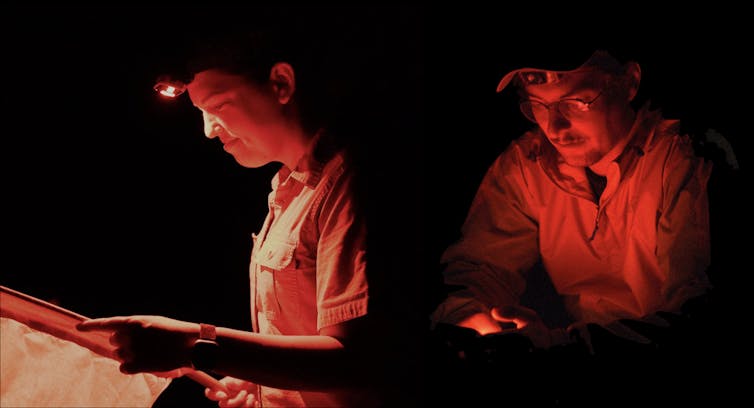
Two people at work in the dark with faces illuminated by red lights.
The authors − Orit, left, and Owen − in the field, taking notes and observing specimens. Nolan R. Bonnie and Mac Stone
Last year in early June it was too early, we thought, for fireflies in Colorado. For weeks we had been checking weather forecasts, comparing them to previous years, waiting for warmer nights and rising temperatures − the signs that would tell us it’s firefly time. Then we got a tip. A friend mentioned seeing one or two flashes near their property. The next morning we packed our gear, rearranged our schedules and contacted our volunteer network. The field season began in a literal flash. As adults, fireflies live and flash for only about two weeks a year − and even then, just for a few hours each night. It’s easy to blink and miss the entire season. The next generation overwinters underground as larvae, emerging as adults the following year, though development may take up to two years in arid climates. Making the most of that narrow window is one of the many reasons we rely on volunteers who help us spot the first flashes and record observations across Colorado.

Western fireflies face unique environmental challenges

Our work joins a growing chorus of scientific observation focused on western fireflies, which pop up across the arid landscape near temporary wetlands, marshes, drainages, desert rivers and other water sources. Because of the dry landscape, these populations tend to be fragmented, isolated to where the water is and nowhere in between. This strong tie to small, unstable habitat spells vulnerability for the fireflies. If the water runs out, or their habitats are damaged by water or light pollution, the flashing populations could vanish. Pesticides in water are toxic to firefly larvae and their prey, and artificial light inhibits the flash courtship between males and females, preventing successful reproduction. Many populations and species of fireflies are threatened with extinction in the United States due to these factors.
Organizations such as our lab at the University of Colorado and the Xerces Society for Inverteberate Conservation are studying the distribution of and direct threats to western firefly populations. Many of the species are either endangered or not yet described. The fireflies of the Photuris genus along the Front Range, for example, still do not have a species name and appear to be genetically distinct from other Photuris around the country. Preliminary genetic results suggest at least one new species might be found here. The genetic data also suggests at least five different bioluminescent species of fireflies are present in Colorado.

How flash patterns help fireflies (and us) tell species apart

During their short mating season, fireflies use their flash patterns as mating calls. Males produce a series of flash-on, flash-off events, each with specific durations and pauses. These Morse code-like signals communicate what type and how fit the fireflies are to potential mates in the darkness. When females detect a suitable male, they respond with their own unique flash pattern. Our work piggybacks on this evolutionary adaptation. We first recorded populations from around the U.S. using two video cameras, which allowed us to accurately track individual fireflies in three dimensions and separate their flash patterns. We used the data on the flash behavior from different species to train a neural network that can classify the firefly’s flash pattern with a high degree of accuracy. Our algorithm learns the unique flash patterns from our data and can identify the species of firefly that is present in a video. This is a powerful tool for firefly conservation efforts. The camera footage can cover more time and ground than field surveys conducted by humans, and our algorithm can more quickly identify species that might be threatened.

Fostering community engagement with citizen science

Based on our success with community science data collection across other states, including Tennessee, South Carolina and Massachusetts, we wanted to apply the same principles to Colorado’s firefly populations. This is a big undertaking: There are dozens of fragmented sites where fireflies are active across Colorado, and more are reported by volunteers every season. Our team of two cannot visit and survey every site during the short firefly season. In 2023 we put out our first call for volunteers in Colorado. Since that time, 18 community members in Boulder, Fort Collins, Divide and Loveland joined the filming effort. We provide cameras for the volunteers, who bring them to their nearby wetlands and set them up in the fading light. Last summer we partnered with local land management agencies in Boulder, Fort Collins and Loveland to host informative community events, where we spoke about firefly biology and conservation to audiences of all ages. On many of those nights, as the flashes began, we heard the excitement build: quiet gasps, hushed enthusiasm and a whisper such as, “Look at that beautiful streak of light!” Fireflies have an important story to tell, and here in Colorado that story is just beginning. Their brief flashes each summer help us learn about communication, ecology and how these delicate insects respond to an ever-changing world. If you’d like to help us find and study fireflies in Colorado, you can sign up to join our community science project.The Conversation Orit Peleg, Associate Professor of Computer Science, University of Colorado Boulder and Owen Martin, Ph.D. Candidate in Computer Science, University of Colorado Boulder This article is republished from The Conversation under a Creative Commons license. Read the original article.
The science section of our news blog STM Daily News provides readers with captivating and up-to-date information on the latest scientific discoveries, breakthroughs, and innovations across various fields. We offer engaging and accessible content, ensuring that readers with different levels of scientific knowledge can stay informed. Whether it’s exploring advancements in medicine, astronomy, technology, or environmental sciences, our science section strives to shed light on the intriguing world of scientific exploration and its profound impact on our daily lives. From thought-provoking articles to informative interviews with experts in the field, STM Daily News Science offers a harmonious blend of factual reporting, analysis, and exploration, making it a go-to source for science enthusiasts and curious minds alike. https://stmdailynews.com/category/science/

Author


Discover more from Daily News

Subscribe to get the latest posts sent to your email.

Continue Reading
Advertisement Tool Tickets

Artificial Intelligence

More than half of new articles on the internet are being written by AI – is human writing headed for extinction?

A new study finds over 50% of online articles are now AI-generated, raising questions about the future of human writing. Discover why formulaic content is most at risk, and why authentic, creative voices may become more valuable than ever.

Published

on

Is AI Replacing Human Writers? Why Over Half of Online Articles Are Now AI-Generated
Preserving the value of real human voices will likely depend on how people adapt to artificial intelligence and collaborate with it. BlackJack3D/E+ via Getty Images

More than half of new articles on the internet are being written by AI – is human writing headed for extinction?

Francesco Agnellini, Binghamton University, State University of New York The line between human and machine authorship is blurring, particularly as it’s become increasingly difficult to tell whether something was written by a person or AI. Now, in what may seem like a tipping point, the digital marketing firm Graphite recently published a study showing that more than 50% of articles on the web are being generated by artificial intelligence. As a scholar who explores how AI is built, how people are using it in their everyday lives, and how it’s affecting culture, I’ve thought a lot about what this technology can do and where it falls short. If you’re more likely to read something written by AI than by a human on the internet, is it only a matter of time before human writing becomes obsolete? Or is this simply another technological development that humans will adapt to?

It isn’t all or nothing

Thinking about these questions reminded me of Umberto Eco’s essay “Apocalyptic and Integrated,” which was originally written in the early 1960s. Parts of it were later included in an anthology titled “Apocalypse Postponed,” which I first read as a college student in Italy. In it, Eco draws a contrast between two attitudes toward mass media. There are the “apocalyptics” who fear cultural degradation and moral collapse. Then there are the “integrated” who champion new media technologies as a democratizing force for culture.
An older man with a beard, glasses and a suit poses while holding a cigarette.
Italian philosopher, cultural critic and novelist Umberto Eco cautioned against overreacting to the impact of new technologies. Leonardo Cendamo/Getty Images
Back then, Eco was writing about the proliferation of TV and radio. Today, you’ll often see similar reactions to AI. Yet Eco argued that both positions were too extreme. It isn’t helpful, he wrote, to see new media as either a dire threat or a miracle. Instead, he urged readers to look at how people and communities use these new tools, what risks and opportunities they create, and how they shape – and sometimes reinforce – power structures. While I was teaching a course on deepfakes during the 2024 election, Eco’s lesson also came back to me. Those were days when some scholars and media outlets were regularly warning of an imminent “deepfake apocalypse.” Would deepfakes be used to mimic major political figures and push targeted disinformation? What if, on the eve of an election, generative AI was used to mimic the voice of a candidate on a robocall telling voters to stay home? Those fears weren’t groundless: Research shows that people aren’t especially good at identifying deepfakes. At the same time, they consistently overestimate their ability to do so. In the end, though, the apocalypse was postponed. Post-election analyses found that deepfakes did seem to intensify some ongoing political trends, such as the erosion of trust and polarization, but there’s no evidence that they affected the final outcome of the election.

Listicles, news updates and how-to guides

Of course, the fears that AI raises for supporters of democracy are not the same as those it creates for writers and artists. For them, the core concerns are about authorship: How can one person compete with a system trained on millions of voices that can produce text at hyper-speed? And if this becomes the norm, what will it do to creative work, both as an occupation and as a source of meaning? It’s important to clarify what’s meant by “online content,” the phrase used in the Graphite study, which analyzed over 65,000 randomly selected articles of at least 100 words on the web. These can include anything from peer-reviewed research to promotional copy for miracle supplements. A closer reading of the Graphite study shows that the AI-generated articles consist largely of general-interest writing: news updates, how-to guides, lifestyle posts, reviews and product explainers. https://stmdailynews.com/wp-admin/post-new.php#visibility The primary economic purpose of this content is to persuade or inform, not to express originality or creativity. Put differently, AI appears to be most useful when the writing in question is low-stakes and formulaic: the weekend-in-Rome listicle, the standard cover letter, the text produced to market a business. A whole industry of writers – mostly freelance, including many translators – has relied on precisely this kind of work, producing blog posts, how-to material, search engine optimization text and social media copy. The rapid adoption of large language models has already displaced many of the gigs that once sustained them.

Collaborating with AI

The dramatic loss of this work points toward another issue raised by the Graphite study: the question of authenticity, not only in identifying who or what produced a text, but also in understanding the value that humans attach to creative activity. How can you distinguish a human-written article from a machine-generated one? And does that ability even matter? Over time, that distinction is likely to grow less significant, particularly as more writing emerges from interactions between humans and AI. A writer might draft a few lines, let an AI expand them and then reshape that output into the final text. This article is no exception. As a non-native English speaker, I often rely on AI to refine my language before sending drafts to an editor. At times the system attempts to reshape what I mean. But once its stylistic tendencies become familiar, it becomes possible to avoid them and maintain a personal tone. Also, artificial intelligence is not entirely artificial, since it is trained on human-made material. It’s worth noting that even before AI, human writing has never been entirely human, either. Every technology, from parchment and stylus paper to the typewriter and now AI, has shaped how people write and how readers make sense of it. Another important point: AI models are increasingly trained on datasets that include not only human writing but also AI-generated and human–AI co-produced text. This has raised concerns about their ability to continue improving over time. Some commentators have already described a sense of disillusionment following the release of newer large models, with companies struggling to deliver on their promises.

Human voices may matter even more

But what happens when people become overly reliant on AI in their writing? Some studies show that writers may feel more creative when they use artificial intelligence for brainstorming, yet the range of ideas often becomes narrower. This uniformity affects style as well: These systems tend to pull users toward similar patterns of wording, which reduces the differences that usually mark an individual voice. Researchers also note a shift toward Western – and especially English-speaking – norms in the writing of people from other cultures, raising concerns about a new form of AI colonialism. In this context, texts that display originality, voice and stylistic intention are likely to become even more meaningful within the media landscape, and they may play a crucial role in training the next generations of models. If you set aside the more apocalyptic scenarios and assume that AI will continue to advance – perhaps at a slower pace than in the recent past – it’s quite possible that thoughtful, original, human-generated writing will become even more valuable. Put another way: The work of writers, journalists and intellectuals will not become superfluous simply because much of the web is no longer written by humans. Francesco Agnellini, Lecturer in Digital and Data Studies, Binghamton University, State University of New York This article is republished from The Conversation under a Creative Commons license. Read the original article.
 

Dive into “The Knowledge,” where curiosity meets clarity. This playlist, in collaboration with STMDailyNews.com, is designed for viewers who value historical accuracy and insightful learning. Our short videos, ranging from 30 seconds to a minute and a half, make complex subjects easy to grasp in no time. Covering everything from historical events to contemporary processes and entertainment, “The Knowledge” bridges the past with the present. In a world where information is abundant yet often misused, our series aims to guide you through the noise, preserving vital knowledge and truths that shape our lives today. Perfect for curious minds eager to discover the ‘why’ and ‘how’ of everything around us. Subscribe and join in as we explore the facts that matter.  https://stmdailynews.com/the-knowledge/

View recent photos

Unlock fun facts & lost history—get The Knowledge in your inbox!

We don’t spam! Read our privacy policy for more info.


Discover more from Daily News

Subscribe to get the latest posts sent to your email.

Continue Reading

astronomy

NASA goes on an ESCAPADE – twin small, low-cost orbiters will examine Mars’ atmosphere

NASA’s ESCAPADE mission launched two small, affordable orbiters to Mars on Blue Origin’s New Glenn rocket. Discover how these twin spacecraft will study Mars’ atmosphere, test new trajectories, and usher in a new era of rapid, low-cost space exploration.

Published

on

NASA’s ESCAPADE mission launched two small, affordable orbiters to Mars on Blue Origin’s New Glenn rocket. Discover how these twin spacecraft will study Mars’ atmosphere, test new trajectories, and usher in a new era of rapid, low-cost space exploration.
This close-up illustration shows what one of the twin ESCAPADE spacecraft will look like conducting its science operations. James Rattray/Rocket Lab USA/Goddard Space Flight Center

NASA goes on an ESCAPADE – twin small, low-cost orbiters will examine Mars’ atmosphere

Christopher Carr, Georgia Institute of Technology and Glenn Lightsey, Georgia Institute of Technology Envision a time when hundreds of spacecraft are exploring the solar system and beyond. That’s the future that NASA’s ESCAPADE, or Escape and Plasma Acceleration and Dynamics Explorers, mission will help unleash: one where small, low-cost spacecraft enable researchers to learn rapidly, iterate, and advance technology and science. The ESCAPADE mission launched on Nov. 13, 2025 on a Blue Origin New Glenn rocket, sending two small orbiters to Mars to study its atmosphere. As aerospace engineers, we’re excited about this mission because not only will it do great science while advancing the deep space capabilities of small spacecraft, but it also will travel to the red planet on an innovative new trajectory. The ESCAPADE mission is actually two spacecraft instead of one. Two identical spacecraft will take simultaneous measurements, resulting in better science. These spacecraft are smaller than those used in the past, each about the size of a copy machine, partly enabled by an ongoing miniaturization trend in the space industry. Doing more with less is very important for space exploration, because it typically takes most of the mass of a spacecraft simply to transport it where you want it to go.
A patch with a drawing of two spacecraft, one behind the other, on a red background and the ESCAPADE mission title.
The ESCAPADE mission logo shows the twin orbiters. TRAX International/Kristen Perrin
Having two spacecraft also acts as an insurance policy in case one of them doesn’t work as planned. Even if one completely fails, researchers can still do science with a single working spacecraft. This redundancy enables each spacecraft to be built more affordably than in the past, because the copies allow for more acceptance of risk.

Studying Mars’ history

Long before the ESCAPADE twin spacecraft Blue and Gold were ready to go to space – billions of years ago, to be more precise – Mars had a much thicker atmosphere than it does now. This atmosphere would have enabled liquids to flow on its surface, creating the channels and gullies that scientists can still observe today. But where did the bulk of this atmosphere go? Its loss turned Mars into the cold and dry world it is today, with a surface air pressure less than 1% of Earth’s. Mars also once had a magnetic field, like Earth’s, that helped to shield its atmosphere. That atmosphere and magnetic field would have been critical to any life that might have existed on early Mars.
A view of Mars' crater-flecked surface from above.
Today, Mars’ atmosphere is very thin. Billions of years ago, it was much thicker. ©UAESA/MBRSC/HopeMarsMission/EXI/AndreaLuck, CC BY-ND
ESCAPADE will measure remnants of this magnetic field that have been preserved by ancient rock and study the flow and energy of Mars’ atmosphere and how it interacts with the solar wind, the stream of particles that the sun emits along with light. These measurements will help to reveal where the atmosphere went and how quickly Mars is still losing it today.

Weathering space on a budget

Space is not a friendly place. Most of it is a vacuum – that is, mostly empty, without the gas molecules that create pressure and allow you to breathe or transfer heat. These molecules keep things from getting too hot or too cold. In space, with no pressure, a spacecraft can easily get too hot or too cold, depending on whether it is in sunlight or in shadow. In addition, the Sun and other, farther astronomical objects emit radiation that living things do not experience on Earth. Earth’s magnetic field protects you from the worst of this radiation. So when humans or our robotic representatives leave the Earth, our spacecraft must survive in this extreme environment not present on Earth. ESCAPADE will overcome these challenges with a shoestring budget totaling US$80 million. That is a lot of money, but for a mission to another planet it is inexpensive. It has kept costs low by leveraging commercial technologies for deep space exploration, which is now possible because of prior investments in fundamental research. For example, the GRAIL mission, launched in 2011, previously used two spacecraft, Ebb and Flow, to map the Moon’s gravity fields. ESCAPADE takes this concept to another world, Mars, and costs a fraction as much as GRAIL. Led by Rob Lillis of UC Berkeley’s Space Sciences Laboratory, this collaboration between spacecraft builders Rocket Lab, trajectory specialists Advanced Space LLC and launch provider Blue Origin – all commercial partners funded by NASA – aims to show that deep space exploration is now faster, more agile and more affordable than ever before.
NASA’s ESCAPADE represents a partnership between a university, commercial companies and the government.

How will ESCAPADE get to Mars?

ESCAPADE will also use a new trajectory to get to Mars. Imagine being an archer in the Olympics. To hit a bull’s-eye, you have to shoot an arrow through a 15-inch – 40-centimeter – circle from a distance of 300 feet, or 90 meters. Now imagine the bull’s-eye represents Mars. To hit it from Earth, you would have to shoot an arrow through the same 15-inch bull’s-eye at a distance of over 13 miles, or 22 kilometers. You would also have to shoot the arrow in a curved path so that it goes around the Sun. Not only that, but Mars won’t be at the bull’s-eye at the time you shoot the arrow. You must shoot for the spot that Mars will be in 10 months from now. This is the problem that the ESCAPADE mission designers faced. What is amazing is that the physical laws and forces of nature are so predictable that this was not even the hardest problem to solve for the ESCAPADE mission. It takes energy to get from one place to another. To go from Earth to Mars, a spacecraft has to carry the energy it needs, in the form of rocket fuel, much like gasoline in a car. As a result, a high percentage of the total launch mass has to be fuel for the trip. When going to Mars orbit from Earth orbit, as much as 80% to 85% of the spacecraft mass has to be propellant, which means not much mass is dedicated to the part of the spacecraft that does all the experiments. This issue makes it important to pack as much capability into the rest of the spacecraft as possible. For ESCAPADE, the propellant is only about 65% of the spacecraft’s mass. ESCAPADE’s route is particularly fuel-efficient. First, Blue and Gold will go to the L2 Lagrange point, one of five places where gravitational forces of the Sun and Earth cancel out. Then, after about a year, during which they will collect data monitoring the Sun, they will fly by the Earth, using its gravitational field to get a boost. This way, they will arrive at Mars in about 10 more months. This new approach has another advantage beyond needing to carry less fuel: Trips from Earth to Mars are typically favorable to save fuel about every 26 months due to the two planets’ relative positions. However, this new trajectory makes the departure time more flexible. Future cargo and human missions could use a similar trajectory to have more frequent and less time-constrained trips to Mars. ESCAPADE is a testament to a new era in spaceflight. For a new generation of scientists and engineers, ESCAPADE is not just a mission – it is a blueprint for a new collaborative era of exploration and discovery. This article was updated on Nov. 13, 2025 to reflect the ESCAPADE launch’s date and success. Christopher Carr, Assistant Professor of Aerospace Engineering, Georgia Institute of Technology and Glenn Lightsey, Professor of Space Systems Technology, Georgia Institute of Technology This article is republished from The Conversation under a Creative Commons license. Read the original article.
Space Force Faces New Challenge: Tracking Debris from Intelsat 33e Breakdown
Link: https://stmdailynews.com/space-force-faces-new-challenge-tracking-debris-from-intelsat-33e-breakdown/

Discover more from Daily News

Subscribe to get the latest posts sent to your email.

Continue Reading

Blog

NASA Astronaut Jonny Kim to Share Insights from Eight-Month Space Station Mission

NASA astronaut Jonny Kim will discuss his eight-month International Space Station mission during a live news conference on Dec. 19. Discover the science, technology, and teamwork behind his groundbreaking journey, streaming live via NASA and covered by STM Daily News.

Published

on

NASA astronaut Jonny Kim inside the International Space Station’s cupola, orbiting above the Indian Ocean near Madagascar.

NASA astronaut Jonny Kim poses inside the International Space Station’s cupola as it orbits 265 miles above the Indian Ocean near Madagascar. Credit: NASA


NASA Astronaut Jonny Kim Recaps Eight-Month International Space Station Mission in Live News Conference

Space exploration continues to push the boundaries of science and human achievement. This month, NASA astronaut Jonny Kim returns from an extraordinary eight-month mission aboard the International Space Station (ISS)—and he’s ready to share his story.
Event Details:
  • What: Jonny Kim’s ISS Mission Recap News Conference
  • When: Friday, Dec. 19, 3:30 p.m. EST
  • Where: NASA’s YouTube channel (also available on other NASA streaming platforms)

A Mission Marked by Discovery

Returning to Earth on Dec. 9 with Roscosmos cosmonauts Sergey Ryzhikov and Alexey Zubritsky, Kim logged an impressive 245 days in space as a flight engineer for Expeditions 72/73. The crew completed a staggering 3,920 orbits—covering nearly 104 million miles—and managed the arrival and departure of multiple spacecraft.
But it’s the science behind the mission that stands out:

Advancing Medicine and Technology

  • Bioprinted Tissues in Microgravity: Kim helped study the behavior of bioprinted tissues containing blood vessels, a step forward in space-based tissue production that could one day revolutionize patient care on Earth.
  • Remote Robotics Operations: Through the Surface Avatar study, Kim tested the remote command of multiple robots in space—work that could lead to more advanced robotic assistants for future missions to the Moon, Mars, and beyond.
  • Nanomaterials for Medicine: Kim contributed to the development of DNA-mimicking nanomaterials, opening doors for improved drug delivery and regenerative medicine both in space and at home.

How to Watch and Participate

NASA invites the public and media to join the news conference. For those interested in direct participation, media accreditation is required (details available via NASA’s newsroom). For everyone else, the event will be streamed live—no registration needed.
Learn more about International Space Station research and ongoing missions: NASA’s ISS Page

Why This Matters

Jonny Kim’s journey is a testament to the power of international collaboration and the relentless pursuit of knowledge. His work aboard the ISS is already shaping the future of medicine, robotics, and exploration—impacting lives both in space and right here on Earth.
Stay tuned to STM Daily News for more updates on science, innovation, and the stories that connect our community to the world beyond.

Want more space and science coverage? Visit STM Daily News for the latest updates, features, and community stories.

Discover more from Daily News

Subscribe to get the latest posts sent to your email.

Continue Reading

Trending