Connect with us

News

From help to harm: How the government is quietly repurposing everyone’s data for surveillance

Published

on

file 20250423 56 4pof6v.jpg?ixlib=rb 4.1
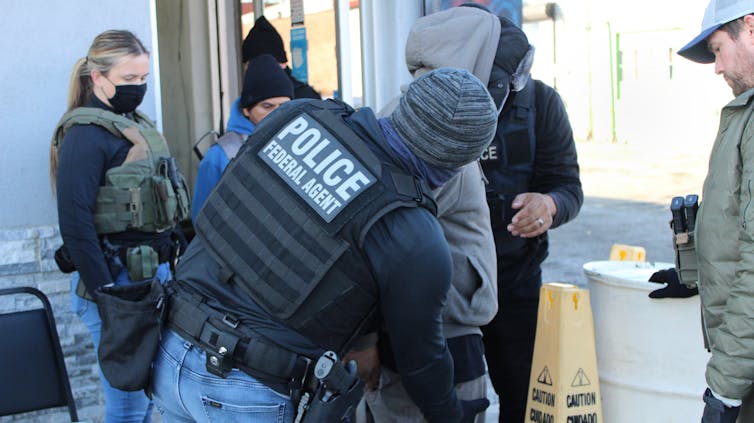
Immigration enforcement is a key justification for repurposing government data. Photo by U.S. Immigration and Customs Enforcement via Getty Images
Nicole M. Bennett, Indiana University A whistleblower at the National Labor Relations Board reported an unusual spike in potentially sensitive data flowing out of the agency’s network in early March 2025 when staffers from the Department of Government Efficiency, which goes by DOGE, were granted access to the agency’s databases. On April 7, the Department of Homeland Security gained access to Internal Revenue Service tax data. These seemingly unrelated events are examples of recent developments in the transformation of the structure and purpose of federal government data repositories. I am a researcher who studies the intersection of migration, data governance and digital technologies. I’m tracking how data that people provide to U.S. government agencies for public services such as tax filing, health care enrollment, unemployment assistance and education support is increasingly being redirected toward surveillance and law enforcement. Originally collected to facilitate health care, eligibility for services and the administration of public services, this information is now shared across government agencies and with private companies, reshaping the infrastructure of public services into a mechanism of control. Once confined to separate bureaucracies, data now flows freely through a network of interagency agreements, outsourcing contracts and commercial partnerships built up in recent decades. These data-sharing arrangements often take place outside public scrutiny, driven by national security justifications, fraud prevention initiatives and digital modernization efforts. The result is that the structure of government is quietly transforming into an integrated surveillance apparatus, capable of monitoring, predicting and flagging behavior at an unprecedented scale. Executive orders signed by President Donald Trump aim to remove remaining institutional and legal barriers to completing this massive surveillance system.

DOGE and the private sector

Central to this transformation is DOGE, which is tasked via an executive order to “promote inter-operability between agency networks and systems, ensure data integrity, and facilitate responsible data collection and synchronization.” An additional executive order calls for the federal government to eliminate its information silos. By building interoperable systems, DOGE can enable real-time, cross-agency access to sensitive information and create a centralized database on people within the U.S. These developments are framed as administrative streamlining but lay the groundwork for mass surveillance. Key to this data repurposing are public-private partnerships. The DHS and other agencies have turned to third-party contractors and data brokers to bypass direct restrictions. These intermediaries also consolidate data from social media, utility companies, supermarkets and many other sources, enabling enforcement agencies to construct detailed digital profiles of people without explicit consent or judicial oversight. Palantir, a private data firm and prominent federal contractor, supplies investigative platforms to agencies such as Immigration and Customs Enforcement, the Department of Defense, the Centers for Disease Control and Prevention and the Internal Revenue Service. These platforms aggregate data from various sources – driver’s license photos, social services, financial information, educational data – and present it in centralized dashboards designed for predictive policing and algorithmic profiling. These tools extend government reach in ways that challenge existing norms of privacy and consent.

The role of AI

Artificial intelligence has further accelerated this shift. Predictive algorithms now scan vast amounts of data to generate risk scores, detect anomalies and flag potential threats. These systems ingest data from school enrollment records, housing applications, utility usage and even social media, all made available through contracts with data brokers and tech companies. Because these systems rely on machine learning, their inner workings are often proprietary, unexplainable and beyond meaningful public accountability.
Data privacy researcher Justin Sherman explains the astonishing amount of information data brokers have about you.
Sometimes the results are inaccurate, generated by AI hallucinations – responses AI systems produce that sound convincing but are incorrect, made up or irrelevant. Minor data discrepancies can lead to major consequences: job loss, denial of benefits and wrongful targeting in law enforcement operations. Once flagged, individuals rarely have a clear pathway to contest the system’s conclusions.

Digital profiling

Participation in civic life, applying for a loan, seeking disaster relief and requesting student aid now contribute to a person’s digital footprint. Government entities could later interpret that data in ways that allow them to deny access to assistance. Data collected under the banner of care could be mined for evidence to justify placing someone under surveillance. And with growing dependence on private contractors, the boundaries between public governance and corporate surveillance continue to erode. Artificial intelligence, facial recognition systems and predictive profiling systems lack oversight. They also disproportionately affect low-income individuals, immigrants and people of color, who are more frequently flagged as risks. Initially built for benefits verification or crisis response, these data systems now feed into broader surveillance networks. The implications are profound. What began as a system targeting noncitizens and fraud suspects could easily be generalized to everyone in the country.

Eyes on everyone

This is not merely a question of data privacy. It is a broader transformation in the logic of governance. Systems once designed for administration have become tools for tracking and predicting people’s behavior. In this new paradigm, oversight is sparse and accountability is minimal. AI allows for the interpretation of behavioral patterns at scale without direct interrogation or verification. Inferences replace facts. Correlations replace testimony. The risk extends to everyone. While these technologies are often first deployed at the margins of society – against migrants, welfare recipients or those deemed “high risk” – there’s little to limit their scope. As the infrastructure expands, so does its reach into the lives of all citizens. With every form submitted, interaction logged and device used, a digital profile deepens, often out of sight. The infrastructure for pervasive surveillance is in place. What remains uncertain is how far it will be allowed to go. Nicole M. Bennett, Ph.D. Candidate in Geography and Assistant Director at the Center for Refugee Studies, Indiana University This article is republished from The Conversation under a Creative Commons license. Read the original article.

Author


Discover more from Daily News

Subscribe to get the latest posts sent to your email.

Continue Reading
Advertisement Tool Tickets

actors & performers

Harkins Theatres Announces Rob Reiner Tribute Screening on December 17

Rob Reiner Tribute: Harkins Theatres will host a special $5 screening of The American President on December 17 to honor filmmaker Rob Reiner, with all proceeds benefiting the Human Rights Campaign.

Published

on

Last Updated on December 17, 2025 by Daily News Staff

Rob Reiner Tribute

Harkins Theatres Announces Rob Reiner Tribute Screening of The American President

Harkins Theatres has announced a special one-day tribute screening honoring acclaimed filmmaker Rob Reiner, celebrating his life’s work and cinematic legacy.

On December 17, select Harkins locations will screen Reiner’s 1995 political romance The American President, with all proceeds benefiting the Human Rights Campaign. Tickets are priced at $5, making the event both an accessible film experience and a charitable fundraiser.

The tribute was announced via Harkins’ official, verified social media accounts and is positioned as a legacy celebration, not a memorial.


🎥 Why The American President?

Released in 1995 and written by Aaron Sorkin, The American President stars Michael Douglas and Annette Bening and remains one of Rob Reiner’s most politically resonant films. The movie blends romance, idealism, and civic responsibility — themes that have consistently appeared throughout Reiner’s career.

The film later served as a creative blueprint for The West Wing, cementing its place in modern political storytelling.


📌 Event Details at a Glance

  • Event: Rob Reiner Tribute Screening

  • Film: The American President (1995)

  • Date: December 17

  • Price: $5

  • Where: Select Harkins Theatres

  • Beneficiary: Human Rights Campaign

  • Host: Harkins Theatres

🔗 Official Event Page:

https://www.harkins.com/movies/the-american-president-a-rob-reiner-tribute


img 1987


🎞️ Rob Reiner’s Lasting Impact

  Rob Reiner’s career spans more than five decades, including landmark films such as:

  • This Is Spinal Tap

  • Stand By Me

  • The Princess Bride

  • When Harry Met Sally…

  • Misery

  • A Few Good Men

His work is often praised for balancing entertainment, empathy, and social conscience, making tribute events like this especially meaningful to longtime audiences.

Hollywood vs. Reality: How LA’s Wilshire Subway Was Really Built

https://stmdailynews.com/wilshire-subway-tunneling-hollywood-vs-reality/

Advertisement
Get More From A Face Cleanser And Spa-like Massage

Discover more from Daily News

Subscribe to get the latest posts sent to your email.

Continue Reading

actors & performers

Hollywood Legend Rob Reiner and Wife Found Dead; Son in Custody

Renowned filmmaker Rob Reiner and his wife, Michele Singer Reiner, were found dead in their Los Angeles home in a reported homicide. Police have arrested their son in connection with the case, and tributes are pouring in.

Published

on

Last Updated on December 16, 2025 by Daily News Staff

Portrait of filmmaker Rob Reiner

Director Rob Reiner participates in a discussion following a screening of the film LBJ at the LBJ Presidential Library in Austin, Texas on Saturday October 22, 2016
On Saturday evening October 22, 2016, the LBJ Presidential Library held a sneak peek of Rob Reiner’s new filmÊLBJ, starring Woody Harrelson as the 36th president. The film, which premiered at the Toronto International Film Festival in September, chronicles the life and times of Lyndon Johnson who would inherit the presidency at one of the most fraught moments in American history.
Following the screening, director Rob Reiner, actor Woody Harrelson, and writer Joey Hartstone joined LBJ Library Director Mark Updegrove on stage for a conversation about the film.
LBJ Library photo by Jay Godwin
10/22/2016

Hollywood Legend Rob Reiner and Wife Found Dead; Son in Custody

December 15, 2025

Renowned filmmaker and actor Rob Reiner, 78, and his wife Michele Singer Reiner, 68, were found dead in their Brentwood, Los Angeles home on Sunday, authorities say. Emergency responders were called to the residence Sunday afternoon, where both were discovered with fatal wounds consistent with a stabbing. Police are treating the case as a double homicide. 

Los Angeles police arrested the couple’s 32-year-old son, Nick Reiner, in connection with the deaths. He is being held in custody as investigators continue to piece together the circumstances surrounding the incident. 

Nick Reiner and Rob Reiner at the 2016 Substance Abuse and Mental Health Services Administrations 2016 SAMHSA Voice Awards cropped

2016 SAMHSA Voice Awards

Reiner was one of Hollywood’s most influential figures, known for his work as a director, producer and actor. His career spanned decades, from early television fame to directing beloved films that shaped American cinema. 

Friends, colleagues and public figures have begun sharing tributes and reactions to the news as the investigation is ongoing. 

More details will be updated as they become available.

The Inspiring Legacy of Raymond E. Fowler: A Journey into the Unknown
Link: https://stmdailynews.com/the-inspiring-legacy-of-raymond-e-fowler-a-journey-into-the-unknown/

Discover more from Daily News

Subscribe to get the latest posts sent to your email.

Continue Reading

Health

FDA’s COVID-19 Vaccine Safety Claims Lack Solid Evidence—Why Overreaction Could Harm Public Health

COVID-19 vaccine safety: The FDA’s claims about COVID-19 vaccine deaths in children lack strong evidence and could restrict vaccine access. Learn why experts say VAERS reports aren’t proof, and how overreacting may harm public health and trust in vaccines.

Published

on

FDA’s COVID-19 Vaccine Safety Claims Lack Solid Evidence—Why Overreaction Could Harm Public Health
The FDA has provided no evidence that children died because of receiving a COVID-19 vaccine. Anchiy/E+ via Getty Images

FDA claims on COVID-19 vaccine safety are unsupported by reliable data – and could severely hinder vaccine access

Frank Han, University of Illinois Chicago The Food and Drug Administration is seeking to drastically change procedures for testing vaccine safety and approving vaccines, based on unproven claims that mRNA-based COVID-19 vaccines caused the death of at least 10 children. The agency detailed its plans in a memo released to staff on Nov. 28, 2025, which was obtained by several news outlets and published by The Washington Post. Citing an internal, unpublished review, the memo, written by the agency’s top vaccine regulator, Vinay Prasad, attributes the children’s deaths to myocarditis, an inflammation of the heart muscle. And it says the deaths were reported to the Vaccine Adverse Event Reporting System, or VAERS, but provides no evidence that the vaccines caused the deaths.  

COVID-19 vaccine safety

The death of children due to an unsafe vaccine is a serious allegation. I am a pediatric cardiologist who has studied the link between COVID-19 vaccines and heart-related side effects such as myocarditis in children. To my knowledge, studies to date have shown such side effects are rare, and severe outcomes even more so. However, I am open to new evidence that could change my mind. But without sufficient justification and solid evidence, restricting access to an approved vaccine and changing well-established procedures for testing vaccines would carry serious consequences. These moves would limit access for patients, create roadblocks for companies and worsen distrust in vaccines and public health. In my view, it’s important for people reading about these FDA actions to understand how the evidence on a vaccine’s safety is generally assessed.

Determining cause of death

The FDA memo claims that the deaths of these children were directly related to receiving a COVID-19 immunization. From my perspective as a clinician, it is awful that any child should die from a routine vaccination. However, health professionals like me owe it to the public to uphold the highest possible standards in investigating why these deaths occurred. If the FDA has evidence demonstrating something that national health agencies worldwide have missed – widespread child deaths due to myocarditis caused by the COVID-19 vaccine – I don’t doubt that even the most pro-vaccine physician will listen. So far, however, no such evidence has been presented. While a death logged in VAERS is a starting point, on its own it is insufficient to conclude whether a vaccine caused the death or other medical causes were to blame. To demonstrate a causal link, FDA staff and physicians must align the VAERS report with physicians’ assessments of the patient, as well as data from other sources for monitoring vaccine safety. These include PRISM, which logs insurance claims data, and the Vaccine Safety Datalink, which tracks safety signals in electronic medical records. It’s known that most deaths logged only in VAERS of children who recently received vaccines have been incorrectly attributed to the vaccines – either by accident or in some cases on purpose by anti-vaccine activists.

Heart-related side effects of COVID-19 vaccines

In his Substack and Twitter accounts, Prasad has said that he believes the rate of severe cardiac side effects after COVID-19 vaccination is severely underestimated and that the vaccines should be restricted far more than they currently are. In a July 2025 presentation, Prasad quoted a risk of 27 cases per million of myocarditis in young men who received the COVID-19 vaccine. A 2024 review suggested that number was a bit lower – about 20 cases out of 1 million people. But that same study found that unvaccinated people had greater risk of heart problems after a COVID-19 infection than vaccinated people. In a different study, people who got myocarditis after a COVID-19 vaccination developed fewer complications than people who got myocarditis after a COVID-19 infection. Existing vaccine safety infrastructure in the U.S. successfully identifies dangers posed by vaccines – and did so during the COVID-19 pandemic. Today, most COVID-19 vaccines in the U.S. rely on mRNA technology. But as vaccines were first emerging during the COVID-19 pandemic, two pharmaceutical companies, Janssen and AstraZeneca, rolled out a vaccine that used a different technology, called a viral vector. This type of vaccine had a very rare but genuine safety problem that was detected.
A report in VAERS is at most a first step to determining whether a vaccine caused harm.
VAERS, the Vaccine Safety Datalink, clinical investigators in the U.S. and their European counterparts detected that these vaccines did turn out to cause blood clotting. In April 2021, the FDA formally recommended pausing their use, and they were later pulled from the market. Death due to myocarditis from COVID-19 vaccination is exceedingly rare. Demonstrating that it occurred requires proof that the person had myocarditis, evidence that no other reasonable cause of death was present, and the absence of any additional cause of myocarditis. These factors cannot be determined from VAERS data, however – and to date, the FDA has presented no other relevant data.

A problematic vision for future vaccine approvals

Currently, vaccines are tested both by seeing how well they prevent disease and by how well they generate antibodies, which are the molecules that help your body fight viruses and bacteria. Some vaccines, such as the COVID-19 vaccine and the influenza vaccine, need to be updated based on new strains. The FDA generally approves these updates based on how well the new versions generate antibodies. Since the previous generation of vaccines was already shown to prevent infection, if the new version can generate antibodies like the previous one, researchers assume its ability to prevent infection is comparable too. Later studies can then test how well the vaccines prevent severe disease and hospitalization. The FDA memo says this approach is insufficient and instead argues for replacing such studies with many more placebo-controlled trials – not just for COVID-19 vaccines but also for widely used influenza and pneumonia vaccines. That may seem reasonable theoretically. In practice, however, it is not realistic. Today’s influenza vaccines must be changed every season to reflect mutations to the virus. If the FDA were to require new placebo-controlled trials every year, the vaccine being tested would become obsolete by the time it is approved. This would be a massive waste of time and resources.
A pharmacy with a sign advertising flu shots
Influenza vaccines must be updated for every flu season. Jacob Wackerhausen/iStock via Getty Images Plus
Also, detecting vaccine-related myocarditis at the low rate at which it occurs would have required clinical trials many times larger than the ones that were done to approve COVID-19 mRNA vaccines. This would have cost at least millions of dollars more, and the delay in rolling out vaccines would have also cost lives. Placebo-controlled trials would require comparing people who receive the updated vaccine with people who remain unvaccinated. When an older version of the vaccine is already available, this means purposefully asking people to forgo that vaccine and risk infection for the sake of the trial, a practice that is widely considered unethical. Current scientific practice is that only a brand-new vaccine may be compared against placebo. While suspected vaccine deaths should absolutely be investigated, stopping a vaccine for insufficient reasons can lead to a significant drop in public confidence. That’s why it’s essential to thoroughly and transparently investigate any claims that a vaccine causes harm.

Vaccine vs illness

To accurately gauge a vaccine’s risks, it is also crucial to compare its side effects with the effects of the illness it prevents. For COVID-19, data consistently shows that the disease is clearly more dangerous. From Aug. 1, 2021, to July 31, 2022, more than 800 children in the U.S. died due to COVID-19, but very few deaths from COVID-19 vaccines in children have been been verified worldwide. What’s more, the disease causes many more heart-related side effects than the vaccine does. Meanwhile, extensive evidence shows that COVID-19 vaccination reduces the risk of hospitalization by more than 70% and the risk of severe illness in adolescent children by 79%. Studies also show it dramatically reduces their risk of developing long COVID, a condition in which symptoms such as extreme fatigue or weakness persist more than three months after a COVID-19 infection. Reporting only the vaccines’ risks, and not their benefits, shows just a small part of the picture. Frank Han, Assistant Professor of Pediatric Cardiology, University of Illinois Chicago This article is republished from The Conversation under a Creative Commons license. Read the original article.
High Demand Marks “Veggies for Veterans” Event Amid SNAP Delays
Link: https://stmdailynews.com/high-demand-marks-veggies-for-veterans-event-amid-snap-delays/

Author


Discover more from Daily News

Subscribe to get the latest posts sent to your email.

Continue Reading

Trending