Connect with us

Blog

Glad and Oscar the Grouch Team Up for a Trashy, Toe-Tapping Campaign

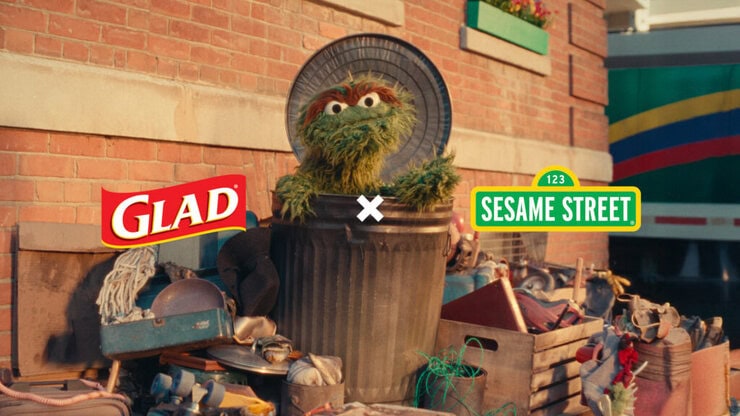
Glad teams up with Oscar the Grouch for a playful revival of the “Don’t Get Mad. Get Glad.” campaign, featuring a musical number, limited-edition Oscar-inspired trash bags, and a fresh take on making trash day fun for all ages.

Published

on

Oscar the Grouch and Glad trash bags featured in a colorful musical campaign, celebrating their playful collaboration with limited-edition green Oscar-inspired totes.

Glad revives its most popular, decades-long, star-studded ad campaign, “Don’t Get Mad. Get Glad.”

What happens when the world’s most iconic grouch meets the nation’s go-to name in trash bags? You get a campaign that’s equal parts nostalgia, Broadway-style fun, and a reminder that even trash can bring a little joy to your day.

A Classic Campaign Gets a Grouchy Remix

Glad has officially revived its legendary “Don’t Get Mad. Get Glad.” campaign, but this time, they’re ditching the usual celebrity faces for a true original: Oscar the Grouch. For the first time, the campaign’s star is none other than Sesame Street’s resident trash enthusiast himself, and he’s bringing his signature tune “I Love Trash” back with a contemporary twist.
The musical number, directed by the award-winning duo Will Speck and Josh Gordon, opens with Oscar in his element—surrounded by trash and a little bit of grumpiness. But the real magic happens when Oscar imagines a world where everyone else shares his passion for trash. The result? A joyful, Broadway-inspired remix that transforms everyday frustration into a celebration of Glad’s dependable trash solutions.

Why Oscar? Why Now?

According to Glad’s Marketing Director, Kellie Li, the choice was simple: “No one feels more strongly about trash than Oscar the Grouch.” The campaign aims to flip the script on how we think about trash—turning a dreaded chore into something a little more lighthearted. With Glad’s reliable bags, there’s less to get mad about, and maybe, just maybe, a little more to sing about.

Nostalgia Meets New Audiences

If “Don’t Get Mad. Get Glad.” sounds familiar, you’re not imagining things. The campaign has been a staple since 1987, featuring everyone from TV stars to athletes. But this new chapter, featuring Oscar and a cast of trash-loving co-stars, is designed to connect with both longtime fans and a new generation discovering Sesame Street on Netflix and PBS KIDS.

Limited-Edition Oscar Goodies and Where to Find Them

To celebrate the campaign, Glad is releasing limited-edition Oscar-inspired trash bag totes—complete with green fur, of course. Fans can snag these playful bags through a social media giveaway this December (follow @gladproducts on Instagram and TikTok for details). And if you miss out, don’t worry: special Oscar-branded Glad ForceFlex with Gain bags will hit Walmart shelves this April, just in time for spring cleaning.

Where to Watch

The campaign is rolling out across the U.S. and Canada, with full-length videos, bite-sized social teasers, and everything in between. Look for it on TikTok, Instagram, Facebook, and Reddit (for our friends up north). Featured products include Glad ForceFlex with Gain and Glad Cherry Blossom.

Bringing the Campaign Home: Phoenix Community Clean-Up

Here in Phoenix, we know the value of coming together to keep our neighborhoods clean and vibrant. Glad’s collaboration with Oscar the Grouch isn’t just a fun national campaign—it’s a reminder that tackling trash can be a community effort, too.
With spring cleaning right around the corner and special Oscar-branded Glad bags hitting Walmart shelves this April, it’s the perfect time for local groups, schools, and neighbors to organize clean-up events across the Valley. Whether you’re sprucing up a park, refreshing a neighborhood, or just making your own block a little brighter, every bag makes a difference.
Ready to join the movement? Rally your friends, family, or local organization and plan a Phoenix clean-up day this spring. Snap a photo of your crew with your Glad or Oscar-inspired trash bags and share it on social media using #GladToCleanPHX and #OscarLovesTrash. Let’s show how Phoenix turns trash day into a reason to celebrate!
  • “Phoenix, let’s get grouchy about litter and Glad about clean streets! Join our community clean-up and share your photos with #GladToCleanPHX.”
  • “Spotted: Oscar the Grouch in Phoenix! Grab your Glad bags, clean up your neighborhood, and tag #OscarLovesTrash for a chance to be featured.”
  • “Spring cleaning in Phoenix just got a lot more fun—thanks to Glad and Oscar! Who’s joining our next clean-up day? #GladToCleanPHX”

About the Brands

Glad, a member of The Clorox Company, has long been a leader in household waste solutions, while Sesame Workshop continues to inspire and educate families worldwide. This collaboration is a perfect blend of dependable products and beloved characters—reminding us all that even the messiest moments can spark a little joy.
The collaboration between Glad and Sesame Workshop for the “Don’t Get Mad. Get Glad.” campaign marks a creative partnership that blends household dependability with beloved children’s entertainment. By bringing Oscar the Grouch into the spotlight, Glad not only revives a classic campaign but also highlights the importance of making everyday chores more enjoyable for families. This partnership leverages Glad’s reputation as the nation’s leading provider of kitchen and outdoor trash bags and food protection products—trusted solutions designed to handle life’s messes with ease (Glad.com). Sesame Workshop, the nonprofit behind Sesame Street, has spent over 50 years enriching families worldwide through educational media and community outreach, helping children grow smarter, stronger, and kinder (Sesame.org). Together, their collaboration aims to inspire a new generation to see the positive side of cleaning up, all while celebrating the joy of community and play.
Sources:

High Demand Marks “Veggies for Veterans” Event Amid SNAP Delays


Discover more from Daily News

Subscribe to get the latest posts sent to your email.

Continue Reading
Advertisement Tool Tickets
Click to comment
0 0 votes
Article Rating
Subscribe
Notify of
guest

0 Comments
Oldest
Newest Most Voted
Inline Feedbacks
View all comments

Artificial Intelligence

More than half of new articles on the internet are being written by AI – is human writing headed for extinction?

A new study finds over 50% of online articles are now AI-generated, raising questions about the future of human writing. Discover why formulaic content is most at risk, and why authentic, creative voices may become more valuable than ever.

Published

on

Is AI Replacing Human Writers? Why Over Half of Online Articles Are Now AI-Generated
Preserving the value of real human voices will likely depend on how people adapt to artificial intelligence and collaborate with it. BlackJack3D/E+ via Getty Images

More than half of new articles on the internet are being written by AI – is human writing headed for extinction?

Francesco Agnellini, Binghamton University, State University of New York The line between human and machine authorship is blurring, particularly as it’s become increasingly difficult to tell whether something was written by a person or AI. Now, in what may seem like a tipping point, the digital marketing firm Graphite recently published a study showing that more than 50% of articles on the web are being generated by artificial intelligence. As a scholar who explores how AI is built, how people are using it in their everyday lives, and how it’s affecting culture, I’ve thought a lot about what this technology can do and where it falls short. If you’re more likely to read something written by AI than by a human on the internet, is it only a matter of time before human writing becomes obsolete? Or is this simply another technological development that humans will adapt to?

It isn’t all or nothing

Thinking about these questions reminded me of Umberto Eco’s essay “Apocalyptic and Integrated,” which was originally written in the early 1960s. Parts of it were later included in an anthology titled “Apocalypse Postponed,” which I first read as a college student in Italy. In it, Eco draws a contrast between two attitudes toward mass media. There are the “apocalyptics” who fear cultural degradation and moral collapse. Then there are the “integrated” who champion new media technologies as a democratizing force for culture.
An older man with a beard, glasses and a suit poses while holding a cigarette.
Italian philosopher, cultural critic and novelist Umberto Eco cautioned against overreacting to the impact of new technologies. Leonardo Cendamo/Getty Images
Back then, Eco was writing about the proliferation of TV and radio. Today, you’ll often see similar reactions to AI. Yet Eco argued that both positions were too extreme. It isn’t helpful, he wrote, to see new media as either a dire threat or a miracle. Instead, he urged readers to look at how people and communities use these new tools, what risks and opportunities they create, and how they shape – and sometimes reinforce – power structures. While I was teaching a course on deepfakes during the 2024 election, Eco’s lesson also came back to me. Those were days when some scholars and media outlets were regularly warning of an imminent “deepfake apocalypse.” Would deepfakes be used to mimic major political figures and push targeted disinformation? What if, on the eve of an election, generative AI was used to mimic the voice of a candidate on a robocall telling voters to stay home? Those fears weren’t groundless: Research shows that people aren’t especially good at identifying deepfakes. At the same time, they consistently overestimate their ability to do so. In the end, though, the apocalypse was postponed. Post-election analyses found that deepfakes did seem to intensify some ongoing political trends, such as the erosion of trust and polarization, but there’s no evidence that they affected the final outcome of the election.

Listicles, news updates and how-to guides

Of course, the fears that AI raises for supporters of democracy are not the same as those it creates for writers and artists. For them, the core concerns are about authorship: How can one person compete with a system trained on millions of voices that can produce text at hyper-speed? And if this becomes the norm, what will it do to creative work, both as an occupation and as a source of meaning? It’s important to clarify what’s meant by “online content,” the phrase used in the Graphite study, which analyzed over 65,000 randomly selected articles of at least 100 words on the web. These can include anything from peer-reviewed research to promotional copy for miracle supplements. A closer reading of the Graphite study shows that the AI-generated articles consist largely of general-interest writing: news updates, how-to guides, lifestyle posts, reviews and product explainers. https://stmdailynews.com/wp-admin/post-new.php#visibility The primary economic purpose of this content is to persuade or inform, not to express originality or creativity. Put differently, AI appears to be most useful when the writing in question is low-stakes and formulaic: the weekend-in-Rome listicle, the standard cover letter, the text produced to market a business. A whole industry of writers – mostly freelance, including many translators – has relied on precisely this kind of work, producing blog posts, how-to material, search engine optimization text and social media copy. The rapid adoption of large language models has already displaced many of the gigs that once sustained them.

Collaborating with AI

The dramatic loss of this work points toward another issue raised by the Graphite study: the question of authenticity, not only in identifying who or what produced a text, but also in understanding the value that humans attach to creative activity. How can you distinguish a human-written article from a machine-generated one? And does that ability even matter? Over time, that distinction is likely to grow less significant, particularly as more writing emerges from interactions between humans and AI. A writer might draft a few lines, let an AI expand them and then reshape that output into the final text. This article is no exception. As a non-native English speaker, I often rely on AI to refine my language before sending drafts to an editor. At times the system attempts to reshape what I mean. But once its stylistic tendencies become familiar, it becomes possible to avoid them and maintain a personal tone. Also, artificial intelligence is not entirely artificial, since it is trained on human-made material. It’s worth noting that even before AI, human writing has never been entirely human, either. Every technology, from parchment and stylus paper to the typewriter and now AI, has shaped how people write and how readers make sense of it. Another important point: AI models are increasingly trained on datasets that include not only human writing but also AI-generated and human–AI co-produced text. This has raised concerns about their ability to continue improving over time. Some commentators have already described a sense of disillusionment following the release of newer large models, with companies struggling to deliver on their promises.

Human voices may matter even more

But what happens when people become overly reliant on AI in their writing? Some studies show that writers may feel more creative when they use artificial intelligence for brainstorming, yet the range of ideas often becomes narrower. This uniformity affects style as well: These systems tend to pull users toward similar patterns of wording, which reduces the differences that usually mark an individual voice. Researchers also note a shift toward Western – and especially English-speaking – norms in the writing of people from other cultures, raising concerns about a new form of AI colonialism. In this context, texts that display originality, voice and stylistic intention are likely to become even more meaningful within the media landscape, and they may play a crucial role in training the next generations of models. If you set aside the more apocalyptic scenarios and assume that AI will continue to advance – perhaps at a slower pace than in the recent past – it’s quite possible that thoughtful, original, human-generated writing will become even more valuable. Put another way: The work of writers, journalists and intellectuals will not become superfluous simply because much of the web is no longer written by humans. Francesco Agnellini, Lecturer in Digital and Data Studies, Binghamton University, State University of New York This article is republished from The Conversation under a Creative Commons license. Read the original article.
 

Dive into “The Knowledge,” where curiosity meets clarity. This playlist, in collaboration with STMDailyNews.com, is designed for viewers who value historical accuracy and insightful learning. Our short videos, ranging from 30 seconds to a minute and a half, make complex subjects easy to grasp in no time. Covering everything from historical events to contemporary processes and entertainment, “The Knowledge” bridges the past with the present. In a world where information is abundant yet often misused, our series aims to guide you through the noise, preserving vital knowledge and truths that shape our lives today. Perfect for curious minds eager to discover the ‘why’ and ‘how’ of everything around us. Subscribe and join in as we explore the facts that matter.  https://stmdailynews.com/the-knowledge/

View recent photos

Unlock fun facts & lost history—get The Knowledge in your inbox!

We don’t spam! Read our privacy policy for more info.


Discover more from Daily News

Subscribe to get the latest posts sent to your email.

Continue Reading

Blog

Why Medieval Christians Loved Stories of Jesus as a Holy ‘Rascal’—Beyond the Bible’s Silence on His Childhood

The Bible says little about Jesus’ early years, but medieval Christians enjoyed vivid tales of his childhood as a wonder-working, mischievous “holy rascal.” Discover how apocryphal stories and art filled in the gaps, shaping Christmas traditions and popular imagination.

Published

on

The Bible says little about Jesus’ childhood – but that didn’t stop medieval Christians from enjoying tales of him as holy ‘rascal’
An illustration from the Vernon Manuscript, from around 1400, shows the familiar motif of an ox and ass watching over the newborn Jesus. © Bodleian Libraries, University of Oxford, CC BY-NC

The Bible says little about Jesus’ childhood – but that didn’t stop medieval Christians from enjoying tales of him as holy ‘rascal’

Mary Dzon, University of Tennessee Manger scenes displayed around Christmastime usually feature an ox and an ass beside the infant Jesus. According to the Gospel of Luke, Mary placed her child in a manger – an animal feeding bin – “because there was no room for them in the inn.” No mere babysitters, the ox and ass harken back to the Book of Isaiah 1:3, a verse early Christians interpreted as a prophecy of the birth of Christ. In some early artwork, these beasts of burden kneel to show their reverence – recognizing this swaddled babe, who entered the world in humble circumstances, as lordly. The canonical Gospels, the accounts of Jesus’ life included in the Bible’s New Testament, make no mention of those animals welcoming the newborn. Yet the motif was already seen in art from the fourth century. It was further popularized by the Gospel of Pseudo-Matthew, an apocryphal text – that is, one not included in the canon of Scripture. Pseudo-Matthew was composed by an anonymous monk, probably in the seventh century, and includes many tales about Jesus growing up. After its account of Jesus’ birth, the Bible is almost entirely silent on his childhood. Yet legends about Jesus’ early years circulated widely in the Middle Ages – the focus of my 2017 book. While the detail of the ox and ass is quite familiar to many Christians today, few are aware of the other striking tales transmitted by the apocrypha.

Wonder-worker

A painting with a gold frame and background shows a man and woman with halos talking to a child with a halo, who has his arms crossed.
‘Christ Discovered in the Temple,’ by Simone Martini (1342). Google Cultural Institute/Walker Art Gallery via Wikimedia Commons
The Bible does include one famous scene from Jesus’ youth: the incident when 12-year-old Jesus stayed behind at the Jewish temple in Jerusalem, unbeknownst to his parents. Searching for him with great anxiety, they find him conversing with religious teachers, both asking questions and astounding them with his answers. Fourteenth-century painter Simone Martini’s “Christ Discovered in the Temple” portrays him standing before his parents with crossed arms – a stubborn youth, apparently unapologetic about making them worry for days. The apocryphal Gospel of Pseudo-Matthew – especially versions that incorporate material from an even earlier apocryphal gospel, the Infancy Gospel of Thomas – focuses on the years of Jesus’ childhood. Like the temple story, they show the boy Jesus as sometimes difficult and having preternatural wisdom that amazes and even offends his would-be teachers. More dramatically, the apocryphal legends depict Jesus exercising divine power from a very young age.
A small, colorful illustration with a gold background shows two adults and a child with halos, looking into a cave at small blue and green dragons
A 14th-century Italian manuscript shows Jesus fending off dragons to protect his parents. © Bodleian Libraries, University of Oxford, CC BY-NC
Like the adult Jesus of the New Testament, this apocryphal Christ child often works wonders to help others in need. According to the biblical Gospel of Matthew, Mary and Joseph take the infant Jesus to Egypt after an angel warns in a dream that Herod, King of Judea, would kill the child. In Pseudo-Matthew’s elaboration of this episode, we see Jesus, not yet 2 years old, bravely stand on his feet before dragons emanating from a cave, where his family has stopped to rest. The terrifying dragons worship him and then depart, while Jesus boldly assures those around him that he is the “perfect man” and can “tame every kind of wild beast.” He later commands a palm tree to bend down so that a weary Mary can partake of its fruits, and he miraculously shortens their journey in the desert. At times, the Jesus of these legends is largely to blame for the troubles around him. The 14th-century Tring Tiles, now in the British Museum, depict one of Jesus’ friends imprisoned by his father in a tower. Christ pulls him out of a tiny hole, like a gallant medieval knight rescuing a maiden in distress. The father had tried to insulate his son from Jesus’ influence – understandable, considering that many legends show Jesus causing the death of his playmates or other boys who somehow irked him. In a story summarized by one scholar as “death for a bump,” a boy runs into Jesus. He curses the child, who instantly drops down dead – though Jesus brings him back to life after a brief reprimand from Joseph.
A dark red or brown tile has lighter etchings on it, with scenes of a man standing next to a tower that a child stands atop, and then the child exiting the tower as another figure with a halo looks on.
One section of the Tring Tiles, created in the 14th century, shows Jesus removing his friend from a tower. © The Trustees of the British Museum, CC BY-NC-SA
In another tale, included in an Anglo-Norman narrative that survives in an illustrated manuscript, Jesus takes off his coat, places it upon a sunbeam and sits upon it. When the other children see this, they “thought they would do the same …. But they were too eager, and they all fell down at once. One and another jumped up quickly onto the sunbeam, but it turned out badly for them, since each one broke his neck.” Jesus heals the boys at his parents’ prompting. Joseph admits to his neighbors that Jesus “was indeed too wild” and sends him away. The 7-year-old Jesus becomes apprenticed to a dyer, who gives him very precise directions about dyeing three pieces of cloth in three different vats. Once his master has left, Jesus ignores his instructions, throwing all the cloth into one vat – yet still achieves the desired outcome. When the master returns, he at first thinks he has been “ruined by this little rascal,” but then realizes that a wonder has occurred.
An illustration with a red background shows several boys in tunics playing on a large, slide-like structure.
Jesus seated on a sunbeam, while other boys attempt to do so, in a miniature from the Selden Supra 38 manuscript, created in the early 14th century. © Bodleian Libraries, University of Oxford, CC BY-NC-SA

Bond with animals

These apocryphal legends also show the boy Jesus having power over the animal world. When he enters a dreaded lion’s cave, cubs “ran about around his feet, fawning and playing with him,” while “the older lions … stood at a distance and worshipped him, and wagged their tails before him.” Jesus tells bystanders that the beasts are better than they are, because the animals “recognize and glorify their Lord.” Indeed, these tales characterize Jesus as a rather haughty boy, conscious of his divinity and not happy with those who treat him as a mere child. At the same time, they depict him as a real child who likes to play. The boy Jesus is childlike in the way he often acts on impulse, not paying much attention to the admonitions of his elders.
An illumination of a pack of lions looking at a young boy with a halo who is stroking a cub outside a cave.
A 14th-century manuscript, the ‘Klosterneuburger Evangelienwerk,’ shows the young Jesus playing with lions. Schaffhausen City Library via Wikimedia Commons
His affinity for animals, too, makes him seem childlike. Strikingly, beasts in the apocrypha, beginning with the ox and ass, often seem to realize that Jesus is no ordinary child before human characters do. The legends’ insidious insinuation that many of the Jews around Jesus were not as perceptive as the animals is part of medieval Europe’s widespread antisemitism. In one fifth-century sermon, Quodvultdeus, the bishop of Carthage, asks why the animals’ recognition of Jesus in the manger was not a sufficient sign for the Jews.
A faded manuscript illustration shows the same boy fetching water, tending a fire, and working at a table as a man and woman look on.
The 14th-century Holkham Bible picture book depicts Jesus performing chores at home (London, British Library, Additional MS 47682, fol. 18). Courtesy British Library
In the Bible, Jesus works his first miracle as an adult, at a wedding feast in Cana. The apocryphal tales, however, toy with the idea of the God-man revealing his power early on. The legends suggest that the childishness of Christ distracted many of those around him, preventing them from concluding that he was the Messiah. This allows the apocrypha to avoid contradicting the Bible’s reference to Jesus as simply “the carpenter’s son,” the opposite of a wonder child. Each Christmas, modern Christians in the Western world tend to celebrate Jesus’ birthday, then quickly drop the theme of the Christ child. Medieval Christians, in contrast, were fascinated by tales about the Son of God growing up. Despite acting as a dragon tamer, physician and magician, the young Jesus of the apocrypha largely flies under the radar, cloaking his divinity with “little rascal” boyishness. Mary Dzon, Associate Professor of English, University of Tennessee This article is republished from The Conversation under a Creative Commons license. Read the original article.
Cash Trapping: How to Protect Yourself from This Sneaky ATM Scam
Link: https://stmdailynews.com/cash-trapping-how-to-protect-yourself-from-this-sneaky-atm-scam/

Discover more from Daily News

Subscribe to get the latest posts sent to your email.

Continue Reading

Blog

NASA Astronaut Jonny Kim to Share Insights from Eight-Month Space Station Mission

NASA astronaut Jonny Kim will discuss his eight-month International Space Station mission during a live news conference on Dec. 19. Discover the science, technology, and teamwork behind his groundbreaking journey, streaming live via NASA and covered by STM Daily News.

Published

on

NASA astronaut Jonny Kim inside the International Space Station’s cupola, orbiting above the Indian Ocean near Madagascar.

NASA astronaut Jonny Kim poses inside the International Space Station’s cupola as it orbits 265 miles above the Indian Ocean near Madagascar. Credit: NASA


NASA Astronaut Jonny Kim Recaps Eight-Month International Space Station Mission in Live News Conference

Space exploration continues to push the boundaries of science and human achievement. This month, NASA astronaut Jonny Kim returns from an extraordinary eight-month mission aboard the International Space Station (ISS)—and he’s ready to share his story.
Event Details:
  • What: Jonny Kim’s ISS Mission Recap News Conference
  • When: Friday, Dec. 19, 3:30 p.m. EST
  • Where: NASA’s YouTube channel (also available on other NASA streaming platforms)

A Mission Marked by Discovery

Returning to Earth on Dec. 9 with Roscosmos cosmonauts Sergey Ryzhikov and Alexey Zubritsky, Kim logged an impressive 245 days in space as a flight engineer for Expeditions 72/73. The crew completed a staggering 3,920 orbits—covering nearly 104 million miles—and managed the arrival and departure of multiple spacecraft.
But it’s the science behind the mission that stands out:

Advancing Medicine and Technology

  • Bioprinted Tissues in Microgravity: Kim helped study the behavior of bioprinted tissues containing blood vessels, a step forward in space-based tissue production that could one day revolutionize patient care on Earth.
  • Remote Robotics Operations: Through the Surface Avatar study, Kim tested the remote command of multiple robots in space—work that could lead to more advanced robotic assistants for future missions to the Moon, Mars, and beyond.
  • Nanomaterials for Medicine: Kim contributed to the development of DNA-mimicking nanomaterials, opening doors for improved drug delivery and regenerative medicine both in space and at home.

How to Watch and Participate

NASA invites the public and media to join the news conference. For those interested in direct participation, media accreditation is required (details available via NASA’s newsroom). For everyone else, the event will be streamed live—no registration needed.
Learn more about International Space Station research and ongoing missions: NASA’s ISS Page

Why This Matters

Jonny Kim’s journey is a testament to the power of international collaboration and the relentless pursuit of knowledge. His work aboard the ISS is already shaping the future of medicine, robotics, and exploration—impacting lives both in space and right here on Earth.
Stay tuned to STM Daily News for more updates on science, innovation, and the stories that connect our community to the world beyond.

Want more space and science coverage? Visit STM Daily News for the latest updates, features, and community stories.

Discover more from Daily News

Subscribe to get the latest posts sent to your email.

Continue Reading

Trending

0
Would love your thoughts, please comment.x
()
x