Not all children learn to read in the same way, but schools tend to adopt a single approach to literacy. luckyvector/iStock via Getty Images PlusK. Dara Hill, University of Michigan-Dearborn Five years after the pandemic forced children into remote instruction, two-thirds of U.S. fourth graders still cannot read at grade level. Reading scores lag 2 percentage points below 2022 levels and 4 percentage points below 2019 levels. This data from the 2024 report of National Assessment of Educational Progress, a state-based ranking sometimes called “America’s report card,” has concerned educators scrambling to boost reading skills. Many school districts have adopted an evidence-based literacy curriculum called the “science of reading” that features phonics as a critical component. Phonics strategies begin by teaching children to recognize letters and make their corresponding sounds. Then they advance to manipulating and blending first-letter sounds to read and write simple, consonant-vowel-consonant words – such as combining “b” or “c” with “-at” to make “bat” and “cat.” Eventually, students learn to merge more complex word families and to read them in short stories to improve fluency and comprehension. Proponents of the curriculum celebrate its grounding in brain science, and the science of reading has been credited with helping Louisiana students outperform their pre-pandemic reading scores last year. In practice, Louisiana used a variety of science of reading approaches beyond phonics. That’s because different students have different learning needs, for a variety of reasons. Yet as a scholar of reading and language who has studied literacy in diverse student populations, I see many schools across the U.S. placing a heavy emphasis on the phonics components of the science of reading. If schools want across-the-board gains in reading achievement, using one reading curriculum to teach every child isn’t the best way. Teachers need the flexibility and autonomy to use various, developmentally appropriate literacy strategies as needed.
Phonics fails some students
Phonics programs often require memorizing word families in word lists. This works well for some children: Research shows that “decoding” strategies such as phonics can support low-achieving readers and learners with dyslexia. However, some students may struggle with explicit phonics instruction, particularly the growing population of neurodivergent learners with autism spectrum disorder or attention deficit hyperactivity disorder. These students learn and interact differently than their mainstream peers in school and in society. And they tend to have different strengths and challenges when it comes to word recognition, reading fluency and comprehension. This was the case with my own child. He had been a proficient reader from an early age, but struggles emerged when his school adopted a phonics program to balance out its regular curriculum, a flexible literature-based curriculum called Daily 5 that prioritizes reading fluency and comprehension. I worked with his first grade teacher to mitigate these challenges. But I realized that his real reading proficiency would likely not have been detected if the school had taught almost exclusively phonics-based reading lessons. Another weakness of phonics, in my experience, is that it teaches reading in a way that is disconnected from authentic reading experiences. Phonics often directs children to identify short vowel sounds in word lists, rather than encounter them in colorful stories. Evidence shows that exposing children to fun, interesting literature promotes deep comprehension.
Balanced literacy
To support different learning styles, educators can teach reading in multiple ways. This is called balanced literacy, and for decades it was a mainstay in teacher preparation and in classrooms. Balanced literacy prompts children to learn words encountered in authentic literature during guided, teacher-led read-alouds – versus learning how to decode words in word lists. Teachers use multiple strategies to promote reading acquisition, such as blending the letter sounds in words to support “decoding” while reading. Another balanced literacy strategy that teachers can apply in phonics-based strategies while reading aloud is called “rhyming word recognition.” The rhyming word strategy is especially effective with stories whose rhymes contribute to the deeper meaning of the story, such as Marc Brown’s “Arthur in a Pickle.”The rhyming structure of ‘Arthur in a Pickle’ helps children learn to read entire words, versus word parts. After reading, teachers may have learners arrange letter cards to form words, then tap the letter cards while saying and blending each sound to form the word. Similar phonics strategies include tracing and writing letters to form words that were encountered during reading. There is no one right way to teach literacy in a developmentally appropriate, balanced literacy framework. There are as many ways as there are students.
STM Daily News is a vibrant news blog dedicated to sharing the brighter side of human experiences. Emphasizing positive, uplifting stories, the site focuses on delivering inspiring, informative, and well-researched content. With a commitment to accurate, fair, and responsible journalism, STM Daily News aims to foster a community of readers passionate about positive change and engaged in meaningful conversations. Join the movement and explore stories that celebrate the positive impacts shaping our world. https://stmdailynews.com/
Harkins Theatres Announces Rob Reiner Tribute Screening of The American President
Harkins Theatres has announced a special one-day tribute screening honoring acclaimed filmmaker Rob Reiner, celebrating his life’s work and cinematic legacy.
On December 17, select Harkins locations will screen Reiner’s 1995 political romance The American President, with all proceeds benefiting the Human Rights Campaign. Tickets are priced at $5, making the event both an accessible film experience and a charitable fundraiser.
The tribute was announced via Harkins’ official, verified social media accounts and is positioned as a legacy celebration, not a memorial.
🎥 Why The American President?
Released in 1995 and written by Aaron Sorkin, The American President stars Michael Douglas and Annette Bening and remains one of Rob Reiner’s most politically resonant films. The movie blends romance, idealism, and civic responsibility — themes that have consistently appeared throughout Reiner’s career.
The film later served as a creative blueprint for The West Wing, cementing its place in modern political storytelling.
Rob Reiner’s career spans more than five decades, including landmark films such as:
This Is Spinal Tap
Stand By Me
The Princess Bride
When Harry Met Sally…
Misery
A Few Good Men
His work is often praised for balancing entertainment, empathy, and social conscience, making tribute events like this especially meaningful to longtime audiences.
Hollywood Legend Rob Reiner and Wife Found Dead; Son in Custody
Renowned filmmaker Rob Reiner and his wife, Michele Singer Reiner, were found dead in their Los Angeles home in a reported homicide. Police have arrested their son in connection with the case, and tributes are pouring in.
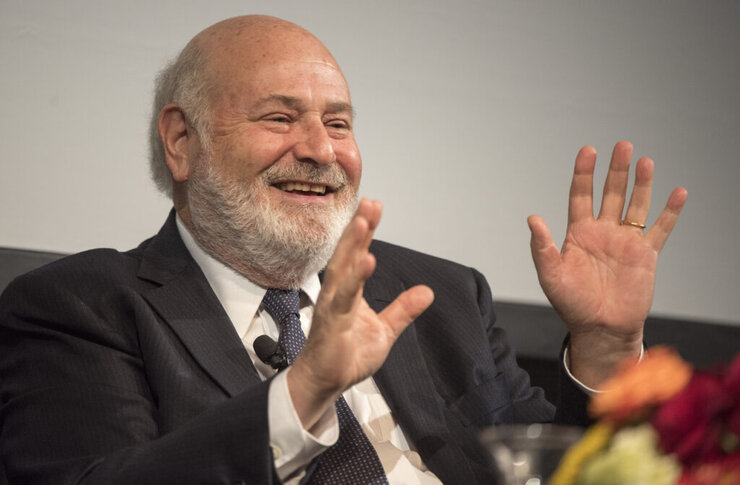
Director Rob Reiner participates in a discussion following a screening of the film LBJ at the LBJ Presidential Library in Austin, Texas on Saturday October 22, 2016 On Saturday evening October 22, 2016, the LBJ Presidential Library held a sneak peek of Rob Reiner’s new filmÊLBJ, starring Woody Harrelson as the 36th president. The film, which premiered at the Toronto International Film Festival in September, chronicles the life and times of Lyndon Johnson who would inherit the presidency at one of the most fraught moments in American history. Following the screening, director Rob Reiner, actor Woody Harrelson, and writer Joey Hartstone joined LBJ Library Director Mark Updegrove on stage for a conversation about the film. LBJ Library photo by Jay Godwin 10/22/2016
Hollywood Legend Rob Reiner and Wife Found Dead; Son in Custody
December 15, 2025
Renowned filmmaker and actor Rob Reiner, 78, and his wife Michele Singer Reiner, 68, were found dead in their Brentwood, Los Angeles home on Sunday, authorities say. Emergency responders were called to the residence Sunday afternoon, where both were discovered with fatal wounds consistent with a stabbing. Police are treating the case as a double homicide.
Los Angeles police arrested the couple’s 32-year-old son, Nick Reiner, in connection with the deaths. He is being held in custody as investigators continue to piece together the circumstances surrounding the incident.
2016 SAMHSA Voice Awards
Reiner was one of Hollywood’s most influential figures, known for his work as a director, producer and actor. His career spanned decades, from early television fame to directing beloved films that shaped American cinema.
Friends, colleagues and public figures have begun sharing tributes and reactions to the news as the investigation is ongoing.
More details will be updated as they become available.
FDA’s COVID-19 Vaccine Safety Claims Lack Solid Evidence—Why Overreaction Could Harm Public Health
COVID-19 vaccine safety: The FDA’s claims about COVID-19 vaccine deaths in children lack strong evidence and could restrict vaccine access. Learn why experts say VAERS reports aren’t proof, and how overreacting may harm public health and trust in vaccines.
The death of children due to an unsafe vaccine is a serious allegation. I am a pediatric cardiologist who has studied the link between COVID-19 vaccines and heart-related side effects such as myocarditis in children. To my knowledge, studies to date have shown such side effects are rare, and severe outcomes even more so. However, I am open to new evidence that could change my mind. But without sufficient justification and solid evidence, restricting access to an approved vaccine and changing well-established procedures for testing vaccines would carry serious consequences. These moves would limit access for patients, create roadblocks for companies and worsen distrust in vaccines and public health. In my view, it’s important for people reading about these FDA actions to understand how the evidence on a vaccine’s safety is generally assessed.
Determining cause of death
The FDA memo claims that the deaths of these children were directly related to receiving a COVID-19 immunization. From my perspective as a clinician, it is awful that any child should die from a routine vaccination. However, health professionals like me owe it to the public to uphold the highest possible standards in investigating why these deaths occurred. If the FDA has evidence demonstrating something that national health agencies worldwide have missed – widespread child deaths due to myocarditis caused by the COVID-19 vaccine – I don’t doubt that even the most pro-vaccine physician will listen. So far, however, no such evidence has been presented. While a death logged in VAERS is a starting point, on its own it is insufficient to conclude whether a vaccine caused the death or other medical causes were to blame. To demonstrate a causal link, FDA staff and physicians must align the VAERS report with physicians’ assessments of the patient, as well as data from other sources for monitoring vaccine safety. These include PRISM, which logs insurance claims data, and the Vaccine Safety Datalink, which tracks safety signals in electronic medical records. It’s known that most deaths logged only in VAERS of children who recently received vaccines have been incorrectly attributed to the vaccines – either by accident or in some cases on purpose by anti-vaccine activists.
Heart-related side effects of COVID-19 vaccines
In his Substack and Twitter accounts, Prasad has said that he believes the rate of severe cardiac side effects after COVID-19 vaccination is severely underestimated and that the vaccines should be restricted far more than they currently are. In a July 2025 presentation, Prasad quoted a risk of 27 cases per million of myocarditis in young men who received the COVID-19 vaccine. A 2024 review suggested that number was a bit lower – about 20 cases out of 1 million people. But that same study found that unvaccinated people had greater risk of heart problems after a COVID-19 infection than vaccinated people. In a different study, people who got myocarditis after a COVID-19 vaccination developed fewer complications than people who got myocarditis after a COVID-19 infection. Existing vaccine safety infrastructure in the U.S. successfully identifies dangers posed by vaccines – and did so during the COVID-19 pandemic. Today, most COVID-19 vaccines in the U.S. rely on mRNA technology. But as vaccines were first emerging during the COVID-19 pandemic, two pharmaceutical companies, Janssen and AstraZeneca, rolled out a vaccine that used a different technology, called a viral vector. This type of vaccine had a very rare but genuine safety problem that was detected.A report in VAERS is at most a first step to determining whether a vaccine caused harm. VAERS, the Vaccine Safety Datalink, clinical investigators in the U.S. and their European counterparts detected that these vaccines did turn out to cause blood clotting. In April 2021, the FDA formally recommended pausing their use, and they were later pulled from the market. Death due to myocarditis from COVID-19 vaccination is exceedingly rare. Demonstrating that it occurred requires proof that the person had myocarditis, evidence that no other reasonable cause of death was present, and the absence of any additional cause of myocarditis. These factors cannot be determined from VAERS data, however – and to date, the FDA has presented no other relevant data.
A problematic vision for future vaccine approvals
Currently, vaccines are tested both by seeing how well they prevent disease and by how well they generate antibodies, which are the molecules that help your body fight viruses and bacteria. Some vaccines, such as the COVID-19 vaccine and the influenza vaccine, need to be updated based on new strains. The FDA generally approves these updates based on how well the new versions generate antibodies. Since the previous generation of vaccines was already shown to prevent infection, if the new version can generate antibodies like the previous one, researchers assume its ability to prevent infection is comparable too. Later studies can then test how well the vaccines prevent severe disease and hospitalization. The FDA memo says this approach is insufficient and instead argues for replacing such studies with many more placebo-controlled trials – not just for COVID-19 vaccines but also for widely used influenza and pneumonia vaccines. That may seem reasonable theoretically. In practice, however, it is not realistic. Today’s influenza vaccines must be changed every season to reflect mutations to the virus. If the FDA were to require new placebo-controlled trials every year, the vaccine being tested would become obsolete by the time it is approved. This would be a massive waste of time and resources.Influenza vaccines must be updated for every flu season.Jacob Wackerhausen/iStock via Getty Images Plus Also, detecting vaccine-related myocarditis at the low rate at which it occurs would have required clinical trials many times larger than the ones that were done to approve COVID-19 mRNA vaccines. This would have cost at least millions of dollars more, and the delay in rolling out vaccines would have also cost lives. Placebo-controlled trials would require comparing people who receive the updated vaccine with people who remain unvaccinated. When an older version of the vaccine is already available, this means purposefully asking people to forgo that vaccine and risk infection for the sake of the trial, a practice that is widely considered unethical. Current scientific practice is that only a brand-new vaccine may be compared against placebo. While suspected vaccine deaths should absolutely be investigated, stopping a vaccine for insufficient reasons can lead to a significant drop in public confidence. That’s why it’s essential to thoroughly and transparently investigate any claims that a vaccine causes harm.




 K. Dara Hill, Professor of Reading and Language Arts, University of Michigan-Dearborn This article is republished from The Conversation under a Creative Commons license. Read the original article.