Connect with us

News

Is supersonic air travel about to return, two decades after the last Concorde flight?

Supersonic air travel : NASA’s X-59 experimental aircraft could bring back supersonic air travel 20 years after Concorde retired. Learn how the “quiet boom” technology works, why the US lifted its supersonic flight ban, and what challenges remain before commercial supersonic jets return to the skies.

Published

on

supersonic air travel
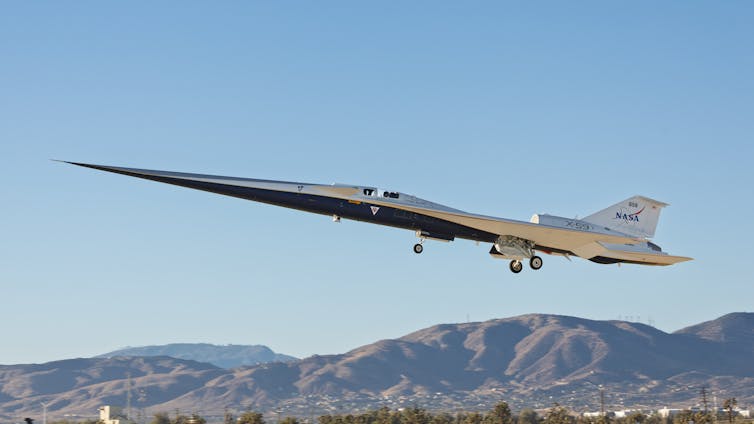
The X-59 undertakes its first flight from Lockheed Martin’s Skunk Works in California.
Lockheed Martin

Is supersonic air travel about to return, two decades after the last Concorde flight?

Malcolm Claus, Kingston University

An experimental supersonic aircraft called the X-59 took to the skies for the first time in October.

The plane lifted off from Skunk Works, the famed research and development facility in California owned by aerospace giant Lockheed Martin. It cruised for about an hour, before landing at Edwards Air Force Base 85 miles (136km) away.

Nasa’s X-59 is designed to test technology for quiet supersonic flight. In the US, loud sonic booms led to a five-decade ban on non-military supersonic aircraft flying over land.

The ban was lifted this year by the US president Donald Trump, via an executive order. In the UK, supersonic flight over land needs to be specifically approved by the Civil Aviation Authority (CAA), which functions independently of government.

The X-59 aims to turn sonic booms into a quieter “sonic thump”. So if this proves possible, how likely is it that we will see a return to commercial supersonic air travel – not seen since the Concorde passenger jet was retired in 2003?

Beginning in the 1950s, the race to achieve commercial supersonic travel was a long and technically challenging one. Teams from the UK and France, consisting of the companies British Aircraft Corporation and Aerospatiale, the US (Boeing) and the Soviet Union (Tupolev) worked on three aircraft to meet this challenge.

Out of these three competing designs only two: Concorde (UK and France) and the Tupolev TU-144 (Soviet Union) produced prototype aircraft and follow-on planes that entered commercial operation.

In the US, the Boeing 2707 aircraft would have carried between 250-300 passengers, three times that of Concorde, and would have done so at a higher cruise speed. However, rising costs, uncertainty about the market for flights and concerns about noise led to the cancellation of the American plane in 1971.

The Soviet TU-144 took to the skies first, on December 31, 1968, while Concorde’s first flight took place in March 1969. The service life of the TU-144 was relatively short, however, lasting from 1975 to 1983.

It initially carried mail, in preparation for passenger services which began in November 1977. However, safety incidents and concern about the economic viability of the plane led to these flights were cancelled in June 1978.

Advertisement
Get More From A Face Cleanser And Spa-like Massage

Once passenger flights had been discontinued, the then-Soviet airline Aeroflot operated an updated variant, called the TU-144D, on freight-only services. The withdrawal from service of the TU-144 left Concorde as the only operating commercial supersonic passenger aircraft.

As the standard bearer for supersonic travel, Concorde carried passengers from London and Paris to destinations such as New York, Washington, Rio de Janeiro and Mexico City. But its routes were limited by the US ban on non-military supersonic aircraft flying over land.

The plane operated successfully until July 2000, when Air France flight 4590 crashed shortly after take-off, killing 109 passengers and four people on the ground. Flights by both British Airways and Air France were suspended after the crash, returning only in November 2001. But a lack of confidence and other factors led to the retirement from service of Concorde in 2003.

But within 13 years of the withdrawal of Concorde there was fresh impetus for supersonic travel. In 2016, Nasa launched the Quiet Supersonic Technology (Quesst) project. The aim of Quesst is to investigate aircraft designs which would reduce the sonic boom typically associated with supersonic flight. The centrepiece of the Quesst project is the X-59 an experimental aircraft built by Lockheed Martin at its experimental Skunk Works site in California.

Flying experiment

The X-59 has been designed, manufactured and flown to test both the theories and assumptions relating to low boom technology and to demonstrate that such an aircraft can operate over land without causing disruption on the ground.

The aircraft will act as a flying experiment, collecting data from its test flights which will be disseminated within the aerospace community. This will support current efforts by the companies Boom Supersonic and Spike Aerospace, both of which are proposing their own supersonic aircraft.

So how does the X-59 achieve this? The short answer is in its configuration. The aircraft design has been reached after detailed design work both through extensive computer simulations and through the use of a wind tunnel test programme.

The final configuration which has been reached in effect reshapes the shockwaves produced during supersonic flight, changing the associated boom to a quieter sound. As a result, however, the X-59 does not resemble any conventional aircraft flying today.

The unusual design of the X-59 prevents the shock waves generated at supersonic speed from merging (which would produce the loud boom).

The long, thin tapered nose and other features of the aircraft will mitigate against this by producing a “quieter” boom. This nose, resembling a spear, means that the cockpit for the pilot is located almost halfway down the length of the aircraft.

Advertisement
Get More From A Face Cleanser And Spa-like Massage

Its location means that a conventional cockpit window, as seen on all aircraft,` is not possible. Consequently, a number of high-resolution cameras and monitors allow the pilot to fly the aircraft and see what is going on outside.

The X-59 will provide useful flight data on supersonic boom mitigation, which could be applied to future aircraft.

But even when boom mitigation has been addressed, there are still a number of challenges which need to be overcome in order for a new generation of supersonic aircraft to enter service.

A clear and well developed business case will be needed, taking into account the potential customer volume and number of aircraft required. The economics will need to be worked out, such as how much the aircraft costs to operate, its fuel costs and the price of maintenance.

There will also be environmental issues to consider, such as the fuel efficiency of new propulsion systems that can operate for long times under supersonic conditions.

If these challenges can’t be overcome, the rebirth of commercial supersonic travel might remain a distant dream.

Malcolm Claus, Senior Lecturer, Astronautics and Space Technology, Kingston University

This article is republished from The Conversation under a Creative Commons license. Read the original article.

Author

Advertisement
Get More From A Face Cleanser And Spa-like Massage

Discover more from Daily News

Subscribe to get the latest posts sent to your email.

Continue Reading
Advertisement Tool Tickets
Click to comment
0 0 votes
Article Rating
Subscribe
Notify of
guest

0 Comments
Oldest
Newest Most Voted
Inline Feedbacks
View all comments

Health

FDA’s COVID-19 Vaccine Safety Claims Lack Solid Evidence—Why Overreaction Could Harm Public Health

COVID-19 vaccine safety: The FDA’s claims about COVID-19 vaccine deaths in children lack strong evidence and could restrict vaccine access. Learn why experts say VAERS reports aren’t proof, and how overreacting may harm public health and trust in vaccines.

Published

on

FDA’s COVID-19 Vaccine Safety Claims Lack Solid Evidence—Why Overreaction Could Harm Public Health
The FDA has provided no evidence that children died because of receiving a COVID-19 vaccine. Anchiy/E+ via Getty Images

FDA claims on COVID-19 vaccine safety are unsupported by reliable data – and could severely hinder vaccine access

Frank Han, University of Illinois Chicago The Food and Drug Administration is seeking to drastically change procedures for testing vaccine safety and approving vaccines, based on unproven claims that mRNA-based COVID-19 vaccines caused the death of at least 10 children. The agency detailed its plans in a memo released to staff on Nov. 28, 2025, which was obtained by several news outlets and published by The Washington Post. Citing an internal, unpublished review, the memo, written by the agency’s top vaccine regulator, Vinay Prasad, attributes the children’s deaths to myocarditis, an inflammation of the heart muscle. And it says the deaths were reported to the Vaccine Adverse Event Reporting System, or VAERS, but provides no evidence that the vaccines caused the deaths.  

COVID-19 vaccine safety

The death of children due to an unsafe vaccine is a serious allegation. I am a pediatric cardiologist who has studied the link between COVID-19 vaccines and heart-related side effects such as myocarditis in children. To my knowledge, studies to date have shown such side effects are rare, and severe outcomes even more so. However, I am open to new evidence that could change my mind. But without sufficient justification and solid evidence, restricting access to an approved vaccine and changing well-established procedures for testing vaccines would carry serious consequences. These moves would limit access for patients, create roadblocks for companies and worsen distrust in vaccines and public health. In my view, it’s important for people reading about these FDA actions to understand how the evidence on a vaccine’s safety is generally assessed.

Determining cause of death

The FDA memo claims that the deaths of these children were directly related to receiving a COVID-19 immunization. From my perspective as a clinician, it is awful that any child should die from a routine vaccination. However, health professionals like me owe it to the public to uphold the highest possible standards in investigating why these deaths occurred. If the FDA has evidence demonstrating something that national health agencies worldwide have missed – widespread child deaths due to myocarditis caused by the COVID-19 vaccine – I don’t doubt that even the most pro-vaccine physician will listen. So far, however, no such evidence has been presented. While a death logged in VAERS is a starting point, on its own it is insufficient to conclude whether a vaccine caused the death or other medical causes were to blame. To demonstrate a causal link, FDA staff and physicians must align the VAERS report with physicians’ assessments of the patient, as well as data from other sources for monitoring vaccine safety. These include PRISM, which logs insurance claims data, and the Vaccine Safety Datalink, which tracks safety signals in electronic medical records. It’s known that most deaths logged only in VAERS of children who recently received vaccines have been incorrectly attributed to the vaccines – either by accident or in some cases on purpose by anti-vaccine activists.

Heart-related side effects of COVID-19 vaccines

In his Substack and Twitter accounts, Prasad has said that he believes the rate of severe cardiac side effects after COVID-19 vaccination is severely underestimated and that the vaccines should be restricted far more than they currently are. In a July 2025 presentation, Prasad quoted a risk of 27 cases per million of myocarditis in young men who received the COVID-19 vaccine. A 2024 review suggested that number was a bit lower – about 20 cases out of 1 million people. But that same study found that unvaccinated people had greater risk of heart problems after a COVID-19 infection than vaccinated people. In a different study, people who got myocarditis after a COVID-19 vaccination developed fewer complications than people who got myocarditis after a COVID-19 infection. Existing vaccine safety infrastructure in the U.S. successfully identifies dangers posed by vaccines – and did so during the COVID-19 pandemic. Today, most COVID-19 vaccines in the U.S. rely on mRNA technology. But as vaccines were first emerging during the COVID-19 pandemic, two pharmaceutical companies, Janssen and AstraZeneca, rolled out a vaccine that used a different technology, called a viral vector. This type of vaccine had a very rare but genuine safety problem that was detected.
A report in VAERS is at most a first step to determining whether a vaccine caused harm.
VAERS, the Vaccine Safety Datalink, clinical investigators in the U.S. and their European counterparts detected that these vaccines did turn out to cause blood clotting. In April 2021, the FDA formally recommended pausing their use, and they were later pulled from the market. Death due to myocarditis from COVID-19 vaccination is exceedingly rare. Demonstrating that it occurred requires proof that the person had myocarditis, evidence that no other reasonable cause of death was present, and the absence of any additional cause of myocarditis. These factors cannot be determined from VAERS data, however – and to date, the FDA has presented no other relevant data.

A problematic vision for future vaccine approvals

Currently, vaccines are tested both by seeing how well they prevent disease and by how well they generate antibodies, which are the molecules that help your body fight viruses and bacteria. Some vaccines, such as the COVID-19 vaccine and the influenza vaccine, need to be updated based on new strains. The FDA generally approves these updates based on how well the new versions generate antibodies. Since the previous generation of vaccines was already shown to prevent infection, if the new version can generate antibodies like the previous one, researchers assume its ability to prevent infection is comparable too. Later studies can then test how well the vaccines prevent severe disease and hospitalization. The FDA memo says this approach is insufficient and instead argues for replacing such studies with many more placebo-controlled trials – not just for COVID-19 vaccines but also for widely used influenza and pneumonia vaccines. That may seem reasonable theoretically. In practice, however, it is not realistic. Today’s influenza vaccines must be changed every season to reflect mutations to the virus. If the FDA were to require new placebo-controlled trials every year, the vaccine being tested would become obsolete by the time it is approved. This would be a massive waste of time and resources.
A pharmacy with a sign advertising flu shots
Influenza vaccines must be updated for every flu season. Jacob Wackerhausen/iStock via Getty Images Plus
Also, detecting vaccine-related myocarditis at the low rate at which it occurs would have required clinical trials many times larger than the ones that were done to approve COVID-19 mRNA vaccines. This would have cost at least millions of dollars more, and the delay in rolling out vaccines would have also cost lives. Placebo-controlled trials would require comparing people who receive the updated vaccine with people who remain unvaccinated. When an older version of the vaccine is already available, this means purposefully asking people to forgo that vaccine and risk infection for the sake of the trial, a practice that is widely considered unethical. Current scientific practice is that only a brand-new vaccine may be compared against placebo. While suspected vaccine deaths should absolutely be investigated, stopping a vaccine for insufficient reasons can lead to a significant drop in public confidence. That’s why it’s essential to thoroughly and transparently investigate any claims that a vaccine causes harm.

Vaccine vs illness

To accurately gauge a vaccine’s risks, it is also crucial to compare its side effects with the effects of the illness it prevents. For COVID-19, data consistently shows that the disease is clearly more dangerous. From Aug. 1, 2021, to July 31, 2022, more than 800 children in the U.S. died due to COVID-19, but very few deaths from COVID-19 vaccines in children have been been verified worldwide. What’s more, the disease causes many more heart-related side effects than the vaccine does. Meanwhile, extensive evidence shows that COVID-19 vaccination reduces the risk of hospitalization by more than 70% and the risk of severe illness in adolescent children by 79%. Studies also show it dramatically reduces their risk of developing long COVID, a condition in which symptoms such as extreme fatigue or weakness persist more than three months after a COVID-19 infection. Reporting only the vaccines’ risks, and not their benefits, shows just a small part of the picture. Frank Han, Assistant Professor of Pediatric Cardiology, University of Illinois Chicago This article is republished from The Conversation under a Creative Commons license. Read the original article.
High Demand Marks “Veggies for Veterans” Event Amid SNAP Delays
Link: https://stmdailynews.com/high-demand-marks-veggies-for-veterans-event-amid-snap-delays/

Author


Discover more from Daily News

Subscribe to get the latest posts sent to your email.

Continue Reading

Economy

Tariffs 101: What they are, who pays them, and why they matter now

Learn what tariffs are, who pays them, and why they matter for the U.S. economy. Explore how import taxes impact prices, trade policy, and everyday consumers as the Supreme Court reviews Trump’s global tariffs.

Published

on

Last Updated on December 13, 2025 by Daily News Staff

Cargo containers and U.S. Customs officers at a busy port, illustrating the impact of tariffs and trade policy on imported goods.

Tariffs 101: What they are, who pays them, and why they matter now

Kent Jones, Babson College The U.S. Supreme Court is currently reviewing a case to determine whether President Donald Trump’s global tariffs are legal. Until recently, tariffs rarely made headlines. Yet today, they play a major role in U.S. economic policy, affecting the prices of everything from groceries to autos to holiday gifts, as well as the outlook for unemployment, inflation and even recession. I’m an economist who studies trade policy, and I’ve found that many people have questions about tariffs. This primer explains what they are, what effects they have, and why governments impose them.

What are tariffs, and who pays them?

Tariffs are taxes on imports of goods, usually for purposes of protecting particular domestic industries from import competition. When an American business imports goods, U.S. Customs and Border Protection sends it a tariff bill that the company must pay before the merchandise can enter the country. Because tariffs raise costs for U.S. importers, those companies usually pass the expense on to their customers by raising prices. Sometimes, importers choose to absorb part of the tariff’s cost so consumers don’t switch to more affordable competing products. However, firms with low profit margins may risk going out of business if they do that for very long. In general, the longer tariffs are in place, the more likely companies are to pass the costs on to customers. Importers can also ask foreign suppliers to absorb some of the tariff cost by lowering their export price. But exporters don’t have an incentive to do that if they can sell to other countries at a higher price. Studies of Trump’s 2025 tariffs suggest that U.S. consumers and importers are already paying the price, with little evidence that foreign suppliers have borne any of the burden. After six months of the tariffs, importers are absorbing as much as 80% of the cost, which suggests that they believe the tariffs will be temporary. If the Supreme Court allows the Trump tariffs to continue, the burden on consumers will likely increase. While tariffs apply only to imports, they tend to indirectly boost the prices of domestically produced goods, too. That’s because tariffs reduce demand for imports, which in turn increases the demand for substitutes. This allows domestic producers to raise their prices as well.

A brief history of tariffs

The U.S. Constitution assigns all tariff- and tax-making power to Congress. Early in U.S. history, tariffs were used to finance the federal government. Especially after the Civil War, when U.S. manufacturing was growing rapidly, tariffs were used to shield U.S. industries from foreign competition. The introduction of the individual income tax in 1913 displaced tariffs as the main source of U.S. tax revenue. The last major U.S. tariff law was the Smoot-Hawley Tariff Act of 1930, which established an average tariff rate of 20% on all imports by 1933. Those tariffs sparked foreign retaliation and a global trade war during the Great Depression. After World War II, the U.S. led the formation of the General Agreement on Tariffs and Trade, or GATT, which promoted tariff reduction policies as the key to economic stability and growth. As a result, global average tariff rates dropped from around 40% in 1947 to 3.5% in 2024. The U.S. average tariff rate fell to 2.5% that year, while about 60% of all U.S. imports entered duty-free. While Congress is officially responsible for tariffs, it can delegate emergency tariff power to the president for quick action as long as constitutional boundaries are followed. The current Supreme Court case involves Trump’s use of the International Emergency Economic Powers Act, or IEEPA, to unilaterally change all U.S. general tariff rates and duration, country by country, by executive order. The controversy stems from the claim that Trump has overstepped his constitutional authority granted by that act, which does not mention tariffs or specifically authorize the president to impose them.

The pros and cons of tariffs

In my view, though, the bigger question is whether tariffs are good or bad policy. The disastrous experience of the tariff war during the Great Depression led to a broad global consensus favoring freer trade and lower tariffs. Research in economics and political science tends to back up this view, although tariffs have never disappeared as a policy tool, particularly for developing countries with limited sources of tax revenue and the desire to protect their fledgling industries from imports. Yet Trump has resurrected tariffs not only as a protectionist device, but also as a source of government revenue for the world’s largest economy. In fact, Trump insists that tariffs can replace individual income taxes, a view contested by most economists. Most of Trump’s tariffs have a protectionist purpose: to favor domestic industries by raising import prices and shifting demand to domestically produced goods. The aim is to increase domestic output and employment in tariff-protected industries, whose success is presumably more valuable to the economy than the open market allows. The success of this approach depends on labor, capital and long-term investment flowing into protected sectors in ways that improve their efficiency, growth and employment. Critics argue that tariffs come with trade-offs: Favoring one set of industries necessarily disfavors others, and it raises prices for consumers. Manipulating prices and demand results in market inefficiency, as the U.S. economy produces more goods that are less efficiently made and fewer that are more efficiently made. In addition, U.S. tariffs have already resulted in foreign retaliatory trade actions, damaging U.S. exporters. Trump’s tariffs also carry an uncertainty cost because he is constantly threatening, changing, canceling and reinstating them. Companies and financiers tend to invest in protected industries only if tariff levels are predictable. But Trump’s negotiating strategy has involved numerous reversals and new threats, making it difficult for investors to calculate the value of those commitments. One study estimates that such uncertainty has actually reduced U.S. investment by 4.4% in 2025. A major, if underappreciated, cost of Trump’s tariffs is that they have violated U.S. global trade agreements and GATT rules on nondiscrimination and tariff-binding. This has made the U.S. a less reliable trading partner. The U.S. had previously championed this system, which brought stability and cooperation to global trade relations. Now that the U.S. is conducting trade policy through unilateral tariff hikes and antagonistic rhetoric, its trading partners are already beginning to look for new, more stable and growing trade relationships. So what’s next? Trump has vowed to use other emergency tariff measures if the Supreme Court strikes down his IEEPA tariffs. So as long as Congress is unwilling to step in, it’s likely that an aggressive U.S. tariff regime will continue, regardless of the court’s judgment. That means public awareness of tariffs ⁠– and of who pays them and what they change ⁠– will remain crucial for understanding the direction of the U.S. economy. Kent Jones, Professor Emeritus, Economics, Babson College This article is republished from The Conversation under a Creative Commons license. Read the original article.

STM Daily News is a vibrant news blog dedicated to sharing the brighter side of human experiences. Emphasizing positive, uplifting stories, the site focuses on delivering inspiring, informative, and well-researched content. With a commitment to accurate, fair, and responsible journalism, STM Daily News aims to foster a community of readers passionate about positive change and engaged in meaningful conversations. Join the movement and explore stories that celebrate the positive impacts shaping our world.

https://stmdailynews.com/

View recent photos

Unlock fun facts & lost history—get The Knowledge in your inbox!

We don’t spam! Read our privacy policy for more info.


Discover more from Daily News

Subscribe to get the latest posts sent to your email.

Continue Reading

News

🇯🇵 Japan Earthquake Update — What You Need to Know (December 2025)

Japan Earthquake Update — A powerful magnitude 7.5 earthquake struck off the coast of Aomori, Japan, triggering tsunami warnings and a rare megaquake advisory. Here are the latest updates on damage, aftershocks, government response, and ongoing seismic risks as of December 2025.

Published

on

Last Updated on December 11, 2025 by Daily News Staff

Japan earthquake December 2025: Aerial view of Japan’s northern Pacific coastline showing emergency crews assessing damage after the December 2025 magnitude 7.5 offshore earthquake near Aomori, with calm ocean waters following lifted tsunami warnings.

🇯🇵 Japan Earthquake Update — What You Need to Know (December 2025)

On December 8, 2025, a powerful earthquake — measured at magnitude 7.5 (7.6 by the U.S. Geological Survey) — struck offshore of Aomori Prefecture in northern Japan around 11:15 p.m. JST. The quake was deep enough (about 44 km) to be felt over a wide area, with intense shaking registering across northern Honshu and parts of Hokkaido. 

🌊 Immediate Impact — Tsunami & Injuries

Tsunami Warnings were promptly issued along the Pacific coasts of Hokkaido, Aomori and Iwate. Authorities initially feared waves up to ~3 meters high, prompting evacuations.  In the end, only small tsunami waves — up to about 70 cm — were observed, and all warnings were lifted by early Tuesday morning.  At least 50 plus people have been injured, mostly lightly, due to falling objects and minor structural impacts from the shaking. 

Across the affected prefectures, emergency crews continue damage assessments and are checking roads, buildings, utilities and other infrastructure for safety concerns. Some power outages and transport disruptions (train suspensions) were reported in the aftermath. 

🧠 Rare “Megaquake Advisory” Issued

Japan’s meteorological authority, the Japan Meteorological Agency (JMA), has issued a megaquake advisory following the M 7.5 quake — a rare alert indicating elevated seismic risk. This advisory:

Does not predict when (or if) a larger earthquake will occur. Signals that the probability of a more powerful quake (M 8.0+) has increased temporarily for the next several days or week. Specifically, a formerly tiny ~0.1% weekly chance has risen to roughly ~1 %.  Applies along a long stretch of Japan’s Pacific coast — from Chiba Prefecture in the south up through Hokkaido in the north — where the Pacific tectonic plate is actively subducting beneath Japan. 

Officials emphasize that this is an advisory, not a prediction, and it’s issued to encourage preparedness: securing furniture, reviewing evacuation plans, and keeping emergency kits ready. 

🌏 Aftershocks and Continued Seismic Activity

Even after the main quake, strong aftershocks have been recorded in the region — including quakes in the magnitude 5–6 range. This ongoing activity is consistent with a typical aftershock sequence but reinforces the public safety message to stay alert. 

Later smaller tremors — including a reported M 6.0 event — have been felt near Aomori and Hokkaido, though none have triggered additional tsunami warnings. 

🛡 Government Response & Public Safety

The Japanese government has mobilized an emergency task force to:

Advertisement
Get More From A Face Cleanser And Spa-like Massage

Assess damage and coordinate response efforts across affected regions.  Monitor infrastructure — including roads, utilities, and nuclear facilities — for any damage or safety issues.  Keep the public informed and ready for possible aftershocks or other quakes. 

Schools, businesses and local municipalities continue to evaluate safety conditions and may adjust operations accordingly.

📌 What This Means for Residents & Visitors

✔ Immediate tsunami danger has passed, but vigilance is still needed due to aftershocks. 

✔ Preparedness is crucial, especially in coastal and northern regions that felt the quake strongest. 

✔ If you’re in Japan or planning travel, follow JMA updates and local government advisories for current regional guidance. 

🧭 In Summary

Japan is dealing with the impacts of a major offshore earthquake that shook the northern Pacific coast and prompted widespread alerts. Although immediate tsunami threats were limited and damage appears relatively light so far, a rare megaquake advisory remains in effect — not as a definitive forecast, but as a cautionary alert to stay prepared in the coming days.

Despite this elevated alert level, experts stress that while seismic risk is higher than normal, a massive quake is not imminent and the advisory’s purpose is to keep people ready rather than alarmed. 


STM Daily News is a vibrant news blog dedicated to sharing the brighter side of human experiences. Emphasizing positive, uplifting stories, the site focuses on delivering inspiring, informative, and well-researched content. With a commitment to accurate, fair, and responsible journalism, STM Daily News aims to foster a community of readers passionate about positive change and engaged in meaningful conversations. Join the movement and explore stories that celebrate the positive impacts shaping our world.

Advertisement
Get More From A Face Cleanser And Spa-like Massage

https://stmdailynews.com/


Authors


Discover more from Daily News

Subscribe to get the latest posts sent to your email.

Continue Reading

Trending

0
Would love your thoughts, please comment.x
()
x