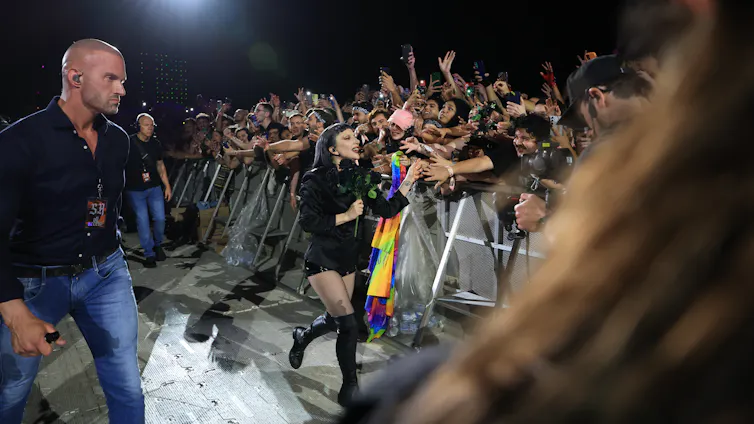
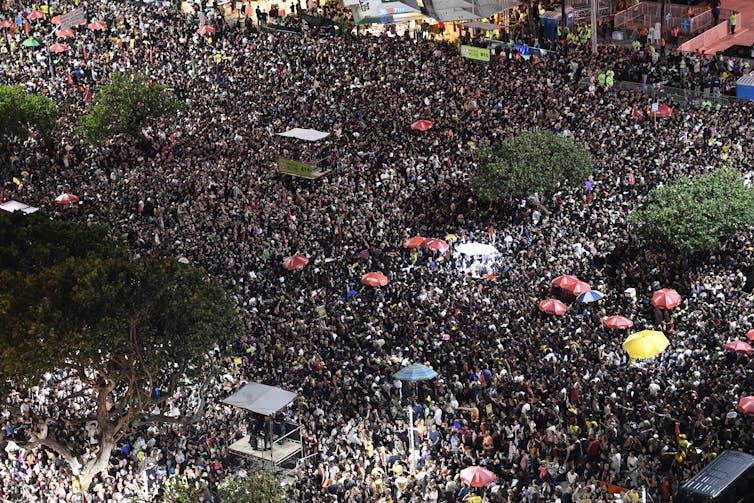
Lady Gaga performs at Copacabana Beach on May 3, 2025, in Rio de Janeiro, Brazil. Kevin Mazur/WireImage for Live NationDavid Nemer, University of Virginia and Arthur Coelho Bezerra, Instituto Brasileiro de Informação em Ciência e Tecnologia (Ibict) The more than 2 million people who attended Lady Gaga’s free concert on Copacabana Beach on May 3, 2025, had no idea of a plot that, if successful, would have turned the event into a tragedy fueled by hate. Just hours before a sea of admirers waved fans in sync with the singer during the event, the Rio de Janeiro Civil Police thwarted a planned attack involving Molotov cocktails and improvised bombs – and targeting the American singer’s LGBTQ following. Two people have since been arrested over the plot, which was organized by users of digital platforms such as Discord. The intent, authorities say, was radicalizing and recruiting teenagers to carry out the planned attack. Those responsible hoped to entice these young people into actions that would gain online notoriety.More than 2 million people are said to have attended the Lady Gaga concert in Rio.Daniel Ramalho/AFP via Getty Images Although authorities were able to prevent the attack, the incident stands as a stark warning about the growth of hate networks among youth − and how platforms fuel the radicalization of teenagers, especially boys and young men. As experts in the anthropology of technologyand information science, we see something deeply generational about this phenomenon. The recent Netflix series “Adolescence” broke viewership records by portraying an environment in which young people live in hyperconnected online spheres, absent of state oversight and parental supervision. In these spheres, bullying toxic masculinity permeates, and violence – often targeted at women and sexual minorities – is normalized. The show was set in the U.K., but it holds up a mirror to the world. Data from polling company Gallup reveals a growing ideological divide between young men and women in Gen Z across the globe. Too often, that divide, in which young men and boys are turning against progressive values, is being expressed through actions associated with the “manosphere,” such as misogyny and incel behavior.
Platforms for hate
In the United States, women aged 18 to 30 are now 30 percentage points more liberal than their male counterparts, according to Gallup’s surveys. In Germany, where a right-wing coalition recently won national elections and the extreme-right AfD party is rising in popularity at an alarming rate, the gap is also 30 points. In Poland, although the far-right left power at the end of 2023 after eight years, nearly half of men ages 18 to 21 support far-right parties − compared with just one-sixth of women in the same age range. This polarization is emerging just as online platforms such as Discord, TikTok and Reddit have become formative spaces of identity. Instead of promoting diversity, however, many of these platforms have been used as machines for producing and spreading hate. The 2021 study Mapping Discord’s Darkside, published in the journal New Media & Society, shows that despite marketing efforts to distance itself from the far right, Discord hosts thousands of servers associated with neo-Nazi, misogynistic, racist, transphobic and conspiratorial discourse. Researchers identified 2,741 such servers − with more than 850,000 active members. These networks end up functioning as recruitment hubs, where young people − especially boys − are lured in by edgy memes, promises of belonging and identity games based on excluding others. Discord’s structure, which prioritizes privacy and decentralization, has become fertile ground for the emergence of what scholar Adrienne Massanari calls “toxic technocultures.” Services such as Disboard − an informal search engine for Discord servers − are used to recruit teens into communities that glorify Nazism, encourage hatred toward women and people from the LGBTQ+ community, and even offer “services” for coordinated attacks on other servers. And this appears to be the case in the thwarted attack on the Lady Gaga concert.
Presenting a challenge
A significant factor in the success of these radicalizing environments is gamification − the use of gamelike elements such as challenges, rewards and leaderboards in nongame contexts. When applied to social networks and extremist forums, gamification turns engagement into competition and hate speech into a playful challenge. This practice makes the entrance into extremism more palatable for young, impressionable people by masking violence behind seemingly harmless mechanics. As noted in the European Commission’s 2021 report Gamification and Online Hate Speech, gamification has become a powerful tool for normalizing and spreading hate, particularly among young people seeking recognition and belonging. This process, known as “bottom-up gamification,” occurs when users create the rules, symbolic rewards and challenges. For example, by turning hate speech into “challenges” that involve humiliating women or people from the LGBTQ+ community online, the dehumanization of targets is presented in playful, viral ways.
Turning hate into entertainment
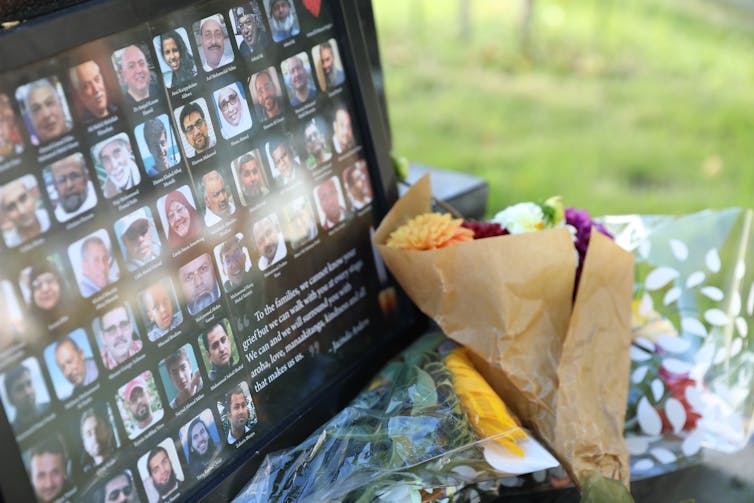
The investigation into the foiled attack on Lady Gaga’s Copacabana concert revealed exactly this mechanism: The attack was treated as a “collective challenge,” with youths recruited to build Molotov cocktails and explosive backpacks in order to gain notoriety on social media. The logic of gamification also creates a structure of “achievement” and “scoring” that fosters competition and reinforces radical ideology. As shown in the 2022 study by criminologists Suraj Lakhani and Susann Wiedlitzka, attacks such as the 2019 mosque attack in Christchurch, New Zealand, in which 51 people were killed, were planned and executed with strong inspiration from gaming, including live broadcasts similar to “Let’s Play” sessions, in which people offer live commentary during walk-throughs of games, typically first-person shooting games, and viewer comments that treat the number of deaths as a “score.”More than 50 people were killed in the terrorist attack on Christchurch mosques in New Zealand on March 15, 2019.Omer Kablan/Anadolu Agency via Getty Images This aestheticization of violence serves as a bonding element among young men in digital spaces, especially those who already feel marginalized or frustrated and who find in these games of hate a sense of belonging and affirmation. In this way, gamification transforms hate into entertainment, strengthening ties in toxic communities and making it harder to recognize the behavior as extremism.
Turning a generation off hate
Society is, we believe, facing a dual challenge: the need for moderation of platforms and for support for measures preventing men and boys from being drawn into toxic digital spaces. The gender divide within Gen Z is no small matter, too. It reflects, in broad terms, a rift between a generation of young women who, empowered by #MeToo and other feminist movements, have embraced progressive causes, and a generation of men who, threatened by their perceived diminished power in this new environment, are being co-opted by far-right and misogynistic discourse in digital spaces. This gap has real consequences in personal relationships, in schools and for democracy at large. But it also reveals something that we believe must be stated clearly: Platform regulation is not just a technical issue. The future of a generation cannot be built on algorithms that reward hate and radicalization. This article is a translated and adapted version of a story that was originally published by The Conversation Brazil on May 8, 2025.David Nemer, Associate Professor in the Department of Media Studies, University of Virginia and Arthur Coelho Bezerra, Professor titular, Instituto Brasileiro de Informação em Ciência e Tecnologia (Ibict) This article is republished from The Conversation under a Creative Commons license. Read the original article.
Traveling to Mexico this spring? Here’s what to know about current advisories
Traveling to Mexico this spring? Visitors should be aware of state-specific travel advisories, as safety concerns in one region do not affect major resort areas like Cancun and Los Cabos, currently rated Level 2, which encourages increased caution. Monitoring official updates is essential for informed travel decisions amidst evolving conditions.
Traveling to Mexico this spring? Here’s what to know about current advisories
(Tiffany Miller for ALG Vacations) For some travelers counting down to spring break, recent headlines about violence in parts of Mexico have sparked a new question: Should I cancel my trip? Travel advisors say they are seeing a surge in calls and emails from clients trying to determine whether developments in one region affect major resort areas elsewhere.
The questions follow several days of unrest in parts of Mexico after security operations targeting organized crime leaders prompted temporary flight disruptions and shelter-in-place guidance for U.S. government personnel in areas including Puerto Vallarta and Guadalajara. In this article, ALG Vacations explains what current travel advisories mean for spring break travelers heading to Mexico.
The U.S. State Department evaluates Mexico state by state, not as a single destination, and advisory levels vary by region. Many major beach destinations, including Cancun, Riviera Maya, Tulum and Los Cabos, are currently under a Level 2 advisory, which encourages travelers to exercise increased caution. It does not discourage travel.
Part of the confusion stems from geography. Puerto Vallarta, on the Pacific coast, is roughly 1,300 miles from Cancun and the Riviera Maya on the Caribbean side, about the distance between New York and Miami. Because advisories are assigned state by state, developments in one region do not automatically alter another.
In recent days, that uncertainty has translated into additional inquiries about whether specific resort areas are experiencing disruptions. U.S. Embassy security alerts issued this week indicate that temporary shelter-in-place guidance affecting Puerto Vallarta was lifted and that flight operations resumed. The advisory level for the Mexican state of Quintana Roo remains unchanged.
Some clients are asking about alternatives, advisors say, but many are continuing with their plans after reviewing official updates. Travel patterns often shift in response to breaking headlines, they add, before stabilizing as clearer information becomes available.
The State Department assigns travel advisories on a four-tier scale ranging from Level 1, exercise normal precautions, to Level 4, do not travel. While Level 2 encourages increased awareness, Level 3 and Level 4 carry stronger language discouraging or restricting travel.
Advisories are reviewed regularly and can be updated as conditions evolve. The State Department’s Mexico advisory page breaks down conditions by state, reflecting the country’s federal structure rather than issuing a single national designation. Travelers can also enroll in the State Department’s Smart Traveler Enrollment Program, which provides real-time security updates and allows U.S. officials to contact citizens in an emergency.
Embassy notices state that airports, hotels and tourism services in Quintana Roo are operating normally. Security conditions across Mexico vary widely by state, with some regions carrying higher advisories and others designated Level 1. Most destinations popular with U.S. travelers are currently classified as Level 2.
Advertisement
As spring break approaches, advisors say informed decision-making depends on reviewing the advisories assigned to a specific destination and monitoring official updates, rather than reacting to national headlines alone. Travel decisions ultimately depend on individual comfort levels, they add, but advisory levels are assigned regionally and should be evaluated accordingly.
Welcome to the Consumer Corner section of STM Daily News, your ultimate destination for savvy shopping and informed decision-making! Dive into a treasure trove of insights and reviews covering everything from the hottest toys that spark joy in your little ones to the latest electronic gadgets that simplify your life. Explore our comprehensive guides on stylish home furnishings, discover smart tips for buying a home or enhancing your living space with creative improvement ideas, and get the lowdown on the best cars through our detailed auto reviews. Whether you’re making a major purchase or simply seeking inspiration, the Consumer Corner is here to empower you every step of the way—unlock the keys to becoming a smarter consumer today!
This question fascinates me because I am a business professor who studies why society abandons and then sometimes returns to certain technologies, such as vinyl records, landline phones and metal coins. The demise of electric streetcars in Los Angeles and attempts to bring them back today vividly demonstrate the costs and challenges of such revivals. https://www.youtube.com/embed/9X78ZqGyc5o?wmode=transparent&start=0 The 2028 Olympic Games will be held in existing sports venues around Los Angeles and are expected to host 15,000 athletes and over 1 million spectators.
Riding the Red and Yellow Cars
Transportation is a critical priority in any city, but especially so in Los Angeles, which has been a sprawling metropolis from the start.
In the early 1900s, railroad magnate Henry Huntington, who owned vast tracts of land around LA, started subdividing his holdings into small plots and building homes. In order to attract buyers, he also built a trolley system that whisked residents from outlying areas to jobs and shopping downtown.
By the 1930s, Los Angeles had a vibrant public transportation network, with over 1,000 miles of electric streetcar routes, operated by two companies: Pacific Electric Railway, with its “Red Cars,” and Los Angeles Railway, with its “Yellow Cars.”
The system wasn’t perfect by any means. Many people felt that streetcars were inconvenient and also unhealthy when they were jammed with riders. Moreover, streetcars were slow because they had to share the road with automobiles. As auto usage climbed and roads became congested, travel times increased.
Advertisement
Nonetheless, many Angelenos rode the streetcars – especially during World War II, when gasoline was rationed and automobile plants shifted to producing military vehicles. https://www.youtube.com/embed/AwKv3_WwD4o?wmode=transparent&start=0 In 1910, Los Angeles had a widely used local rail network, with over 1,200 miles (1,930 kilometers) of track. What happened?
Demise of public transit
The end of the war marked the end of the line for streetcars. The war effort had transformed oil, tire and car companies into behemoths, and these industries needed new buyers for goods from the massive factories they had built for military production. Civilians and returning soldiers were tired of rationing and war privations, and they wanted to spend money on goods such as cars.
After years of heavy usage during the war, Los Angeles’ streetcar system needed an expensive capital upgrade. But in the mid-1940s, most of the system was sold to a company called National City Lines, which was partly owned by the carmaker General Motors, the oil companies Standard Oil of California and Phillips Petroleum, and the Firestone tire company.
These powerful forces had no incentive to maintain or improve the old electric streetcar system. National City ripped up tracks and replaced the streetcars with buses that were built by General Motors, used Firestone tires and ran on gasoline.
What’s undisputed is that, starting in the mid-1940s, powerful social forces transformed Los Angeles so that commuters had only two choices: drive or take a public bus. As a result, LA became so choked with traffic that it often took hours to cross the city.
Three key improvements are planned for the Olympics. First, LA’s airport terminals will be connected to the rail system. Second, the Los Angeles organizing committee is planning heavily on using buses to move people. It will do this by reassigning some lanes away from cars and making them available for 3,000 more buses, which will be borrowed from other locales.
Finally, there are plans to permanently increase bicycle lanes around the city. However, one major initiative, a bike path along the Los Angeles River, is still under an environmental review that may not be completed by 2028.
Car-free for 17 days
I expect that organizers will pull off a car-free Olympics, simply by making driving and parking conditions so awful during the Games that people are forced to take public transportation to sports venues around the city. After the Games end, however, most of LA is likely to quickly revert to its car-centric ways.
As Casey Wasserman, chair of the LA 2028 organizing committee, recently put it: “The unique thing about Olympic Games is for 17 days you can fix a lot of problems when you can set the rules – for traffic, for fans, for commerce – than you do on a normal day in Los Angeles.”
This article has been updated to indicate that Los Angeles has four light-rail lines.
Dive into “The Knowledge,” where curiosity meets clarity. This playlist, in collaboration with STMDailyNews.com, is designed for viewers who value historical accuracy and insightful learning. Our short videos, ranging from 30 seconds to a minute and a half, make complex subjects easy to grasp in no time. Covering everything from historical events to contemporary processes and entertainment, “The Knowledge” bridges the past with the present. In a world where information is abundant yet often misused, our series aims to guide you through the noise, preserving vital knowledge and truths that shape our lives today. Perfect for curious minds eager to discover the ‘why’ and ‘how’ of everything around us. Subscribe and join in as we explore the facts that matter. https://stmdailynews.com/the-knowledge/
International Women’s Day is celebrated globally on March 8th to honor women’s achievements and promote gender equality, originating from a 1908 march in New York for better rights.
International Women’s Day is a global celebration that honors the achievements of women and highlights the progress still to be made in the fight for gender equality. On this day, people around the world come together to recognize the amazing contributions of women everywhere and to rally for greater gender equity in all areas of life.
The origins of International Women’s Day can be traced back to 1908, when 15,000 women marched through the streets of New York City to demand better working conditions and the right to vote. Since then, the celebration has grown to be an international event, with more than 100 countries recognizing the day. The United Nations even declared March 8th as International Women’s Day in 1975, to honor the struggles of women around the world.
This year’s International Women’s Day theme is #ChooseToChallenge, meaning that everyone is encouraged to call out gender bias and inequality when they see it. We’re also encouraged to celebrate women’s achievements, support each other, and take action for equality.
It’s important to recognize the progress we’ve made in terms of gender equality, but we still have a long way to go. International Women’s Day serves as a reminder that we must continue to fight for gender equality in all areas of life. Let’s use this day to honor the contributions of women around the world, and to continue the fight for a more equitable world.
Rebecca Jo is a mother of four and is a creative soul from Phoenix, Arizona, who also enjoys new adventures. Rebecca Jo has a passion for the outdoors and indulges in activities like camping, fishing, hunting and riding roller coasters. She is married to Rod Washington


 David Nemer, Associate Professor in the Department of Media Studies, University of Virginia and Arthur Coelho Bezerra, Professor titular, Instituto Brasileiro de Informação em Ciência e Tecnologia (Ibict) This article is republished from The Conversation under a Creative Commons license. Read the original article.