Connect with us

Space and Tech

Blue Origin’s New Glenn rocket landed its booster on a barge at sea – an achievement that will broaden the commercial spaceflight market

Blue Origin’s New Glenn rocket successfully landed its booster at sea on only its second launch, marking a major milestone for commercial spaceflight. Learn how this achievement reduces launch costs and creates real competition for SpaceX.

Published

on

Last Updated on December 28, 2025 by Daily News Staff

file 20251114 56 9a7x2v.jpg?ixlib=rb 4.1
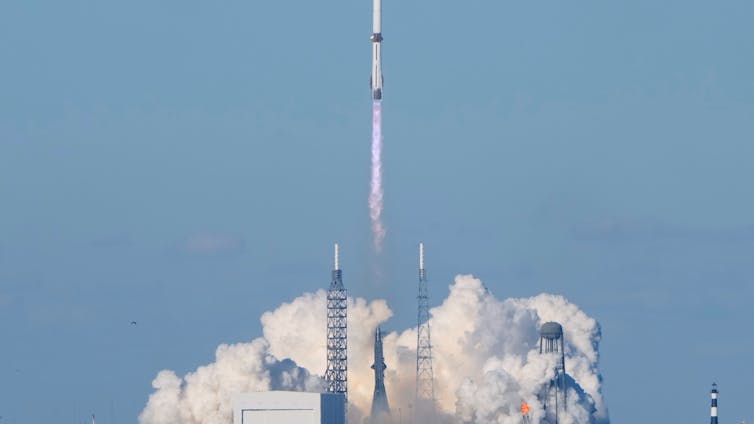
Blue Origin’s New Glenn rocket lifted off for its second orbital flight on Nov. 13, 2025.
AP Photo/John Raoux

Blue Origin’s New Glenn rocket landed its booster on a barge at sea – an achievement that will broaden the commercial spaceflight market

Wendy Whitman Cobb, Air University

Blue Origin’s New Glenn rocket successfully made its way to orbit for the second time on Nov. 13, 2025. Although the second launch is never as flashy as the first, this mission is still significant in several ways.

For one, it launched a pair of NASA spacecraft named ESCAPADE, which are headed to Mars orbit to study that planet’s magnetic environment and atmosphere. The twin spacecraft will first travel to a Lagrange point, a place where the gravity between Earth, the Moon and the Sun balances. The ESCAPADE spacecraft will remain there until Mars is in better alignment to travel to.

And two, importantly for Blue Origin, New Glenn’s first stage booster successfully returned to Earth and landed on a barge at sea. This landing allows the booster to be reused, substantially reducing the cost to get to space.

Blue Origin launched its New Glenn rocket and landed the booster on a barge at sea on Nov. 13, 2025.

As a space policy expert, I see this launch as a positive development for the commercial space industry. Even though SpaceX has pioneered this form of launch and reuse, New Glenn’s capabilities are just as important.

New Glenn in context

Although Blue Origin would seem to be following in SpaceX’s footsteps with New Glenn, there are significant differences between the two companies and their rockets.

For most launches today, the rocket consists of several parts. The first stage helps propel the rocket and its spacecraft toward space and then drops away when its fuel is used up. A second stage then takes over, propelling the payload all the way to orbit.

While both New Glenn and Falcon Heavy, SpaceX’s most powerful rocket currently available, are partially reusable, New Glenn is taller, more powerful and can carry a greater amount of payload to orbit.

Blue Origin plans to use New Glenn for a variety of missions for customers such as NASA, Amazon and others. These will include missions to Earth’s orbit and eventually to the Moon to support Blue Origin’s own lunar and space exploration goals, as well as NASA’s.

NASA’s Artemis program, which endeavors to return humans to the Moon, is where New Glenn may become important. In the past several months, several space policy leaders, as well as NASA officials, have expressed concern that Artemis is progressing too slowly. If Artemis stagnates, China may have the opportunity to leap ahead and beat NASA and its partners to the lunar south pole.

Advertisement
Get More From A Face Cleanser And Spa-like Massage

These concerns stem from problems with two rockets that could potentially bring Americans back to the Moon: the space launch system and SpaceX’s Starship. NASA’s space launch system, which will launch astronauts on its Orion crew vehicle, has been criticized as too complex and costly. SpaceX’s Starship is important because NASA plans to use it to land humans on the Moon during the Artemis III mission. But its development has been much slower than anticipated.

In response, Blue Origin has detailed some of its lunar exploration plans. They will begin with the launch of its uncrewed lunar lander, Blue Moon, early next year. The company is also developing a crewed version of Blue Moon that it will use on the Artemis V mission, the planned third lunar landing of humans.

Blue Origin officials have said they are in discussions with NASA over how they might help accelerate the Artemis program.

New Glenn’s significance

New Glenn’s booster landing makes this most recent launch quite significant for the company. While it took SpaceX several tries to land its first booster, Blue Origin has achieved this feat on only the second try. Landing the boosters – and, more importantly, reusing them – has been key to reducing the cost to get to space for SpaceX, as well as others such as Rocket Lab.

That two commercial space companies now have orbital rockets that can be partially reused shows that SpaceX’s success was no fluke.

With this accomplishment, Blue Origin has been able to build on its previous experience and success with its suborbital rocket, New Shepard. Launching from Blue Origin facilities in Texas since 2015, New Shepard has taken people and cargo to the edge of space, before returning to its launch site under its own power.

A short, wide rocket lifts off from a launchpad.
Blue Origin’s suborbital rocket, New Shepard.
Joe Raedle/Getty Images

New Glenn is also significant for the larger commercial space industry and U.S. space capabilities. It represents real competition for SpaceX, especially its Starship rocket. It also provides more launch options for NASA, the U.S. government and other commercial customers, reducing reliance on SpaceX or any other launch company.

In the meantime, Blue Origin is looking to build on the success of New Glenn’s launch and its booster landing. New Glenn will next launch Blue Origin’s Blue Moon uncrewed lander in early 2026.

This second successful New Glenn launch will also contribute to the rocket’s certification for national security space launches. This accomplishment will allow the company to compete for contracts to launch sensitive reconnaissance and defense satellites for the U.S. government.

Blue Origin will also need to increase its number of launches and reduce the time between them to compete with SpaceX. SpaceX is on pace for between 165 and 170 launches in 2025 alone. While Blue Origin may not be able to achieve that remarkable cadence, to truly build on New Glenn’s success it will need to show it can scale up its launch operations.

Wendy Whitman Cobb, Professor of Strategy and Security Studies, Air University

Advertisement
Get More From A Face Cleanser And Spa-like Massage

This article is republished from The Conversation under a Creative Commons license. Read the original article.

Author

View recent photos

Unlock fun facts & lost history—get The Knowledge in your inbox!

We don’t spam! Read our privacy policy for more info.

The Knowledge

Artemis II crew brought a human eye and storytelling vision to the photos they took on their mission

Artemis II crew: Artemis II’s astronaut photos show how human perspective and storytelling make space imagery feel authentic—especially in an era of AI-generated visuals.

Published

on

file 20260410 57 xmsmko.jpg?ixlib=rb 4.1
Astronaut Jeremy Hansen takes a picture through the camera shroud covering a window on the Orion spacecraft. NASA

Christye Sisson, Rochester Institute of Technology

In early April 2026, the Artemis II mission captivated me and millions of people watching from across the world. The crew’s courage, skill and infectious wonder served as tangible proof of human persistence and technological achievement, all against the mysterious backdrop of space.

People back on Earth got to witness the mission through remarkable photos of space captured by astronauts. Images created and shared by astronauts underscore how photography builds a powerful, authentic connection that goes beyond what technology alone can capture.

As a photographer and the director of the Rochester Institute of Technology’s School of Photographic Arts and Sciences, I am especially drawn to how these photographs have been at the center of the public’s collective experience of this mission.

In an era when image authenticity is often questioned and with the capabilities of autonomous, AI-driven imaging, NASA’s choice to train astronauts in photography has placed meaning over convenience and prioritized their human perspectives and creativity.

Capturing space from the crew’s perspective

Photography was not originally placed as a high priority in NASA’s Apollo era. The astronauts only took photographs if they had the chance and all their other tasks were complete.

An image of the entire Earth from space.
‘The Blue Marble’ view of the Earth as seen by the Apollo 17 crew in 1972. NASA

Thanks largely in part to public response to those images from Apollo, including “Earthrise” and the “Blue Marble” being widely credited for helping catalyze the modern environmental movement, NASA shifted its approach to utilize photography to help capture the public’s imagination by training their astronauts in photographic practices.

The Artemis II mission’s photographs have helped cut through the increasing volume of artificially generated images circulating on social media. NASA’s social media releases of the crew’s photographs have garnered thousands of shares and comments.

This excitement could be explained by the novelty of photos from space, but these images also distinguish themselves as products of astronauts experiencing these sights and interpreting them through their photographs. These differences require an important distinction around where technology ends and humanity begins.

An astronaut looking out the window of the Orion spacecraft, where the full moon is visible in space.
NASA astronaut Reid Wiseman watches the Moon from one of the Orion spacecraft’s windows. NASA

Human perspective versus AI tools

Photography has long integrated AI-powered software and data-driven tools in a variety of ways: to process raw images, fill in missing color information, drive precise focus and guide image editing, among others. These modern technological assists help human photographers realize their vision.

Artificial intelligence is also increasingly capable of operating machinery competently and autonomously, from cars to drones and cameras.

And AI can generate convincing, realistic images and videos from nothing more than a text prompt, using readily available tools.

Researchers train AI to mimic patterns informed by millions of sample images, and the algorithm can then either take or create a photograph based on what it predicts would be the most likely version of a successful, believable image.

Advertisement
Get More From A Face Cleanser And Spa-like Massage

Human-created photos are rooted in direct observation, intent and lived experience, while AI images – or choices made by AI-driven tools – are not. While both can produce compelling and believable visuals, the human photographs carry emotional power because the photographer is drawing from their experiences and perspective in that moment to tell an authentic story.

Artemis II photographs resonate, not only because they are historic, but because they reflect the deliberate choices and intent of a human being in that specific moment and context. The exposure, camera setting, lens choice and composition are all dictated by the astronaut’s vision, skill, perspective and experience. Each image is unique in comparison with the others. These choices give the images narrative power, anchoring them in human perspective.

The Earth shown partially shadowed beyond the Moon in space
NASA’s ‘Earthset’ photo captured by the Artemis II crew. NASA

Images to tell a story

Photographers choose what to include in the final version of their image to tell a story. In the Artemis II images, this human perspective comes out. In the “Earthset” photo, you see a striking juxtaposition of the Moon’s monochromatic, textured surface in the foreground against a slivered, bright Earth.

The choice to include both in the frame contrasts these objects literally and figuratively, inviting comparison. It creates a narrative where Earth is contrasted against the Moon – life is contrasted against the absence of it.

Another photo shows the nightside of the whole Earth, featuring the Sun’s halo, auroras and city lights. The choice to include the subtle framing of the window of the capsule in the lower left corner reminds the viewer where and how this image was captured: by a human, inside a capsule, hurtling through space. That detail grounds the photograph in the human perspective.

Both photos are reminiscent of Earthrise and the Blue Marble. These past images hold a place in the global collective consciousness, shaped by a shared historical moment.

The Artemis II photographs are anchored in this collective moment of lived human experience, yet also shaped by each astronaut’s viewpoint. The crew’s unique perspectives exemplify photography’s transformative power by inviting viewers to engage emotionally and intellectually with their journey. These photographs share the astronauts’ awe and wonder and affirm the value of human creativity and its ability to connect us in a captured moment.

Christye Sisson, Professor of Photographic Sciences, Rochester Institute of Technology

This article is republished from The Conversation under a Creative Commons license. Read the original article.

Dive into “The Knowledge,” where curiosity meets clarity. This playlist, in collaboration with STMDailyNews.com, is designed for viewers who value historical accuracy and insightful learning. Our short videos, ranging from 30 seconds to a minute and a half, make complex subjects easy to grasp in no time. Covering everything from historical events to contemporary processes and entertainment, “The Knowledge” bridges the past with the present. In a world where information is abundant yet often misused, our series aims to guide you through the noise, preserving vital knowledge and truths that shape our lives today. Perfect for curious minds eager to discover the ‘why’ and ‘how’ of everything around us. Subscribe and join in as we explore the facts that matter.  https://stmdailynews.com/the-knowledge/

Author

Continue Reading

Science

Seeing an eclipse from Earth is awe‑inspiring – for astronauts seeing one from space, the scene was even more grand

Discover the stunning eclipse seen by Artemis II astronauts during their 2026 Moon mission. A truly extraordinary spectacle awaits.

Published

on

Seeing an eclipse from Earth is awe‑inspiring – for astronauts seeing one from space, the scene was even more grand
During a total solar eclipse, the Sun is barely visible behind the Moon. Roger Sorensen

Deana L. Weibel, Grand Valley State University

The astronauts on Artemis II’s trip to the Moon in April 2026 didn’t just have an amazing journey through space. They also saw something extraordinary. They were the first humans to see a total solar eclipse from space.

A solar eclipse happens when the Moon moves in front of the Sun. In a total eclipse, the Sun’s central disc is covered completely.

From Earth, the circle of the Sun is about the same size as the circle of the Moon. With the bright circle blocked, you can see the undulating rays of the Sun’s corona, or outer atmosphere, that are normally too dim to be observed.

Moon covering most, then all, then most of the Sun
Composite image of moments before, during and after totality. NASA/Aubrey Gemignani

I’m a cultural anthropologist who studies awe-inspiring aspects of space exploration. I have been lucky enough to have seen two total solar eclipses. The first one was in Nebraska in 2017, the second in Indiana in 2024.

During my second total eclipse, the period of totality – that short span when you can remove your protective glasses and look directly at the eclipse – lasted close to 4 minutes. I saw waves of diffuse light snaking around an ink-black hole in the sky. It looked very wrong – almost alien.

On Aug. 12, 2026, there will be another total solar eclipse, visible only from Greenland, Iceland, Spain and the Balearic Islands of the Mediterranean. Some fortunate viewers in Spain and nearby islands may see the eclipse just before sunset, low on the horizon. The Moon illusion, a phenomenon where the Moon looks bigger when it’s near the horizon, might make this eclipse look unusually large.

Unusual eclipse perspectives

Astronauts will occasionally also have less common eclipse experiences. I interviewed one I call by the pseudonym “Jackie” in my research about astronauts’ experiences of awe. She was part of an astronaut training group that did a flight exercise during a total solar eclipse.

Jackie and her squad flew their jets in the shadow of the Moon. This lengthened their time in totality because they could follow and stay within the shadow. Jackie was most impressed with how the Sun’s corona seemed to shift and ripple.

“It’s not static … it’s alive,” she told me.

On April 6, 2026, the astronauts of NASA’s Artemis II mission saw another kind of unusual eclipse as they flew around the Moon. At one point during their flight, the Moon and the spacecraft aligned so that the Moon was directly between them and the Sun, blocking the Sun’s disk in a way that looks very different from what we see on Earth.

Astronaut Victor Glover said it felt like they “just went sci-fi.” https://www.youtube.com/embed/YLjPci5bo1k?wmode=transparent&start=0 ‘An impressive sight’: The Artemis II crew were the first humans to observe a solar eclipse from near the Moon.

Advertisement
Get More From A Face Cleanser And Spa-like Massage

The astronauts were so close to the Moon that the Moon looked bigger than the Sun and hid more of its bright circle. Earth was also in view, and sunlight reflected from the Earth onto the Moon in a phenomenon NASA calls “earthshine.” This dim light is very similar to the moonlight that shines on the Earth at night.

Imagine the Sun hidden behind the Moon, creating a hazy halo around the Moon’s edges. At the same time, faint light reflected from Earth softly illuminates the Moon, revealing mountains and craters in a dim twilight. Now imagine this striking scene lasting 54 minutes.

This sight was, without a doubt, one of the most unusual eclipses ever seen by human eyes.

Although Artemis’ astronauts are trained to think scientifically, this experience propelled them into a state of awe. They talked openly about how their brains were “not processing” what they observed. While NASA kept them busy with a variety of tasks, the sound of emotion and excitement in their voices as they broadcast live from their lunar flyby was unmistakable.

An eclipse visible from space - the Moon is shown shadowed with some sunlight visible behind it, and part of the Orion capsule shown off to the left.
The Moon during a solar eclipse on April 6, 2026, photographed by one of the Orion spacecraft’s cameras during Artemis II. Earth is reflecting sunlight at the left edge of the Moon, called ‘earthshine.’ NASA

The psychology of awe

Researchers have studied the effects of awe on the human brain, including awe felt during solar eclipses. Moments of wonder like these can transform how you feel and even how you think, making you more thoughtful and open-minded.

In my own work I’ve found these experiences can change how astronauts understand their own place in the universe.

One astronaut said she gained an awareness of the fragility of our planet that now shapes everything she does, while another described becoming more curious after returning to Earth. A third said the awe he experienced in lunar orbit changed his understanding of time and infinity.

Space travel creates many opportunities for awe, but a solar eclipse from behind the Moon, as Mission Commander Reid Wiseman put it, required “20 new superlatives.”

It’s an experience most of the earthbound eclipse-chasers heading to Greenland or Iceland or Spain this summer will only dream about. Whether eclipses happen in space or on Earth, though, close encounters with the grandeur of our universe can make you feel profoundly human.

Deana L. Weibel, Professor of Anthropology, Grand Valley State University

Advertisement
Get More From A Face Cleanser And Spa-like Massage

This article is republished from The Conversation under a Creative Commons license. Read the original article.

Dive into “The Knowledge,” where curiosity meets clarity. This playlist, in collaboration with STMDailyNews.com, is designed for viewers who value historical accuracy and insightful learning. Our short videos, ranging from 30 seconds to a minute and a half, make complex subjects easy to grasp in no time. Covering everything from historical events to contemporary processes and entertainment, “The Knowledge” bridges the past with the present. In a world where information is abundant yet often misused, our series aims to guide you through the noise, preserving vital knowledge and truths that shape our lives today. Perfect for curious minds eager to discover the ‘why’ and ‘how’ of everything around us. Subscribe and join in as we explore the facts that matter.  https://stmdailynews.com/the-knowledge/

Continue Reading

aerospace

Boom Supersonic Update 2026: Overture Progress, XB-1 Milestones, and What’s Next

Boom Supersonic’s 2026 update: XB-1 test success, Overture production timeline, funding progress, and the challenges facing the return of commercial supersonic travel.

Published

on

By STM Daily News Staff

The race to bring back commercial supersonic travel is accelerating once again, led by Boom Supersonic, a Colorado-based aerospace company aiming to succeed where Concorde left off. As of 2026, the company has achieved meaningful technical milestones—but still faces significant financial, regulatory, and industrial hurdles.

Here’s a comprehensive look at where Boom stands today, and what it means for the future of high-speed air travel.

Boom Supersonic’s 2026 update: XB-1 test success, Overture production timeline, funding progress, and the challenges facing the return of commercial supersonic travel.
Image Credit: Boom Supersonic

XB-1 Demonstrator Completes Historic Test Program

Boom’s experimental aircraft, the XB-1, has successfully completed its flight test campaign, marking a critical step toward validating the company’s supersonic technology.

  • Achieved multiple supersonic flights in 2025
  • Demonstrated aerodynamic stability and performance
  • Tested “boomless cruise” capabilities to reduce sonic disturbances

The XB-1 program served as a scaled demonstrator for the company’s flagship commercial jet, proving that modern materials, software, and engine integration can support efficient supersonic flight.

With testing complete, the aircraft is expected to be preserved as a prototype, representing a turning point in private-sector aerospace innovation.


Overture: Boom’s Commercial Supersonic Jet

The centerpiece of Boom’s vision is the Overture, a next-generation supersonic passenger aircraft designed to carry between 60 and 80 passengers at speeds approaching Mach 1.7.

Current projected timeline:

  • Prototype rollout: Targeted for 2026
  • First flight: Expected around 2027
  • Commercial service entry: Late 2020s (estimated 2029–2030)

Unlike Concorde, which catered primarily to elite travelers, Boom aims to position Overture with business-class pricing, potentially expanding access to faster global travel.

The aircraft is also being designed with sustainability in mind, including compatibility with sustainable aviation fuel (SAF).


Funding and Financial Momentum

In recent developments, Boom Supersonic secured an additional $100 million in funding, reinforcing investor confidence in the company’s long-term vision.

However, building a supersonic passenger aircraft remains one of the most capital-intensive challenges in aviation. Continued fundraising and strategic partnerships will be essential as the company moves from prototype to production.


Boomless Cruise: A Potential Game-Changer

One of Boom’s most significant innovations is its focus on “boomless cruise,” a method of flying supersonically without producing an audible sonic boom on the ground.

Advertisement
Get More From A Face Cleanser And Spa-like Massage

If proven viable at scale, this technology could influence regulatory changes—particularly in the United States, where overland supersonic flight is currently restricted.

The ability to fly faster-than-sound over land would unlock major domestic routes, dramatically reducing travel times between cities like New York and Los Angeles.


Manufacturing Challenges and Delays

Despite technical progress, Boom’s manufacturing ambitions face uncertainty. A planned production facility in North Carolina has experienced delays, raising questions about when large-scale assembly will begin.

Scaling production from prototype to commercial aircraft remains one of the most difficult phases of any aerospace program, requiring supply chain coordination, workforce development, and regulatory alignment.


Industry Skepticism Remains

While Boom has secured interest from major airlines, skepticism persists within the aviation industry.

Key concerns include:

  • Certification complexity and regulatory approval timelines
  • Operational costs versus ticket pricing
  • Long-term demand for supersonic travel

Even airline executives have expressed cautious optimism, with some suggesting the project’s success remains uncertain.


The Bigger Picture: A Defining Decade for Supersonic Travel

Boom Supersonic has moved beyond concept and into real-world testing, demonstrating that modern supersonic flight is technically achievable.

However, the next phase—bringing Overture to market—will determine whether supersonic passenger travel becomes a viable industry once again or remains an ambitious experiment.

If successful, Boom could redefine global travel times. If not, it will join a long list of bold aerospace ventures that struggled to overcome economic reality.


Sources and External Links

Dive into “The Knowledge,” where curiosity meets clarity. This playlist, in collaboration with STMDailyNews.com, is designed for viewers who value historical accuracy and insightful learning. Our short videos, ranging from 30 seconds to a minute and a half, make complex subjects easy to grasp in no time. Covering everything from historical events to contemporary processes and entertainment, “The Knowledge” bridges the past with the present. In a world where information is abundant yet often misused, our series aims to guide you through the noise, preserving vital knowledge and truths that shape our lives today. Perfect for curious minds eager to discover the ‘why’ and ‘how’ of everything around us. Subscribe and join in as we explore the facts that matter.  https://stmdailynews.com/the-knowledge/

Advertisement
Get More From A Face Cleanser And Spa-like Massage
Continue Reading

Trending