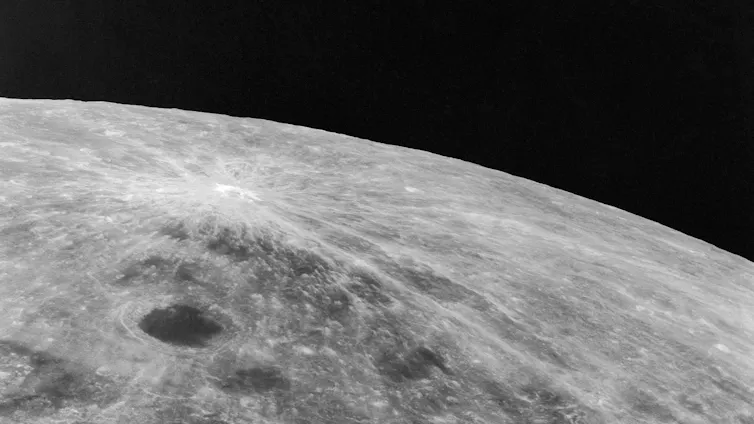
Several missions have already attempted to land on the lunar surface in 2025, with more to come. AP Photo
NASA wants to put a nuclear reactor on the Moon by 2030 – choosing where is tricky
Clive Neal, University of Notre Dame In a bold, strategic move for the U.S., acting NASA Administrator Sean Duffy announced plans on Aug. 5, 2025, to build a nuclear fission reactor for deployment on the lunar surface in 2030. Doing so would allow the United States to gain a foothold on the Moon by the time China plans to land the first taikonaut, what China calls its astronauts, there by 2030. Apart from the geopolitical importance, there are other reasons why this move is critically important. A source of nuclear energy will be necessary for visiting Mars, because solar energy is weaker there. It could also help establish a lunar base and potentially even a permanent human presence on the Moon, as it delivers consistent power through the cold lunar night. As humans travel out into the solar system, learning to use the local resources is critical for sustaining life off Earth, starting at the nearby Moon. NASA plans to prioritize the fission reactor as power necessary to extract and refine lunar resources. As a geologist who studies human space exploration, I’ve been mulling over two questions since Duffy’s announcement. First, where is the best place to put an initial nuclear reactor on the Moon, to set up for future lunar bases? Second, how will NASA protect the reactor from plumes of regolith – or loosely fragmented lunar rocks – kicked up by spacecraft landing near it? These are two key questions the agency will have to answer as it develops this technology.
Where do you put a nuclear reactor on the Moon?
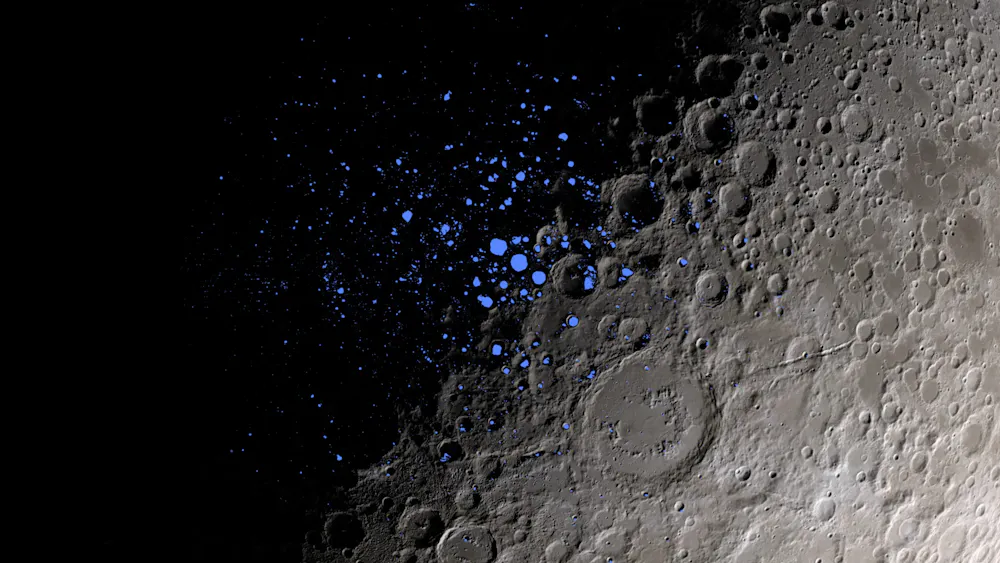
The nuclear reactor will likely form the power supply for the initial U.S.-led Moon base that will support humans who’ll stay for ever-increasing lengths of time. To facilitate sustainable human exploration of the Moon, using local resources such as water and oxygen for life support and hydrogen and oxygen to refuel spacecraft can dramatically reduce the amount of material that needs to be brought from Earth, which also reduces cost. In the 1990s, spacecraft orbiting the Moon first observed dark craters called permanently shadowed regions on the lunar north and south poles. Scientists now suspect these craters hold water in the form of ice, a vital resource for countries looking to set up a long-term human presence on the surface. NASA’s Artemis campaign aims to return people to the Moon, targeting the lunar south pole to take advantage of the water ice that is present there.Dark craters on the Moon, parts of which are indicated here in blue, never get sunlight. Scientists think some of these permanently shadowed regions could contain water ice.NASA’s Goddard Space Flight Center In order to be useful, the reactor must be close to accessible, extractable and refinable water ice deposits. The issue is we currently do not have the detailed information needed to define such a location. The good news is the information can be obtained relatively quickly. Six lunar orbital missions have collected, and in some cases are still collecting, relevant data that can help scientists pinpoint which water ice deposits are worth pursuing. These datasets give indications of where either surface or buried water ice deposits are. It is looking at these datasets in tandem that can indicate water ice “hot prospects,” which rover missions can investigate and confirm or deny the orbital observations. But this step isn’t easy. Luckily, NASA already has its Volatiles Investigating Polar Exploration Rover mission built, and it has passed all environmental testing. It is currently in storage, awaiting a ride to the Moon. The VIPER mission can be used to investigate on the ground the hottest prospect for water ice identified from orbital data. With enough funding, NASA could probably have this data in a year or two at both the lunar north and south poles.The VIPER rover would survey water at the south pole of the Moon.
How do you protect the reactor?
Once NASA knows the best spots to put a reactor, it will then have to figure out how to shield the reactor from spacecraft as they land. As spacecraft approach the Moon’s surface, they stir up loose dust and rocks, called regolith. It will sandblast anything close to the landing site, unless the items are placed behind large boulders or beyond the horizon, which is more than 1.5 miles (2.4 kilometers) away on the Moon. Scientists already know about the effects of landing next to a pre-positioned asset. In 1969, Apollo 12 landed 535 feet (163 meters) away from the robotic Surveyor 3 spacecraft, which showed corrosion on surfaces exposed to the landing plume. The Artemis campaign will have much bigger lunar landers, which will generate larger regolith plumes than Apollo did. So any prepositioned assets will need protection from anything landing close by, or the landing will need to occur beyond the horizon. Until NASA can develop a custom launch and landing pad, using the lunar surface’s natural topography or placing important assets behind large boulders could be a temporary solution. However, a pad built just for launching and landing spacecraft will eventually be necessary for any site chosen for this nuclear reactor, as it will take multiple visits to build a lunar base. While the nuclear reactor can supply the power needed to build a pad, this process will require planning and investment. Human space exploration is complicated. But carefully building up assets on the Moon means scientists will eventually be able to do the same thing a lot farther away on Mars. While the devil is in the details, the Moon will help NASA develop the abilities to use local resources and build infrastructure that could allow humans to survive and thrive off Earth in the long term. Clive Neal, Professor of Civil and Environmental Engineering and Earth Sciences, University of Notre Dame This article is republished from The Conversation under a Creative Commons license. Read the original article.
The Unfavorable Semicircle Mystery: The YouTube Channel That Uploaded Tens of Thousands of Cryptic Videos
In 2015, the YouTube channel Unfavorable Semicircle gained attention for its enigmatic and abundant video uploads, totaling over 70,000 before its deletion in 2016. Theories about its purpose vary, from automated content generation to digital art experimentation, leaving its intent unresolved.
In the vast digital landscape of the internet, strange phenomena occasionally emerge that leave investigators, tech enthusiasts, and everyday viewers scratching their heads. One of the most puzzling cases appeared in 2015, when a mysterious YouTube channel called Unfavorable Semicircle began uploading an astonishing number of cryptic videos.
Within months, the channel had published tens of thousands of bizarre clips, many of which seemed random, incomprehensible, and visually chaotic. But as internet detectives began analyzing the content more closely, they discovered that these videos might not have been random at all.
The Sudden Appearance of an Internet Mystery
The Unfavorable Semicircle channel reportedly appeared in March 2015, with its first uploads arriving in early April.
Almost immediately, the channel began publishing videos at an incredible pace. Observers estimated that the account uploaded thousands of videos per week, sometimes multiple videos per minute. By the time the channel disappeared in early 2016, researchers believed it had uploaded well over 70,000 videos, possibly far more.
The scale alone made the project seem impossible for a human to manage manually.
Most of the videos shared similar characteristics:
Extremely short or very long runtime
Abstract visuals such as flashing colors, static, or distorted imagery
Little or no audio, or heavily distorted sounds
Titles made of random characters, symbols, or numbers
To casual viewers, the videos looked like pure digital noise. However, online investigators suspected something more deliberate was happening.
Hidden Images Discovered
The mystery deepened when researchers began extracting individual frames from some videos.
When thousands of frames from certain clips were stitched together, the results sometimes formed coherent images. One of the most famous examples involved a video titled “LOCK.” While the footage appeared chaotic at first, combining the frames revealed a recognizable composite image.
This discovery suggested the videos were carefully constructed rather than random uploads.
Theories About the Channel’s Purpose
Because the creator never explained the project, several theories emerged across Reddit, YouTube, and internet forums.
Automated Experiment Many believe the channel was created using automated software that generated and uploaded content at scale.
Alternate Reality Game (ARG) Some viewers suspected the channel might be part of a hidden puzzle or digital scavenger hunt.
Advertisement
Encrypted Communication Others compared the channel to Cold War “numbers stations,” suggesting the videos could contain coded messages.
Digital Art Project Another theory suggests the channel was an experimental art project exploring algorithms, data, and visual noise.
Despite years of investigation, no single explanation has been confirmed.
Why the Channel Disappeared
In February 2016, YouTube removed the channel, reportedly due to spam or automated activity violations.
By that time, the channel had already become a minor internet legend. Fortunately, some researchers managed to archive a large portion of the videos before they disappeared.
Even today, archived clips continue to circulate online as investigators attempt to decode them.
Unfavorable Semicircle: The Most Bizarre YouTube Mystery
Other Mysterious YouTube Channels
The Unfavorable Semicircle mystery is not the only strange case on YouTube.
One well-known example is Webdriver Torso, a channel that uploaded hundreds of thousands of videos showing red and blue rectangles with simple beeping sounds. Internet speculation ran wild before Google eventually confirmed it was an internal YouTube testing account.
Another example is AETBX, which posts distorted visuals and unusual audio that some viewers believe contain hidden patterns or encoded information.
These cases highlight how automation, experimentation, and creativity can sometimes blur the line between technology and mystery.
Advertisement
A Digital Mystery That Remains Unsolved
Nearly a decade later, the true purpose behind Unfavorable Semicircle remains unknown.
Was it a sophisticated experiment? A piece of algorithmic art? Or simply an automated test that accidentally captured the internet’s imagination?
Whatever the explanation, the channel stands as a reminder that even in a world filled with billions of videos and endless information, the internet can still produce mysteries that challenge our understanding of technology.
Why Internet Mysteries Still Fascinate Us
Stories like Unfavorable Semicircle capture attention because they combine technology, creativity, and the unknown. They invite people from around the world to collaborate, analyze patterns, and search for meaning hidden in the noise.
And sometimes, the most intriguing part of the mystery is that the answer may never fully be known.
Dive into “The Knowledge,” where curiosity meets clarity. This playlist, in collaboration with STMDailyNews.com, is designed for viewers who value historical accuracy and insightful learning. Our short videos, ranging from 30 seconds to a minute and a half, make complex subjects easy to grasp in no time. Covering everything from historical events to contemporary processes and entertainment, “The Knowledge” bridges the past with the present. In a world where information is abundant yet often misused, our series aims to guide you through the noise, preserving vital knowledge and truths that shape our lives today. Perfect for curious minds eager to discover the ‘why’ and ‘how’ of everything around us. Subscribe and join in as we explore the facts that matter. https://stmdailynews.com/the-knowledge/
2025 was hotter than it should have been – 5 influences and a dirty surprise offer clues to what’s ahead
The past three years recorded unprecedented global heat, with 2025 being particularly warm. Factors such as greenhouse gas emissions and a decline in solar activity influenced temperatures and extreme weather patterns.
The past three years have been the world’s hottest on record by far, with 2025 almost tied with 2023 for second place. With that energy came extreme weather, from flash flooding to powerful hurricanes and severe droughts. Yet, by most indicators, the planet should have been cooler in 2025 than it was.
So, what happened, and what does that say about the year ahead?
As an earth and environmental scientist, I study influences that affect global temperatures year to year, such as El Niño, wildfires and solar cycles. Some make Earth hotter. Some make it cooler. And one particularly unhealthy influence has been quietly hiding a large amount of global warming – until now.The past three years have been the warmest on record. The chart compiled by the European Union’s Copernicus Climate Change Service shows the comparison to preindustrial-era temperatures in the second half of the 1800s. C3S/ECMWF
Factors that made 2025 cooler than 2024
The Earth’s climate is the result of many factors that change from year to year. Some that helped make 2025 cooler than 2024 include:
La Niña’s arrival: La Niña is part of the El Niño-Southern Oscillation, a natural climate pattern that fluctuates between warm El Niño conditions and cooler La Niña conditions. During El Niño, the Pacific Ocean heats up along the equator, influencing the atmosphere in ways that can cause intense storms, droughts and heat waves around the planet. La Niña does the opposite; it’s like putting an ice pack on the atmosphere.
Both 2023 and 2024 were El Niño years, but in 2025 conditions shifted to neutral and then to La Niña starting in September.
The solar cycle: The Sun reached its solar maximum near the end of 2024, the peak of its energy output in an approximately 11-year cycle, and began declining in 2025. So, while the sun’s output was still stronger than average in 2025, it was less than in 2024.
Fewer wildfires: Despite some destructive blazes, the world also saw fewer wildfires during 2025 than 2024, which put less carbon dioxide – a planet-warming greenhouse gas – into the atmosphere.Major warming and cooling influences from 2016 to 2025. Each graph starts at 2016. Anthropogenic warming, natural carbon sinks and sulfur dioxide (SO2) reductions start from zero in 2016 to illustrate cumulative changes to existing reservoirs; El Niño/La Niña and the solar cycle show real-time influences on the global temperature, relative to mean values. Michael Wysession. Data: Global Carbon Project (Anthropogenic Global Warming, Natural Carbon Sinks); NOAA (El Niño/La Niña, Solar Cycle); SO2 Reductions (FaIR Analysis by Carbon Brief)
Several other factors made 2025 warmer than expected, and some are likely to continue to increase in 2026. They include:
Greenhouse gas emissions: The big driver of global warming is excess greenhouse gas emissions, largely from burning fossil fuels, and 2025 had plenty.
Greenhouse gases trap heat near Earth’s surface like a blanket, raising the temperature. They also linger in the atmosphere for years to centuries, meaning gases released today will continue to warm the planet well into the future. The levels of carbon dioxide, methane and nitrous oxide in the atmosphere all increased in 2025.
Advertisement
Sources of worldwide carbon dioxide emissions that have grown the most in recent decades. Carbon Brief, CC BY
Earth’s energy imbalance: Other sources can disrupt the natural balance between the amount of sunlight that reaches Earth and the lesser amount radiated back to space. A recent study found that Earth’s energy uptake surged and temperatures rose quickly when a rare three-year La Niña in 2020-2022 shifted to El Niño in 2023-2024.
Declining polar ice, which efficiently reflects sunlight back into space, also affects the energy balance. As sea ice declines, it leaves dark ocean water that absorbs most of the sunlight that reaches it. In a spiraling feedback, warmer water melts sea ice, allowing more sunlight into the ocean, warming it faster; 2025 had the lowest winter peak of Arctic sea ice on record and the third-lowest minimum extent of Antarctic ice.
Air pollution: Sulfate aerosol pollution from coal combustion and burning heavy fuel oil in shipping has also been affecting Earth’s energy balance. It has been masking the full effects of human-caused greenhouse gases for years by reflecting sunlight back into space, creating a cooling effect. But sulfate aerosol pollution is also a serious health hazard, blamed for about 8 million human deaths per year from lung diseases.
Recent reductions in sulfate pollution – now 40% less than 20 years ago – have meant about a 0.2 F (0.13 C) increase in global temperatures. Much of the reduction was from China’s efforts to reduce its notoriously bad air pollution in recent years and international shipping rules in effect since 2020 that have reduced sulfur emissions from large ships by 85%.Sea ice levels were near record lows for both Arctic and Antarctic ice in 2025. Carbon Brief, CC BY
Taking all factors together, humans are now warming the planet at a faster rate than at any point in human history: at about 0.5 F (0.27 C) per decade. That extra heat can fuel extreme weather, including flash floods, heat waves, extended droughts, wildfires and coastal flooding, affecting human lives and economies.
Predictions for 2026
Most climate models predict 2026 will be about as hot as 2025, depending on whether a Pacific El Niño develops, which forecasters give about a 60% chance of happening. The planet is already starting the year out warm, even if it doesn’t feel like that everywhere. While January was very cold in parts of the U.S., globally, Earth saw its fifth-warmest January on record, and much of the western U.S. saw one of its warmest winters on record.
Dive into “The Knowledge,” where curiosity meets clarity. This playlist, in collaboration with STMDailyNews.com, is designed for viewers who value historical accuracy and insightful learning. Our short videos, ranging from 30 seconds to a minute and a half, make complex subjects easy to grasp in no time. Covering everything from historical events to contemporary processes and entertainment, “The Knowledge” bridges the past with the present. In a world where information is abundant yet often misused, our series aims to guide you through the noise, preserving vital knowledge and truths that shape our lives today. Perfect for curious minds eager to discover the ‘why’ and ‘how’ of everything around us. Subscribe and join in as we explore the facts that matter. https://stmdailynews.com/the-knowledge/
After the Blood Moon: Scientists and Skywatchers React to the March 3, 2026 Total Lunar Eclipse
The March 3, 2026 total lunar eclipse amazed skywatchers worldwide. Scientists and amateur astronomers share reactions and photos from the dramatic blood moon event.
Millions of people around the world looked to the sky in the early hours of March 3, 2026 to witness one of the most striking astronomical events of the year — a total lunar eclipse, often referred to as a “Blood Moon.” As the Moon passed completely into Earth’s shadow, it transformed from its familiar silver glow into a deep copper-red color, captivating observers from North America to Asia and across the Pacific.
Blood Moon Aftermath: Scientists and Skywatchers React to the March 3, 2026 Total Lunar Eclipse
For viewers in the western United States, including Arizona and California, the eclipse occurred just before sunrise. The timing created a dramatic scene as the reddish Moon hovered low in the western sky while the eastern horizon began to brighten with dawn.
A Global Skywatching Event
Total lunar eclipses occur when the Sun, Earth, and Moon align so that Earth’s shadow completely covers the Moon. During the March 3 event, the Moon spent nearly an hour fully inside the darkest part of Earth’s shadow, known as the umbra. During this phase, sunlight filtered through Earth’s atmosphere projected reddish light onto the Moon’s surface, creating the dramatic “blood moon” effect.
Astronomers noted that the event was particularly significant because total lunar eclipses are relatively infrequent. While partial eclipses occur more often, a full eclipse visible across large portions of the globe remains a memorable experience for both scientists and casual observers.
Scientists Explain the Phenomenon
According to researchers at NASA, the reddish color seen during totality occurs because Earth’s atmosphere scatters shorter wavelengths of sunlight — such as blue — while allowing longer red wavelengths to pass through. This filtered light is then bent, or refracted, into Earth’s shadow and projected onto the Moon.
Planetary scientists say lunar eclipses provide a powerful visual demonstration of the geometry of the Earth–Moon–Sun system. The curved shadow moving across the Moon also historically served as one of the earliest pieces of evidence that Earth is spherical.
Researchers also point out that lunar eclipses offer opportunities to study Earth’s atmosphere. Variations in dust, volcanic particles, and atmospheric conditions can influence how dark or red the Moon appears during totality.Taken in North Phoenix around 5 AM MST March 3, 2026
Amateur Astronomers Share Their Views
While professional observatories monitored the eclipse with precision instruments, amateur astronomers and astrophotographers helped document the event from countless locations worldwide. Social media platforms and astronomy forums quickly filled with images showing the Moon’s color shifting from pale gray to orange and deep red.
Many skywatchers in the southwestern United States described the experience as particularly dramatic because the eclipse occurred just before moonset. Observers reported seeing the Moon glowing red above desert landscapes and city skylines before gradually fading into the brightening morning sky.
Astrophotographers also emphasized that lunar eclipses are among the easiest astronomical events to capture. Unlike solar eclipses, they can be photographed safely without special filters, making them accessible to beginners using smartphones as well as professionals using telescopes and high-end cameras.
Advertisement
A Rare Pre-Dawn Sight
In parts of the western United States, some observers were able to witness a rare atmospheric phenomenon known as a selenelion, when both the eclipsed Moon and the rising Sun appear in the sky at the same time due to atmospheric refraction. The effect added an unusual visual element to an already impressive celestial event.
The combination of a deep red Moon and the approaching dawn created striking photographic opportunities and memorable moments for early-morning skywatchers.
When Is the Next Total Lunar Eclipse?
Although partial eclipses occur periodically, the next widely visible total lunar eclipse will not occur until late 2028. That makes the March 2026 eclipse one of the most notable skywatching events of the decade.
For many observers, the event served as a reminder that some of the most spectacular astronomical experiences require nothing more than stepping outside, looking up, and taking a moment to appreciate the universe above.
Rod: A creative force, blending words, images, and flavors. Blogger, writer, filmmaker, and photographer. Cooking enthusiast with a sci-fi vision. Passionate about his upcoming series and dedicated to TNC Network. Partnered with Rebecca Washington for a shared journey of love and art.