Connect with us

News

Space law hasn’t been changed since 1967 – but the UN aims to update laws and keep space peaceful

Published

on

Space law
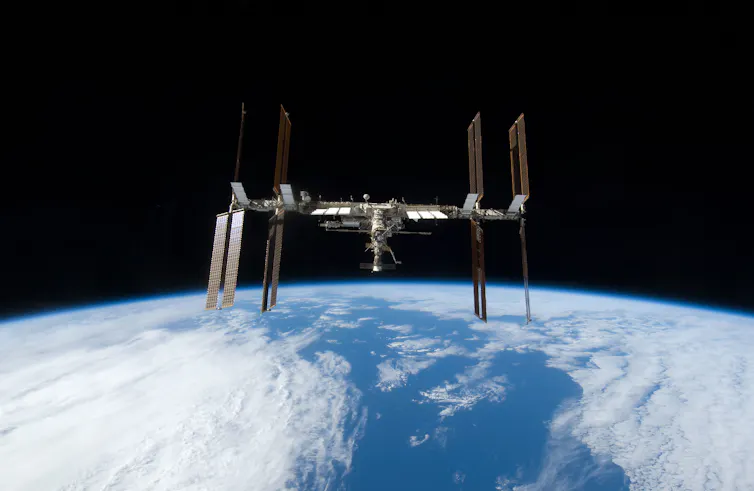
The International Space Station is a great example of how space has, for the most part, been a peaceful and collaborative international arena. NASA Marshall Spaceflight Center/Flickr, CC BY-NC
Michelle L.D. Hanlon, University of Mississippi and Greg Autry, Arizona State University On Nov. 15, 2021, Russia destroyed one of its own old satellites using a missile launched from the surface of the Earth, creating a massive debris cloud that threatens many space assets, including astronauts onboard the International Space Station. This happened only two weeks after the United Nations General Assembly First Committee formally recognized the vital role that space and space assets play in international efforts to better the human experience – and the risks military activities in space pose to those goals.

Space Law and the UN

The U.N. First Committee deals with disarmament, global challenges and threats to peace that affect the international community. On Nov. 1, it approved a resolution that creates an open-ended working group. The goals of the group are to assess current and future threats to space operations, determine when behavior may be considered irresponsible, “make recommendations on possible norms, rules and principles of responsible behaviors,” and “contribute to the negotiation of legally binding instruments” – including a treaty to prevent “an arms race in space.” We are two space policy experts with specialties in space law and the business of commercial space. We are also the president and vice president at the National Space Society, a nonprofit space advocacy group. It is refreshing to see the U.N. acknowledge the harsh reality that peace in space remains uncomfortably tenuous. This timely resolution has been approved as activities in space become ever more important and – as shown by the Russian test – tensions continue to rise.
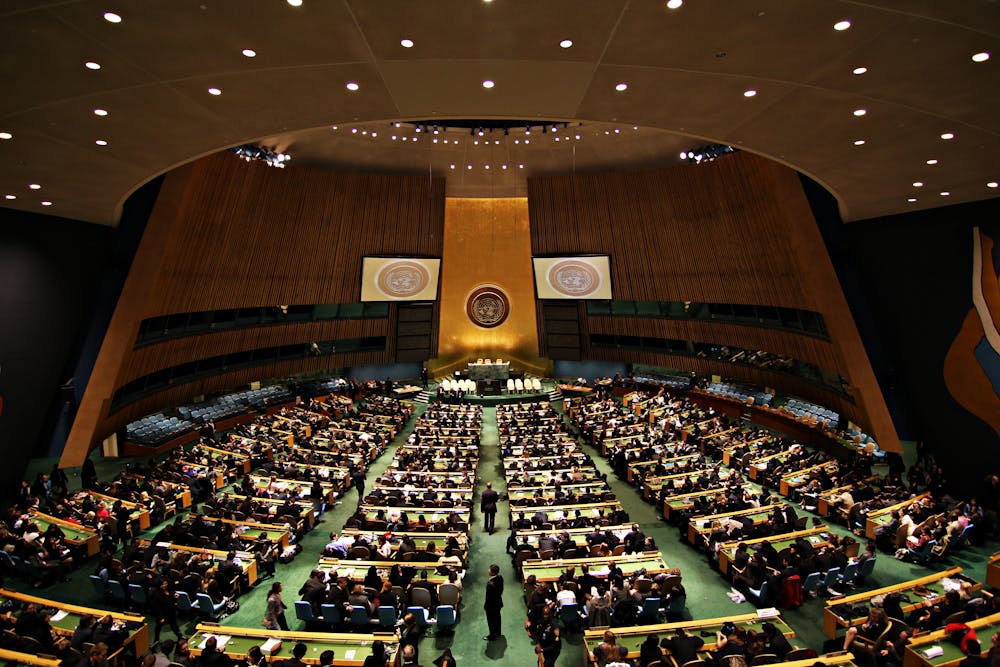
A large meeting hall in the United Nations headquarters.
Current actions in space are governed by the 1967 Outer Space Treaty that was developed within the United Nations, seen here. Basil D Soufi/WikimediaCommons, CC BY-SA

The 1967 Outer Space Treaty

Outer space is far from a lawless vacuum. Activities in space are governed by the 1967 Outer Space Treaty, which is currently ratified by 111 nations. The treaty was negotiated in the shadow of the Cold War when only two nations – the Soviet Union and the U.S. – had spacefaring capabilities. While the Outer Space Treaty offers broad principles to guide the activities of nations, it does not offer detailed “rules of the road.” Essentially, the treaty assures freedom of exploration and use of space to all humankind. There are just two caveats to this, and multiple gaps immediately present themselves. The first caveat states that the Moon and other celestial bodies must be used exclusively for peaceful purposes. It omits the rest of space in this blanket prohibition. The only guidance offered in this respect is found in the treaty’s preamble, which recognizes a “common interest” in the “progress of the exploration and use of space for peaceful purposes.” The second caveat says that those conducting activities in space must do so with “due regard to the corresponding interests of all other States Parties to the Treaty.” A major problem arises from the fact that the treaty does not offer clear definitions for either “peaceful purposes” or “due regard.” While the Outer Space Treaty does specifically prohibit placing nuclear weapons or weapons of mass destruction anywhere in space, it does not prohibit the use of conventional weapons in space or the use of ground-based weapons against assets in space. Finally, it is also unclear if some weapons – like China’s new nuclear capable partial-orbit hypersonic missile – should fall under the treaty’s ban. The vague military limitations built into the treaty leave more than enough room for interpretation to result in conflict.

A satellite image of a storm over the U.S.
Nonmilitary satellites, like those used to take images for weather forecasts, can also serve important military functions. NASA Goddard Spaceflight Center/Flickr, CC BY

Space is militarized, conflict is possible

Space has been used for military purposes since Germany’s first V2 rocket launch in 1942. Many early satellites, GPS technology, a Soviet Space Station and even NASA’s space shuttle were all either explicitly developed for or have been used for military purposes. With increasing commercialization, the lines between military and civilian uses of space are less blurry. Most people are able to identify terrestrial benefits of satellites like weather forecasts, climate monitoring and internet connectivity but are unaware that they also increase agricultural yields and monitor human rights violations. The rush to develop a new space economy based on activities in and around Earth and the Moon suggests that humanity’s economic dependence on space will only increase. However, satellites that provide terrestrial benefits could or already do serve military functions as well. We are forced to conclude that the lines between military and civilian uses remain sufficiently indistinct to make a potential conflict more likely than not. Growing commercial operations will also provide opportunities for disputes over operational zones to provoke governmental military responses.

Military testing

While there has not yet been any direct military conflict in space, there has been an escalation of efforts by nations to prove their military prowess in and around space. Russia’s test is only the most recent example. In 2007, China tested an anti-satellite weapon and created an enormous debris cloud that is still causing problems. The International Space Station had to dodge a piece from that Chinese test as recently as Nov. 10, 2021. [Understand new developments in science, health and technology, each week. Subscribe to The Conversation’s science newsletter.] Similar demonstrations by the U.S. and India were far less destructive in terms of creating debris, but they were no more welcomed by the international community. The new U.N. resolution is important because it sets in motion the development of new norms, rules and principles of responsible behavior. Properly executed, this could go a long way toward providing the guardrails needed to prevent conflict in space.

From guidelines to enforcement

The U.N. Committee on the Peaceful Uses of Outer Space has been addressing space activities since 1959. However, the remit of the 95-member committee is to promote international cooperation and study legal problems arising from the exploration of outer space. It lacks any ability to enforce the principles and guidelines set forth in the 1967 Outer Space Treaty or even to compel actors into negotiations. The U.N. resolution from November 2021 requires the newly created working group to meet two times a year in both 2022 and 2023. While this pace of activity is glacial compared with the speed of commercial space development, it is a major step in global space policy. Michelle L.D. Hanlon, Professor of Air and Space Law, University of Mississippi and Greg Autry, Clinical Professor of Space Leadership, Policy and Business, Arizona State University This article is republished from The Conversation under a Creative Commons license. Read the original article.


Discover more from Daily News

Subscribe to get the latest posts sent to your email.

The Knowledge

Metro Board Advances Sepulveda Transit Corridor as C Line South Bay Extension Remains Under Review

The Los Angeles Metro Board meeting addressed progress on two key rail projects: the approved underground Sepulveda Transit Corridor, enhancing regional connectivity, and the debated extension of the Metro C Line into the South Bay, which remains undecided.

Published

on

The LA Metro Board approved the Sepulveda Transit Corridor’s underground rail plan while continuing debate over the C Line extension into the South Bay. Here’s what it means for LA transit’s future.
Image Credit: LA Metro

The future of Los Angeles transit was the focus of a recent Los Angeles County Metropolitan Transportation Authority (Metro) Board meeting, where directors considered progress on two major rail projects: the Sepulveda Transit Corridor and the long-planned extension of the Metro C Line into the South Bay.

STC LPA scaled 1
Image Credit: LA Metro

While the meeting resulted in a decisive vote on one project, the other continues to generate debate among Metro officials, local cities, and residents.

Sepulveda Transit Corridor: Underground Heavy Rail Moves Forward

The Metro Board unanimously approved the Locally Preferred Alternative (LPA) for the Sepulveda Transit Corridor, marking a major milestone for a project that has been discussed for decades.

The approved alternative calls for a fully underground heavy rail subway connecting the San Fernando Valley to the Westside, running from the Van Nuys Metrolink Station to the Metro E Line’s Expo/Sepulveda Station. The line would pass beneath the Sepulveda Pass, UCLA, and other high-demand travel areas.

Metro officials emphasized that the underground alignment offers the fastest travel times, highest passenger capacity, and the fewest surface-level impacts when compared with earlier aerial or monorail alternatives. The project is expected to significantly reduce congestion along the 405 Freeway corridor and improve regional connectivity.

With the LPA now selected, the Sepulveda Transit Corridor advances toward final environmental clearance, engineering, and eventual construction — a process that will continue over the coming years.

Metro C Line Extension: South Bay Alignment Debate Continues

The Board also discussed the Metro C Line extension into the South Bay, a project intended to extend light rail service approximately 4.5 miles from the current Redondo Beach station to the Torrance Transit Center.

Metro has released the project’s Final Environmental Impact Report (FEIR), which incorporates years of technical analysis and public input. However, unlike the Sepulveda project, the Board did not take final action to certify the FEIR or formally adopt a locally preferred alignment at this meeting.

Hawthorne Boulevard vs. Metro Right-of-Way

At the center of the C Line discussion is the question of alignment.

Metro staff has identified a “hybrid” alignment using an existing Metro-owned rail right-of-way as the preferred option. This route would largely follow the historic Harbor Subdivision corridor, minimizing new street disruptions while blending at-grade, elevated, and below-grade segments.

Some South Bay cities, however, continue to advocate for a Hawthorne Boulevard alignment, which would place rail tracks within the median of the busy commercial corridor. Supporters argue it offers better street-level access, while Metro has cited higher costs, longer construction timelines, and greater traffic impacts as key concerns.

Metro officials indicated that additional coordination with local jurisdictions and further Board action will be needed before a final decision is made.

Advertisement
Get More From A Face Cleanser And Spa-like Massage

What This Means for LA Transit

The contrast between the two projects was clear at the meeting: the Sepulveda Transit Corridor is now firmly on a defined path forward, while the C Line extension remains in a critical decision-making phase.

Together, the projects highlight both the ambition and complexity of expanding transit in Los Angeles County — balancing regional mobility goals, neighborhood impacts, and long-term funding realities.

Further Reading & Official Project Information


Metro Sepulveda Transit Corridor Project Page

– Official Metro overview of the Sepulveda Pass project, including alternatives, maps, timelines, and environmental documents.

Metro Board Considers Locally Preferred Alternative for Sepulveda Corridor

– Metro’s summary of the Board action and rationale behind selecting the underground heavy rail option.

Metro C Line Extension to Torrance Project Page

– Background, station concepts, and status updates for the South Bay light rail extension.

Final Environmental Impact Report: C Line Extension

– Details on the Final EIR, public comments, and next steps toward Board certification.

Metro Project Updates – The Source

– Ongoing Metro blog updates covering major transit projects, board actions, and construction milestones.

LA Metro Board of Directors

– Information on Metro Board members, meeting schedules, agendas, and voting records.

STM Daily News will continue to follow both projects closely, providing updates as Metro moves toward final approvals, construction timelines, and funding decisions that will shape how Angelenos travel for decades to come.

For ongoing coverage of Metro projects, transportation policy, and infrastructure across Southern California, visit STM Daily News.


Discover more from Daily News

Subscribe to get the latest posts sent to your email.

Continue Reading

News

From FIFA to the LA Clippers, carbon offset scandals are exposing the gap between sports teams’ green promises and reality

Under Steve Ballmer’s ownership, the LA Clippers have made strides in reducing greenhouse gas emissions, yet concerns arise over the efficacy of their carbon offsets, especially following issues with their partner, Aspiration. Many sports organizations face scrutiny for their offset claims, highlighting a need for transparent, verified carbon reduction strategies and a reassessment of sustainability practices in the industry.

Published

on

file 20251124 56 apz1fe
Under team owner Steve Ballmer, in the checkered shirt, the LA Clippers have cut their greenhouse gas emissions, but their carbon offsets raise questions. Ric Tapia/Icon Sportswire via Getty Images

Brian P. McCullough, University of Michigan and Edward Carrington, University of Michigan

If you go to a pro sports event today, there’s a good chance the stadium or arena will be powered at least in part by renewable energy. The team likely takes steps to reduce energy and waste. Some even claim to have net-zero greenhouse gas emissions, meaning any emissions they still do produce they offset by paying for projects, such as tree-planting, that reduce greenhouse gases elsewhere.

The venue upgrades have been impressive – Seattle’s hockey and basketball arena runs on 100% renewable energy, makes its rink ice from captured rainwater, and offers free public transit for ticket holders.

But how much of the teams’ offset purchases are actually doing the good that they claim?

It’s an important question, in part because fans may ultimately pay for those offsets.

A soccer player directs the ball with his head while leaping high into the air. The stands behind him are packed.
Lionel Messi of Argentina controls the ball during the FIFA World Cup Qatar 2022 final match. FIFA drew criticism for claiming the games were carbon neutral while relying heavily on sometimes questionable carbon offsets. Julian Finney/Getty Images

The cost of carbon offsetting in sports varies by organization, with no industry standard for who pays. Some teams and leagues absorb costs through their operational budgets, treating carbon neutrality as a core responsibility. Others pass costs to consumers: Some teams add sustainability fees to ticket prices to offset each attendee’s carbon footprint. The payment model ultimately reflects whether an organization views offsetting as an institutional obligation or a shared responsibility with fans.

Carbon offsets in sports are also in the news, with scandals erupting around them in connection with sports from FIFA’s 2022 World Cup to basketball’s LA Clippers.

As sport management researchers, we have been following offset agreements and other sustainability commitments that teams and sports leagues such as FIFA have been making to see whether they translate into measurable environmental outcomes. We see lots of good intentions but also a disturbing amount of failures and outright fraud.

Where sports teams’ emissions come from

The vast majority of a sports team’s climate footprint comes from team’s and fans’ travel, which they have little control over. Leagues can reduce teams’ travel somewhat with creative scheduling, but unlike other industries, sports teams have few ways to reduce the bulk of their emissions.

What many of them do instead is offset those travel emissions by buying carbon credits.

https://datawrapper.dwcdn.net/C9q2E/1

Carbon credits are generated by projects that reduce greenhouse gases in the atmosphere or prevent greenhouse gas emissions. Many of those projects involve planting trees to remove carbon dioxide from the atmosphere; others expand clean energy to reduce fossil fuel use. Each carbon credit is supposed to represent the reduction or prevention of one metric ton of carbon dioxide.

Advertisement
Get More From A Face Cleanser And Spa-like Massage

However, carbon offset projects have come under scrutiny in recent years. Tree-planting projects, the most common type, take time to meet their promise as the trees grow, and wildfires and logging can wipe out the benefit. Studies have found that companies tend to buy cheap, low-quality carbon credits, which run a risk of exaggerating their carbon reduction claims or providing results that would have happened anyway, leaving no real climate benefit.

Unfortunately, several teams, perhaps unknowingly, have been purchasing fraudulent or low-quality credits.

Reputations at risk

FIFA brought the sports world’s carbon offset problem into the spotlight during the 2022 Qatar World Cup.

FIFA claimed the event would be carbon neutral, but that claim relied on creative accounting that understated the event’s construction and travel emissions. Organizers also used low-quality offsets. Many of those offsets were renewable energy projects with a high likelihood of being built anyway.

A year after the tournament, FIFA had completed offset purchases for less than a third of the World Cup’s estimated emissions, the nonprofit Carbon Market Watch found. And Switzerland’s advertising regulator ordered FIFA to stop claiming the World Cup had been “carbon neutral.”

A view across the stands during a game at Fenway Park under the lights.
In 2022, the Boston Red Sox announced a plan to route a portion of the proceeds from every ticket purchased at Fenway Park to a carbon offset project run by Aspiration. Aspiration later went bankrupt, and a ProPublica investigation found it had planted far fewer trees to store that carbon than promised. Werner Kunz/Wikimedia Commons, CC BY-SA

The Clippers and baseball’s Boston Red Sox ran into problems when they publicly partnered with Aspiration, a now-bankrupt finance technology company and carbon credit broker, to meet their “carbon neutral” claims.

The Clippers had a US$300 million partnership with Aspiration that included paying the company at least $56 million for carbon credits in mid-2022, The New York Times reported. Both teams also had plans with Aspiration to offer fans a way to buy carbon credits to cover their own travel when purchasing tickets.

However, Aspiration officials claimed to have supported millions more tree-plantings than what had actually happened, a ProPublica investigation found. Aspiration co-founder Joe Sanberg pleaded guilty in 2025 to wire fraud involving false statements about financing to secure loans and attract investors, who lost at least $248 million.

The Aspiration partnership is also under investigation by the NBA over an endorsement deal the company made with Clippers all-star Kawhi Leonard at about the same time and questions about whether it was used to violate the league’s salary cap. Team owner Steve Ballmer, who personally invested at least $50 million in Aspiration, told ESPN he and the team did nothing wrong. “They conned me,” he said.

While the scandal focused on financial fraud and the salary cap, it also raised questions about the team’s sustainability claim.

Without verification, who knows?

In some cases, the value of offset projects is difficult to verify, even when trees are being planted nearby.

Advertisement
Get More From A Face Cleanser And Spa-like Massage

The Seattle Sounders FC declared itself the first carbon-neutral professional soccer team in North America in 2019 by cutting its waste, water and energy use and offsetting its remaining emissions through the nonprofit organization Forterra, which plants trees in the Puget Sound region.

While the effort positioned the club as a sustainability leader, the offsets lacked what’s known as third-party verification. Similar to how organic food must be certified by reputable agencies, third-party validation of carbon credits ensures credits truly represent the removal of carbon from the atmosphere or avoided emissions.

Without verification, it’s unclear whether claimed emission reductions are permanent, accurately tracked and transparently reported.

Potential legal consequences

Even the most prominent venues are susceptible to issues with unreliable credits.

Climate Pledge Arena in Seattle has been celebrated as the world’s first “zero-carbon” certified arena, with electric Zambonis, recycled materials, renewable energy and free public transit. It represents one of the most ambitious pushes to develop sustainable sport infrastructure globally.

A view from the upper deck of a large hockey arena. Two Zambonis are cleaning the ice.
Hockey rinks need energy to keep the ice frozen. Seattle’s Climate Pledge Arena has lowered its emissions with solar power from a local array and has even electried its Zambonis. But reports have raised questions about the quality of carbon offsets it purchased. AP Photo/Maddy Grassy

To offset unavoidable construction emissions, the arena’s owner relied on carbon credits tied to projects meant to reduce rainforest loss in Colombia. However, an analysis by the carbon rating company Calyx Global found that while the arena’s credits may prevent some deforestation, the numbers likely overstate the benefits.

A 2023 report suggested that over 90% of rainforest carbon credits from the leading certifier of offsets lack evidence that they reduced deforestation. The certifier disputed that conclusion but is working to revise its review process.

When credits fail to offset real emissions, that erodes public trust and can expose organizations to potential legal consequences.

Delta Air Lines, for example, is facing a lawsuit over its carbon neutrality claim. The suit alleges that Delta misled passengers by describing itself as a “carbon-neutral airline” while relying on carbon offset projects that were ineffective or “junk.”

Time for some strategic reassessment

These and other failures in the carbon credit market suggest the industry needs to fundamentally reassess how sports teams achieve their climate goals.

To provide meaningful sustainability commitments, sports organizations and facilities can start at home by lowering their fossil fuel use and increasing their energy efficiency. Many arenas do this.

Advertisement
Get More From A Face Cleanser And Spa-like Massage
People walk under a canopy with solar panels above.
Fans walk under solar panels at NRG Stadium in Houston. Tom Pennington/Getty Images

https://datawrapper.dwcdn.net/O1mkr/1

Leagues can design game schedules to reduce team and fan travel. Many of the Paris Olympics venues in 2022, for example, were connected by subway or bus. The 2026 FIFA World Cup, in contrast, has venues hundreds of miles apart across North America, meaning potentially higher emissions from fan travel.

Where offsets will still play a role, teams can ensure that they partner with verified carbon credit providers that deliver measurable, transparent carbon reductions.

In a field where public trust and reputation matter as much as performance, the sports industry cannot afford foul play on climate. We believe a shift toward strategies that cut emissions first, and then use only the most credible offsets, will be the difference between striking out and leading the sustainability game.

Brian P. McCullough, Associate Professor of Sport Management, University of Michigan and Edward Carrington, Assistant in Research in Sports Management, University of Michigan

This article is republished from The Conversation under a Creative Commons license. Read the original article.

Author


Discover more from Daily News

Subscribe to get the latest posts sent to your email.

Continue Reading

STM Daily News

HGTV Unveils the HGTV Dream Home 2026: A $2.4M+ Lake Wylie Retreat Near Charlotte

HGTV unveils the Dream Home 2026 on Lake Wylie near Charlotte, NC—a 3,000+ sq.-ft. waterfront retreat. Enter daily through Feb. 13, 2026.

Published

on

Exterior view of HGTV Dream Home 2026, a fully furnished waterfront house on Lake Wylie near Charlotte, North Carolina.
HGTV Dream Home 2026

HGTV just pulled back the curtain on its HGTV® Dream Home 2026—a newly built, fully furnished waterfront escape set on a secluded peninsula along Lake Wylie near Charlotte, North Carolina. And yes, the stakes are big: the sweepstakes winner takes home a grand prize package valued at more than $2.4 million, including the home plus $100,000 cash.

Designed to feel equal parts “weekend getaway” and “forever home,” the property leans hard into lake life—panoramic water views, warm natural finishes, and outdoor spaces built for slow mornings and long sunsets.

A lakeside home built for views (and actual living)

Spanning more than 3,000 square feet, HGTV Dream Home 2026 includes three bedrooms and three-and-a-half bathrooms, with a layout intentionally oriented to capture Lake Wylie views from nearly every angle.

HGTV describes the home as a calm, curated retreat—where indoor comfort and outdoor beauty are basically in constant conversation. The design palette is rooted in the landscape: earth tones, organic materials, hand-laid stone, custom millwork, classic furnishings, and vintage collectibles that keep the vibe warm and timeless rather than overly trendy.

Some of the standout interior features include:

  • A central great room anchored by a reclaimed-wood mantle
  • A welcoming dining space with a café-style door
  • chef-style kitchen featuring an over-grouted stone backsplash
  • morning room for casual coffee-and-light moments
  • A garage with pantry access plus a dedicated pet wash
  • A main bedroom suite with sweeping lake views and a spa-like bath, plus a closet that includes an all-in-one washer/dryer

Outdoor living takes center stage—hello, two-story dock

If the inside is designed for comfort, the outside is designed for the lifestyle. HGTV’s Dream Home 2026 leans into relaxed waterfront living with natural landscaping, laid-back outdoor furnishings, and a pebbled pathway leading to what might be the showstopper: a spectacular two-story dock.

It’s the kind of feature HGTV fans will immediately picture in use—sunrise coffee, sunset watching, and full-on lake days without leaving your property line.

Why Lake Wylie? Location meets laid-back Southern charm

Lake Wylie sits across the North Carolina–South Carolina border and is known for calm waters and an outdoors-first pace. HGTV highlights the lake’s 300+ miles of shoreline and its reputation as a haven for water activities—boating, paddling, and everything in between.

The location also hits that sweet spot of “peaceful but not remote”: it’s about 20 minutes from downtown Charlotte, and within easy reach of nearby towns like Belmont and Fort Mill.

The team behind the build and design

The home was built by Knotts Builders, with interior design led by Brian Patrick Flynn, who said he aimed to reflect Lake Wylie’s natural beauty while keeping the home “warm, inviting, and effortlessly livable.”

HGTV’s Howard Lee, Chief Creative Officer & President, US Networks, added that the home showcases the lifestyle of the Lake Wylie destination—and invited viewers to explore and enter for a chance to make it their own.

Sponsors featured throughout the home

HGTV Dream Home projects are also a showcase for sponsor products integrated into the build and lifestyle experience. This year’s lineup includes:

  • Spectrum (connectivity)
  • HGTV Home® by Sherwin-Williams (paint palette)
  • Husqvarna (lawn tools)
  • SimpliSafe (home security)
  • Snuggle (laundry products)
  • Stanley Steemer (cleaning)
  • Trex (decking/outdoor materials)
  • VELUX (skylights and sun tunnels)
  • Wayfair (furniture, décor, appliances)

How to enter the HGTV Dream Home 2026 giveaway

The official entry window runs from 9 a.m. ET Tuesday, Dec. 16, 2025 through 5 p.m. ET Friday, Feb. 13, 2026. Eligible fans can enter daily at:

  • HGTV.com
  • FoodNetwork.com

HGTV notes that both sites will include full details, official rules, and additional home features.

When to watch the HGTV Dream Home 2026 special

Viewers can tune into the one-hour special HGTV Dream Home 2026 on Tuesday, Jan. 1, 2026 at 8 p.m. ET on HGTV, with streaming availability on Max and discovery+ the same day.

Advertisement
Get More From A Face Cleanser And Spa-like Massage

For fans who want a closer look right now, HGTV also has a dedicated Dream Home hub and photo tours online.

Sources:

If you tell me which outlet this is for (STM Daily News vs. another publication), I can tighten the lede and SEO it to match that site’s voice (headline options + meta description + suggested tags).

Authors


Discover more from Daily News

Subscribe to get the latest posts sent to your email.

Continue Reading

Trending


