

The Long Track Back
The Fall of the Red Cars: How LA Gave Up the Rails
Los Angeles once featured the largest electric railway system, the Pacific Electric Railway, Red Cars! connecting key regions. However, by 1961, the rise of automobiles led to its demise, shifting the city’s transit identity towards freeways.

Last Updated on August 9, 2025 by Daily News Staff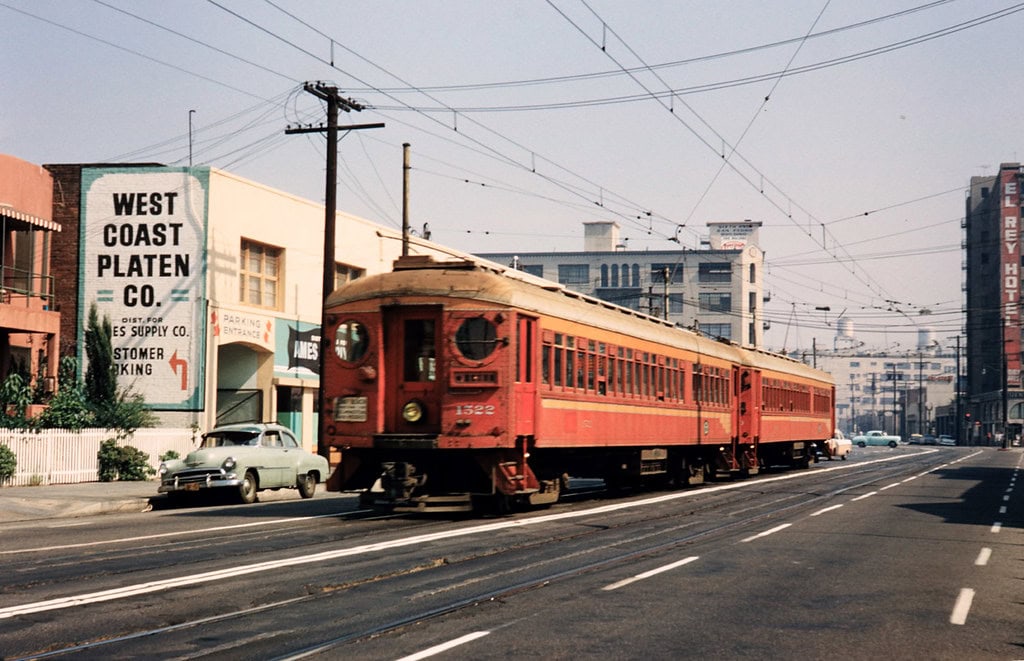
At one time, Los Angeles boasted the largest electric railway system in the world. The Pacific Electric Railway — known as the Red Cars — stretched over 1,000 miles, connecting Downtown LA to Pasadena, Long Beach, Santa Monica, and beyond. It was a marvel of early 20th-century transit planning and an integral part of life in Southern California.
But by 1961, it was gone.
@stmblog The A Line follows the exact route of the old Red Car — once the largest electric rail system in America. In 1961, it disappeared. In 1990, it came back. LAMetro TransitTok HistoryInMotion UrbanPlanning #LosAngeles https://stmdailynews.com/the-fall-of-the-red-cars-how-la-gave-up-the-rails/ ♬ original sound – STMDailyNews – STMDailyNews
The Red Cars fell victim to a perfect storm: the rise of the automobile, the birth of suburbia, a freeway construction boom, and political decisions that prioritized highways over rail. General Motors, Standard Oil, and Firestone Tire — companies that would benefit from a car-dominated world — were famously linked to efforts to dismantle electric rail systems across the country, including LA.
By the late 1950s, LA’s transit identity had shifted completely. The city that once led the world in streetcars became the poster child for freeway culture.
But while the Red Cars were gone, the need for mass transit never left. And by the late 1980s, Los Angeles was ready to reconsider rail.
Next Up: The Blue Line Revival: LA Takes a Risk on Rail
Related Links:
Pacific Electric (wikipedia): https://en.wikipedia.org/wiki/Pacific_Electric
Metro Transportation Library and Archive
Author

Discover more from Daily News
Subscribe to get the latest posts sent to your email.


The Knowledge
Brightline West Nears Final Environmental Clearance Milestone
Brightline West’s final environmental assessment is 99% complete, clearing a major hurdle for the high-speed rail line connecting Southern California and Las Vegas.

Last Updated on March 1, 2026 by Daily News Staff
The long-awaited high-speed rail connection between Southern California and Las Vegas just hit a major milestone.
According to recent reports, the final environmental assessment for Brightline West is now 99% complete — signaling that one of the most critical regulatory hurdles for the project is nearly finished.
For a project that has been discussed for over a decade, this is significant progress.
What “99% Complete” Really Means
Before major infrastructure projects like high-speed rail can move into full construction, they must go through extensive federal environmental review under the National Environmental Policy Act (NEPA).
For Brightline West, this includes:
- Environmental impact evaluations
- Wildlife and habitat assessments
- Air quality studies
- Noise and vibration analysis
- Cultural and tribal consultations
- Traffic and community impact reviews
Reaching 99% completion means the overwhelming majority of those studies, revisions, and agency approvals are essentially done. In practical terms, the project is nearly clear of its final federal environmental review requirements.
That’s a huge step toward full-scale construction.
The Route: Southern California to Las Vegas
Brightline West will run approximately 218 miles largely within the median of Interstate 15, connecting:
- Las Vegas
- Apple Valley
- Hesperia
- Rancho Cucamonga (with connections to Metrolink toward Los Angeles)
Trains are designed to reach speeds up to 200 mph, cutting travel time between Southern California and Las Vegas to roughly 2 hours.
Instead of battling I-15 weekend traffic, travelers could board a train in Rancho Cucamonga and arrive on the Las Vegas Strip in about the time it currently takes just to get through the Cajon Pass on a busy Friday.
Construction Status
The project officially broke ground in 2024, and early work has included:
- Geotechnical testing
- Land surveying
- Utility relocation
- Pre-construction corridor preparation
While heavy civil construction has not yet fully ramped up across the entire route, completing environmental clearance removes one of the last major barriers before large-scale building accelerates.
Timeline Update
The original goal was to open before the 2028 Los Angeles Olympics. That timeline has shifted.
Current projections place passenger service around late 2029, depending on construction pace and financing milestones.
Why This Milestone Matters
High-speed rail projects in the United States often stall due to environmental review delays, funding gaps, or regulatory challenges.
Getting to 99% completion on final environmental assessment means:
- Federal review is nearly wrapped
- Legal vulnerability is reduced
- Major construction can proceed with more certainty
- Investor confidence improves
For Southern California and Nevada, it represents real forward momentum.
The Bigger Picture
Brightline West is privately developed, separate from California’s state high-speed rail system. If completed as planned, it would become one of the first true high-speed rail lines operating in the western United States.
The I-15 corridor between Los Angeles and Las Vegas is one of the most heavily traveled leisure routes in the country. A successful rail alternative could significantly reshape travel patterns between the two regions.
Final Take
The headline may sound small — “99% complete” — but in infrastructure terms, it’s a major breakthrough.
With environmental review nearly finished, Brightline West is closer than ever to turning renderings into reality.
Now the question shifts from if the train gets built… to how fast construction can move from here.
Further Reading & Outside Coverage
- Brightline West Official Project Website
- Federal Railroad Administration (FRA)
- Las Vegas Review-Journal – Brightline West Coverage
- Los Angeles Times – Transportation & Infrastructure
- Progressive Railroading – Industry Updates
- Trains Magazine – Rail Industry News
- U.S. Department of Transportation
Dive into “The Knowledge,” where curiosity meets clarity. This playlist, in collaboration with STMDailyNews.com, is designed for viewers who value historical accuracy and insightful learning. Our short videos, ranging from 30 seconds to a minute and a half, make complex subjects easy to grasp in no time. Covering everything from historical events to contemporary processes and entertainment, “The Knowledge” bridges the past with the present. In a world where information is abundant yet often misused, our series aims to guide you through the noise, preserving vital knowledge and truths that shape our lives today. Perfect for curious minds eager to discover the ‘why’ and ‘how’ of everything around us. Subscribe and join in as we explore the facts that matter. https://stmdailynews.com/the-knowledge/
Author

Discover more from Daily News
Subscribe to get the latest posts sent to your email.
Urbanism
The Building That Proved Los Angeles Could Go Vertical
Los Angeles once banned skyscrapers, yet City Hall broke the height limit and proved high-rise buildings could be engineered safely in an earthquake zone.
Last Updated on February 19, 2026 by Daily News Staff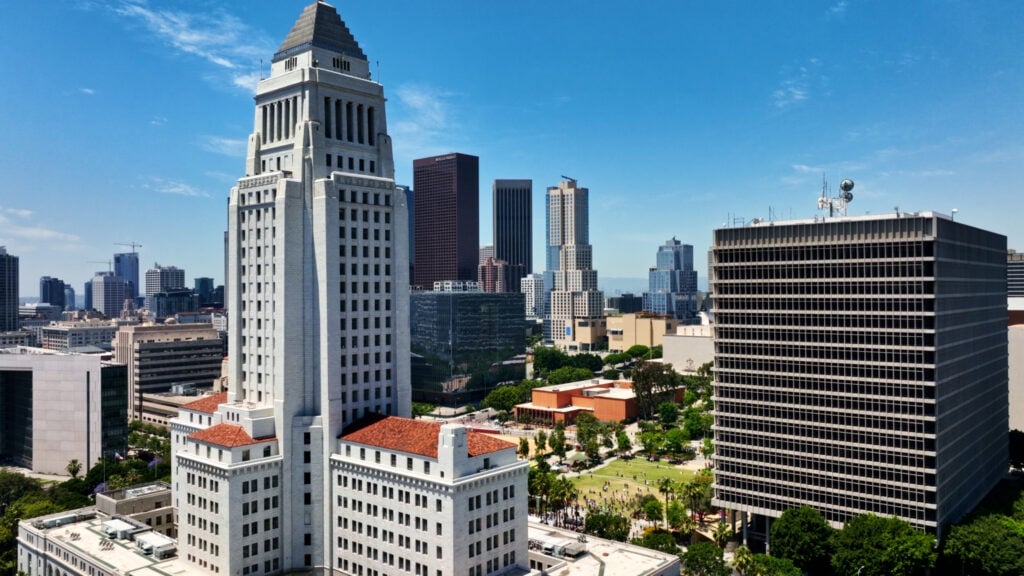
How City Hall Quietly Undermined LA’s Own Height Limits
The Knowledge Series | STM Daily News
For more than half a century, Los Angeles enforced one of the strictest building height limits in the United States. Beginning in 1905, most buildings were capped at 150 feet, shaping a city that grew outward rather than upward.
The goal was clear: avoid the congestion, shadows, and fire dangers associated with dense Eastern cities. Los Angeles sold itself as open, sunlit, and horizontal — a place where growth spread across land, not into the sky.
And yet, in 1928, Los Angeles City Hall rose to 454 feet, towering over the city like a contradiction in concrete.
It wasn’t built to spark a commercial skyscraper boom.
But it ended up proving that Los Angeles could safely build one.
A Rule Designed to Prevent a Manhattan-Style City
The original height restriction was rooted in early 20th-century fears:
- Limited firefighting capabilities
- Concerns over blocked sunlight and airflow
- Anxiety about congestion and overcrowding
- A strong desire not to resemble New York or Chicago
Los Angeles wanted prosperity — just not vertical density.
The height cap reinforced a development model where:
- Office districts stayed low-rise
- Growth moved outward
- Automobiles became essential
- Downtown never consolidated into a dense core
This philosophy held firm even as other American cities raced upward.
Why City Hall Was Never Meant to Change the Rules
City Hall was intentionally exempt from the height limit because the law applied primarily to private commercial buildings, not civic monuments.
But city leaders were explicit about one thing:
City Hall was not a precedent.
It was designed to:
- Serve as a symbolic seat of government
- Stand alone as a civic landmark
- Represent stability, authority, and modern governance
- Avoid competing with private office buildings
In effect, Los Angeles wanted a skyline icon — without a skyline.
Innovation Hidden in Plain Sight
What made City Hall truly significant wasn’t just its height — it was how it was built.
At a time when seismic science was still developing, City Hall incorporated advanced structural ideas for its era:
- A steel-frame skeleton designed for flexibility
- Reinforced concrete shear walls for lateral strength
- A tapered tower to reduce wind and seismic stress
- Thick structural cores that distributed force instead of resisting it rigidly
These choices weren’t about aesthetics — they were about survival.
The Earthquake That Changed the Conversation
In 1933, the Long Beach earthquake struck Southern California, causing widespread damage and reshaping building codes statewide.
Los Angeles City Hall survived with minimal structural damage.
This moment quietly reshaped the debate:
- A tall building had endured a major earthquake
- Structural engineering had proven effective
- Height alone was no longer the enemy — poor design was
City Hall didn’t just survive — it validated a new approach to vertical construction in seismic regions.
Proof Without Permission
Despite this success, Los Angeles did not rush to repeal its height limits.
Cultural resistance to density remained strong, and developers continued to build outward rather than upward. But the technical argument had already been settled.
City Hall stood as living proof that:
- High-rise buildings could be engineered safely in Los Angeles
- Earthquakes were a challenge, not a barrier
- Fire, structural, and seismic risks could be managed
The height restriction was no longer about safety — it was about philosophy.
The Ironic Legacy
When Los Angeles finally lifted its height limit in 1957, the city did not suddenly erupt into skyscrapers. The habit of building outward was already deeply entrenched.
The result:
- A skyline that arrived decades late
- Uneven density across the region
- Multiple business centers instead of one core
- Housing and transit challenges baked into the city’s growth pattern
City Hall never triggered a skyscraper boom — but it quietly made one possible.
Why This Still Matters
Today, Los Angeles continues to wrestle with:
- Housing shortages
- Transit-oriented development debates
- Height and zoning battles near rail corridors
- Resistance to density in a growing city
These debates didn’t begin recently.
They trace back to a single contradiction: a city that banned tall buildings — while proving they could be built safely all along.
Los Angeles City Hall wasn’t just a monument.
It was a test case — and it passed.
Further Reading & Sources
- Los Angeles Department of City Planning – History of Urban Planning in LA
- Los Angeles Conservancy – History & Architecture of LA City Hall
- Water and Power Associates – Early Los Angeles Buildings & Height Limits
- USGS – How Buildings Are Designed to Withstand Earthquakes
- Los Angeles Department of Building and Safety – Building Code History
More from The Knowledge Series on STM Daily News
Discover more from Daily News
Subscribe to get the latest posts sent to your email.
The Long Track Back
Why Downtown Los Angeles Feels Small Compared to Other Cities
Downtown Los Angeles often feels “small” compared to other U.S. cities, but that’s only part of the story. With some of the tallest buildings west of the Mississippi and skyline clusters spread across the region, LA’s downtown reflects the city’s unique polycentric identity—one that, if combined, could form a true mega downtown.
Last Updated on February 18, 2026 by Daily News Staff

Panorama of Los Angeles from Mount Hollywood – California, United States
When people think of major American cities, they often imagine a bustling, concentrated downtown core filled with skyscrapers. New York has Manhattan, Chicago has the Loop, San Francisco has its Financial District. Los Angeles, by contrast, often leaves visitors surprised: “Is this really downtown?”
The answer is yes—and no.
Downtown LA in Context
Compared to other major cities, Downtown Los Angeles (DTLA) is relatively small as a central business district. For much of the 20th century, strict height restrictions capped most buildings under 150 feet, while cities like Chicago and New York were erecting early skyscrapers. LA’s skyline didn’t really begin to climb until the late 1960s.
But history alone doesn’t explain why DTLA feels different. The real story lies in how Los Angeles grew: not as one unified city center, but as a collection of many hubs.

Downtown Los Angeles
A Polycentric City
Los Angeles is famously decentralized. Hollywood developed around the film industry. Century City rose on former studio land as a business hub. Burbank became a studio and aerospace center. Long Beach grew around the port. The Wilshire Corridor filled with office towers and condos.
Unlike other cities where downtown is the place for work, culture, and finance, Los Angeles spread its energy outward. Freeways and car culture made it easy for businesses and residents to operate outside of downtown. The result is a polycentric metropolis, with multiple “downtowns” rather than one dominant core.
A Resident’s Perspective
As someone who lived in Los Angeles for 28 years, I see DTLA differently. While some outsiders describe it as “small,” the reality is that Downtown Los Angeles is still significant. It has some of the tallest buildings west of the Mississippi River, including the Wilshire Grand Center and the U.S. Bank Tower. Over the last two decades, adaptive reuse projects have transformed old office buildings into lofts, while developments like LA Live, Crypto.com Arena, and the Broad Museum have revitalized the area.
In other words, DTLA is large enough—it just plays a different role than downtowns in other American cities.

View of Westwood, Century City, Beverly Hills, and the Wilshire Corridor.
The “Mega Downtown” That Isn’t
A friend once put it to me with a bit of imagination: “If you could magically pick up all of LA’s skyline clusters—Downtown, Century City, Hollywood, the Wilshire Corridor—and drop them together in one spot, you’d have a mega downtown.”
He’s right. Los Angeles doesn’t lack tall buildings or urban energy—it just spreads them out over a vast area, reflecting the city’s unique history, geography, and culture.
A Downtown That Fits Its City
So, is Downtown LA “small”? Compared to Manhattan or Chicago’s Loop, yes. But judged on its own terms, DTLA is a vibrant hub within a much larger, decentralized metropolis. It’s a downtown that reflects Los Angeles itself: sprawling, diverse, and impossible to fit neatly into the mold of other American cities.
🔗 Related Links
Dive into “The Knowledge,” where curiosity meets clarity. This playlist, in collaboration with STMDailyNews.com, is designed for viewers who value historical accuracy and insightful learning. Our short videos, ranging from 30 seconds to a minute and a half, make complex subjects easy to grasp in no time. Covering everything from historical events to contemporary processes and entertainment, “The Knowledge” bridges the past with the present. In a world where information is abundant yet often misused, our series aims to guide you through the noise, preserving vital knowledge and truths that shape our lives today. Perfect for curious minds eager to discover the ‘why’ and ‘how’ of everything around us. Subscribe and join in as we explore the facts that matter. https://stmdailynews.com/the-knowledge/
Author
Discover more from Daily News
Subscribe to get the latest posts sent to your email.





