

Entertainment
The sex scene isn’t disappearing – it’s simply shifting from clichéd fantasy to messy reality


Maria San Filippo, Emerson College
Writing during what seems – in retrospect – to have been the wildly carefree summer of 2019, Washington Post film critic Ann Hornaday lamented that “sex is disappearing from the big screen.”
Fast forward two years, and, improbably enough, it’s conservative New York Times columnist Ross Douthat who’s pleading for “sex and romance [to] make a comeback at the movies.”
Both commentators blame this sexual stagnation on what they see as an abstinence-only policy in Hollywood, fueled by the Weinstein effect on one hand and family-friendly franchise fever on the other, where libidinal energy has been sublimated into buff-yet-sexless superheroes. To Hornaday and Douthat, sexual prudence seems to be tipping into prudery.
Hornaday and Douthat are correct that the traditional sex scene – a tasteful “pas de deux” between glossy stars, typically straight and vanilla, presented as a spectacle for our visual pleasure – has become increasingly rare.
But after devoting hours to watching sex scenes as research for my book “Provocauteurs and Provocations: Selling Sex in 21st Century Media,” I can reassure the randy and romantic among us that sex onscreen isn’t disappearing. Far from it.
Instead, over the last decade, it’s simply changed – and mostly for the better.
What’s hot: honesty and humor
Today’s sex scenes are first and foremost fun – as ideally sex itself should be – and emphasize the truthful over the tasteful.
In some cases, you’ll see likable, relatable characters revealing perverse predilections, such as the all-consuming hots that Phoebe Waller-Bridge’s protagonist in the TV series “Fleabag” has for a clergyman she dubs “Hot Priest.” Or when Kathryn Hahn’s character in Joey Soloway’s directorial debut “Afternoon Delight” drunkenly confesses to her gal pals that she’s “masturbated to that scene for two decades.” The scene she’s describing? The gang rape from “The Accused.” What’s more, her friends agree it’s hot.
Other moments make for embarrassing yet endearing waypoints en route to real intimacy. In Desiree Akhavan’s “The Bisexual,” a bout of postcoital queefing cracks up a couple and dispels the awkwardness of their morning after. And in a carnal scene from Michaela Coel’s “I May Destroy You,” neither sanitary products nor a blood clot manages to kill the moment. It’s the latest woman-created show – joining “Girls”, “GLOW” and “I Love Dick” – to shatter the taboo against mentioning, much less showing, menstruation during sex.
Other filmmakers bulldoze the boundaries of which bodies the culture industry deems fit to depict. For this we have “Girls” creator Lena Dunham largely to thank; the actress famously insisted on baring all in the face of brutal fat shaming and portraying her show’s privileged protagonists’ sexual escapades in all their cringe-inducing candor.
Alongside defying the opposition and outrage meted out to artworks or artists deemed obscene or unattractive, some filmmakers have sought to redefine the sex scene altogether.
In my view, some of the most arousing sex scenes put to celluloid are ones where clothing stays put and verbal foreplay takes center stage. In “Laurel Canyon” and “Take This Waltz” – again, works created by women – would-be philanderers engage in dirty talk as a means to sublimate their desire, but in such smoldering terms as to arouse the viewer. https://www.youtube.com/embed/C_8fbYOtG90?wmode=transparent&start=0 Sexually charged dialogue permeates ‘Take This Waltz.’
Romcom’s morning after
While not clinching my case that the sex scene is flourishing, these films repudiate Douthat’s assertion that there’s “a cultural void where romance used to be.”
It’s all part of redefining what romance looks like on screen.
And I don’t mean merely making the couplings and casting more inclusive: “Crazy Rich Asians” relies on the same Cinderella-style premise as “Pretty Woman.” I’m talking about the sunsets-and-soulmates wish fulfillment fantasies that, for decades, served as the template for most romantic comedies: boy meets girl, boy loses girl, boy gets girl.
As my new edited collection “After ‘Happily Ever After’: Romantic Comedy in the Post-Romantic Age” points out, recent films like “Appropriate Behavior,” “Before Midnight,” “Medicine for Melancholy” and the Netflix series “Love” rejuvenate the romantic comedy genre by actually addressing the realities and complexities of intimacy.
In these works, issues of coming out, growing old, being Black and staying sober are what drive the plots – and true love doesn’t conquer all.
Queering the scene
Regrettably, outside of art cinema, queer male characters rarely get naked or have sex onscreen. But given that straight sex on screen got a huge head start on queer sex, it’s no surprise that same-sex couples aren’t getting it on with gusto at the multiplex.
Queer male intimacy more often finds mainstream success by inviting viewers to relish unrequited romance in films like “Weekend,” “Moonlight” and “God’s Own Country.” Even films focused on queer women are getting in on the swoon-worthiness of not getting off, a phenomenon mocked by Saturday Night Live’s recent parody “Lesbian Period Drama.”
In some cases, queer filmmakers have stretched the boundaries of the sex scene by exchanging explicit sex acts for erotic insinuation, as with the suggestive shots of one woman’s hand penetrating the other’s armpit in Céline Sciamma’s “Portrait of a Lady on Fire,” or the infamous scene of Armie Hammer’s character slurping cum from a hollowed-out peach in “Call Me by Your Name.”

Safer is … sexier?
An outgrowth of the #MeToo era is the on-set intimacy coordinator – a professional trained to ensure that safe practices are in place when shooting sex scenes. In many ways, their presence is long overdue in an on-set environment where nudity quotas were, for a time, the norm.
Rather than delivering a cold shower for spectators, these more ethically and safely executed scenes are arguably sexier – perhaps in part because the performers feel safer and less inhibited, and perhaps because viewers might feel less morally compromised while watching them.
As in real life, consent is what makes scenes of sexual degradation and endangerment hot. A film like Jane Campion’s “In the Cut,” in which Meg Ryan’s character is clearly heard consenting to having rough sex with Mark Ruffalo’s character, is exemplary in this regard. So, too, are the intimacy-coordinated sex scenes in last year’s “Normal People,” along with those in “Duck Butter,” which even gave the performers the opportunity to co-script the scenes themselves.
[Over 106,000 readers rely on The Conversation’s newsletter to understand the world. Sign up today.]
Though I find that Hornaday’s and Douthat’s laments leave out a lot, I share their view that preaching abstinence takes a blinkered approach to art, as to life. The repercussions of rendering sex invisible – unseen and unacknowledged – aren’t just aesthetic. In times of political division and social unrest, sexual freedoms and sexual minorities are more strictly regulated and persecuted.
This threat of silencing makes it all the more important that filmmakers continue screening and – as radical sex theorist Gayle Rubin titled her landmark 1984 essay – “thinking sex.”
So far, filmmakers are meeting the challenge.
Maria San Filippo, Associate Professor of Visual and Media Arts, Emerson College
This article is republished from The Conversation under a Creative Commons license. Read the original article.
Looking for an entertainment experience that transcends the ordinary? Look no further than STM Daily News Blog’s vibrant Entertainment section. Immerse yourself in the captivating world of indie films, streaming and podcasts, movie reviews, music, expos, venues, and theme and amusement parks. Discover hidden cinematic gems, binge-worthy series and addictive podcasts, gain insights into the latest releases with our movie reviews, explore the latest trends in music, dive into the vibrant atmosphere of expos, and embark on thrilling adventures in breathtaking venues and theme parks. Join us at STM Entertainment and let your entertainment journey begin! https://stmdailynews.com/category/entertainment/
and let your entertainment journey begin!
Discover more from Daily News
Subscribe to get the latest posts sent to your email.



actors & performers
Hollywood Legend Rob Reiner and Wife Found Dead; Son in Custody
Renowned filmmaker Rob Reiner and his wife, Michele Singer Reiner, were found dead in their Los Angeles home in a reported homicide. Police have arrested their son in connection with the case, and tributes are pouring in.

Last Updated on December 16, 2025 by Daily News Staff
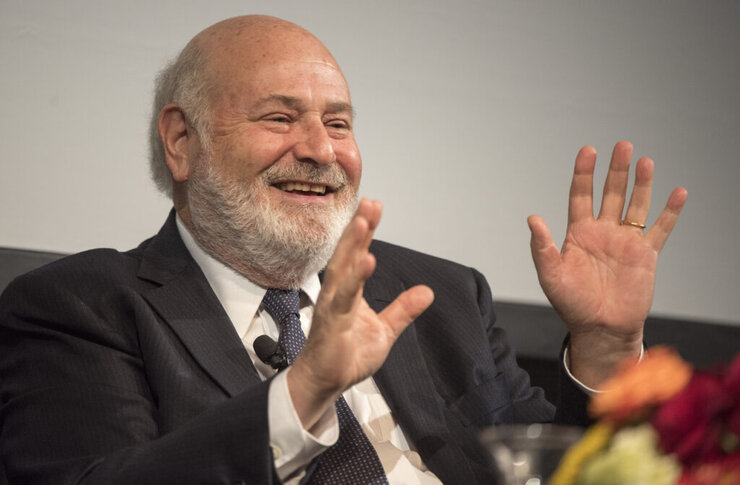
Director Rob Reiner participates in a discussion following a screening of the film LBJ at the LBJ Presidential Library in Austin, Texas on Saturday October 22, 2016
On Saturday evening October 22, 2016, the LBJ Presidential Library held a sneak peek of Rob Reiner’s new filmÊLBJ, starring Woody Harrelson as the 36th president. The film, which premiered at the Toronto International Film Festival in September, chronicles the life and times of Lyndon Johnson who would inherit the presidency at one of the most fraught moments in American history.
Following the screening, director Rob Reiner, actor Woody Harrelson, and writer Joey Hartstone joined LBJ Library Director Mark Updegrove on stage for a conversation about the film.
LBJ Library photo by Jay Godwin
10/22/2016
Hollywood Legend Rob Reiner and Wife Found Dead; Son in Custody
December 15, 2025
Renowned filmmaker and actor Rob Reiner, 78, and his wife Michele Singer Reiner, 68, were found dead in their Brentwood, Los Angeles home on Sunday, authorities say. Emergency responders were called to the residence Sunday afternoon, where both were discovered with fatal wounds consistent with a stabbing. Police are treating the case as a double homicide.
Los Angeles police arrested the couple’s 32-year-old son, Nick Reiner, in connection with the deaths. He is being held in custody as investigators continue to piece together the circumstances surrounding the incident.

2016 SAMHSA Voice Awards
Reiner was one of Hollywood’s most influential figures, known for his work as a director, producer and actor. His career spanned decades, from early television fame to directing beloved films that shaped American cinema.
Friends, colleagues and public figures have begun sharing tributes and reactions to the news as the investigation is ongoing.
More details will be updated as they become available.
The Inspiring Legacy of Raymond E. Fowler: A Journey into the UnknownLink: https://stmdailynews.com/the-inspiring-legacy-of-raymond-e-fowler-a-journey-into-the-unknown/
Discover more from Daily News
Subscribe to get the latest posts sent to your email.
Entertainment
Hollywood vs. Reality: How LA’s Wilshire Subway Was Really Built
Wilshire Subway: Did LA blast subway tunnels under Wilshire Boulevard? Hollywood says yes — engineers say no. Here’s how Metro safely tunneled beneath Miracle Mile.

When the 1997 disaster film Volcano depicted lava erupting along Wilshire Boulevard and referenced blasting during Red Line subway construction, it delivered gripping cinema — but not accurate engineering.
In reality, Los Angeles Metro did not rely on large-scale blasting to construct subway tunnels beneath Wilshire Boulevard and the Miracle Mile. Instead, engineers used tunnel boring machines (TBMs) specifically to avoid the very risks Hollywood dramatized.
Why Blasting Was Avoided
The Wilshire Corridor sits atop historic oil fields, making methane gas pockets a known and serious concern. A deadly methane explosion near Fairfax Avenue in 1985 led to heightened scrutiny of underground construction in the area. Blasting in such conditions could have caused unpredictable gas releases, ground instability, or damage to surface structures.
As a result, Metro engineers chose pressurized, closed-face tunnel boring machines, which allow for:
Controlled excavation in dense urban environments
Continuous ground support to prevent settlement
Integrated gas detection and ventilation systems
These machines grind slowly through soil and rock while installing precast concrete tunnel linings, creating a sealed, gas-resistant structure as they advance. 
The Real Engineering Feat
Although Volcano took creative liberties for dramatic effect, the true story of tunneling under Wilshire is no less impressive. Advances in TBM technology and methane mitigation ultimately allowed the Metro D Line (formerly the Red Line/Purple Line) to safely pass through one of Los Angeles’ most geologically complex corridors — without explosions, collapsing streets, or cinematic chaos.
Bottom Line
Volcano remains a memorable piece of 1990s disaster cinema, but its portrayal of subway construction is fiction. The real achievement lies in decades of careful planning, modern tunneling technology, and engineering solutions that quietly reshaped Los Angeles beneath its busiest boulevard.
Related Links:
- LA Metro – D Line (Purple Line) Extension Project
- Engineering News-Record: Tunneling Through Gas and Tar in LA
- Los Angeles Times Archive: Methane Risk and Subway Construction
Dreambreaker: A Pickleball Story — A Closer Look at the Documentary and Its Uncredited VoiceLink: https://stmdailynews.com/dreambreaker-a-pickleball-story-a-closer-look-at-the-documentary-and-its-uncredited-voice/
Discover more from Daily News
Subscribe to get the latest posts sent to your email.
Entertainment
Beam Unveils Veo 3.1-Powered AI Platform: Transforming Videos into Playable Games and Interactive Stories
Discover Beam’s new Veo 3.1-powered AI platform, transforming videos into playable mini-games and interactive stories—no coding required. Explore the future of interactive media for creators and storytellers.

Last Updated on December 13, 2025 by Daily News Staff

Play and Create
Interactive Shorts
Beam Unveils Veo 3.1-Powered AI Platform: Transforming Videos into Playable Games and Interactive Stories
Video, Reimagined: From Passive Watching to Active Playing
How It Works: No-Code Creation, Limitless Possibilities
- AI-Generated Media: Instantly create video, images, and music using cutting-edge AI tools.
- Drag-and-Drop Grid Editor: Arrange scenes, add branching choices, and build interactive storylines—all visually, right in your browser.
- Instant Publishing: Share your playable mini-games and interactive shorts to the web with a single click.
Free Early Access for Creators
The Future of Interactive Media
STM Daily News is a multifaceted podcast that explores a wide range of topics, from life and consumer issues to the latest in food and beverage trends. Our discussions dive into the realms of science, covering everything from space and Earth to nature, artificial intelligence, and astronomy. We also celebrate the amateur sports scene, highlighting local athletes and events, including our special segment on senior Pickleball, where we report on the latest happenings in this exciting community. With our diverse content, STM Daily News aims to inform, entertain, and engage listeners, providing a comprehensive look at the issues that matter most in our daily lives. https://stories-this-moment.castos.com/
Authors


Discover more from Daily News
Subscribe to get the latest posts sent to your email.





