

Economy
Trump’s ‘golden age’ economic message undercut by his desire for much lower interest rates – which typically signal a weak jobs market

Joshua Stillwagon, Babson College
President Donald Trump seems to want to have it both ways on the U.S. economy.
On the one hand, he recently said the economy is in its “golden age” and referred to the U.S. as the “hottest country anywhere in the world.”
Yet at the same time, he has outright demanded that the Federal Reserve sharply slash interest rates to fuel economic activity. And his recently handpicked governor, Stephen Miran, has led the charge in pushing for a bigger cut than preferred by his new colleagues at the Fed.
When an economy is strong, central banks typically don’t cut interest rates and may even raise them to avoid spurring inflation. And so to support his argument for large cuts, Miran has played up “downside risks” to the economy and a weakening labor market, contrasting with Trump’s talk of a “golden age.”
Trump and Miran also seem to be ignoring the problem of inflation, which the president has said “has been defeated” and Miran considers close enough to the Fed’s target of 2%. Yet, inflation remains high and has been picking back up in recent months – one of the core reasons the Fed has taken a gradual approach to lowering interest rates.
I’m a macroeconomist, which means I study big-picture factors affecting an economy, such as interest rates.
It’s well known that lower rates spur faster growth, and of course all presidents want a stronger economy on their watch. But the Fed’s job when it sets interest rates is to deal with whatever reality the data shows – and make decisions accordingly.
Is the economy hot or not?
In the simplest terms, the Fed raises interest rates when the economy is “hot,” or inflation is above the Fed’s 2% target, and lowers them when there are concerns about unemployment.
At its most recent meeting, in September, the Fed lowered rates a quarter of a point, citing slowing jobs growth, and increased economic uncertainty. Trump nominee Miran was the only one of the 12 members of the Fed’s policy-setting committee to instead vote for a more aggressive half-point cut.
The only credible rationale for that large of an interest rate cut, in the face of still-high inflation, is by believing the labor market is incredibly weak. According to the Fed’s preferred measure, the personal consumption expenditures index, inflation has been accelerating all summer and was 2.7% at the end of August, well above the Fed’s 2% target.
There’s no doubt jobs growth has slowed considerably in recent months, but enough to completely ignore the risk of driving inflation higher? At this point at least, the Fed doesn’t think so.
And if the economy were in fact running hot, as the president claims, the Fed would have little choice but to keep rates flat or raise them, especially given elevated inflation.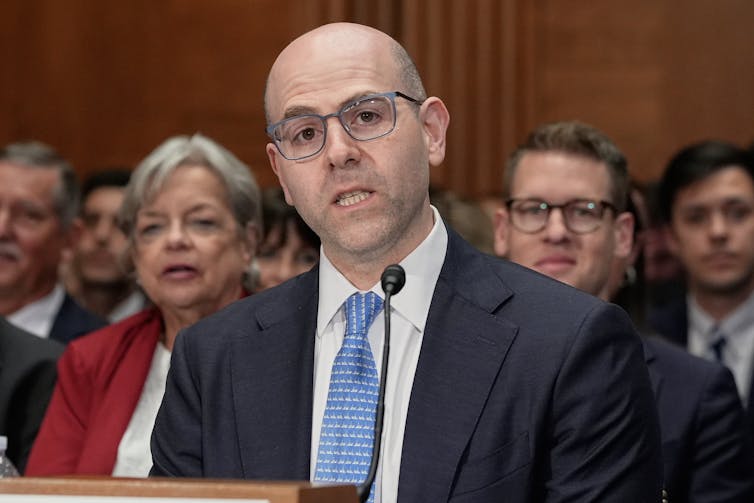
Risks of following political whims
This situation gets at the heart of why central bank independence matters.
Trump’s efforts to influence the Federal Reserve have not been subtle and break with Congress’ intention to insulate the Fed from political manipulation. Besides pressing for big rate cuts, he has tried to fire a member of the Board of Governors over questionable allegations and mused about removing Fed Chair Jerome Powell.
The risks of following the wishes of a president in the face of what the data shows were starkly demonstrated in 2021, when Turkey’s president, Recep Tayyip Erdogan, fired the head of the country’s central bank. The central banker was pushing rates higher to tame inflation, which was at about 20%, but Erdogan demanded they be lowered. In response, Turkey’s lira plunged to record lows and inflation soared to over 70% in 2022.
Something similar could happen in the U.S. if Trump continues down the same path of meddling with the Fed. As a sign of how much Wall Street worries about this risk, a recent study estimated that if Trump followed through on his threat to fire Powell, the stock market could lose an estimated US$1 trillion as a result.
That’s because the Fed’s credibility rests on its ability to make decisions driven by economic evidence, not political expedience. That independence means policymakers must weigh data on inflation, jobs and growth rather than election cycles or partisan demands.
Justifying deeper rate cuts
Looking ahead to the Fed’s next meeting Oct. 28-29, policymakers face a delicate balancing act. With inflation still running above target and signs of slowing jobs growth, it needs to lower rates enough to prevent a downturn but not so low that inflation spirals out of control.
Traders are putting near-100% odds of two more quarter-point cuts this year, one on Oct. 29 and another in December. This would bring the Fed’s benchmark interest rate to a range of 3.5%-3.75% by the end of 2025, down from 4%-4.25% now.
Based on Miran’s own interest rate projections, he’s likely to again push for a larger cut of a half-point or more at both meetings, as he believes the Fed’s benchmark rate should be below 3% by the end of the year.
To me, as an economist, the only way a Fed acting independently could reasonably justify such a significant cut in rates in the next few months is if the unemployment rate begins rising steadily, with the economy clearly at risk of slipping into a recession.
Joshua Stillwagon, Associate Professor of Economics, Babson College
This article is republished from The Conversation under a Creative Commons license. Read the original article.


Community
McDonald’s First Job Confessional Turns Career Stories Into Free Meal Opportunity
McDonald’s is launching First Job Confessional, a campaign inviting fans to share first job stories for a chance to receive a $15 gift card in select cities.


First Job Confessional
McDonald’s is putting first jobs in the spotlight with a new campaign that asks fans to share the real-world skills they gained early in their working lives. Launched on National Employee Appreciation Day, the brand’s First Job Confessional invites people to reflect on how those first roles helped shape their careers — and, in some cases, earn a free meal in the process.
The campaign is built around a simple idea: first jobs often teach lasting skills that deserve more recognition. Whether someone learned problem-solving while babysitting, communication during a lunch rush, or teamwork behind a counter, McDonald’s is framing those experiences as valuable career foundations. The company says those are the same kinds of skills employers continue to prioritize as workplace demands evolve.

How the First Job Confessional Works
In select cities, McDonald’s is setting up confessional booths designed to look like ordering kiosks. But instead of placing a meal order, participants can record a story about their first job and the skills they picked up along the way. Those who take part in person will have the opportunity to receive a $15 McDonald’s gift card, while supplies last.
Fans who cannot attend in person can still join online by posting their stories using #FirstJobConfessional. McDonald’s says selected videos may also be featured on its YouTube channel, extending the campaign beyond the live events.
External Related Links
- McDonald’s corporate article: McDonald’s is Asking Fans to Get Real About Their First Job Skills in Exchange for Free Meals
- McDonald’s 1 in 8: First Job Confessional
- McDonald’s 1 in 8 home page
- Marketing Dive coverage of the campaign
- Parade coverage of the First Job Confessional tour
Source Links
- Original PRNewswire press release from McDonald’s USA, LLC
- McDonald’s official corporate story
- McDonald’s 1 in 8 First Job Confessional page
- McDonald’s 1 in 8 official website
The Bridge is a section of the STM Daily News Blog meant for diversity, offering real news stories about bona fide community efforts to perpetuate a greater good. The purpose of The Bridge is to connect the divides that separate us, fostering understanding and empathy among different groups. By highlighting positive initiatives and inspirational actions, The Bridge aims to create a sense of unity and shared purpose. This section brings to light stories of individuals and organizations working tirelessly to promote inclusivity, equality, and mutual respect. Through these narratives, readers are encouraged to appreciate the richness of diverse perspectives and to participate actively in building stronger, more cohesive communities.
https://stmdailynews.com/the-bridge
News
Jay Leno Test Drives the Slate Truck as Startup Pushes Toward 2026 Launch
The affordable electric pickup from Slate Auto is gaining attention after Jay Leno test drove the prototype on Jay Leno’s Garage. Here’s the latest update on pricing, features, reservations, and the planned 2026 production launch.

Testing the Slate Truck
The affordable electric pickup from Slate Auto is continuing to gain attention as the startup moves closer to production. One of the most visible recent developments came when legendary car collector and TV host Jay Leno featured the truck on his popular YouTube series Jay Leno’s Garage.
The episode offered one of the most detailed looks yet at the upcoming Slate Truck, including a real-world test drive, design insights, and a closer look at the company’s philosophy behind building what could become one of America’s most affordable electric vehicles.
Watch the Jay Leno Test Drive
What Jay Leno Revealed About the Slate Truck
During the episode, Leno drove a pre-production prototype of the truck while engineers from Slate Auto explained the design approach.
Unlike many modern EVs packed with luxury features, the Slate Truck is intentionally simple.
Key highlights from the test drive include:
A Focus on Simplicity and Repairability
One of the most notable ideas behind the truck is that it is designed to be easy to repair and modify. Instead of relying on proprietary parts or complex electronics, the vehicle uses a more straightforward architecture that could allow owners or independent mechanics to work on it.
This approach contrasts with many EVs that require dealership service or specialized tools.
Modular Body Panels and Customization
The Slate Truck is built around a modular platform with removable exterior panels and optional accessory kits.
According to the company, owners will be able to customize the vehicle with:
Different body panel styles Accessory racks and cargo options A potential conversion kit that can transform the pickup into a small SUV
The idea is to allow the vehicle to evolve with the owner’s needs over time.
Minimalist Interior
Inside the prototype shown to Leno, the truck features a very basic interior layout.
Instead of a large infotainment system, the vehicle relies heavily on smartphone integration and simpler controls to keep costs down. This minimalist philosophy is part of the company’s effort to build a lower-cost EV.
Pricing and the “Affordable EV” Promise
When the truck was first revealed in 2025, Slate Auto suggested the vehicle could cost under $20,000 after incentives.
However, with changes to federal EV incentives and updated pricing expectations, analysts now estimate the truck will likely start around the mid-$20,000 range.
Even at that price, the vehicle could still become one of the most affordable electric trucks available in the United States.
Production Plans in Indiana
The company plans to manufacture the truck in Warsaw, Indiana, where a large former industrial facility is being converted into an EV factory.
Production targets include:
Production start: Late 2026 Early deliveries: Possibly 2027 Potential capacity: Up to about 150,000 vehicles per year once fully ramped
Strong early interest has also been reported, with more than 100,000 reservations placed for the truck shortly after its reveal.
A Different Kind of Electric Truck
The Slate Truck is entering a market where most electric pickups—such as the Ford F-150 Lightning and Rivian R1T—sit at much higher price points.
Rather than competing on luxury or performance, the Slate Truck is aiming to fill a different niche: a practical, customizable, and relatively affordable electric work vehicle.
If the company can deliver on its promises, it could open the door to a new category of budget-friendly EVs.
For now, the test drive on Jay Leno’s Garage provides one of the clearest glimpses yet at how the truck might perform in the real world.
Related Coverage on STM Daily News
- Automotive News and Innovation – STM Daily News
- Boom Supersonic and the Overture: The Return of Commercial Supersonic Travel
- The Evolution of Public Transportation in Los Angeles
- Technology News and Emerging Innovations
Further Reading and Information
- Slate Auto Official Website
- Watch the Slate Truck Test Drive on Jay Leno’s Garage
- Car and Driver: First Look at the Slate Truck
- TechCrunch: Slate Auto Leadership Changes Ahead of Launch
- InsideEVs: Latest Electric Vehicle News
Welcome to the Consumer Corner section of STM Daily News, your ultimate destination for savvy shopping and informed decision-making! Dive into a treasure trove of insights and reviews covering everything from the hottest toys that spark joy in your little ones to the latest electronic gadgets that simplify your life. Explore our comprehensive guides on stylish home furnishings, discover smart tips for buying a home or enhancing your living space with creative improvement ideas, and get the lowdown on the best cars through our detailed auto reviews. Whether you’re making a major purchase or simply seeking inspiration, the Consumer Corner is here to empower you every step of the way—unlock the keys to becoming a smarter consumer today!
https://stmdailynews.com/category/consumer-corner
Author

Economy
US Consumer Confidence Fell Sharply in January: What the Latest Conference Board Data Signals
In January 2026, U.S. consumer confidence plummeted to its lowest level since 2014, as the Consumer Confidence Index fell by 9.7 points to 84.5. Concerns about inflation, employment, and economic stability led to decreased optimism across all demographics and a cautious approach to major purchases, signaling potential recession ahead.


US consumers started 2026 on a noticeably more cautious note. New data from The Conference Board shows its Consumer Confidence Index® fell sharply in January, wiping out a brief December rebound and pushing overall sentiment to its weakest level in more than a decade.
Confidence drops to the lowest level since 2014
The Conference Board Consumer Confidence Index® fell 9.7 points in January to 84.5 (1985=100), down from an upwardly revised 94.2 in December. The organization noted that December’s figure was revised up by 5.1 points, meaning what initially looked like a decline last month was actually a small uptick—before January’s slide reasserted the broader downward trend.
The cutoff for the preliminary January results was January 16, 2026.
Both “right now” and “what’s next” got worse
The decline wasn’t isolated to one part of the survey. Both consumers’ views of current conditions and their expectations for the months ahead weakened.
- Present Situation Index: down 9.9 points to 113.7
- Expectations Index: down 9.5 points to 65.1
That Expectations reading matters because it’s well below 80, a level The Conference Board says “usually signals a recession ahead.”
Dana M. Peterson, Chief Economist at The Conference Board, summed it up bluntly: confidence “collapsed” in January, with all five components deteriorating. The overall Index hit its lowest level since May 2014.
What consumers are worried about (and what’s showing up in write-ins)
The Conference Board said consumers’ write-in responses continued to skew pessimistic. The biggest themes weren’t hard to guess:
- Prices and inflation
- Oil and gas prices
- Food and grocery prices
Mentions of tariffs and trade, politics, and the labor market also rose in January. References to health/insuranceand war edged higher.
In other words: consumers aren’t just feeling uneasy—they’re pointing to specific pressure points that affect day-to-day costs and long-term stability.
Labor market perceptions softened
Consumers’ views of employment conditions weakened, with fewer respondents saying jobs are plentiful and more saying jobs are hard to get.
- 23.9% said jobs were “plentiful,” down from 27.5% in December
- 20.8% said jobs were “hard to get,” up from 19.1%
That shift matters because consumer confidence often follows the labor market. When people feel less secure about job availability, they tend to pull back on big purchases and discretionary spending.
Expectations for business conditions and jobs turned more negative
Looking six months out, pessimism increased:
- 15.6% expected business conditions to improve (down from 18.7%)
- 22.9% expected business conditions to worsen (up from 21.3%)
On jobs:
- 13.9% expected more jobs to be available (down from 17.4%)
- 28.5% anticipated fewer jobs (up from 26.0%)
Income expectations cooled too:
- 15.7% expected incomes to increase (down from 18.8%)
- 12.6% expected incomes to decline (down slightly from 13.0%)
So while fewer people expected their income to fall, the bigger story is that optimism about income growth faded.
Who’s feeling it most: age, income, and politics
On a six-month moving average basis, confidence dipped across:
- All age groups (though under 35 remained more confident than older consumers)
- All generations (with Gen Z still the most optimistic)
- All income brackets (with those earning under $15K the least optimistic)
- All political affiliations (with the sharpest decline among Independents)
This broad-based decline suggests the shift isn’t confined to one demographic pocket—it’s spreading.
Big-ticket buying plans: more “maybe,” less “yes”
The survey also pointed to increased caution around major purchases.
Consumers saying “yes” to buying big-ticket items declined in January, while “maybe” responses rose and “no” edged higher.
- Auto buying plans were flat overall, though expectations for new cars continued to falter and plans to buy used cars climbed.
- Homebuying expectations continued to retreat.
- Plans to purchase appliances, furniture, and TVs decreased.
- Electronics purchase intentions dipped in most categories—except smartphones, which continued trending upward on a six-month moving average basis.
Services spending softened—but restaurants and travel stayed interesting
Planned spending on services over the next six months weakened in January, with fewer consumers saying “yes” and more shifting into “maybe.”
Still, a few categories stood out:
- Restaurants, bars, and take-out remained the top planned services spending category and continued to rise.
- Consumers also intended to spend more on hotels/motels for personal travel, airfare/trains, and motor vehicle services.
The Conference Board noted this was surprising given the plunge in vacation plans—especially for domestic travel—also recorded in the survey.
What to watch next
January’s report paints a clear picture: consumers are feeling squeezed by costs, less confident about the labor market, and more hesitant about major purchases. The Expectations Index dropping deeper below the “recession signal” threshold will likely keep economists, businesses, and policymakers watching the next few releases closely.
The Conference Board publishes the Consumer Confidence Index® at 10 a.m. ET on the last Tuesday of every month.
Source: The Conference Board, January 2026 Consumer Confidence Survey® (PRNewswire release, Jan. 27, 2026).





