

News
What is an Atlantic Niña? How La Niña’s smaller cousin could affect hurricane season
In August 2024, both La Niña and the lesser-known Atlantic Niña seem to be developing. This rare combination may impact Atlantic hurricane season, potentially reducing risk despite global warming’s influence.


Annalisa Bracco, Georgia Institute of Technology and Zachary Handlos, Georgia Institute of Technology
The North Atlantic Ocean has been running a fever for months, with surface temperatures at or near record highs. But cooling along the equator in both the Atlantic and eastern Pacific may finally be starting to bring some relief, particularly for vulnerable coral reef ecosystems.
This cooling is related to two climate phenomena with similar names: La Niña, which forms in the tropical Pacific, and the less well-known Atlantic Niña.
Both can affect the Atlantic hurricane season. While La Niña tends to bring conditions ideal for Atlantic hurricanes, the less powerful Atlantic Niña has the potential to reduce some of the hurricane risk.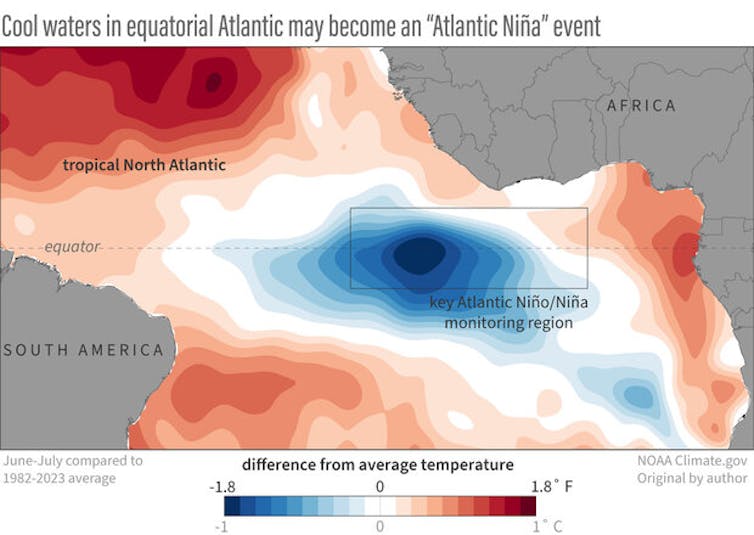
We’re ocean and atmospheric scientists who study this type of climate phenomenon. It’s rare to see both Niñas at the same time, yet in August 2024, both appeared to be developing. Let’s take a closer look at what that means.
La Niña and its cousin, Atlantic Niña
La Niña is part of the El Niño–Southern Oscillation, a well-known climate phenomenon that has widespread effects on climate and weather around the world.
During La Niña, sea surface temperatures in the tropical Pacific dip below normal. Easterly trade winds then strengthen, allowing more cool water to well up along the equator off South America. That cooling affects the atmosphere in ways that reverberate across the planet. Some areas become stormier and others drier during La Niña, and the wind shear that can tear apart Atlantic hurricanes tends to weaken.
La Niña and its warmer opposite, El Niño, oscillate every three to four years or so. https://www.youtube.com/embed/wVlfyhs64IY?wmode=transparent&start=0 La Niña and its opposite, El Niño, explained. NOAA.
A similar climate phenomenon, Atlantic Niña, occurs in the Atlantic Ocean but at a much smaller scale and amplitude. It typically peaks around July or August and tends to have a shorter duration than its Pacific cousin, and much more modest and local impacts. Atlantic Niñas generally have the opposite effect of Atlantic Niños, which tend to reduce rainfall over Africa’s Sahel region and increase rainfall in Brazil and the countries that surround the Gulf of Guinea, such as Ghana, Nigeria and Cameroon.
While much weaker than their Pacific counterpart, Atlantic Niñas can, however, partially counteract La Niñas by weakening summer winds that help drive the upwelling that cools the eastern Pacific.
Why might both happen now?
In July and August 2024, meteorologists noted cooling that suggested an Atlantic Niña might be developing along the equator. The winds at the ocean surface had been weak through most of the summer, and sea surface temperatures there were quite warm until early June, so signs an Atlantic Niña might be emerging were a surprise.
At the same time, waters along the equator in the eastern Pacific were also cooling, with La Niña conditions expected there around October or November.

Getting a Pacific-Atlantic Niña combination is rare but not impossible. It’s like finding two different pendulums that are weakly coupled to swing in opposite directions moving together in time. The combinations of La Niña and Atlantic Niño, or El Niño and Atlantic Niña are more common.
Good news or bad for hurricane season?
An Atlantic Niña may initially suggest good news for those living in hurricane-prone areas.
Cooler than average waters off the coast of Africa can suppress the formation of African easterly waves. These are clusters of thunderstorm activity that can form into tropical disturbances and eventually tropical storms or hurricanes.
Tropical storms draw energy from the process of evaporating water associated with warm sea surface temperatures. So, cooling in the tropical Atlantic could weaken this process. That would leave less energy for thunderstorms, which would reduce the probability of a tropical cyclone forming.
However, NOAA takes all factors into account when it updates its Atlantic hurricane season outlook, released in early August, and it still anticipates an extremely active 2024 season. Tropical storm season typically peaks in early to mid-September.
https://datawrapper.dwcdn.net/lcaEc/2
Two reasons are behind the busy forecast: The near record-breaking warm sea surface temperatures in much of the North Atlantic can strengthen hurricanes. And the expected development of a La Niña in the Pacific tends to weaken wind shear – the change in wind speed with height that can tear apart hurricanes. La Niña’s much stronger effects can override any impacts associated with the Atlantic Niña.
Exacerbating the problem: Global warming
The past two years have seen exceptionally high ocean temperatures in the Atlantic and around much of the world’s oceans. The two Niñas are likely to contribute some cooling relief for certain regions, but it may not last long.
In addition to these cycles, the global warming trend caused by rising greenhouse gas emissions is raising the baseline temperatures and can fuel major hurricanes.
Annalisa Bracco, Professor of Ocean and Climate Dynamics, Georgia Institute of Technology and Zachary Handlos, Atmospheric Science Educator, Georgia Institute of Technology
This article is republished from The Conversation under a Creative Commons license. Read the original article.
Our Lifestyle section on STM Daily News is a hub of inspiration and practical information, offering a range of articles that touch on various aspects of daily life. From tips on family finances to guides for maintaining health and wellness, we strive to empower our readers with knowledge and resources to enhance their lifestyles. Whether you’re seeking outdoor activity ideas, fashion trends, or travel recommendations, our lifestyle section has got you covered. Visit us today at https://stmdailynews.com/category/lifestyle/ and embark on a journey of discovery and self-improvement.
Author

Discover more from Daily News
Subscribe to get the latest posts sent to your email.




The Long Track Back
Why Downtown Los Angeles Feels Small Compared to Other Cities
Downtown Los Angeles often feels “small” compared to other U.S. cities, but that’s only part of the story. With some of the tallest buildings west of the Mississippi and skyline clusters spread across the region, LA’s downtown reflects the city’s unique polycentric identity—one that, if combined, could form a true mega downtown.

Last Updated on February 18, 2026 by Daily News Staff

Panorama of Los Angeles from Mount Hollywood – California, United States
When people think of major American cities, they often imagine a bustling, concentrated downtown core filled with skyscrapers. New York has Manhattan, Chicago has the Loop, San Francisco has its Financial District. Los Angeles, by contrast, often leaves visitors surprised: “Is this really downtown?”
The answer is yes—and no.
Downtown LA in Context
Compared to other major cities, Downtown Los Angeles (DTLA) is relatively small as a central business district. For much of the 20th century, strict height restrictions capped most buildings under 150 feet, while cities like Chicago and New York were erecting early skyscrapers. LA’s skyline didn’t really begin to climb until the late 1960s.
But history alone doesn’t explain why DTLA feels different. The real story lies in how Los Angeles grew: not as one unified city center, but as a collection of many hubs.

Downtown Los Angeles
A Polycentric City
Los Angeles is famously decentralized. Hollywood developed around the film industry. Century City rose on former studio land as a business hub. Burbank became a studio and aerospace center. Long Beach grew around the port. The Wilshire Corridor filled with office towers and condos.
Unlike other cities where downtown is the place for work, culture, and finance, Los Angeles spread its energy outward. Freeways and car culture made it easy for businesses and residents to operate outside of downtown. The result is a polycentric metropolis, with multiple “downtowns” rather than one dominant core.
A Resident’s Perspective
As someone who lived in Los Angeles for 28 years, I see DTLA differently. While some outsiders describe it as “small,” the reality is that Downtown Los Angeles is still significant. It has some of the tallest buildings west of the Mississippi River, including the Wilshire Grand Center and the U.S. Bank Tower. Over the last two decades, adaptive reuse projects have transformed old office buildings into lofts, while developments like LA Live, Crypto.com Arena, and the Broad Museum have revitalized the area.
In other words, DTLA is large enough—it just plays a different role than downtowns in other American cities.

View of Westwood, Century City, Beverly Hills, and the Wilshire Corridor.
The “Mega Downtown” That Isn’t
A friend once put it to me with a bit of imagination: “If you could magically pick up all of LA’s skyline clusters—Downtown, Century City, Hollywood, the Wilshire Corridor—and drop them together in one spot, you’d have a mega downtown.”
He’s right. Los Angeles doesn’t lack tall buildings or urban energy—it just spreads them out over a vast area, reflecting the city’s unique history, geography, and culture.
A Downtown That Fits Its City
So, is Downtown LA “small”? Compared to Manhattan or Chicago’s Loop, yes. But judged on its own terms, DTLA is a vibrant hub within a much larger, decentralized metropolis. It’s a downtown that reflects Los Angeles itself: sprawling, diverse, and impossible to fit neatly into the mold of other American cities.
🔗 Related Links
Dive into “The Knowledge,” where curiosity meets clarity. This playlist, in collaboration with STMDailyNews.com, is designed for viewers who value historical accuracy and insightful learning. Our short videos, ranging from 30 seconds to a minute and a half, make complex subjects easy to grasp in no time. Covering everything from historical events to contemporary processes and entertainment, “The Knowledge” bridges the past with the present. In a world where information is abundant yet often misused, our series aims to guide you through the noise, preserving vital knowledge and truths that shape our lives today. Perfect for curious minds eager to discover the ‘why’ and ‘how’ of everything around us. Subscribe and join in as we explore the facts that matter. https://stmdailynews.com/the-knowledge/
Author

Discover more from Daily News
Subscribe to get the latest posts sent to your email.
The Knowledge
Century City: From Hollywood Backlot to Business Hub
Century City, originally part of 20th Century Fox’s backlot, transformed into a prominent business district in Los Angeles during the 1950s amid the decline of cinema. Developer William Zeckendorf envisioned a mixed-use urban center, leading to iconic skyscrapers and establishing the area as a hub for law, finance, and media, blending Hollywood history with modern business.

Before Century City became one of Los Angeles’ premier business districts, it was part of 20th Century Fox’s sprawling backlot, used for filming movies and housing studio operations. By the 1950s, as television rose and movie attendance declined, 20th Century Fox faced financial challenges and decided to sell a portion of its land.

Developer William Zeckendorf envisioned a “city within a city”—a modern, mixed-use urban center with office towers, hotels, and entertainment facilities. Branded Century City, the name paid homage to its studio roots while symbolizing LA’s vision for the future.
The first skyscrapers, including the Gateway West Building, set the tone for the district’s sleek, futuristic skyline. Architects like Welton Becket and Minoru Yamasaki helped shape Century City’s iconic look. Over time, it evolved from Hollywood’s backlot to a corporate and legal hub, attracting law firms, financial institutions, and media companies.
Today, Century City stands as a testament to Los Angeles’ postwar optimism, westward expansion, and multi-centered urban growth—a unique blend of Hollywood history and modern business.
Related STM Daily News Links:
- The Evolution of Los Angeles Public Transportation
- Why Los Angeles Grew Into a Sprawling City
- Downtown Los Angeles: Past, Present, and Future
Dive into “The Knowledge,” where curiosity meets clarity. This playlist, in collaboration with STMDailyNews.com, is designed for viewers who value historical accuracy and insightful learning. Our short videos, ranging from 30 seconds to a minute and a half, make complex subjects easy to grasp in no time. Covering everything from historical events to contemporary processes and entertainment, “The Knowledge” bridges the past with the present. In a world where information is abundant yet often misused, our series aims to guide you through the noise, preserving vital knowledge and truths that shape our lives today. Perfect for curious minds eager to discover the ‘why’ and ‘how’ of everything around us. Subscribe and join in as we explore the facts that matter. https://stmdailynews.com/the-knowledge/
Discover more from Daily News
Subscribe to get the latest posts sent to your email.
Community
Local governments provide proof that polarization is not inevitable
Local politics help mitigate national polarization by focusing on concrete issues like infrastructure and community needs rather than divisive symbolic debates. A survey indicates that local officials experience less partisanship, as interpersonal connections foster recognition of shared interests. This suggests that reducing polarization is possible through collaboration and changes in election laws.

Lauren Hall, Rochester Institute of Technology
When it comes to national politics, Americans are fiercely divided across a range of issues, including gun control, election security and vaccines. It’s not new for Republicans and Democrats to be at odds over issues, but things have reached a point where even the idea of compromising appears to be anathema, making it more difficult to solve thorny problems.
But things are much less heated at the local level. A survey of more than 1,400 local officials by the Carnegie Corporation and CivicPulse found that local governments are “largely insulated from the harshest effects of polarization.” Communities with fewer than 50,000 residents proved especially resilient to partisan dysfunction.
Why this difference? As a political scientist, I believe that lessons from the local level not only open a window onto how polarization works but also the dynamics and tools that can help reduce it.
Problems are more concrete
Local governments deal with concrete issues – sometimes literally, when it comes to paving roads and fixing potholes. In general, cities and counties handle day-to-day functions, such as garbage pickup, running schools and enforcing zoning rules. Addressing tangible needs keeps local leaders’ attention fixed on specific problems that call out for specific solutions, not lengthy ideological debates.
By contrast, a lot of national political conflict in the U.S. involves symbolic issues, such as debates about identity and values on topics such as race, abortion and transgender rights. These battles are often divisive, even more so than purely ideological disagreements, because they can activate tribal differences and prove more resistant to compromise.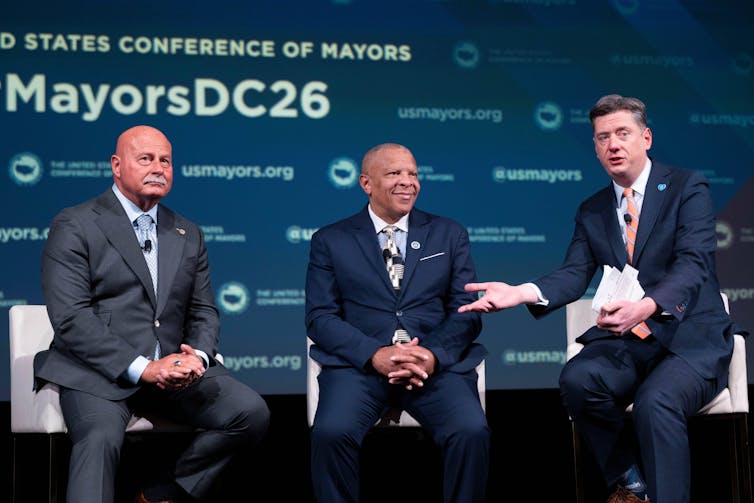
Such arguments at the national level, or on social media, can lead to wildly inaccurate stereotypes about people with opposing views. Today’s partisans often perceive their opponents as far more extreme than they actually are, or they may stereotype them – imagining that all Republicans are wealthy, evangelical culture warriors, for instance, or conversely being convinced that all Democrats are radical urban activists. In terms of ideology, the median members of both parties, in fact, look similar.
These kinds of misperceptions can fuel hostility.
Local officials, however, live among the human beings they represent, whose complexity defies caricature. Living and interacting in the same communities leads to greater recognition of shared interests and values, according to the Carnegie/CivicPulse survey.
Meaningful interaction with others, including partisans of the opposing party, reduces prejudice about them. Local government provides a natural space where identities overlap.
People are complicated
In national U.S. politics today, large groups of individuals are divided not only by party but a variety of other factors, including race, religion, geography and social networks. When these differences align with ideology, political disagreement can feel like an existential threat.
Such differences are not always as pronounced at the local level. A neighbor who disagrees about property taxes could be the coach of your child’s soccer team. Your fellow school board member might share your concerns about curriculum but vote differently in presidential elections.
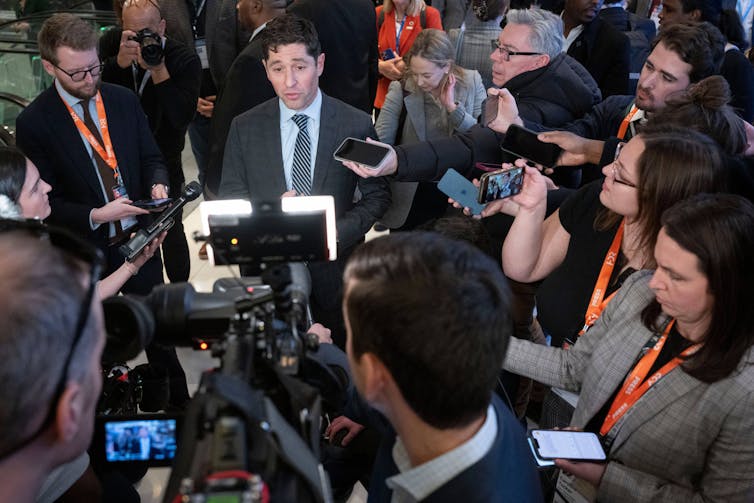
These cross-cutting connections remind us that political opponents are not a monolithic enemy but complex individuals. When people discover they have commonalities outside of politics with others holding opposing views, polarization can decrease significantly.
Finally, most local elections are technically nonpartisan. Keeping party labels off ballots allows voters to judge candidates as individuals and not merely as Republicans or Democrats.
National implications
None of this means local politics are utopian.
Like water, polarization tends to run downhill, from the national level to local contests, particularly in major cities where candidates for mayor and other office are more likely to run as partisans. Local governments also see culture war debates, notably in the area of public school instruction.
Nevertheless, the relative partisan calm of local governance suggests that polarization is not inevitable. It emerges from specific conditions that can be altered.
Polarization might be reduced by creating more opportunities for cross-partisan collaboration around concrete problems. Philanthropists and even states might invest in local journalism that covers pragmatic governance rather than partisan conflict. More cities and counties could adopt changes in election law that would de-emphasize party labels where they add little information for voters.
Aside from structural changes, individual Americans can strive to recognize that their neighbors are not the cardboard cutouts they might imagine when thinking about “the other side.” Instead, Americans can recognize that even political opponents are navigating similar landscapes of community, personal challenges and time constraints, with often similar desires to see their roads paved and their children well educated.
The conditions shaping our interactions matter enormously. If conditions change, perhaps less partisan rancor will be the result.
Lauren Hall, Associate professor of Political Science, Rochester Institute of Technology
This article is republished from The Conversation under a Creative Commons license. Read the original article.
The Bridge is a section of the STM Daily News Blog meant for diversity, offering real news stories about bona fide community efforts to perpetuate a greater good. The purpose of The Bridge is to connect the divides that separate us, fostering understanding and empathy among different groups. By highlighting positive initiatives and inspirational actions, The Bridge aims to create a sense of unity and shared purpose. This section brings to light stories of individuals and organizations working tirelessly to promote inclusivity, equality, and mutual respect. Through these narratives, readers are encouraged to appreciate the richness of diverse perspectives and to participate actively in building stronger, more cohesive communities.
https://stmdailynews.com/the-bridge
Discover more from Daily News
Subscribe to get the latest posts sent to your email.





