Connect with us

Community

When grief involves trauma − a social worker explains how to support survivors of the recent floods and other devastating losses

Published

on

survivors
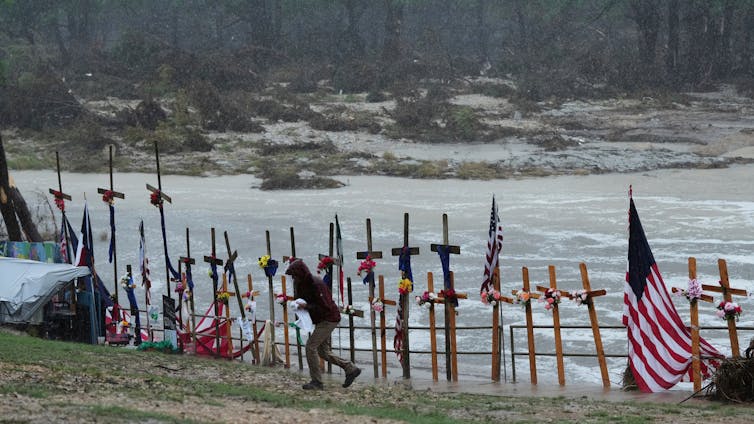
Rain falls over a makeshift memorial for flood victims along the Guadalupe River on July 13, 2025, in Kerrville, Texas. AP Photo/Eric Gay
Liza Barros-Lane, University of Houston-Downtown

When grief involves trauma − a social worker explains how to support survivors of the recent floods and other devastating losses

The July 4, 2025, floods in Kerr County, Texas, swept away children and entire families, leaving horror in their wake. Days later, flash floods struck Ruidoso, New Mexico, killing three people, including two young children. These are not just devastating losses. When death is sudden, violent, or when a body is never recovered, grief gets tangled up with trauma. In these situations, people don’t only grieve the death. They struggle with the terror of how it happened, the unanswered questions and the shock etched into their bodies. I’m a social work professor, grief researcher and the founder of The Young Widowhood Project, a research initiative aimed at expanding scholarship and public understanding of premature spousal loss. I was widowed when I was 36. In July 2020, my husband, Brent, went missing after testing a small, flat-bottomed fishing boat called a Jon boat. His body was recovered two days later, but I never saw his remains. Both my personal loss and professional work have shown me how trauma changes the grieving process and what kind of support actually helps. To understand how trauma can complicate grief, it’s important to first understand how people typically respond to loss.

Grief isn’t a set of stages

Many people still think of grief through the lens of psychiatrist Dr. Elisabeth Kübler-Ross’ five stages of grief, popularized in the early 1970s: denial, anger, bargaining, depression and acceptance. But in fact, this model was originally designed for people facing their own deaths, not for mourners. In the absence of accessible grief research in the 1960s, it became a leading framework for understanding the grieving process – even though it wasn’t meant for that. Despite this misapplication, the stages model has shaped cultural expectations: namely, that grief ends once people reach the “acceptance” stage. But research doesn’t support this idea. Trying to force grief into this model can cause real harm, leaving mourners feeling they’re grieving “wrong.” In reality, mourning is often lifelong. Most people go through an acute period of overwhelming pain right after the loss. This is usually followed by integrated grief, where the pain softens but the loss is still part of everyday life, returning in waves. Although grief is unique to each person and relationship, researchers have found that mourners often strive to a) make sense of the death; b) adjust to a world without their loved one; c) form an ongoing connection with their deceased loved one in new ways; and d) figure out who they are without their loved one. It’s difficult and at times disorienting work, but most people find ways to carry their grief and keep living.
A grandmother embraces a young woman in front of a wall of flowers.
Julia Mora embraces her granddaughter, Isla Meyer, during a vigil for Texas flood victims on July 11, 2025. AP Photo/Gerald Herbert

When grief and trauma collide

However, some losses carry an extra layer of pain, confusion and trauma. Sudden, unexpected, accidental, violent or deeply tragic deaths – like those experienced during the recent floods – can lead to what researchers call traumatic bereavement: grief that is disrupted by the traumatic nature of the death. People experiencing traumatic bereavement often endure a longer and more intense acute grief period. They may be haunted by disturbing images, nightmares or relentless thoughts about how their loved one died or suffered. Many wrestle with dread, spiritual disorientation and a shattered sense of safety in the world. Some of these deaths are also considered “ambiguous” – unclear or unconfirmed loss – such as when a body is never recovered or is too damaged to view. Without physical confirmation, mourners often feel stuck in disbelief and helplessness. This was true in my case. Not seeing my husband’s body left a part of me suspended between knowing and not knowing. I knew he had died but couldn’t fully believe it, no matter how much I lived with the reality of his absence. For a long time, I caught myself repeating these words every morning: “Brent is dead. Brent is dead.” In many cases, these reactions aren’t short term. Many people affected by traumatic loss remain overwhelmed and sometimes physically and emotionally impaired for years. Symptoms may taper over time, but they rarely disappear entirely.

Supporting mourners

Traumatic bereavement can feel unbearable. Many mourners struggle with intense, long-lasting reactions that can leave them feeling helpless, altered or even unrecognizable to themselves. They may appear withdrawn, forgetful or emotionally drained because their systems are overwhelmed. Coping can look messy or self-destructive, but these are often survival strategies, not conscious choices. I’ve also seen how those same struggles become more survivable when mourners don’t have to carry them alone. If you’re supporting someone through traumatic loss, here are three ways to help.
  • Make space for the horror. Listen without flinching. Acknowledge the full weight of what happened and how terrifying and unjust the loss was. This means saying things like, “This should never have happened,” or “What you went through is beyond words.” It means staying present when the mourner speaks about what haunts them. Let them know they don’t have to carry this alone. You may feel the urge to say something hopeful such as, “At least the body was recovered,” but there is no silver lining in these cases. Instead, say: “There’s nothing I can say to fix this, but I’m not going anywhere.”
  • Help them find others who can understand. Trauma can be isolating. Mourners often feel uniquely overwhelmed or confused. Support groups, peer companions and therapists trained in treating grief and trauma can offer the kind of recognition and validation that even the most devoted friend may not be able to provide.
  • Take care of yourself, too. Being present for someone in deep grief takes energy, especially if you were personally affected by the loss. Stay connected to replenishing people, practices and routines. If you don’t, you may begin to experience trauma, too. Taking care of yourself will help you remain grounded so that you can show up.
I believe supporting someone through traumatic bereavement is one of the most meaningful things you can do. You don’t need perfect words or a plan. What sustains them won’t be advice or solutions, but your simple, powerful act of staying. Liza Barros-Lane, Assistant Professor of Social Work, University of Houston-Downtown This article is republished from The Conversation under a Creative Commons license. Read the original article.

Discover more from Daily News

Subscribe to get the latest posts sent to your email.

The Bridge

Hard Rock International and Coca-Cola Launch ‘Women Empower’ Series for International Women’s Month

Published

on

Last Updated on March 15, 2026 by Daily News Staff

Hard Rock and Coca-Cola launch the ‘Women Empower’ series for International Women’s Month, with events, menu specials, and a donation to Women in Music.
The ‘Women Empower’ micro-documentary series spotlights women across the music industry as Hard Rock hosts global events and limited-time Cafe offerings in March.
Throughout International Women’s Month, participating Hard Rock Cafes will serve limited-edition Coca-Cola specialty drinks inspired by the different regions represented in the ‘Women Empower’ series

Hard Rock International is teaming up with long-time partner Coca-Cola to spotlight women shaping the music business with a new content initiative and a month-long slate of events.

Announced Feb. 26, 2026, the collaboration introduces “Women Empower,” a micro-documentary series rolling out throughout March as part of Hard Rock’s annual International Women’s Month celebrations. Alongside the video series, Hard Rock says it’s aiming to host 1,000 live music and special events globally across its Cafes, Hotels, Casinos and Live venues.

IWM Hard Rock
Hard Rock International and Coca-Cola celebrate International Women’s Month with micro-documentary series that honor women shaping the music industry around the world

A micro-documentary series focused on women across the industry

Rather than focusing only on performers, “Women Empower” highlights women working in a range of roles across music and media. Hard Rock notes that less than 5% of music and media creators are women, and the series is designed to put more faces—and job titles—into the public conversation.

The six featured women include:

  • Janelle Abraham — Director/Film Producer
  • Kat Luna — Singer/Songwriter
  • Minami Minami — Composer/Dancer/Singer
  • Claire Murphy — Guitar Tech
  • Mayna Nevarez — CEO & Founder, Nevarez Communications
  • Wendy Ong — Co-President/CMO, TaP Music

Elena Alvarez, Senior Vice President of Marketing and Brand Partnerships at Seminole Gaming and Hard Rock International, said the brand is using International Women’s Month to “lift the curtain” on the series while tying the celebration back to Hard Rock’s music-first identity and philanthropic work.

$100,000 donation to Women in Music

Hard Rock Heals Foundation®, Hard Rock’s charitable arm, is donating $100,000 to Women in Music, supporting the nonprofit’s education and empowerment efforts.

Nicole Barsalona, President of Women in Music, said the campaign highlights diversity on stage and “the wide range of roles across the music business—and the women behind the scenes whose work drives our industry forward.”

Limited-time Coca-Cola menu items at participating Hard Rock Cafes

Throughout March, participating Hard Rock Cafes will offer a limited-time Coca-Cola-inspired menu tied to the regions represented in the series.

Specialty drinks include:

  • Passionfruit Splash — passionfruit beverage with Minute Maid Lemonade, Sprite and cranberry juice
  • Mango Guava Chiller — mango and guava-flavored drink with Sprite, pineapple and lime juice
  • Spiced Yuzu Soda — spiced brown sugar, yuzu and Coca-Cola blend

Food items include:

  • Fattoush Chicken Caesar Salad — romaine with grilled chicken, mint, vegetables, fried naan and red wine Caesar dressing
  • Mahi Sandwich — mahi filet with remoulade, lettuce, tomato and shoestring onions, served with seasoned fries
  • Dulce de Leche Brownie — brownie with chocolate sauce, vanilla ice cream, dulce de leche and whipped cream

Hard Rock Hotels: curated listening experiences honoring female artists

Hard Rock Hotels will also highlight women in music through live performances, curated playlists and themed listening experiences using the brand’s Sound of Your Stay® program. Hard Rock says guests can expect music-themed amenities such as limited-edition vinyl, memorabilia highlights and playlists centered on female artists—both iconic names and emerging talent.

Events worldwide + Rock Shop merch

Hard Rock says it will host women-led performances, networking events, brunches and other community-driven experiences across its global footprint throughout March.

Hard Rock’s official International Women’s Month T-shirts are available at Rock Shop® retail locations and online.

For the full list of International Women’s Month activations, visit https://www.hardrock.com/women.

Advertisement
Reveal Your Skin's Youthful Radiance with FOREO's LUNA 2 Facial Massager. Shop Now For $199

The Bridge is a section of the STM Daily News Blog meant for diversity, offering real news stories about bona fide community efforts to perpetuate a greater good. The purpose of The Bridge is to connect the divides that separate us, fostering understanding and empathy among different groups. By highlighting positive initiatives and inspirational actions, The Bridge aims to create a sense of unity and shared purpose. This section brings to light stories of individuals and organizations working tirelessly to promote inclusivity, equality, and mutual respect. Through these narratives, readers are encouraged to appreciate the richness of diverse perspectives and to participate actively in building stronger, more cohesive communities.

https://stmdailynews.com/the-bridge

Authors

  • Raphael

    Dolores Raphael is a dedicated writer and blogger focused on health, fitness, and everyday living. She shares practical tips and inspiring insights to help others lead a balanced and vibrant lifestyle. one of her passions is Pickleball.

    View all posts blogger/ writer

Discover more from Daily News

Subscribe to get the latest posts sent to your email.

Continue Reading

Community

Arizona Scholarships 2026: $1,500 Awards + Free ACF Virtual Workshops

Arizona scholarships 2026: Arizona scholarships are open through ACF: one application for 160+ awards, plus ARAC’s $1,500 Ashby-Herring scholarships due April 6, 2026.

Published

on

Last Updated on March 11, 2026 by Daily News Staff

AdobeStock 480368912


Arizona Scholarships 2026: $1,500 Awards + Free ACF Virtual Workshops

Scholarship season moves fast, and for a lot of Arizona families, the hardest part isn’t writing the essay or gathering transcripts—it’s simply finding the right opportunities in time.

The Archer Ragsdale Arizona Chapter (ARAC), Tuskegee Airmen, Inc. is encouraging students and the community to take advantage of scholarship resources through the Arizona Community Foundation (ACF), including an easy online application that can match applicants with 160+ scholarships—plus virtual workshops where students can get help directly from ACF’s scholarship team.

Whether you’re a high school senior, a current college student, or an adult re-entry student, ACF’s scholarship portal is designed to meet people where they are.

The Big Picture: One Application, 160+ Scholarships

According to the flyer, ACF awarded $6.3 million in scholarships last year, with over 160 scholarships available through a single, easy application.

What to watch for: Even if a student is only targeting one scholarship, completing the ACF application can surface additional matches they didn’t know existed.


ARAC Tuskegee Airmen Scholarship: Ashby-Herring Scholarships ($1,500) — Deadline April 6, 2026

ARAC (Tuskegee Airmen, Inc.) awards two or more scholarships to deserving Arizona students who are college-bound. The flyer highlights the Ashby-Herring scholarships, named in honor of late founding ARAC members who were original Tuskegee Airmen.

Award: Two Ashby-Herring scholarships (each $1,500)
Deadline:April 6, 2026
Apply here:https://www.azfoundation.org/archer-ragsdale

Eligibility:

  • Graduating high school senior from Arizona
  • Attending a 2-year or 4-year college/university
  • African-American
  • 3.0 GPA or higher
  • Demonstrated financial need

Free Virtual Workshops (Zoom): Get Help With Your Application

If you’ve ever watched a student stall out halfway through an application, these workshops are a smart fix: they’re designed so applicants can work on their scholarship application with support from ACF’s scholarship team.

Workshop dates (Zoom):

  • February 12, 2026 — 4:00 to 5:00 p.m.
  • March 5, 2026 — 4:00 to 5:00 p.m.
  • March 26 — 4:00 to 5:00 p.m. (date listed on flyer; confirm year when registering)

Register here:https://acf.cventevents.com/acfscholarships2026

View the flyer here: https://stmdailynews.com/wp-content/uploads/2026/03/Deadline-updated-12.29.2025-Archer-Ragsdale-Flyer-FINAL.pdf

Advertisement
Reveal Your Skin's Youthful Radiance with FOREO's LUNA 2 Facial Massager. Shop Now For $199

Download Flyer (PDF)


What to watch for: Register for the dates you can attend and come prepared with what you already have (basic info, activities list, questions). One hour of guided progress can save days of procrastination.


Why This Matters (and Why Sharing Helps)

The Tuskegee Airmen legacy is rooted in excellence, discipline, and breaking barriers—and scholarships tied to that legacy are meant to elevate futures for the next generation.

If you’re a parent, teacher, coach, mentor, or neighbor, consider this your nudge: forward the link, post it in a group chat, or share it with a student who might qualify. Deadlines hit quickly, and the easiest scholarship to win is often the one you actually apply for.


View the press release: https://stmdailynews.com/wp-content/uploads/2026/03/FOR-IMMEDIATE-RELEASE.pdf

Related Links:

College Life

College isn’t just classes and credits — it’s learning how to manage your time, money, health, and relationships while you build a future that actually fits. In our College Life coverage, STM Daily News shares practical, real-world guides for students and families: campus living tips, study and productivity habits, career prep, budgeting basics, mental wellness check-ins, and smart ways to make the most of college in Arizona and beyond.

Expect quick reads, useful takeaways, and “what to do next” advice — whether you’re a first-year student, a transfer, or heading back to school.

Explore Lifestyle

Advertisement
Reveal Your Skin's Youthful Radiance with FOREO's LUNA 2 Facial Massager. Shop Now For $199

Discover more from Daily News

Subscribe to get the latest posts sent to your email.

Continue Reading

The Bridge

Scrappy, campy and unabashedly queer, public access TV series of the 1980s and 1990s offered a rare glimpse into LGBTQ+ life

Published

on

Last Updated on March 10, 2026 by Daily News Staff

woman in black skirt sitting on an old television
Photo by Ivan S on Pexels.com

Lauren Herold, Kenyon College

“Hello to all you lovely lesbians out there! My name is Debbie, and I’m here to show you a few things about taking care of your vaginal health.”

So opens the first “Lesbian Health” segment on “Dyke TV,” a lesbian feminist television series that aired on New York’s public access stations from 1993 to 2006.

The half-hour program focused on lesbian activism, community issues, art and film, news, health, sports and culture. Created by three artist-activists – Cuban playwright Ana Simo, theater director and producer Linda Chapman and independent filmmaker Mary Patierno – “Dyke TV” was one of the first TV shows made by and for LGBTQ women.

While many people might think LGBTQ+ representation on TV began in the 1990s on shows like “Ellen” and “Will & Grace,” LGBTQ+ people had already been producing their own television programming on local stations in the U.S. and Canada for decades.

In fact my research has identified hundreds of LGBTQ+ public access series produced across the country.

In a media environment historically hostile to LGBTQ+ people and issues, LGBTQ+ people created their own local programming to shine a spotlight on their lives, communities and concerns.

Experimentation and advocacy

On this particular health segment on “Dyke TV,” a woman proceeds to give herself a cervical exam in front of the camera using a mirror, a flashlight and a speculum.

Close-up shots of this woman’s genitalia show her vulva, vagina and cervix as she narrates the exam in a matter-of-fact tone, explaining how viewers can use these tools on their own to check for vaginal abnormalities. Recalling the ethos of the women’s health movement of the 1970s, “Dyke TV” instructs audiences to empower themselves in a world where women’s health care is marginalized.

Because public access TV in New York was relatively unregulated, the show’s hosts could openly discuss sexual health and air segments that would otherwise be censored on broadcast networks.

Advertisement
Reveal Your Skin's Youthful Radiance with FOREO's LUNA 2 Facial Massager. Shop Now For $199

Like today’s LGBTQ content creators, many of the producers of LGBTQ+ public access series experimented with genre, form and content in entertaining and imaginative ways.

LGBTQ+ actors, entertainers, activists and artists – who often experienced discrimination and tokenism on mainstream media – appeared on these series to publicize and discuss their work. Iconic drag queen RuPaul got his start performing on public access in Atlanta, where “The American Music Show” gave him a platform to promote his burgeoning drag persona in the mid-1980s. https://www.youtube.com/embed/hab5HrnfEZk?wmode=transparent&start=0 RuPaul appears on a 1985 episode of ‘The American Music Show.’

The producers often saw their series as a blend of entertainment, art and media activism.

Shows like “The Gay Dating Game” and “Be My Guest” were tongue-in-cheek satires of 1950s game shows. News programs such as “Gay USA,” which broadcast its first episode in 1985, reported on local and national LGBTQ news and health issues.

Variety shows like “The Emerald City” in the 1970s, “Gay Morning America” in the 1980s, and “Candied Camera” in the 1990s combined interviews, musical performances, comedy skits and news programming. Scripted soap operas, like “Secret Passions,” starred amateur gay actors. And on-the-street interview programs like “The Glennda and Brenda Show” used drag and street theater to spark discussions about LGBTQ issues.

Other programs featured racier content.

In the 1980s and ‘90s, “Men & Films,” “The Closet Case Show” and “Robin Byrd’s Men for Men” incorporated interviews with porn stars, clips from porn videos and footage of sex at nightclubs and parties.

Title screen with red fireworks reading 'Gay Morning America.'
LGBTQ public access series experimented with genre, form and content. IMDB

Skirting the censors

The regulation of sex on cable television has long been a political and cultural flashpoint.

But regulatory loopholes inadvertently allowed sexual content on public access. This allowed hosts and guests to talk openly about gay sex and safer sex practices on these shows – and even demonstrate them on camera.

The impetus for public access television was similar to the ethos of public broadcasting, which sought to create noncommercial and educational television programming in the service of the public interest.

In 1972, the Federal Communications Commission issued an order requiring cable television systems in the country’s top 100 markets to offer access channels for public use. The FCC mandated that cable companies make airtime, equipment and studio space to individuals and community groups to use for their own programming on a first-come, first-serve basis.

Middle-aged man with mustache and middle-aged woman with short hair sit at a news desk.
Andy Humm and Ann Northrop, the longtime hosts of ‘Gay USA.’ David Shankbone/Wikimedia Commons, CC BY-SA

The FCC’s regulatory authority does not extend to editorial control over public access content. For this reason, repeated attempts to block, regulate and censor programming throughout the 1970s, 1980s and 1990s were challenged by cable access producers and civil liberties organizations.

The Supreme Court has continually struck down laws that attempt to censor cable access programming on First Amendment grounds. A cable operator can refuse to air a program that contains “obscenity,” but what counts as obscenity is up for interpretation.

Advertisement
Reveal Your Skin's Youthful Radiance with FOREO's LUNA 2 Facial Massager. Shop Now For $199

Over the years, producers of LGBTQ-themed shows have fiercely defended their programming from calls for censorship, and the law has consistently been on their side.

Airing the AIDS crisis

As the AIDS crisis began to devastate LGBTQ+ communities in the 1980s, public access television grew increasingly important.

Many of the aforementioned series devoted multiple segments and episodes to discussing the devastating impact of HIV/AIDS on their personal lives, relationships and communities. Series like “Living with AIDS”, “HoMoVISIONES” and “ACT UP Live!” were specifically designed to educate and galvanize viewers around HIV/AIDS activism. With HIV/AIDS receiving minimal coverage on mainstream media outlets – and a lack of political action by local, state and national officials – these programs were some of the few places where LGBTQ+ people could learn the latest information about the epidemic and efforts to combat it.

The long-running program “Gay USA” is one of the few remaining LGBTQ+ public access series; new episodes air locally in New York and nationally via Free Speech TV each week. While public access stations still exist in most cities around the country, production has waned since the advent of cheaper digital media technologies and streaming video services in the mid-2000s.

And yet during this media era – let’s call it “peak public access TV” – these scrappy, experimental, sexual, campy and powerful series offered remarkable glimpses into LGBTQ+ culture, history and activism.

Lauren Herold, Visiting Assistant Professor of Gender & Sexuality Studies, Kenyon College

This article is republished from The Conversation under a Creative Commons license. Read the original article.

The Bridge is a section of the STM Daily News Blog meant for diversity, offering real news stories about bona fide community efforts to perpetuate a greater good. The purpose of The Bridge is to connect the divides that separate us, fostering understanding and empathy among different groups. By highlighting positive initiatives and inspirational actions, The Bridge aims to create a sense of unity and shared purpose. This section brings to light stories of individuals and organizations working tirelessly to promote inclusivity, equality, and mutual respect. Through these narratives, readers are encouraged to appreciate the richness of diverse perspectives and to participate actively in building stronger, more cohesive communities.

https://stmdailynews.com/category/the-bridge

Author


Discover more from Daily News

Subscribe to get the latest posts sent to your email.

Continue Reading

Trending


