

STM Daily News
Widespread Verizon Outages Leave Customers in SOS Mode Nationwide
Verizon OutageVerizon customers across the U.S. faced major service disruptions, with over 100,000 outages reported. Phones reverted to SOS mode, affecting calls and Wi-Fi services. Restoration is ongoing.

Last Updated on September 30, 2024 by Rod Washington
Verizon customers across the United States are grappling with significant service disruptions this morning. Reports have flooded in that mobile phones are stuck in SOS mode, indicating a lack of connectivity. As of 10:11 a.m. ET, over 100,000 outages were logged with DownDetector, a real-time service tracker that monitors telecommunication issues nationwide.
Verizon Outages
The outage began around 9 a.m. ET, with customers from New York to Los Angeles experiencing inability to make phone calls or access the network. On social media platforms, disgruntled users have been vocal about the situation, with many demanding compensation for the service disruption.
One frustrated customer took to X (formerly Twitter) to express their dissatisfaction: “It’s been over two hours and we don’t even know why this is happening. We all pay a pretty penny for our Verizon bill, and this time should be compensated until the issue is fully resolved.”
What we know
Reports have cited that while users can’t access standard mobile services, their phones have reverted to SOS mode—rendering them unable to make calls. A customer from Ohio shared their experience: “SOS in Ohio since mid-morning. Was working on my drive into work, but went down several hours ago and hasn’t come back.”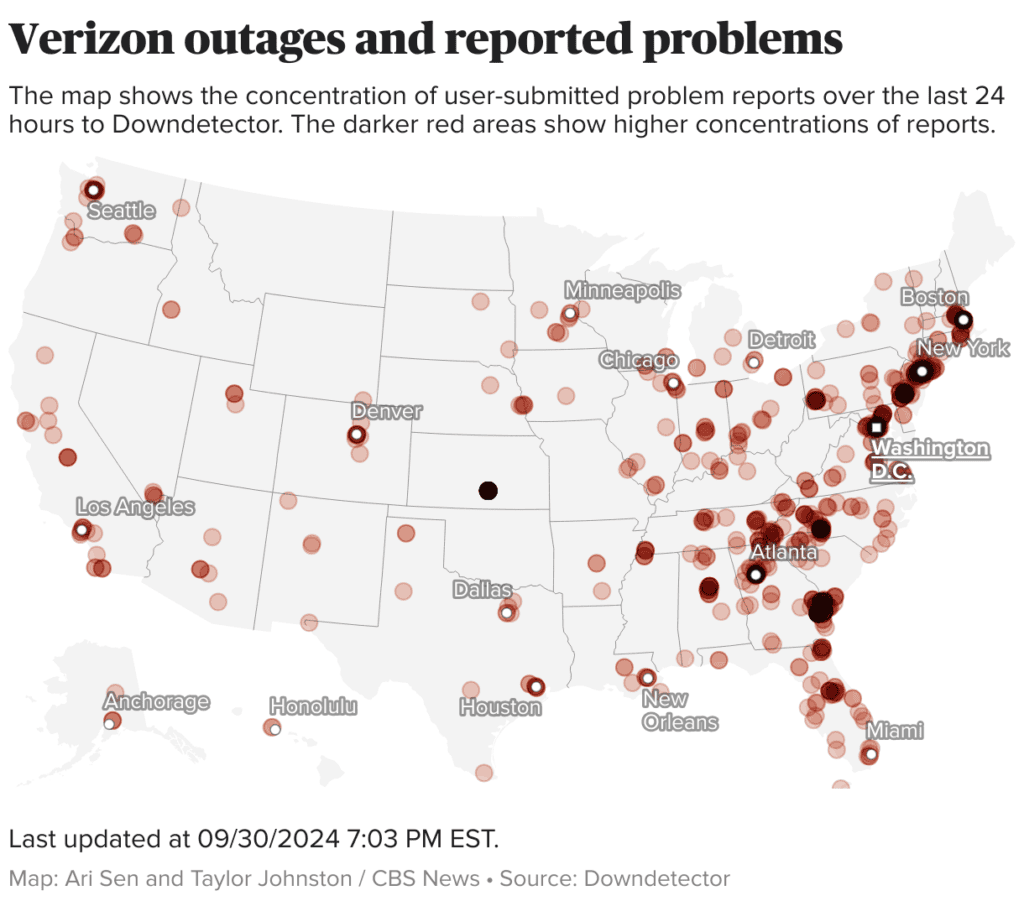
In an emailed statement to CBS MoneyWatch, a Verizon spokesperson acknowledged the issue, stating, “We are aware of an issue impacting service for some customers. Our engineers are engaged and we are working quickly to identify and solve the issue.”
As the disruptions persist, issues are being noted across various devices, affecting both iPhone and Android users. The outages have also disrupted Wi-Fi calling services, which typically serve as an alternative connectivity method. As of 5:48 p.m. ET, Verizon announced that service restoration efforts were underway and gradually making progress, but customers are still experiencing challenges.
This marks a significant incident in a landscape where communication reliability is essential, and customers are left wondering about the cause of the outage. With many turning to social media to voice their concerns and seek resolutions, the call for timely updates from Verizon is clear.
The situation remains fluid, and Verizon customers are encouraged to stay informed as more information becomes available. If you’re experiencing issues with your Verizon service, let us know your experience in the comments below.
Stay tuned for further updates on this developing story.
https://www.cbsnews.com/news/verizon-outage-network-down-sos-mode-downdetector-map
https://www.fox10phoenix.com/news/verizon-outage-network-down-monday-september-30
STM Daily News is a vibrant news blog dedicated to sharing the brighter side of human experiences. Emphasizing positive, uplifting stories, the site focuses on delivering inspiring, informative, and well-researched content. With a commitment to accurate, fair, and responsible journalism, STM Daily News aims to foster a community of readers passionate about positive change and engaged in meaningful conversations. Join the movement and explore stories that celebrate the positive impacts shaping our world.

Local News
Maricopa Boil Water Advisory Lifted After Negative E. Coli Tests
Maricopa boil water advisory lifted: Global Water–Santa Cruz Water Company customers in Maricopa can resume normal tap water use after follow-up testing found no E. coli.

MARICOPA, Ariz. — A precautionary boil water advisory for Global Water–Santa Cruz Water Company customers in the city of Maricopa was lifted Thursday, October 8, after repeat testing found no E. coli in water samples. The utility announced the cancellation at approximately 2 p.m. Arizona time.

The advisory was issued October 7 after two preliminary tests indicated possible contamination. Customers were temporarily instructed to use bottled water or boil tap water for at least one minute before drinking it or using it for food preparation.
With follow-up results negative, affected customers no longer need to boil water for drinking, cooking, making ice, brushing teeth or washing dishes, according to the utility.
The advisory affected the utility’s customers in the city of Maricopa, located in Pinal County. It was not a countywide warning for Maricopa County or Phoenix.
Residents can visit Global Water Resources’ official notice page for updates or call 866-940-1102 with questions.

STM Daily News
Woman Charged With Felony Animal Cruelty in Santa Ana Puppy Killing
Santa Ana Puppy Killing: Prosecutors have filed felony charges against a 75-year-old Anaheim woman accused of deliberately running over and killing her puppy, Blackey, in Santa Ana.

Last Updated on October 3, 2026 by Daily News Staff
SANTA ANA, Calif. — A 75-year-old Anaheim woman accused of deliberately running over and killing her puppy on a Santa Ana street has now been formally charged with felony animal cruelty, marking a major development in a case that drew widespread attention after surveillance video was released by police.
The Orange County District Attorney’s Office announced Friday, October 2, that Hanh Minh Nguyen, 75, of Anaheim, has been charged with one felony count of animal cruelty, one felony count of animal abuse by a caretaker, and a felony enhancement alleging the personal use of a weapon — a vehicle — to kill the animal.
Nguyen was arrested by Santa Ana police on Thursday, October 1, after investigators used automated license plate reader technology to identify the green Honda Odyssey seen in surveillance footage from the September 8 incident. Police subsequently located Nguyen and found the minivan at her Anaheim residence.
According to the District Attorney’s Office, Nguyen was released from custody after posting $20,000 bail. She is scheduled to appear at the Central Justice Center in Santa Ana on November 2, 2026, in Department C55.
Surveillance video led to investigation
The case began on September 8 at approximately 9:15 a.m., when Santa Ana Animal Services officers responded to a report of a dead black-and-white male pit bull-mix puppy on West Park Lane.

Surveillance footage obtained during the investigation showed a woman removing the puppy from a minivan and placing food near the driver’s side of the vehicle. Authorities allege the woman then slowly drove forward as the puppy approached the food, running over the animal with the vehicle’s rear tire before leaving the scene.
The puppy, identified by authorities as Blackey, died.
The District Attorney’s Office describes Blackey as a 9-week-old puppy. Earlier statements and local news reports described him as approximately 9 months old.
Santa Ana police released surveillance footage of the incident on September 30 and appealed to the public for help identifying the driver.
Within a day, investigators said automated license plate reader technology helped them trace the Honda Odyssey to Nguyen. Police found the vehicle in her garage and took her into custody.
Police previously said Nguyen acknowledged owning and abandoning Blackey. According to the Los Angeles Times, a Santa Ana Police Department spokesperson said Nguyen told detectives she had left the puppy because he had been annoying her boyfriend by biting his shoes and belongings. Police said she acknowledged abandoning the dog but did not admit to intentionally running him over.
Prosecutors file felony charges
The filing of felony charges moves the case beyond the initial police investigation and into the Orange County court system.
Orange County District Attorney Todd Spitzer condemned the alleged killing in announcing the charges and said his office intends to prosecute acts of violence against animals.
Deputy District Attorney Danica Drotman of the Orange County District Attorney’s Animal Cruelty Unit is prosecuting the case.
Nguyen is accused of the offenses and has not been convicted. The allegations against her will now be addressed through the court process.
Her next scheduled court appearance is November 2.
STM Daily News will continue following the case and provide updates as additional information becomes available.
Source and Related Links
- Orange County District Attorney — October 2 charging announcement
- The DA’s release is the strongest source for this update. It provides case number 26CF4923, the exact charges, $20,000 bail, November 2 court date and the prosecutor assigned to the case. Orange County District Attorney
- For corroborating coverage, CBS Los Angeles reports the arrest, use of automated license-plate readers and the subsequent felony charges. CBS News
- CBS Los Angeles — arrest and charges update
- NBC Los Angeles — felony charges update
Local News
Santa Ana Police Seek Woman Accused of Intentionally Running Over Puppy
Santa Ana police are asking for the public’s help identifying a woman accused of intentionally running over and killing a puppy with a minivan on September 8.
Last Updated on September 30, 2026 by Daily News Staff
SANTA ANA, Calif. — Santa Ana police are asking for the public’s help identifying a woman accused of deliberately running over and killing a puppy after leaving the animal in a residential street earlier this month.
The disturbing incident occurred at approximately 9:15 a.m. on September 8, 2026, in the 900 block of West Park Lane, near 926 W. Park Lane. Police said the dog, described as a pit bull mix puppy, was later found dead in the street.
Investigators subsequently obtained home-surveillance footage showing an older-model green or blue Honda Odyssey minivan stopped along the street.
According to police, the female driver opened the vehicle’s door and placed the puppy on the ground. The puppy went underneath the minivan, and the woman then allegedly placed food on the street near the driver’s side of the vehicle.
As the puppy approached the food, the driver moved the minivan forward. Police said the vehicle’s rear driver’s-side tire went over the puppy and that the minivan remained stopped on the animal for approximately 15 seconds before the driver drove away.
A nearby resident later told officers that they had seen the minivan in the area and believed the puppy had been deliberately run over. Police and animal services personnel spent several weeks canvassing the neighborhood and eventually located surveillance footage that authorities said corroborated the witness’s account.
Police searching for driver
Investigators have not been able to obtain a readable license plate from the surveillance footage.
As of September 30, Santa Ana police were seeking information that could help identify either the woman or the older green or blue Honda Odyssey seen in the video.
Anyone with information about the case is being asked to contact Santa Ana police at 714-245-8378.
The case comes two years after another highly publicized animal-cruelty incident in Santa Ana involving a woman accused of intentionally running over a 2-month-old Rottweiler puppy in August 2024. In that case, the puppy survived after emergency treatment, and the suspect subsequently turned herself in to police.
STM Daily News will update this story if authorities announce an identification, arrest or charges in the case.
Sure and Related Links
Los Angeles Times — “Santa Ana Police search for woman who appears to deliberately run over puppy in disturbing video”
Los Angeles Times report
CBS Los Angeles — “Santa Ana police seek minivan driver who allegedly intentionally ran over puppy”
CBS Los Angeles report
NBC Los Angeles — “Female driver wanted for ‘intentionally’ running over a puppy in Santa Ana”
NBC Los Angeles report
MyNewsLA — “Santa Ana Police Seek Help Woman Who Fatally Struck Puppy”
MyNewsLA report




