

The Knowledge
🚦 Who Really Invented the Modern Traffic Light?
The modern traffic light, largely attributed to Garrett Morgan’s 1923 invention, introduced a critical yellow warning light that improved public safety. Despite his significant impact on traffic systems, Morgan’s contributions have often been overlooked due to historical racism.

Last Updated on February 14, 2026 by Daily News Staff
When you think about the traffic light, you probably picture green for go, red for stop, and maybe a frustrated glance at the yellow. But have you ever stopped to ask: Who actually invented this system we take for granted every day?
The story of the modern traffic light isn’t just about technology—it’s about innovation, public safety, and a Black inventor named Garrett Morgan who changed the way we move through the world.
🔦 Early Traffic Signals: A Dangerous Beginning
Before cars dominated streets, early attempts at traffic control involved manual policing and hand signals. In 1868, the first gas-powered traffic signal was installed in London outside the British Houses of Parliament. Designed by J.P. Knight, a railway engineer, this early signal exploded after just a month due to a gas leak—killing a police officer and abandoning the idea for years.
As cars became more common in the early 20th century, so did traffic jams—and accidents. Cities needed a safer, more efficient solution.
🛠️ Enter Garrett Morgan
In 1923, Garrett Morgan, an African-American inventor and entrepreneur from Cleveland, Ohio, received U.S. Patent No. 1,475,024 for a traffic control device that added a crucial feature: a “warning position” between stop and go. This idea is the basis for today’s yellow light.
His signal was:
- Manually operated
- T-shaped
- Designed to be mounted on a post
- And included a buffer phase to clear intersections before switching direction
This innovation was not only about traffic flow—it was about safety and preventing collisions at a time when automobile fatalities were rapidly increasing.
Morgan sold the rights to his invention to General Electric for $40,000 (equivalent to over $700,000 today), though his contributions were overlooked for decades.
👉 View the full patent on Google Patents
⚙️ Was Morgan the
Only
Inventor?
No. Traffic signal history has multiple contributors:
- Lester Wire, a Salt Lake City policeman, created an electric traffic light prototype in 1912.
- William Ghiglieri patented an automatic signal in 1917.
- Garrett Morgan’s version stood out for its practical innovation—the transitional phase—and for being one of the first widely adopted and commercially viable versions.
In other words, Morgan helped move the traffic light from an experimental device to a nationwide safety standard.
🎥 Watch the Story in 60 Seconds
We break this story down in our latest Forgotten Genius Fridays episode from The Knowledge series on STM Daily News.
📺 Watch “Who Really Invented the Modern Traffic Light?” here: https://youtu.be/cS-emlzhjjk
✊ Why Garrett Morgan Deserves More Recognition
Garrett Morgan’s impact goes far beyond traffic lights. He also invented a gas mask used by firefighters and soldiers, and he launched one of the first Black-owned newspapers in the U.S.
He was a true innovator, working in an era where his contributions were often ignored due to racism. Today, we honor his legacy by telling his story and recognizing how his vision saved countless lives.
🧠 Now you know.
— STM Daily News
Dive into “The Knowledge,” where curiosity meets clarity. This playlist, in collaboration with STMDailyNews.com, is designed for viewers who value historical accuracy and insightful learning. Our short videos, ranging from 30 seconds to a minute and a half, make complex subjects easy to grasp in no time. Covering everything from historical events to contemporary processes and entertainment, “The Knowledge” bridges the past with the present. In a world where information is abundant yet often misused, our series aims to guide you through the noise, preserving vital knowledge and truths that shape our lives today. Perfect for curious minds eager to discover the ‘why’ and ‘how’ of everything around us. Subscribe and join in as we explore the facts that matter. https://stmdailynews.com/the-knowledge/
Discover more from Daily News
Subscribe to get the latest posts sent to your email.


The Knowledge
Dr. Charles R. Drew: The Father of the Blood Bank
Dr. Charles R. Drew revolutionized blood storage and stood against racial injustice, earning the title “Father of the Blood Bank.”
Last Updated on March 13, 2026 by Daily News Staff

AI generated image
Dr. Charles R. Drew: The Father of the Blood Bank
In the 1930s and 40s, one man’s groundbreaking medical research transformed how we save lives — and his legacy still flows through hospitals around the world.
Dr. Charles R. Drew (1904–1950), an African American physician and surgeon, discovered a better way to store and transport blood plasma. Plasma, the liquid component of blood, can be preserved longer than whole blood and safely shipped over great distances — a game changer for emergency medicine.
@stmblog He revolutionized how we store blood, saved thousands in WWII, and stood up to injustice. 🩸 Meet Dr. Charles R. Drew — the Father of the Blood Bank. History BlackHistory WWII MedicalBreakthrough STMDailyNews DidYouKnow ScienceHistory BloodBank InspiringStories LearnOnTikTok ♬ original sound – STMDailyNews – STMDailyNews
During World War II, Drew’s expertise powered the “Blood for Britain” program, which sent vital plasma to soldiers and civilians injured in the Blitz. Later, as the first director of the American Red Cross blood bank, he helped establish modern blood collection and distribution systems.
But Drew was more than a scientist — he was a man of principle. He resigned from the Red Cross in protest over its policy of segregating blood by race, a practice he condemned as scientifically baseless and morally wrong.
Known today as the “Father of the Blood Bank,” Dr. Drew’s innovations continue to save millions of lives every year. His story is a testament to the power of science, dedication, and courage to challenge injustice.
Related Links:
Link: https://stmdailynews.com/the-woman-who-invented-the-home-security-system/
Moments in History: Dr. Charles R Drew
Link: https://stmdailynews.com/moments-in-history-dr-charles-r-drew/
Author

Discover more from Daily News
Subscribe to get the latest posts sent to your email.
The Knowledge
Why can’t it always be summer? It’s all about the Earth’s tilt
Earth’s axial tilt causes the seasons. As Earth orbits the Sun, different hemispheres tilt toward or away, creating summer and winter depending on location.

Last Updated on March 13, 2026 by Daily News Staff
Stephanie Spera, University of Richmond
Curious Kids is a series for children of all ages. If you have a question you’d like an expert to answer, send it to curiouskidsus@theconversation.com.
Why can’t it always be summer? – Amanda, age 5, Chile
With its long days just itching to be spent by water doing nothing, summer really can be an enchanting season. As Jenny Han wrote in the young adult novel “The Summer I Turned Pretty”: “Everything good, everything magical happens between the months of June and August.”
But all good things must come to an end, and summer cannot last forever. There’s both a simple reason and a more complicated one. The simple reason is that it can’t always be summer because the Earth is tilted. The more complicated answer requires some geometry.
I’m a professor of geography and the environment who has studied seasonal changes on the landscape. Here’s what seasons have to do with our planet’s position as it moves through the solar system.
This animation shows why the Earth has seasons.
Closeness to the Sun doesn’t explain seasons
First, you need to know that the Earth is a sphere – technically, an oblate spheroid. That means Earth has a round shape a little wider than it is tall.
Every year, Earth travels in its orbit to make one revolution around the Sun. The Earth’s orbit is an ellipse, which is more like an oval than a circle. So there are times when Earth is closer to the Sun and times when it’s farther away.
A lot of people assume this distance is why we have seasons. But these people would be wrong. In the United States, the Earth is 3 million miles closer to the Sun during winter than in the summer.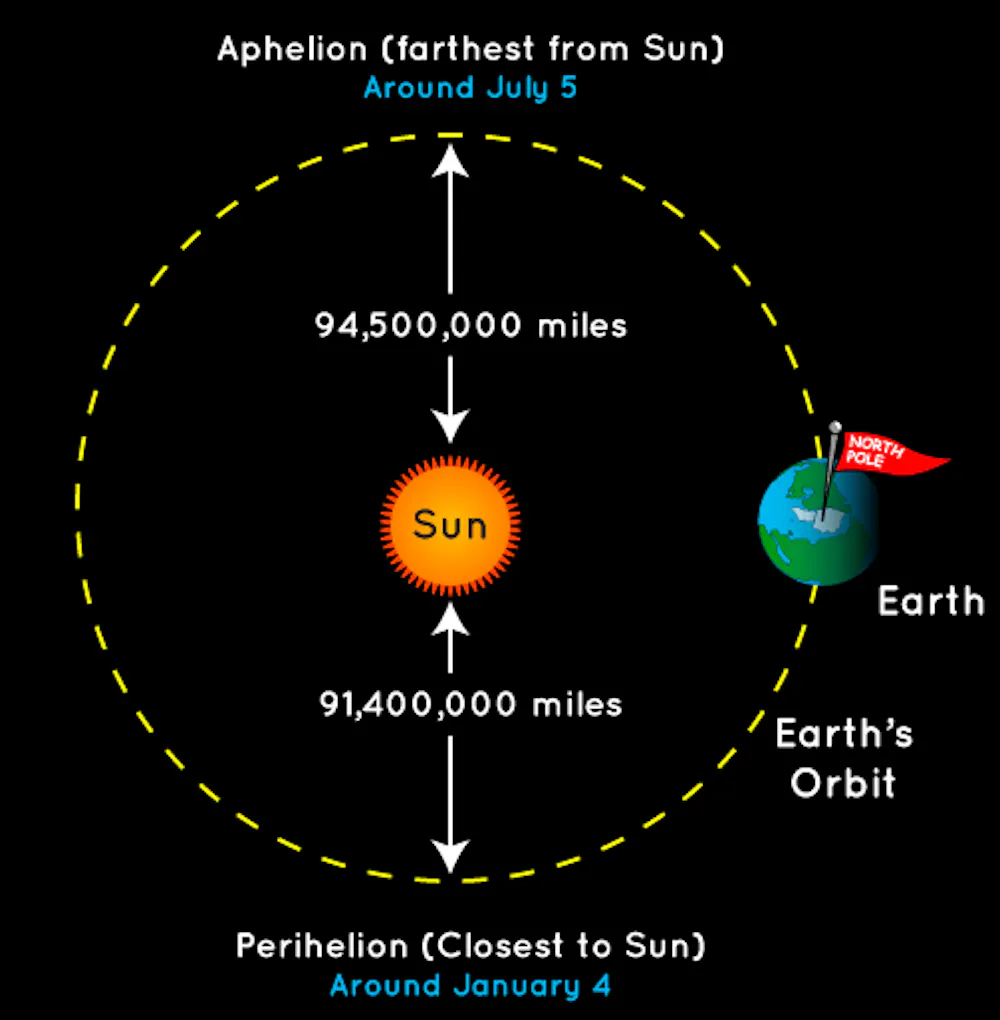
Spinning like a top
Now picture an imaginary line across Earth, right in the middle, at 0° latitude. This line is called the equator. If you drew it on a globe, the equator would pass through countries including Brazil, Kenya, Indonesia and Ecuador.
Everything north of the equator, including the United States, is considered the Northern Hemisphere, and everything south of the equator is the Southern Hemisphere.
Now think of the Earth’s axis as another imaginary line that runs vertically through the middle of the Earth, going from the North Pole to the South Pole.
As it orbits, or revolves, around the Sun, the Earth also rotates. That means it spins on its axis, like a top. The Earth takes one full year to revolve around the Sun and takes 24 hours, or one day, to do one full rotation on its axis.
This axis is why we have day and night; during the day, we’re facing the Sun, and at night, we’re facing away.
But the Earth’s axis does not go directly up and down. Instead, its axis is always tilted at 23.5 degrees in the exact same direction, toward the North Star.
The Earth’s axis is tilted due to a giant object – perhaps an ancient planet – smashing into it billions of years ago. And it’s this tilt that causes seasons.
It’s all about the tilt
So that means in June, the Northern Hemisphere is tilted toward the Sun. That tilt means more sunlight, more solar energy, longer days – all the things that make summer, well, summer.
At the same time, the Southern Hemisphere is tilted away from the Sun. So countries such as Australia, Chile and Argentina are experiencing winter then.
To say it another way: As the Earth moves around the Sun throughout the year, the parts of the Earth getting the most sunlight are always changing.
Fast-forward to December, and Earth is on the exact opposite side of its orbit as where it was in June. It’s the Southern Hemisphere’s turn to be tilted toward the Sun, which means its summer happens in December, January and February.
If Earth were not tilted at all, there would be no seasons. If it were tilted more than it is, there would be even more extreme seasons and drastic swings in temperature. Summers would be hotter and winters would be colder.
Defining summer
Talk to a meteorologist, climate scientist or author Jenny Han, and they’ll tell you that for those of us in the Northern Hemisphere, summer is June, July and August, the warmest months of the year.
But there’s another way to define summer. Talk to astronomers, and they’ll tell you the first day of summer is the summer solstice – the day of the year with the longest amount of daylight and shortest amount of darkness.
The summer solstice occurs every year sometime between June 20 and June 22. And every day after, until the winter solstice in December, the Northern Hemisphere receives a little less daylight.
Summer officially ends on the autumnal equinox, the fall day when everywhere on Earth has an equal amount of daylight and night. The autumnal equinox happens every year on either September 22 or 23.
But whether you view summer like Jenny Han or like an astronomer, one thing is certain: Either way, summer must come to an end. But the season and the magic it brings with it will be back before you know it.
Hello, curious kids! Do you have a question you’d like an expert to answer? Ask an adult to send your question to CuriousKidsUS@theconversation.com. Please tell us your name, age and the city where you live.
And since curiosity has no age limit – adults, let us know what you’re wondering, too. We won’t be able to answer every question, but we will do our best.
Stephanie Spera, Assistant Professor of Geography and the Environment, University of Richmond
This article is republished from The Conversation under a Creative Commons license. Read the original article.
The science section of our news blog STM Daily News provides readers with captivating and up-to-date information on the latest scientific discoveries, breakthroughs, and innovations across various fields. We offer engaging and accessible content, ensuring that readers with different levels of scientific knowledge can stay informed. Whether it’s exploring advancements in medicine, astronomy, technology, or environmental sciences, our science section strives to shed light on the intriguing world of scientific exploration and its profound impact on our daily lives. From thought-provoking articles to informative interviews with experts in the field, STM Daily News Science offers a harmonious blend of factual reporting, analysis, and exploration, making it a go-to source for science enthusiasts and curious minds alike. https://stmdailynews.com/category/science/
Dive into “The Knowledge,” where curiosity meets clarity. This playlist, in collaboration with STMDailyNews.com, is designed for viewers who value historical accuracy and insightful learning. Our short videos, ranging from 30 seconds to a minute and a half, make complex subjects easy to grasp in no time. Covering everything from historical events to contemporary processes and entertainment, “The Knowledge” bridges the past with the present. In a world where information is abundant yet often misused, our series aims to guide you through the noise, preserving vital knowledge and truths that shape our lives today. Perfect for curious minds eager to discover the ‘why’ and ‘how’ of everything around us. Subscribe and join in as we explore the facts that matter. https://stmdailynews.com/the-knowledge/
Discover more from Daily News
Subscribe to get the latest posts sent to your email.
Last Updated on March 11, 2026 by Daily News Staff

“From Public Access to Social Media.” Image: AI
Before there were influencers, viral videos, and billion-view platforms, there was something raw, real, and radically democratic: public access television.
Born in the 1970s, public access TV was one of the first true experiments in community-driven media. And while it may seem like a relic of the analog past, its legacy is alive and well every time someone hits “post” on YouTube, TikTok, or Instagram.
🎤 What Was Public Access Television?
Public access television was part of the “PEG” system—Public, Educational, and Government access channels—mandated by the FCC and local cable providers to serve community needs. The public access arm gave everyday people a platform to create and share their own content, often with free or low-cost equipment provided by local studios.
There were no ads, no executives, and no creative restrictions (aside from legal limitations). Programming ranged from the bizarre to the brilliant—local news, activist messages, drag performances, punk rock shows, religious rants, DIY cooking series, and more. If you had something to say and the courage to get in front of a camera, you could be on the air.
Scrappy, campy and unabashedly queer, public access TV series of the 1980s and 1990s offered a rare glimpse into LGBTQ+ life
🧪 Experimental, Inclusive, and Sometimes Outrageous
Public access TV wasn’t polished. It wasn’t corporate. It wasn’t predictable. And that was exactly the point.
It empowered:
Marginalized voices who couldn’t get airtime elsewhere. Aspiring creatives looking to test out new formats. Communities wanting to share local culture, ideas, and events.
In many ways, it was an open sandbox where media could be weird, wild, and wonderfully honest.
🌐 The Bridge to Social Media
Today, anyone with a smartphone can start a channel, build an audience, or go viral. But the foundation was laid decades earlier by public access.
Public Access TV
Modern Social Media
Community studios
Smartphones, apps, home setups
Broadcast on local cable channels
Global reach via internet
No advertising
Monetized, ad-supported
Free expression, limited censorship
Still a battleground for free speech
Niche, quirky content
Same—just with algorithms
The spirit of user-generated content—amateur, authentic, and accessible—is deeply rooted in the public access ethos. Creators like early YouTubers and digital activists have often cited public access as an inspiration.
🔄 A Full Circle Moment
Today’s digital platforms have expanded the reach and speed of content creation, but they also reintroduce challenges public access once bypassed—like algorithmic bias, platform censorship, and commercialization.
Ironically, as tech giants dominate digital communication, the original values of public access—local control, equal access, and creative freedom—are more relevant than ever.
🧠 Final Thought
Public access television may have existed before likes, shares, or subscribers—but it’s the ancestor of everything we now take for granted in social media. It showed us that the best stories don’t always come from studios, and the most important voices don’t always have a microphone—until they make one.
So next time you scroll through a creator’s feed or stumble on a strange but delightful video, remember:
📼 Public access walked so the internet could run
Related Links:
Public Access Television (Wikipedia): https://en.wikipedia.org/wiki/Public-access_television
Cable Communications Policy Act of 1984 (Wikipedia) https://en.wikipedia.org/wiki/Cable_Communications_Policy_Act_of_1984
Dive into “The Knowledge,” where curiosity meets clarity. This playlist, in collaboration with STMDailyNews.com, is designed for viewers who value historical accuracy and insightful learning. Our short videos, ranging from 30 seconds to a minute and a half, make complex subjects easy to grasp in no time. Covering everything from historical events to contemporary processes and entertainment, “The Knowledge” bridges the past with the present. In a world where information is abundant yet often misused, our series aims to guide you through the noise, preserving vital knowledge and truths that shape our lives today. Perfect for curious minds eager to discover the ‘why’ and ‘how’ of everything around us. Subscribe and join in as we explore the facts that matter. https://stmdailynews.com/the-knowledge/
Discover more from Daily News
Subscribe to get the latest posts sent to your email.


PickleRage Opens First South Carolina Club in North Charleston — Grand Opening Weekend Set for March 6–7

PickleRage is opening its first South Carolina indoor pickleball club in North Charleston on March 6-7, 2026. The launch features a two-day celebration with open play, clinics, and community activities. The climate-controlled facility aims to enhance year-round pickleball accessibility for players of all skill levels.





