

News
Media Invited to NASA’s 30th Anniversary of International Rover Competition
Join NASA in celebrating 30 years of rover competition! Media invited to witness the incredible innovation and engineering prowess of student teams from around the world. #NASA #RoverCompetition

Calling all space enthusiasts! Get ready to witness an incredible display of innovation and engineering prowess as NASA celebrates the 30th anniversary of the Human Exploration Rover Challenge. This prestigious rover competition will be held at the U.S. Space & Rocket Center’s Aviation Challenge Course in Huntsville, Alabama, on Friday, April 19, and Saturday, April 20. The best part? It’s free and open to the public!
Imagine more than 600 students from around the world, representing 42 colleges and universities and 30 high schools, utilizing their knowledge and skills to navigate a complex obstacle course. These brilliant young minds will be piloting their very own human-powered vehicles, designed and produced as part of NASA’s engineering design challenge. It’s an event you won’t want to miss!
Media personnel are cordially invited to attend this awe-inspiring event and witness firsthand the ingenuity and determination radiating from these talented students. Whether you’re a journalist looking to cover the competition or an interviewer eager to sit down with the participants, this is an opportunity you can’t afford to pass up. Contact Taylor Goodwin in the Marshall Office of Communications at 938-210-2891 no later than 2 p.m. Thursday, April 18, to secure your spot.
The International Rover Competition has always been a platform for aspiring engineers to showcase their skills, and this year’s event promises to be a milestone celebration. Participants from not only 24 states across the United States but also the District of Columbia, Puerto Rico, and 13 other countries will gather to demonstrate their enthusiastic pursuit of knowledge and their passion for space exploration.
As a testament to their hard work, dedication, and creativity, NASA will host an in-person awards ceremony on Saturday, April 20, at 5 p.m. inside the Space Camp Operations Center at the U.S. Space & Rocket Center. This grand finale will honor the remarkable achievements of the teams throughout the eight-month-long engineering design project. Awards will be presented for categories such as best rover design, best pit crew, and even best social media presence.
So mark your calendars and get ready for an exhilarating experience! Witness the future of space exploration unfold before your eyes. Join NASA in celebrating the 30th anniversary of the International Rover Competition and support these incredible young minds as they inspire a new generation of engineers and explorers.
Don’t forget to contact Taylor Goodwin in the Marshall Office of Communications at 938-210-2891 no later than 2 p.m. Thursday, April 18, to secure your media access and set up interviews. Remember, you don’t want to miss out on this out-of-this-world opportunity!
See you at the U.S. Space & Rocket Center for an incredible showcase of innovation and human ingenuity!
About the Challenge
The Human Exploration Rover Challenge tasks high school, college, and university students around the world to design, build, and test their lightweight, human-powered rovers on a course simulating lunar and Martian terrain, all while completing mission-focused science tasks. Eligible teams compete to be among the top three finishers in their divisions, and to win multiple awards including best vehicle design, best rookie team, and more.
The challenge annually draws hundreds of students from around the world and reflects the goals of NASA’s Artemis campaign, which will land the first woman and first person of color on the Moon.
The event was launched in 1994 as the NASA Great Moonbuggy Race – a collegiate competition to commemorate the 25th anniversary of the Apollo 11 lunar landing. It expanded in 1996 to include high school teams, evolving again in 2014 into the NASA Human Exploration Rover Challenge. Since its inception, more than 15,000 students have participated – with many former students now working in the aerospace industry, including with NASA.
The Human Exploration Rover Challenge is managed by NASA’s Southeast Regional Office of STEM Engagement at Marshall and is one of eight Artemis Student Challenges. NASA’s Office of STEM Engagement uses challenges and competitions to further the agency’s goal of encouraging students to pursue degrees and careers in science, technology, engineering, and mathematics.
To learn more about the challenge, visit:
https://www.nasa.gov/roverchallenge/home/index.html
https://stmdailynews.com/category/science/



(Feature Impact) Every year, approximately 200,000 service men and women transition from military life to corporate America. Finding the right civilian career is a transition, but it’s an opportunity to leverage military leadership and mission-driven talent.
Traditional hiring processes often focus on conventional resumes, but forward-thinking organizations recognize military experience as a competitive advantage in today’s workforce. The resilience, integrity and adaptability of America’s veterans and military families make them uniquely positioned to drive growth and innovation in their communities.
“Veterans bring unmatched discipline, adaptability and a results-driven mindset that directly translates to high-impact corporate careers,” said Drew Matheson, senior director at Capital One’s Commercial Bank and retired U.S. Army infantry officer. “While military experience doesn’t always fit perfectly on a traditional paper resume, employers like Capital One who know how to decode these unique leadership skills are able to unlock an incredible pipeline of proven performers.”
To help transitioning service members successfully navigate this career pivot, military community leaders at Capital One offer these five essential tips for service members entering the civilian workforce: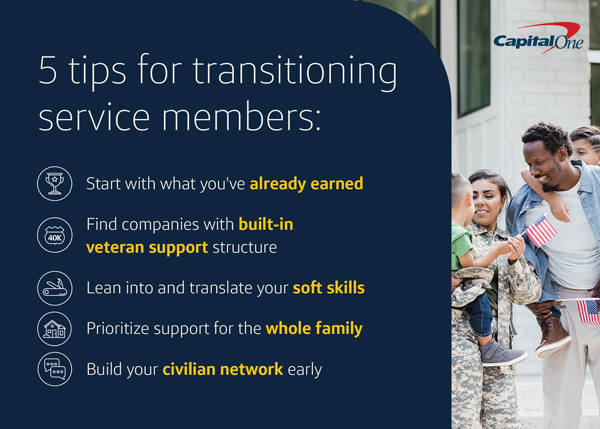
Start With What You’ve Already Earned
Opportunity starts with preparation. Beyond the well-known Post-9/11 GI Bill, which can cover tuition, housing and books, transitioning service members can look into vocational rehab or the SkillBridge program, which allows them to do civilian internships during the last 180 days of service. Many employers also offer internal tuition reimbursement programs. Taking the time to proactively map out these benefits ensures you aren’t leaving valuable opportunities or money on the table.
Find Employers with Veteran Support Structures
With almost half of veterans leaving their first post-military job within a year, according to research published by the Institute for Veterans and Military Families and VetAdvisor, finding the right culture and community is key to a successful transition. Look for employers with active veteran networks and dedicated mentorship.
For example, Capital One’s Salute Business Resource Group serves as a thriving internal community of more than 6,000 members, offering peer support, year-round professional development and mentorship for veterans, reservists and military spouses. Additionally, partner organizations like Hiring Our Heroes provide career workshops, fellowships and job fairs to ensure you’re employment-ready from day one.
Lean Into and Translate Your Soft Skills
Veterans bring a distinct competitive advantage to the applicant pool. You should confidently lean into the cross-functional “soft skills” learned in the line of duty such as risk management, crisis resolution and building trust under high-pressure scenarios.
The trick is translating these capabilities out of military jargon on your resume. Swap military terms like “NCOIC” for “Operations Manager” or “commanded” for “directed.” To make this easier, look for military-friendly employers that employ dedicated military recruiters who specialize in decoding military resumes to align skills with the right roles.
Prioritize Support for the Whole Family
Military service is a family commitment, and the transition out of uniform affects everyone. Military spouses often face unique career hurdles, including frequent relocations and employment gaps. When evaluating employers, look for companies that offer holistic benefits and flexible structures.
For example, Capital One, recognized by “U.S. Veterans Magazine” as a Top Veteran Employer and Top Military Spouse Employer, actively supports military spouses and families through dedicated spouse hiring initiatives and internal support mechanisms. Furthermore, look for organizations that support continued military training and active-duty leave, ensuring military associates never have to choose between their service and their careers.
Build Your Civilian Network Early
In the military, your network is built in. In the civilian world, you have to cultivate it. Long before your terminal leave begins, connect with veterans who work at companies you admire. Reach out for brief, 15-minute informational interviews to learn about their transition journeys rather than simply asking for a job. With more than 70% of civilian jobs filled through networking, according to estimates from Career Horizons, making organic connections early is a powerful tool for getting your foot in the door.
To find additional resources and learn more about how to support the hiring of veterans and military spouses, visit CapitalOneCareers.com/Military.
Photo courtesy of Shutterstock

SOURCE:
health and wellness
Zepbound Linked to Lower Healthcare Costs in Adults 55+ With Obesity, Real-World Study Suggests

A new real-world study of adults over age 55 with overweight or obesity found that sustained use of Zepbound (tirzepatide) for weight management was associated with lower healthcare costs over time compared with similar adults who were not treated. Eli Lilly and Company said the findings were driven in part by lower rates of hospital admissions and emergency department visits, and were published in Diabetes, Obesity and Metabolism.
What the study found
According to Lilly, researchers estimated healthcare cost differences over time (excluding the cost of Zepbound itself) using two established analytic methods. Across both approaches, monthly healthcare costs were lower, on average, among older adults who stayed on Zepbound.
Key estimates reported in the release include:
- At six months: costs were up to 15% lower (up to $181 per patient, per month).
- At 12 months: the estimated difference widened to as much as $607 per patient, per month, reflecting up to 38% lower costs than those not treated (estimates varied by model).
In the primary analysis, adults over 55 treated with Zepbound had lower rates of hospital admissions and emergency department visits across every follow-up period, along with numerically higher rates of routine outpatient and office visitsa pattern the company said was consistent with greater engagement in routine care.
Why Medicare is part of the conversation
Lilly said the cost findings may be relevant for older adults, including those in Medicares GLP-1 Bridge program. The company noted that beginning at six months, estimated healthcare savings nearly covered the programs monthly treatment cost of $195 per patient, per month, and by 12 months the estimated savings exceeded the reported monthly treatment cost.
Its important to note the release also emphasizes a limitation: claims data do not capture Zepbounds net price, and the study excluded the cost of Zepbound from total treatment costs. That means the reported differences reflect potential savings elsewhere in care that could offset treatment costs, not the full net cost impact.
Who was included in the analysis
The retrospective observational cohort study used Komodos Healthcare Map, a database of de-identified claims data from more than 330 million individuals enrolled in U.S. healthcare plans. The analysis included 15,843 adults over age 55 (mean age 64.5) with obesity or overweight plus at least one obesity-related complication who initiated Zepbound between November 2023 and September 2025. Each Zepbound user was matched 1:1 with a control participant who met the same eligibility criteria but did not initiate GLP-1 or GIP/GLP-1 receptor agonist medication.
What Zepbound is
Zepbound (tirzepatide) is a dual GIP and GLP-1 receptor agonist indicated for adults with obesity, or some adults with overweight who also have at least one weight-related medical problem, to lose weight and keep it off. Lilly also noted Zepbound is FDA-approved to treat adults with moderate-to-severe obstructive sleep apnea and obesity, and should be used alongside a reduced-calorie diet and increased physical activity.
Safety summary (high level)
The release includes an indications and safety summary with warnings. Among other risks, Lilly notes Zepbound carries a warning about thyroid tumors, including thyroid cancer, and may cause serious side effects such as severe stomach problems, dehydration leading to kidney problems, gallbladder problems, pancreatitis, serious allergic reactions, and low blood sugar (especially when used with certain diabetes medicines). Patients should talk with a healthcare provider about risks and whether the medication is appropriate for them.
Related Links
- Zepbound (official product site): https://zepbound.lilly.com/
- Lilly newsroom: https://www.lilly.com/news
- Journal page (publisher hub): https://dom-pubs.onlinelibrary.wiley.com/journal/14631326
- Medicare (official): https://www.medicare.gov/
- FDA MedWatch (side effect reporting): https://www.fda.gov/medwatch
Source
- PRNewswire / Eli Lilly and Company press release (Aug. 26, 2026): Zepbound linked to lower healthcare costs in adults over age 55 with obesity according to a real-world study
💪 Your health journey starts here! Explore the latest health news, fitness tips, wellness trends, and healthy living advice. Share your thoughts in the comments and subscribe to the STM Daily News newsletter to stay informed and inspired every day.
Economy
U.S. Consumer Confidence Slips as Americans Grow More Cautious About the Future
U.S. consumer confidence edged lower in August as Americans became more pessimistic about jobs, income and business conditions over the next six months, despite improved views of the current economy.

NEW YORK — U.S. consumer confidence edged lower in August as Americans expressed greater concern about future business conditions, jobs and household income, even as their assessment of the current economy improved.
The Conference Board reported that its Consumer Confidence Index fell 0.8 points to 89.4 in August, down from 90.2 in July.
The relatively small decline, however, masks a widening gap between how consumers view conditions today and what they expect in the months ahead.
The Present Situation Index, which measures consumers’ assessment of current business and labor market conditions, climbed 6.8 points to 121.2, reversing three consecutive months of declines.
Meanwhile, the Expectations Index, which measures the short-term outlook for income, business and employment conditions, dropped 5.8 points to 68.2.
“Consumer confidence moderated slightly in August for a second consecutive month,” Dana M. Peterson, chief economist at The Conference Board, said in the organization’s Aug. 25 release.
Jobs Look Better Today — But Consumers Worry About Tomorrow
Americans’ perceptions of the current labor market improved considerably during August. About 27% said jobs were plentiful, up from 24.4% in July, while 19.5% said jobs were hard to get, down from 21.7%.
The outlook for the next six months was considerably weaker.
Only 14.6% expected more jobs to become available, compared with 16.4% in July. At the same time, 26.1% expected fewer jobs.
Consumers were also less optimistic about their incomes. About 17.6% expected their income to increase, down from 19.5% in July, while 13.8% expected their income to decline.
Prices Remain on Consumers’ Minds
Inflation continues to influence how Americans feel about the economy. According to The Conference Board, consumers’ written responses frequently mentioned prices, oil and gasoline, food and groceries, trade, jobs, and war or conflict.
Average and median expectations for inflation over the next 12 months also increased slightly.
Interest rates remain another concern. More than six in 10 consumers — 61.3% — expected interest rates to rise over the next year, although that was slightly lower than the 62% recorded in July.
Consumers Are Still Planning to Spend
The softer outlook hasn’t eliminated Americans’ willingness to make purchases.
Auto-buying expectations remained strong on a six-month moving-average basis, while homebuying expectations declined slightly in August but remained on a longer-term upward trend after hitting decade lows in early 2024.
Restaurants, bars and takeout; utilities; and streaming, internet and mobile services ranked among consumers’ leading planned service expenses.
Consumers were less enthusiastic about discretionary activities including movies, personal-travel hotels, airfare, amusement parks, museums and historical sites.
Why It Matters
The August numbers paint a mixed picture of the American consumer.
People are seeing some improvement in the economy they are experiencing today, particularly in the labor market. But their expectations for the next six months are becoming noticeably more cautious.
That divide matters because consumer spending represents a major part of U.S. economic activity. If concerns about employment, inflation and household income begin translating into reduced spending, weakening confidence could eventually become more significant for the broader economy.
For now, the August survey suggests Americans haven’t stopped spending — but they’re increasingly keeping an eye on what may be coming next.
The preliminary August Consumer Confidence Survey was conducted online for The Conference Board by Toluna. The survey period was Aug. 3–16, 2026.
Source: The Conference Board, August 2026 Consumer Confidence Survey®, released Aug. 25, 2026.
STM Daily News Economy News Brief
Sources
- The Conference Board — U.S. Consumer Confidence, August 2026 — Primary source for the August Consumer Confidence Index, Present Situation Index and Expectations Index.
- The Conference Board — Consumer Confidence Survey & Data — Consumer confidence survey information, methodology and release schedule.
Related Economic Data
- Bureau of Economic Analysis — Consumer Spending — Official U.S. data tracking personal consumption expenditures. Consumer spending increased 0.2% in July 2026.
- BEA — Personal Income and Outlays, July 2026 — Tracks household income, disposable income, consumer spending and saving.
- Bureau of Labor Statistics — Consumer Price Index — Official inflation data. The July 2026 CPI was up 3.4% from a year earlier; August CPI is scheduled for release September 11.
- Federal Reserve — Consumer Credit — Federal Reserve data covering revolving and nonrevolving consumer credit.





