

News
The Boeing Starliner has returned to Earth without its crew
Boeing’s Starliner returned uncrewed after thruster issues left astronauts on the ISS longer than planned. SpaceX remains a reliable option, challenging Boeing’s standing.

Last Updated on September 7, 2024 by Daily News Staff
– a former astronaut details what that means for NASA, Boeing and the astronauts still up in space
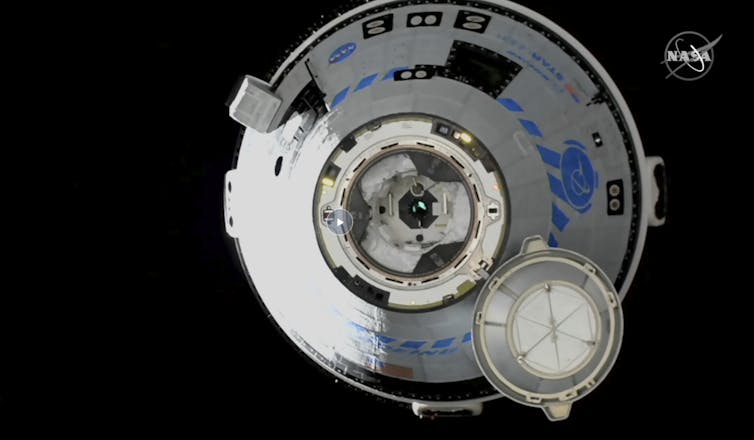
Michael E. Fossum, Texas A&M University
Boeing’s crew transport space capsule, the Starliner, returned to Earth without its two-person crew right after midnight Eastern time on Sept. 7, 2024. Its remotely piloted return marked the end of a fraught test flight to the International Space Station which left two astronauts, Butch Wilmore and Sunita “Suni” Williams, on the station for months longer than intended after thruster failures led NASA to deem the capsule unsafe to pilot back.
Wilmore and Williams will stay on the International Space Station until February 2025, when they’ll return to Earth on a SpaceX Dragon capsule.
The Conversation U.S. asked former commander of the International Space Station Michael Fossum about NASA’s decision to return the craft uncrewed, the future of the Starliner program and its crew’s extended stay at the space station.
What does this decision mean for NASA?
NASA awarded contracts to both Boeing and SpaceX in 2014 to provide crew transport vehicles to the International Space Station via the Commercial Crew Program. At the start of the program, most bets were on Boeing to take the lead, because of its extensive aerospace experience.
However, SpaceX moved very quickly with its new rocket, the Falcon 9, and its cargo ship, Dragon. While they suffered some early failures during testing, they aggressively built, tested and learned from each failure. In 2020, SpaceX successfully launched its first test crew to the International Space Station.
Meanwhile, Boeing struggled through some development setbacks. The outcome of this first test flight is a huge disappointment for Boeing and NASA. But NASA leadership has expressed its support for Boeing, and many experts, including me, believe it remains in the agency’s best interest to have more than one American crew launch system to support continued human space operations.
NASA is also continuing its exchange partnership with Russia. This partnership provides the agency with multiple ways to get crew members to and from the space station.
As space station operations continue, NASA and its partners have enough options to get people to and from the station that they’ll always have the essential crew on the station – even if there are launch disruptions for any one of the capable crewed vehicles. Having Starliner as an option will help with that redundancy.
What does this decision mean for Boeing?
I do think Boeing’s reputation is going to ultimately suffer. The company is going head-to-head with SpaceX. Now, the SpaceX Dragon crew spacecraft has several flights under its belt. It has proven a reliable way to get to and from the space station.
It’s important to remember that this was a test flight for Starliner. Of course, the program managers want each test flight to run perfectly, but you can’t anticipate every potential problem through ground testing. Unsurprisingly, some problems cropped up – you expect them in a test flight.
The space environment is unforgiving. A small problem can become catastrophic in zero gravity. It’s hard to replicate these situations on the ground.
The technology SpaceX and Boeing use is also radically different from the kind of capsule technology used in the early days of the Mercury, Gemini and Apollo programs.
NASA has evolved and made strategic moves to advance its mission over the past two decades. The agency has leaned into its legacy of thinking outside the box. It was an innovative move to break from tradition and leverage commercial competitors to advance the program. NASA gave the companies a set of requirements and left it up to them to figure out how they would meet them.
What does this decision mean for Starliner’s crew?
I know Butch Wilmore and Suni Williams as rock-solid professionals, and I believe their first thoughts are about completing their mission safely. They are both highly experienced astronauts with previous long-duration space station experience. I’m sure they are taking this in stride.
Prior to joining NASA, Williams was a Naval aviator and Wilmore a combat veteran, so these two know how to face risk and accomplish their missions. This kind of unfavorable outcome is always a possibility in a test mission. I am sure they are leaning forward with a positive attitude and using their bonus time in space to advance science, technology and space exploration.
Their families shoulder the bigger impact. They were prepared to welcome the crew home in less than two weeks and now must adjust to unexpectedly being apart for eight months.
Right now, NASA is dealing with a ripple effect, with more astronauts than expected on the space station. More people means more consumables – like food and clothing – required. The space station has supported a large crew for short periods in the past, but with nine crew members on board today, the systems have to work harder to purify recycled drinking water, generate oxygen and remove carbon dioxide from their atmosphere.
Wilmore and Williams are also consuming food, and they didn’t arrive with the clothes and other personal supplies they needed for an eight-month stay, so NASA has already started increasing those deliveries on cargo ships.
What does this decision mean for the future?
Human spaceflight is excruciatingly hard and relentlessly unforgiving. A million things must go right to have a successful mission. It’s impossible to fully understand the performance of systems in a microgravity environment until they’re tested in space.
NASA has had numerous failures and near-misses in the quest to put Americans on the Moon. They lost the Apollo 1 crew in a fire during a preflight test. They launched the first space shuttle in 1981, and dealt with problems throughout that program’s 30-year life, including the terrible losses of Challenger and Columbia.
After having no other U.S. options for over 30 years, three different human spacecraft programs are now underway. In addition to the SpaceX Crew Dragon and the Boeing Starliner, NASA’s Orion spacecraft for the Artemis II mission, is planned to fly four astronauts around the Moon in the next couple of years.
These programs have had setbacks and bumps along the way – and there will be more – but I haven’t been this excited about human spaceflight since I was an 11-year-old cheering for Apollo and dreaming about putting the first human footprints on Mars.
Michael E. Fossum, Vice President, Texas A&M University
This article is republished from The Conversation under a Creative Commons license. Read the original article.
The science section of our news blog STM Daily News provides readers with captivating and up-to-date information on the latest scientific discoveries, breakthroughs, and innovations across various fields. We offer engaging and accessible content, ensuring that readers with different levels of scientific knowledge can stay informed. Whether it’s exploring advancements in medicine, astronomy, technology, or environmental sciences, our science section strives to shed light on the intriguing world of scientific exploration and its profound impact on our daily lives. From thought-provoking articles to informative interviews with experts in the field, STM Daily News Science offers a harmonious blend of factual reporting, analysis, and exploration, making it a go-to source for science enthusiasts and curious minds alike. https://stmdailynews.com/category/science/


Community
‘Give Like a Kid Again’ for Real-World Impact This Halloween
Costumes. Candy. Jack-o-lanterns glowing on porches. Halloween is filled with moments that spark children’s imaginations. This Halloween, children and families can “Give Like a Kid Again,” turning imagination into kindness and helping children around the world.

‘Give Like a Kid Again’ for Real-World Impact This Halloween
(Feature Impact)Costumes. Candy. Jack-o-lanterns glowing on porches. Halloween is filled with moments that spark children’s imaginations.
This Halloween, Trick-or-Treat for UNICEF is inviting children and families to “Give Like a Kid Again,” turning imagination into kindness and helping children around the world. For eight decades,the campaign has shown children that even the smallest act of kindness can travel farther than any front porch and shine brighter than any jack-o-lantern. As the longest-running youth engagement campaign in the United States, it has inspired generations of children to discover that when kids help kids, one Halloween tradition can turn into a lifetime of impact.
What started with just $17 in 1950, when a small group of children filled milk cartons with spare change to help children recovering from World War II, has grown into one of America’s most beloved Halloween traditions, raising nearly $200million to help the organization deliver lifesaving support for children around the world. Today, the iconic orange collection box reminds families that small acts of generosity can create lasting change.
“Each Halloween, Trick-or-Treat for UNICEF reminds us that even the smallest acts of generosity can grow into something extraordinary,” said Shelley Diamond, chief marketing officer, UNICEF USA. “For more than 75 years, this campaign has shown generations of children that you are never too young to make a difference and ‘Give Like a Kid Again’ is about passing that belief on to the next generation.”
Beyond supporting programs in more than 190 countries and territories, donations strengthen the organization’s global humanitarian supply network, delivering emergency essentials like therapeutic food, medicine, blankets and safe water to children impacted by conflict, disasters and disease.
- Be a mermaid and help make waves for clean water. Help provide safe water for a child for a year for $5.
- Be a vampire and help scare away preventable diseases. World Polio Day, just a week before Halloween, provides an opportunity to protect 200 children under age 5 from polio with a $43 donation.
- Be a scientist and help uncover lifesaving answers. Provide 25 malaria diagnostic tests for just $8, helping children receive timely treatment.
- Be a teacher and help children write their next chapter. Provide 1,000 pencils to help children put their ideas, lessons and dreams on paper for $30.
- Be a chef and help cook up a healthier future. Over a two-month period, $10 can treat 15 children by providing 450 packets of micronutrient powder.
- Be an astronaut and help a girl reach for the stars. To helpsix girls feel confident in school, $36 can provide reusable menstrual pads.
- Be a snowman and help bundle up a child against the cold. A donation of $50 could provide a child in an emergency setting with winter clothing, including a jacket, hat, scarf, mittens, socks, winter boots, a warm sweater and warm puffball trousers.
- Be a soccer player (or referee) and help kick off playtime. Provide up to four packages of soccer balls for a child-friendly space for $25 to help kids just be kids again.
This October, everyone can “Give Like a Kid Again” through the iconic orange collection box, online fundraising and family-friendly activities. Visit unicefusa.org/TOT2026 to join the tradition and help make a difference for children around the world.
SOURCE:
UNICEF
📰 Enjoying STM Daily News? Join the conversation!
💬 Leave a comment, share your thoughts, and subscribe to our newsletter for the latest stories, updates, and “News You Can Use This Moment!” delivered to your inbox.
Stay connected with STM Daily News!
Forgotten Genius Fridays
The Tuskegee Airmen: The Red Tails Who Fought Two Wars
The Tuskegee Airmen were far more than the legendary Red Tail fighter pilots. Thousands of pilots, mechanics, instructors and support personnel challenged segregation while helping fight World War II—and their achievements helped change the U.S. military.

A Forgotten Genius Special | STM Daily News
They were training to fight America’s enemies overseas while confronting discrimination in the country they had volunteered to defend. The Red Tails.
They became known as the Tuskegee Airmen.
Their story is often reduced to an image of Black fighter pilots flying red-tailed P-51 Mustangs over Europe during World War II. But the real story was much larger.
The Tuskegee Airmen included pilots, mechanics, instructors, navigators, bombardiers, radio operators, parachute riggers, medical personnel, meteorologists, cooks, clerks, control-tower personnel and many others who helped make military aviation possible.
The National Park Service describes more than 16,000 people as participants in the broader Tuskegee experience.
Together, they helped challenge one of the most persistent prejudices in the American military: the racist assumption that Black Americans lacked the intelligence, discipline or ability required to become successful military aviators.
They proved otherwise.
An Experiment Built on a False Assumption
In January 1941, Secretary of War Henry L. Stimson authorized the formation of a Black pursuit squadron.
The 99th Pursuit Squadron, later redesignated the 99th Fighter Squadron, was activated in March 1941.
Because the American military remained segregated, Black aviators weren’t simply incorporated into existing flying units. A separate training program was established around Tuskegee, Alabama.
Flight training took place at Moton Field, while Tuskegee Army Air Field provided advanced military flight training.
What military officials regarded as an experiment would ultimately help demonstrate that the restrictions placed upon Black aviators had nothing to do with their abilities.
More Than Pilots
The name “Tuskegee Airmen” can be misleading if we imagine only the men sitting inside fighter cockpits.
Aircraft don’t fly because of pilots alone.
They require mechanics.
Fuel crews.
Radio operators.
Meteorologists.
Armorers.
Dispatchers.
Parachute riggers.
Medical personnel.
Instructors.
Navigators.
Engineers.
Control-tower operators.
Administrative personnel.
And many others.
Women were part of the Tuskegee experience as well. According to the National Park Service, women worked as mechanics, control-tower operators, aircraft fuselage technicians, gate guards, secretaries and clerks. Three permanent female parachute riggers helped train hundreds of cadets in the proper packing and maintenance of parachutes.
The Tuskegee story was therefore not simply the story of several hundred pilots.
It was the story of an entire aviation community.
Taking the Fight Overseas
The 99th Fighter Squadron deployed overseas in 1943.
Flying Curtiss P-40 Warhawks, its pilots entered combat in the Mediterranean theater, operating from North Africa and later Sicily and Italy.
The Tuskegee program continued expanding.
Three additional Black fighter squadrons—the 100th, 301st and 302nd—became part of the 332nd Fighter Group.
And the man who would eventually command them had already experienced another form of racial isolation.
His name was Benjamin O. Davis Jr.
The son of America’s first Black Army general had graduated from West Point in 1936 after fellow cadets subjected him to years of deliberate social isolation.
Now Davis was leading Black American fighter pilots into combat.
The Red Tails
The 332nd eventually transitioned to the aircraft that became most closely associated with the Tuskegee Airmen:
The North American P-51 Mustang.
The tails of the group’s aircraft were painted red to identify the unit.
The distinctive markings helped produce one of the most famous nicknames in American military aviation:
The Red Tails.
Operating primarily from Italy, the 332nd escorted heavy bombers deep into enemy territory while also attacking ground targets.
Escort duty was extraordinarily important.
American bombers flying deep into enemy territory were vulnerable to German fighters. Escort pilots had to remain close enough to protect the bombers while simultaneously watching for enemy aircraft.
The Tuskegee Airmen developed an impressive record performing that mission.
The Legend — and the Reality
One claim became particularly famous after the war:
The Tuskegee Airmen never lost a bomber they escorted to enemy fighters.
It is an inspiring story.
It also isn’t completely accurate.
Research by Air Force historian Daniel Haulman using wartime mission reports found that 27 bombers being escorted by the 332nd Fighter Group were shot down by enemy aircraft.
Those losses occurred during seven of the group’s 179 bomber escort missions for the Fifteenth Air Force.
But correcting the legend doesn’t diminish their accomplishment.
In fact, the documented record remains impressive.
Research comparing the 332nd with other P-51 fighter groups in the Fifteenth Air Force found that the Tuskegee Airmen lost substantially fewer escorted bombers to enemy aircraft than the other groups examined.
The truth doesn’t weaken their story.
The truth makes their achievement real.
Fighting Two Wars
The enemy wasn’t confined to the skies over Europe.
Black servicemen returned from missions defending democracy overseas while still confronting segregation at American military installations and throughout American society.
This contradiction became part of the broader Double V campaign during World War II—the call for victory against fascism abroad and racial discrimination at home.
Tuskegee personnel repeatedly challenged discriminatory military policies.
One of the most significant confrontations occurred in 1945 at Freeman Field, Indiana, when Black officers protested restrictions that prevented them from using an officers’ club reserved for white officers.
Their resistance became known as the Freeman Field Mutiny.
The confrontation demonstrated that the Tuskegee story wasn’t simply about proving Black Americans could fly airplanes.
It was also about demanding the rights that should accompany wearing the same uniform.
Changing More Than Aviation
The Tuskegee Airmen didn’t single-handedly desegregate the United States military.
But their performance undermined one of the principal arguments used to justify segregation—that Black servicemen could not perform highly technical or demanding military assignments as effectively as white servicemen.
Three years after the Tuskegee flying program began sending pilots into combat, President Harry S. Truman issued Executive Order 9981 on July 26, 1948, establishing a federal policy of equality of treatment and opportunity in the armed services regardless of race, color, religion or national origin.
Military integration would take additional years to implement.
But the old assumptions had become increasingly difficult to defend.
A Legacy Larger Than the Red Tails
The Tuskegee Airmen eventually became symbols of perseverance, military excellence and the long struggle to expand opportunity within America’s armed forces.
In 2007, the Tuskegee Airmen collectively received the Congressional Gold Medal in recognition of their service.
Yet perhaps the best way to understand their achievement is not through mythology.
They didn’t need a perfect combat record to make history.
They trained in a system created because many officials doubted Black Americans could become military aviators.
They went into combat.
They flew.
They fought.
They protected bomber formations.
They maintained aircraft.
They trained pilots.
And thousands of people behind the scenes made those missions possible.
They demonstrated through performance what segregation had attempted to deny.
And among the men leading them was the son of America’s first Black Army general.
His name was Benjamin O. Davis Jr.
His journey had taken him from isolation at West Point to the cockpit of a military aircraft and command of the 332nd Fighter Group.
But his story was far from finished.
Next Friday on Forgotten Genius Fridays: Benjamin O. Davis Jr. — From West Point Isolation to Four-Star General.
Forgotten Genius Fridays is an STM Daily News series exploring innovators, pioneers and historical figures whose achievements deserve a larger place in our collective memory.
Sources & Related Links
National Park Service — Tuskegee Airmen History & Culture documents the broad definition of the Tuskegee Airmen and the many ground and support occupations involved.
Air Force Historical Support Division — Tuskegee Airmen provides an excellent military chronology of the 99th Fighter Squadron and 332nd Fighter Group.
National Park Service — Tuskegee Airmen National Historic Site is especially useful for Moton Field, training and the Red Tails.
National Park Service — And There Were Women provides material for an often-overlooked part of the story: women who participated in the Tuskegee experience.
Congress authorized a Congressional Gold Medal for the Tuskegee Airmen collectively, recognizing their military record and its role in inspiring reform in the armed forces; the presentation ceremony took place in 2007.
Explore more fascinating stories, videos, and articles on The Knowledge at STM Daily News!
Entertainment
Mattel Adventure Park and VAI Resort: What’s the Latest in Glendale?
Mattel Adventure Park and VAI Resort still have no announced opening date. VAI says construction continues and expects to share more about the park in late 2026.

GLENDALE, Ariz. — The wait continues for Mattel Adventure Park and VAI Resort near State Farm Stadium. Both remain under development, and neither has announced an opening date.
There has, however, been a change in how the park is being described. In August, Axios Phoenix reported that Epic Resort Destinations, the park’s original developer, appears to be out of the Glendale project. Asked about Epic’s involvement, a VAI spokesperson told Axios that VAI is the park’s owner and operator, but did not directly answer whether Epic still has any role. Another VAI spokesperson said the park and resort are now considered part of the same project and that construction continues on both.
VAI also told Axios it is redefining the park’s guest experience and creative vision and expects to share more in the fourth quarter of 2026. That is a promise of a project update, not an opening announcement.
The VAI Resort FAQ currently says it will announce an opening date approximately nine months in advance. Mattel Adventure Park’s Glendale page continues to promote planned attractions, including the Barbie Beach House and two Hot Wheels roller coasters, without listing an opening date.
For families hoping to visit, the practical answer is that there is still no date to put on the calendar. The next meaningful development to watch is VAI’s promised fourth-quarter update: it may clarify the park’s plans, but visitors will need an official opening announcement before they can plan a trip.
Source links: VAI Resort FAQ · Mattel Adventure Park Glendale page · Axios Phoenix’s August report
🎬🍿 Lights, camera, entertainment! From must-see movies and TV to music, celebrities, events, and the latest pop culture buzz, STM Daily News keeps you in the know. 💬 Join the conversation, share your take in the comments, and 📬 subscribe to our newsletter so you never miss the next big story!





