Pagers and walkie-talkies over cellphones – a security expert explains why Hezbollah went low-tech for communications
The synchronized explosion of pagers and walkie-talkies in Lebanon in 2024 targeted Hezbollah, demonstrating the vulnerabilities and tracking capabilities of communication devices.
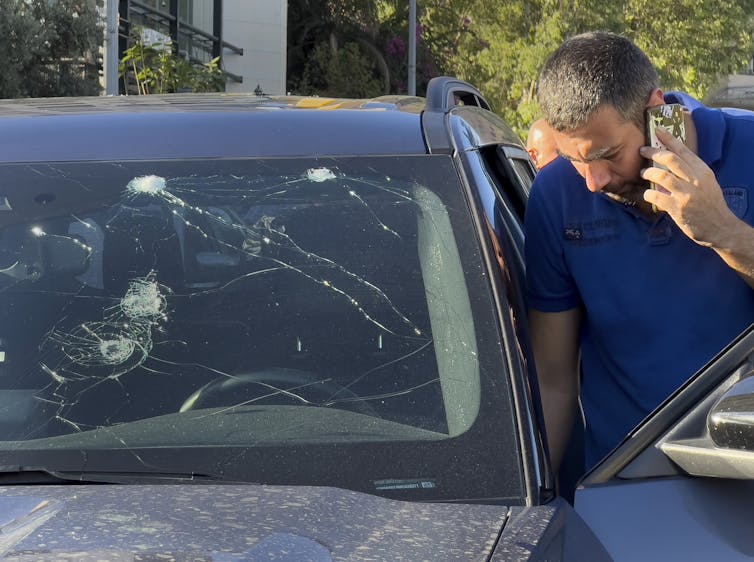
Last Updated on September 18, 2024 by Daily News StaffA police officer examines a damaged car after thousands of pagers exploded simultaneously across Lebanon on Sept. 17, 2024. AP Photo/Hussein Malla
Electronic pagers across Lebanon exploded simultaneously on Sept. 17, 2024, killing 12 and wounding more than 2,700. The following day, another wave of explosions in the country came from detonating walkie-talkies. The attacks appeared to target members of the militant group Hezbollah.
The pagers attack involved explosives planted in the communications devices by Israeli operatives, according to U.S. officials cited by The New York Times. Hezbollah had recently ordered a shipment of pagers, according to the report.
Secretly attacking the supply chain is not a new technique in intelligence and military operations. For example, the U.S. National Security Agency intercepted computer hardware bound for overseas customers, inserted malware or other surveillance tools and then repackaged them for delivery to certain foreign buyers, a 2010 NSA internal document showed. This differs from accessing a specific person’s device, such as when Israel’s Shin Bet secretly inserted explosives into a cellphone to remotely kill a Hamas bombmaker in 1996.
Hezbollah, a longtime adversary of Israel, had increased its use of pagers in the wake of the Hamas attack on Israel on Oct. 7, 2023. By shifting to relatively low-tech communication devices, including pagers and walkie-talkies, Hezbollah apparently sought an advantage against Israel’s well-known sophistication in tracking targets through their phones.The second wave of explosions in Lebanon involved walkie-talkies. AP Photo
Cellphones: The ultimate tracker
As a former cybersecurity professional and current security researcher, I view cellular devices as the ultimate tracking tool for both government and commercial entities – in addition to users, criminals and the mobile phone provider itself. As a result, mobile phone tracking has contributed to the fight against terrorism, located missing people and helped solve crimes.
Conversely, mobile phone tracking makes it easy for anyone to record a person’s most intimate movements. This can be done for legitimate purposes such as parents tracking children’s movements, helping you find your car in a parking lot, and commercial advertising, or nefarious ends such as remotely spying on a lover suspected of cheating or tracking political activists and journalists. Even the U.S. military remains concerned with how its soldiers might be tracked by their phones.
Mobile device tracking is conducted in several ways. First, there is the network location data generated by the phone as it moves past local cell towers or Stingray devices, which law enforcement agencies use to mimic cell towers. Then there are the features built into the phone’s operating system or enabled by downloaded apps that may lead to highly detailed user tracking, which users unwittingly agree to by ignoring the software’s privacy policy or terms of service.
This collected data is sometimes sold to governments or other companies for additional data mining and user profiling. And modern smartphones also have built-in Bluetooth, Wi-Fi and GPS capabilities that can help with locating and tracking user movements around the world, both from the ground and via satellites. https://www.youtube.com/embed/CxC1KCoGbIM?wmode=transparent&start=0 Your phone contains many sensors that make it useful – and easy to track.
Mobile devices can be tracked in real time or close to it. Common technical methods include traditional radio direction-finding techniques, using intelligence satellites or drones, deploying “man in the middle” tools like Stingrays to impersonate cellular towers to intercept and isolate device traffic, or installing malware such as Pegasus, made by Israeli cyberarms company NSO to report a device’s location.
Nontechnical and slower techniques of user tracking include potentially identifying general user locations from their internet activity. This can be done from website logs or the metadata contained in content posted to social media, or contracting with data brokers to receive any collected location data from the apps that a user might install on their device.
Advertisement
Indeed, because of these vulnerabilities, the leader of Hezbollah earlier this year advised his members to avoid using cellular phones in their activities, noting that Israel’s “surveillance devices are in your pockets. If you are looking for the Israeli agent, look at the phone in your hands and those of your wives and children.”
Researchers have shown how these features, often intended for the user’s convenience, can be used by governments, companies and criminals to track people in their daily lives and even predict movements. Many people still aren’t aware of how much their mobile devices disclose about them.
Pagers, however, unlike mobile phones, can be harder to track depending on whether they support two-way communication.
Why go low-tech
A pager that only receives messages does not provide a signal that can facilitate tracking its owner. Therefore, Hezbollah’s use of pagers likely made it more challenging to track their operatives – thus motivating Israeli intelligence services’ purported attack on the supply chain of Hezbollah’s pagers.
Using low-tech tactics and personal couriers while avoiding the use of mobile phones and digital tools also made it difficult for the technologically superior Western intelligence agencies to locate Osama bin Laden for years after the 9/11 attacks.
In general, I believe the adversary in an asymmetric conflict using low-tech techniques, tactics and technology will almost always be able to operate successfully against a more powerful and well-funded opponent.
A well-documented demonstration of this asymmetry in action was the U.S. military’s Millennium Challenge war game in 2002. Among other things, the insurgent Red forces, led by Marine General Paul van Riper, used low-tech tactics including motorcycle couriers instead of cellphones to evade the Blue forces’ high-tech surveillance. In the initial run of the exercise, the Red team won the contest in 24 hours, forcing exercise planners to controversially reset and update the scenario to ensure a Blue team victory.
Lessons for everyone
The preference for terrorist organizations like Hezbollah and al-Qaida to avoid using smartphones is a reminder for everyone that you can be, and likely are being tracked in various ways and for various purposes.
Israel’s purported response to Hezbollah’s actions also holds a lesson for everyone. From a cybersecurity perspective, it shows that any device in your life can be tampered with by an adversary at points along the supply chain – long before you even receive it.
The science section of our news blog STM Daily News provides readers with captivating and up-to-date information on the latest scientific discoveries, breakthroughs, and innovations across various fields. We offer engaging and accessible content, ensuring that readers with different levels of scientific knowledge can stay informed. Whether it’s exploring advancements in medicine, astronomy, technology, or environmental sciences, our science section strives to shed light on the intriguing world of scientific exploration and its profound impact on our daily lives. From thought-provoking articles to informative interviews with experts in the field, STM Daily News Science offers a harmonious blend of factual reporting, analysis, and exploration, making it a go-to source for science enthusiasts and curious minds alike. https://stmdailynews.com/category/science/
Veteran actor T.K. Carter, best known for his roles in The Thing and the popular 1980s television series Punky Brewster, has died at the age of 69.
Authorities confirmed Carter was found unresponsive at his home in Duarte, California. No foul play is suspected, and an official cause of death has not yet been released.
A Career Spanning Decades
Born Thomas Kent Carter, T.K. Carter built a career in film and television that spanned more than four decades. He became a cult favorite portraying Nauls in John Carpenter’s 1982 horror classic The Thing, a film that continues to influence the genre today.
Television audiences widely remember Carter for his role as Mike Fulton on Punky Brewster, where his comedic timing and grounded performances helped make the show a lasting favorite of the era.
Film and Television Legacy
In addition to his best-known roles, Carter appeared in films such as Runaway Train, Ski Patrol, and Space Jam. His television work included guest appearances on a wide range of series throughout the 1980s, 1990s, and beyond.
Known within the industry as a reliable and versatile performer, Carter often brought authenticity and warmth to supporting roles that left a lasting impression, even in brief appearances.
Remembering T.K. Carter
As news of his passing spreads, fans and colleagues alike are reflecting on T.K. Carter’s contributions to film and television. While he may not have always been the leading name on the marquee, his work helped shape stories that continue to be watched and appreciated by new generations.
T.K. Carter is remembered for his enduring performances, professional dedication, and the quiet but meaningful legacy he leaves behind.
Stay with STM Daily News for updates to this developing story and more independent coverage of entertainment, history, and culture. Visit www.stmdailynews.com for the latest.
Gregory Outreach Services Expands Food Access with Addition of Third Refrigerated Van
Gregory Outreach Services expands its mission to fight food insecurity with the addition of a third refrigerated van, doubling food access for low-income seniors and veterans in Phoenix.
Gregory Outreach Services’ newest refrigerated delivery van expands food access for low-income seniors and veterans across Phoenix.
Phoenix, AZ — Gregory Outreach Services has taken a major step forward in its mission to fight food insecurity with the addition of a third refrigerated delivery van, significantly expanding its capacity to serve low-income seniors and veterans across the Phoenix area.
The new refrigerated van was made possible through the support of a generous anonymous donor. The expansion is further strengthened by the continued generosity of the BHHS Legacy Foundation, who donated fresh produce to support the organization’s growing distribution efforts.
As rising food costs and inflation continue to place pressure on individuals living on fixed incomes, the need for reliable access to nutritious food has never been greater. This latest addition to the organization’s mobile fleet allows Gregory Outreach Services to double the number of individuals served, while maintaining strict food safety and quality standards.
“As the cost of living continues to rise, more seniors and veterans are struggling to afford nutritious food,” said Diana Gregory, Founder and CEO of Gregory Outreach Services. “This van allows us to bridge a widening gap for individuals living on fixed incomes, many of whom face mobility challenges and limited access to fresh food options.”
Meeting a Growing Community Need
Gregory Outreach Services works directly with seniors and veterans who are disproportionately affected by inflation, medical expenses, and transportation barriers. For many, simply reaching a grocery store can be a challenge. Refrigerated vehicles are essential to ensuring that fresh fruits and vegetables arrive safely and consistently at senior housing communities, veteran shelters, and community distribution sites.
“This third van complements the two already in operation and represents a critical milestone in our growth,” Gregory added. “We are deeply grateful to our anonymous donor for investing in our mission, and to BHHS Legacy Foundation’s Board of Directors and its CEO, Jerry Wissink for Legacy’s generosity in donating fresh produce. Together, this support allows us to scale our impact and respond to the increasing needs of our community.”
Expanding Impact While Preserving Dignity
With an expanded fleet and increased food supply, Gregory Outreach Services is better positioned to address food insecurity, promote healthier outcomes, and serve seniors and veterans with dignity, respect, and care. The organization’s mobile delivery model ensures help reaches those who need it most — directly and reliably.
About Gregory Outreach Services
Advertisement
Gregory Outreach Services is a nonprofit organization dedicated to improving health outcomes for low-income seniors and veterans through mobile produce delivery, nutrition education, and community-based wellness programs. By bringing fresh food directly to those most in need, the organization works to reduce food insecurity and strengthen community wellness.
Discover inspiring stories of changemakers making a positive impact. Explore videos and articles of people tackling today’s biggest challenges with action and hope. Visit: https://stmdailynews.com/stories-of-change/
Dive into “The Knowledge,” where curiosity meets clarity. This playlist, in collaboration with STMDailyNews.com, is designed for viewers who value historical accuracy and insightful learning. Our short videos, ranging from 30 seconds to a minute and a half, make complex subjects easy to grasp in no time. Covering everything from historical events to contemporary processes and entertainment, “The Knowledge” bridges the past with the present. In a world where information is abundant yet often misused, our series aims to guide you through the noise, preserving vital knowledge and truths that shape our lives today. Perfect for curious minds eager to discover the ‘why’ and ‘how’ of everything around us. Subscribe and join in as we explore the facts that matter. https://stmdailynews.com/the-knowledge/Get The Knowledge. Read more community news and local stories at STM Daily News.
Slayer Rule Explained: How Rob Reiner’s Estate Could Be Handled After the Killings
After the deaths of Rob Reiner and Michele Singer Reiner, legal experts explain how the “slayer rule” can block a killer from inheriting—and what could happen next in probate court.
All states have some form of a slayer rule that prevents killers from inheriting from their victims. While the rules differ slightly from state to state, they always bar murderers from profiting from their own crimes. Simply put, if you’re found guilty of killing someone or plead guilty to their murder, you can’t inherit anything from your victim’s estate. In some states, this might go beyond inheritance and apply to jointly held property, insurance policies and other kinds of accounts. Most of these slayer rules, including California’s, apply only to “felonious and intentional” killings, meaning that they don’t apply if you accidentally kill someone. Although there doesn’t have to be a guilty verdict by a judge or a jury, or a guilty plea from the accused, there must be some finding by a criminal or civil court of an intentional and felonious killing. These rules, known as slayer rules, have a long history in the United States. They became more prominent following an 1889 murder case in New York state, in which a 16-year-old boy poisoned his grandfather to get an inheritance that was written into his grandfather’s will.
How often are slayer rules invoked?
It’s hard to say for sure. As far as we know, nobody’s tried to keep track. Slayer rules come into play whenever someone who would otherwise inherit assets from an estate is convicted of or found liable for murder, and the slayer is entitled to inherit from the victim. These tragic cases almost always involve murders committed by relatives. Many of the high-profile ones have been tied to murders that occurred in California. Famous disinherited murderers include Lyle and Erik Menendez, the Californians known as the Menendez brothers. In 1996, a jury found them guilty of the first-degree murder of their parents, José and Mary Louise “Kitty” Menendez. The Menendez brothers’ parents, who were killed in 1989, had a fortune that today would be worth more than $35 million. The brothers, who became eligible for parole but were denied it in 2025, have been in prison ever since. Once there has been a finding of an intentional and felonious killing, even if the slayer is later released on parole – or even if they serve no prison time at all – they would still not inherit anything. In practical terms, that means if one or both of the Menendez brothers were to win parole in the future, they would still be ineligible to inherit any of their parents’ wealth upon their release from prison. California’s slayer rule also meant that salesman Scott Peterson, who was convicted of killing his pregnant wife, Laci Peterson, in 2002, couldn’t collect the money he would otherwise have been due from her life insurance policy. Peterson has been in prison since 2005.Erik Menendez, left, and Lyle Menendez, seen standing trial for their parents’ murders, in 1994. They were convicted in 1996.Ted Soqui/Sygma via Getty Images
What can block its application?
In the absence of a murder conviction, the slayer rule may not apply. For example, a conviction for a lesser criminal offense, such as manslaughter, might allow the accused – or their lawyers – to argue that the killing was unintentional. This exception could be relevant to the prosecution of the Reiners’ murders if it were to turn out that Nick Reiner’s defense can show that substance abuseor schizophrenia rendered him insane when he allegedly killed his parents at their Los Angeles home. On the other hand, under California law, even if there is no conviction the probate court administering the murder victim’s estate could still separately find that the killing was intentional and felonious. That civil finding would bar the slayer from inheriting without a criminal conviction.Rob Reiner and his son Nick, seen in 2016 speaking about ‘Being Charlie,’ the movie about a young man’s struggle with substance use that they made together.Laura Cavanaugh/FilmMagic via Getty Images
Does this only apply to families with big fortunes?
Slayer rules apply to anyone who kills one or more of their relatives, whether their victims were rich, poor or in between. When large amounts of money are at stake, cases tend to garner more attention due to media coverage during the criminal trial and subsequent inheritance litigation.
Who will inherit Rob Reiner’s and Michele Singer Reiner’s wealth?
It’s too soon for both the public and the family to know who will inherit ultimately from the Reiners. Wills are typically public documents, although the Reiners may have also engaged in other types of estate planning, such as trusts, that do not typically become public records. And celebrities with valuable intellectual property rights, such as copyrights from the Reiners’ many film and television properties, tend to establish trusts. Assuming that, like many parents, the Reiners left most of their fortune – which reportedly was worth some US$200 million – to their children, including Nick, then California’s slayer statute may come into play. The couple had two other children together, Romy and Jake. Rob Reiner also had another daughter, Tracy Reiner, whom he adopted after his marriage to his first wife, the actor and filmmaker Penny Marshall. It’s also likely that the Reiners included charitable bequests in their estate plans. They were strong supporters of many causes, including early childhood development.
Might the slayer rule apply to Nick Reiner?
It’s much too soon to know. It is important to emphasize that the wills and other estate planning documents of Rob Reiner and Michele Singer Reiner have not yet been made public. That means what Nick Reiner might stand to inherit, if the slayer rule were to prove irrelevant in this case, is unknown. Nor, with the investigation of the couple’s deaths still underway, can anyone make any assumptions about Nick’s innocence or guilt. And, as of mid-December 2025, an unnamed source was telling entertainment reporters that Nick Reiner’s legal bills were being paid for by the Reiner family. Naomi Cahn, Professor of Law, University of Virginia and Reid Kress Weisbord, Distinguished Professor of Law and Judge Norma Shapiro Scholar, Rutgers University – Newark This article is republished from The Conversation under a Creative Commons license. Read the original article.