

Community
News coverage boosts giving after disasters – Australian research team’s findings may offer lessons for Los Angeles fires
Media coverage significantly influences charitable donations during disasters by highlighting urgency, personal stories, and the scale of the crisis, shaping public generosity and nonprofit support choices.


Cassandra Chapman, The University of Queensland
In late 2019 and early 2020, a series of devastating wildfires, known as the “black summer” bushfire disaster, left Australia reeling: More than 20% of the country’s forests burned.
As a scholar of the psychology of charitable giving, I have long been interested in the unique emotional response that disasters evoke – often generating an urgent and visceral wish to help.
I wanted to understand how and why people respond to a crisis of this magnitude. For the project, I teamed up with three Australian environmental psychology and collective action experts: Matthew Hornsey, Kelly Fielding and Robyn Gulliver.
We found that international media coverage of disasters can help increase donations. Our findings, which were published in the peer-reviewed academic journal Disasters in 2022, are relevant to the situation in Los Angeles, where severe fires destroyed thousands of homes and businesses in January 2025, devastating many communities.
That recovery could take years.
5 key factors affect generosity
All told, Australian donors gave more than US$397 million, or $640 million in Australian dollars, to support the recovery from the black summer bushfire disaster. The international community also rallied: U.S. and U.K. donors contributed an additional US$2.6 million. These donations were used to fund evacuation centers, support groups for victims, and cash grants for repairs and rebuilding, among other things.
When we surveyed 949 Australians about what influenced their donations and analyzed news articles about the disaster, we found that coverage of disasters significantly increased generosity and influenced which charities drew donations. This may be because news articles communicated directly the need for charitable support.
Using this survey data, we identified key factors that influenced how much money, if any, people donated in response to the bushfire disaster appeals. These five were linked with the amounts Australians donated:
• Scale: The sheer scale of the fires.
• Personal impact: Having been personally affected, knowing people who have been affected, or being worried that they will be affected in the future.
• Climate change beliefs: Believing that climate change is impacting the environment.
• News footage: The dramatic footage of the fires they have seen.
• Stories: The stories of those who have been affected.
Three of these factors – scale, news footage and stories – relate to information people were exposed to in media coverage of the disaster. Further, when we asked people how they chose which charities to support, they said that media coverage was more influential than either their friends and family or direct communication from those same charities.
These findings collectively show how media coverage can powerfully influence both how much people give to disaster relief and which nonprofits they choose to support.
Setting the agenda
In the next phase of our research, we tried to learn how media coverage affects the public’s generosity.
We downloaded every news article we could find about the disaster over the three-month period that fires raged and analyzed the text of 30,239 news articles using Linguistic Inquiry and Word Count software.
We looked at which kinds of language and concepts were being used in media coverage, and how frequently they were used compared with their use in everyday written language.
In addition to concepts we expected to see, like emergency, heroes and human loss, we found that the concepts of support and money frequently showed up in coverage. Words like “donations,” “help” and “support” occurred in 74% of news articles. Words having to do with money were even more common: They appeared almost twice as often as they do in ordinary written language.
Our findings suggest that news coverage may have helped to set the agenda for the huge charitable response to Australia’s wildfire disaster because the media told people what they should be thinking about in terms of that disaster. In Australia’s case, it was how they could help.
A consideration for the media
We also believe that it’s likely that news coverage of disasters like this one can serve an agenda-setting function by teaching the public how to think about the crisis.
To the extent that news coverage highlights concepts like support, possibly communicating that donating is a normal response to a crisis, it’s reasonable to expect people to donate more money.
Given that news coverage can influence how much someone donates, as well as which charities they choose to support, nonprofits responding to the Los Angeles fires may wish to encourage media outlets to mention their work in news coverage.
It is likely that being featured in news coverage – especially when calls to action or opportunities to donate are incorporated in an article – would result in more funds being raised for the charity’s response to the disaster.
Cassandra Chapman, Associate Professor, The University of Queensland
This article is republished from The Conversation under a Creative Commons license. Read the original article.

Community
‘Give Like a Kid Again’ for Real-World Impact This Halloween
Costumes. Candy. Jack-o-lanterns glowing on porches. Halloween is filled with moments that spark children’s imaginations. This Halloween, children and families can “Give Like a Kid Again,” turning imagination into kindness and helping children around the world.

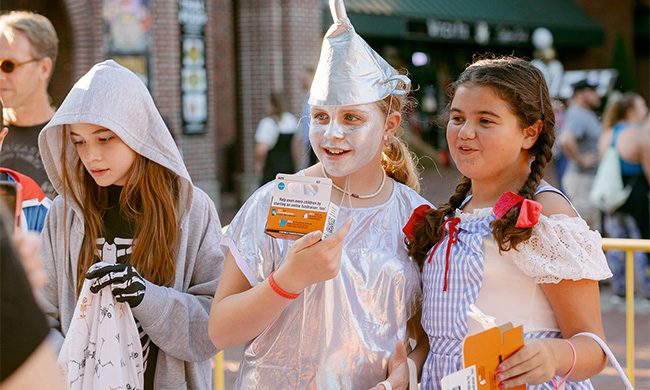
‘Give Like a Kid Again’ for Real-World Impact This Halloween
(Feature Impact)Costumes. Candy. Jack-o-lanterns glowing on porches. Halloween is filled with moments that spark children’s imaginations.
This Halloween, Trick-or-Treat for UNICEF is inviting children and families to “Give Like a Kid Again,” turning imagination into kindness and helping children around the world. For eight decades,the campaign has shown children that even the smallest act of kindness can travel farther than any front porch and shine brighter than any jack-o-lantern. As the longest-running youth engagement campaign in the United States, it has inspired generations of children to discover that when kids help kids, one Halloween tradition can turn into a lifetime of impact.
What started with just $17 in 1950, when a small group of children filled milk cartons with spare change to help children recovering from World War II, has grown into one of America’s most beloved Halloween traditions, raising nearly $200million to help the organization deliver lifesaving support for children around the world. Today, the iconic orange collection box reminds families that small acts of generosity can create lasting change.
“Each Halloween, Trick-or-Treat for UNICEF reminds us that even the smallest acts of generosity can grow into something extraordinary,” said Shelley Diamond, chief marketing officer, UNICEF USA. “For more than 75 years, this campaign has shown generations of children that you are never too young to make a difference and ‘Give Like a Kid Again’ is about passing that belief on to the next generation.”
Beyond supporting programs in more than 190 countries and territories, donations strengthen the organization’s global humanitarian supply network, delivering emergency essentials like therapeutic food, medicine, blankets and safe water to children impacted by conflict, disasters and disease.
- Be a mermaid and help make waves for clean water. Help provide safe water for a child for a year for $5.
- Be a vampire and help scare away preventable diseases. World Polio Day, just a week before Halloween, provides an opportunity to protect 200 children under age 5 from polio with a $43 donation.
- Be a scientist and help uncover lifesaving answers. Provide 25 malaria diagnostic tests for just $8, helping children receive timely treatment.
- Be a teacher and help children write their next chapter. Provide 1,000 pencils to help children put their ideas, lessons and dreams on paper for $30.
- Be a chef and help cook up a healthier future. Over a two-month period, $10 can treat 15 children by providing 450 packets of micronutrient powder.
- Be an astronaut and help a girl reach for the stars. To helpsix girls feel confident in school, $36 can provide reusable menstrual pads.
- Be a snowman and help bundle up a child against the cold. A donation of $50 could provide a child in an emergency setting with winter clothing, including a jacket, hat, scarf, mittens, socks, winter boots, a warm sweater and warm puffball trousers.
- Be a soccer player (or referee) and help kick off playtime. Provide up to four packages of soccer balls for a child-friendly space for $25 to help kids just be kids again.
This October, everyone can “Give Like a Kid Again” through the iconic orange collection box, online fundraising and family-friendly activities. Visit unicefusa.org/TOT2026 to join the tradition and help make a difference for children around the world.
SOURCE:
UNICEF
📰 Enjoying STM Daily News? Join the conversation!
💬 Leave a comment, share your thoughts, and subscribe to our newsletter for the latest stories, updates, and “News You Can Use This Moment!” delivered to your inbox.
Stay connected with STM Daily News!

Community
PenFed Foundation Raises Over $1.2M for Veterans and Military Families at 23rd Annual Military Heroes Golf Classic
The PenFed Foundation says it raised over $1.2 million for veterans and military families at its 23rd annual Military Heroes Golf Classic.

The PenFed Foundation for Military Heroes said it raised more than $1.2 million to support veterans and military families during its 23rd annual Military Heroes Golf Classic, held Monday, Aug. 31, according to a PRNewswire release. The nonprofit, based in the Washington, D.C. region, focuses on helping veterans transition “from service to success” through programs and grants aimed at military-connected communities.
“We are deeply grateful to our partners and supporters whose generosity and dedication make this event—and the Foundation’s work—possible,” said retired Air Force Lt. Gen. Bradford J. “B.J.” Shwedo, president of the PenFed Foundation, in a statement announcing the fundraising total.
At a dinner held the night before the Golf Classic, PenFed Credit Union President/CEO and PenFed Foundation CEO James Schenck recognized Ed Cody for 25 years of service on the foundation’s board of directors. Cody also serves as chairman of the PenFed Credit Union board and was credited with helping guide initiatives including Defender’s Lodge, the Afghan Rescue and Resettlement Program, the Veteran Entrepreneur Program, and grants supporting wounded, ill, and injured service members.
The foundation said it has provided more than $55 million in financial support to veterans, active-duty service members, and military families since it was founded in 2001. It also noted that PenFed Credit Union covers salaries and administrative costs, allowing more donations to go directly to programs.
What to watch for: How the foundation allocates the new $1.2M across its veteran transition and emergency support programs—and whether it announces new grant rounds tied to entrepreneurship and resettlement work.
SOURCE PenFed Foundation
Subscribe to our newsletter STM Morning Brief!
Community
Veggies for Veterans Distributes 600 Produce Bags at Phoenix VA
Volunteers distributed 600 bags of fresh produce in less than an hour during the latest Veggies for Veterans event at the Phoenix VA Medical Center. Santander participated for the first time, while Peddler’s Son donated watermelons.

Last Updated on September 21, 2026 by Daily News Staff
Santander made its first appearance alongside volunteers and partners supporting the fresh-food distribution.
PHOENIX — Volunteers distributed 600 bags of fresh fruits and vegetables to veterans in less than an hour during the September 10 Veggies for Veterans event at the Phoenix VA Medical Center.
Hosted by Diana Gregory Outreach Services, the event brought volunteers together in an assembly line to pack grocery bags and distribute them to waiting veterans. Participating volunteer groups and partners included SRP, State Farm, Fry’s, Legacy, BHHS Legacy and Santander.
“It’s been almost a decade since we’ve been doing Veggies for Veterans,” Diana Gregory said. “We want to thank all the volunteers, our partners and everyone who makes this possible.”
Veterans received an additional seasonal treat during the distribution. Peddler’s Son donated watermelons for the event, providing a bonus item alongside the bags of produce.
Dr. Isabel Kozak, a partner in the outreach effort, said the fresh food can be especially meaningful for veterans managing chronic health conditions.
“We distributed 600 bags to veterans today, and I heard many, many heartfelt thank-yous,” Dr. Kozak said. “We have veterans who have hypertension and diabetes, and I think it’s really important that we provide this very nutritious food.”
The strong early turnout kept volunteers busy as veterans moved through the indoor distribution area and the outdoor setup near the medical center’s main entrance. Gregory praised the teamwork that allowed all 600 bags to be handed out in under an hour.
Diana Gregory Outreach Services plans to hold two more community events before the end of 2026. One will be another Veggies for Veterans distribution in November, featuring more fresh fruits and vegetables.
The organization’s continuing work supports its broader mission of uplifting veterans and seniors throughout the Phoenix community.
To learn more about Veggies for Veterans, upcoming community events, volunteer opportunities or ways to support Diana Gregory Outreach Services, visit DianaGregory.com.
Reporting and video production by STM Daily News and TNC Network, LLC.





