Connect with us

Food

How Pecans Became a Holiday Staple: 8,000 Years of American Pecan History

Pecan History? Discover the 8,000-year history of pecans—America’s only native major nut crop. Learn how pecans evolved from wild, overlooked trees to a beloved holiday staple found in pies, pralines, and more.

Published

on

Last Updated on December 18, 2025 by Daily News Staff

How Pecans Became a Holiday Staple: 8,000 Years of American Pecan History
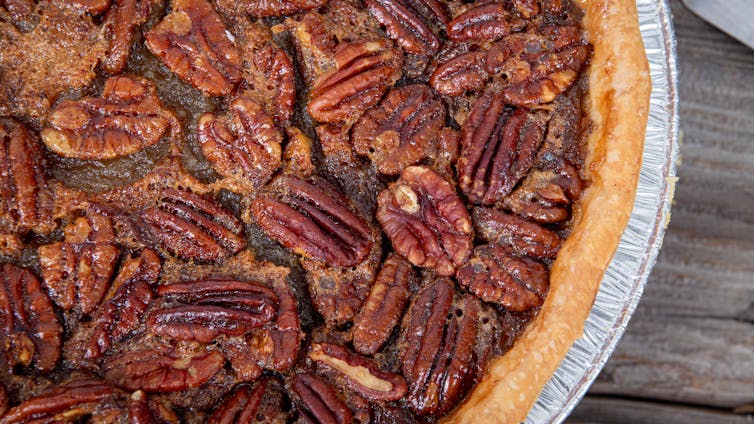
Pecan pie is a popular holiday treat in the United States.
Julie Deshaies/iStock via Getty Images

How Pecans Became a Holiday Staple: 8,000 Years of American Pecan History

Shelley Mitchell, Oklahoma State University

Pecans have a storied history in the United States. Today, American trees produce hundreds of million of pounds of pecans – 80% of the world’s pecan crop. Most of that crop stays here. Pecans are used to produce pecan milk, butter and oil, but many of the nuts end up in pecan pies.

Throughout history, pecans have been overlooked, poached, cultivated and improved. As they have spread throughout the United States, they have been eaten raw and in recipes. Pecans have grown more popular over the decades, and you will probably encounter them in some form this holiday season.

I’m an extension specialist in Oklahoma, a state consistently ranked fifth in pecan production, behind Georgia, New Mexico, Arizona and Texas. I’ll admit that I am not a fan of the taste of pecans, which leaves more for the squirrels, crows and enthusiastic pecan lovers.

The spread of pecans

The pecan is a nut related to the hickory. Actually, though we call them nuts, pecans are actually a type of fruit called a drupe. Drupes have pits, like the peach and cherry.

Three green, oval-shaped pods on the branch of a tree
Three pecan fruits, which ripen and split open to release pecan nuts, clustered on a pecan tree.
IAISI/Moment via Getty Images

The pecan nuts that look like little brown footballs are actually the seed that starts inside the pecan fruit – until the fruit ripens and splits open to release the pecan. They are usually the size of your thumb, and you may need a nutcracker to open them. You can eat them raw or as part of a cooked dish.

The pecan derives its name from the Algonquin “pakani,” which means “a nut too hard to crack by hand.” Rich in fat and easy to transport, pecans traveled with Native Americans throughout what is now the southern United States. They were used for food, medicine and trade as early as 8,000 years ago.

A map of the US with parts of Texas, Louisiana, Oklahoma, Arkansas and Missouri highlighted in green.
Pecans are native to the southern United States.
Elbert L. Little Jr. of the U.S. Department of Agriculture, Forest Service

Pecans are native to the southern United States, and while they had previously spread along travel and trade routes, the first documented purposeful planting of a pecan tree was in New York in 1722. Three years later, George Washington’s estate, Mount Vernon, had some planted pecans. Washington loved pecans, and Revolutionary War soldiers said he was constantly eating them.

Meanwhile, no one needed to plant pecans in the South, since they naturally grew along riverbanks and in groves. Pecan trees are alternate bearing: They will have a very large crop one year, followed by one or two very small crops. But because they naturally produced a harvest with no input from farmers, people did not need to actively cultivate them. Locals would harvest nuts for themselves but otherwise ignored the self-sufficient trees.

It wasn’t until the late 1800s that people in the pecan’s native range realized the pecan’s potential worth for income and trade. Harvesting pecans became competitive, and young boys would climb onto precarious tree branches. One girl was lifted by a hot air balloon so she could beat on the upper branches of trees and let them fall to collectors below. Pecan poaching was a problem in natural groves on private property.

Pecan cultivation begins

Even with so obvious a demand, cultivated orchards in the South were still rare into the 1900s. Pecan trees don’t produce nuts for several years after planting, so their future quality is unknown.

Two lines of trees
An orchard of pecan trees.
Jon Frederick/iStock via Getty Images

To guarantee quality nuts, farmers began using a technique called grafting; they’d join branches from quality trees to another pecan tree’s trunk. The first attempt at grafting pecans was in 1822, but the attempts weren’t very successful.

Grafting pecans became popular after an enslaved man named Antoine who lived on a Louisiana plantation successfully produced large pecans with tender shells by grafting, around 1846. His pecans became the first widely available improved pecan variety.

Advertisement
Get More From A Face Cleanser And Spa-like Massage
A cut tree trunk with two smaller, thiner shoots (from a different type of tree) protruding from it.
Grafting is a technique that involves connecting the branch of one tree to the trunk of another.
Orest Lyzhechka/iStock via Getty Images

The variety was named Centennial because it was introduced to the public 30 years later at the Philadelphia Centennial Expedition in 1876, alongside the telephone, Heinz ketchup and the right arm of the Statue of Liberty.

This technique also sped up the production process. To keep pecan quality up and produce consistent annual harvests, today’s pecan growers shake the trees while the nuts are still growing, until about half of the pecans fall off. This reduces the number of nuts so that the tree can put more energy into fewer pecans, which leads to better quality. Shaking also evens out the yield, so that the alternate-bearing characteristic doesn’t create a boom-bust cycle.

US pecan consumption

The French brought praline dessert with them when they immigrated to Louisiana in the early 1700s. A praline is a flat, creamy candy made with nuts, sugar, butter and cream. Their original recipe used almonds, but at the time, the only nut available in America was the pecan, so pecan pralines were born.

Two clusters of nuts and creamy butter on a plate.
Pralines were originally a French dessert, but Americans began making them with pecans.
Jupiterimages/The Image Bank via Getty Images

During the Civil War and world wars, Americans consumed pecans in large quantities because they were a protein-packed alternative when meat was expensive and scarce. One cup of pecan halves has about 9 grams of protein.

After the wars, pecan demand declined, resulting in millions of excess pounds at harvest. One effort to increase demand was a national pecan recipe contest in 1924. Over 21,000 submissions came from over 5,000 cooks, with 800 of them published in a book.

Pecan consumption went up with the inclusion of pecans in commercially prepared foods and the start of the mail-order industry in the 1870s, as pecans can be shipped and stored at room temperature. That characteristic also put them on some Apollo missions. Small amounts of pecans contain many vitamins and minerals. They became commonplace in cereals, which touted their health benefits.

In 1938, the federal government published the pamphlet Nuts and How to Use Them, which touted pecans’ nutritional value and came with recipes. Food writers suggested using pecans as shortening because they are composed mostly of fat.

The government even put a price ceiling on pecans to encourage consumption, but consumers weren’t buying them. The government ended up buying the surplus pecans and integrating them into the National School Lunch Program.

A machine with an arm attached to a tree, and a wheeled cab on the ground.
Today, pecan producers use machines called tree shakers to shake pecans out of the trees.
Christine_Kohler/iStock via Getty Images

While you are sitting around the Thanksgiving table this year, you can discuss one of the biggest controversies in the pecan industry: Are they PEE-cans or puh-KAHNS?

Editor’s note: This article was updated to include the amount of protein in a cup of pecans.

Shelley Mitchell, Senior Extension Specialist in Horticulture and Landscape Architecture, Oklahoma State University

This article is republished from The Conversation under a Creative Commons license. Read the original article.

Food and Drink

Advertisement
Get More From A Face Cleanser And Spa-like Massage

Link: https://stmdailynews.com/food-and-drink/

HUNGRY FOR MORE?

Discover a feast for your senses with our Food & Drink Blog, a tantalizing part of STM Daily News. Get the latest articles, recipes, and foodie news delivered straight to your inbox. Satisfaction guaranteed!

SIGN UP TO RECEIVE THE LATEST RECIPES & FOODIE NEWS, PLUS SOME EXCLUSIVE GOODIES!

We don’t spam! Read our privacy policy for more info.

Food and Drink

Discover more from Daily News

Subscribe to get the latest posts sent to your email.

Continue Reading
Advertisement Tool Tickets
Click to comment
0 0 votes
Article Rating
Subscribe
Notify of
guest

0 Comments
Oldest
Newest Most Voted
Inline Feedbacks
View all comments

Food

Chef Swap at the Beach Christmas Special Hits Cooking Channel Dec. 20 — and You Can Taste It in Myrtle Beach

Chef Swap at the Beach returns with a Christmas Special on Dec. 20 on Cooking Channel. Plus, Myrtle Beach’s new Chef Swap Chef’s Table Pass lets visitors dine at featured restaurants across the Grand Strand.

Published

on

Chef Swap at the Beach Christmas Special cast pictured at the International Culinary Institute of Myrtle Beach promoting the Dec. 20 Cooking Channel episode and the Chef Swap Chef’s Table Pass

A “Chef Swap at The Beach” Christmas Special will air December 20 on the Cooking Channel. The cast includes L-R: Jamie Daskalis, Jason Trinh, Johanna Wilson Jones, Mason Zeglen, Dylan Foster, Jess Sagun, Gabriel Hernandez. The holiday-themed episode was filmed at the International Culinary Institute of Myrtle Beach. In addition, the new Chef Swap Chef’s Table Pass dining trail allows fans to engage with the featured restaurants and chefs when in Myrtle Beach. Credit: Visit Myrtle Beach

Chef Swap at the Beach Christmas Special Hits Cooking Channel Dec. 20 — and You Can Taste It in Myrtle Beach

If you’ve ever watched a cooking competition and thought, I need to eat that, Myrtle Beach is making it easy to turn screen-time cravings into real-life reservations. On Dec. 20, the Cooking Channel will air a festive new episode of “Chef Swap at The Beach” — a Christmas Special that brings back familiar chefs from past seasons for a holiday-themed cooking competition. And for anyone planning a trip (or looking for a reason to), the show’s newest extension makes the experience even more tangible: the Chef Swap Chef’s Table Pass, a free digital dining trail that connects fans directly to the restaurants featured across the series.

A holiday episode built on community (and a little friendly pressure)

The Christmas Special follows the established “Chef Swap” format: chefs step outside their own kitchens and comfort zones, then race to create themed dishes under tight time constraints. The twist is the season. Filmed at the International Culinary Institute of Myrtle Beach, the special leans into holiday energy with seasonal elements and a charitable component — while still spotlighting what the series does best: collaboration, creativity, and the relationships that make the Myrtle Beach food scene feel like a community. As Stuart Butler, President of Visit Myrtle Beach, put it, the series has become “a meaningful way to showcase the talent of the Myrtle Beach area’s culinary community to a national audience,” reflecting “the relationships and sense of community that exist across the Grand Strand.”

Why the International Culinary Institute matters

The setting isn’t just a backdrop. The International Culinary Institute of Myrtle Beach plays a real role in the region’s dining identity — serving as a training ground for aspiring chefs and hospitality pros, and helping feed the local restaurant ecosystem with new talent. In other words: Myrtle Beach’s culinary growth isn’t accidental. It’s being built, taught, and refined — and this special gives viewers a look at that foundation.

The Chef Swap Chef’s Table Pass: from TV episode to dining itinerary

Here’s the part that makes this more than a one-night watch. Restaurants featured throughout multiple seasons of “Chef Swap at The Beach” are now included in the Chef Swap Chef’s Table Pass, a self-guided dining trail that visitors can use while exploring the Grand Strand. When you sign up for the free digital pass, you unlock a mobile “passport” to participating restaurants, including:
  • Special offers
  • Insights into the show’s signature dishes
  • A curated way to experience restaurants from every season, year-round
It’s a smart move for food lovers who want structure without feeling boxed in — and a fun way to build a Myrtle Beach trip around meals you’ll actually remember. For details on the pass and participating restaurants, visit ChefSwap.com.

Myrtle Beach: more than 60 miles of oceanfront

Yes, Myrtle Beach has 60 miles of beautiful oceanfront — but the story Visit Myrtle Beach is telling here is bigger than sand and surf. Known as the Grand Strand, Myrtle Beach is made up of 14 unique communities along South Carolina’s northeast coast. Visitors come for the classic vacation staples — entertainment, family attractions, shopping, and world-class golf — but increasingly, they’re also coming hungry. Fresh coastal Carolina cuisine isn’t a side note anymore. It’s part of the main event.

Mark your calendar (and maybe your restaurant list)

If you’re looking for a holiday watch that’s equal parts competition and community, set a reminder for Dec. 20 on the Cooking Channel. And if you want to take it one step further, the Chef Swap Chef’s Table Pass gives you a ready-made reason to plan a winter escape — one plate at a time. Learn more about Myrtle Beach tourism: visitmyrtlebeach.com Explore the Chef’s Table Pass: ChefSwap.com
The fate of Lucky Supermarkets in SoCal
Link: https://stmdailynews.com/the-fate-of-lucky-supermarkets-in-socal/

Discover more from Daily News

Subscribe to get the latest posts sent to your email.

Continue Reading

Food

Fresh Del Monte Honored at Rabobank Leadership Summit: Shaping the Future of Food

Fresh Del Monte was honored at the Rabobank Leadership Summit for its commitment to responsible growth, innovation, and sustainability in the global food industry. Discover how this visionary company is shaping the future of food.

Published

on

Fresh Del Monte leadership team receiving the Rabobank Leadership Award at the 2025 Rabobank Leadership Summit in New York City.

Heap of fresh fruits and vegetables

Fresh Del Monte Honored at Rabobank Leadership Summit: Shaping the Future of Food

Celebrating Responsible Growth and Visionary Leadership in the Food Industry
Fresh Del Monte Produce Inc. has been recognized as a trailblazer in the food and agribusiness sector, receiving the prestigious Rabobank North America Leadership Award at this year’s Rabobank Leadership Summit in New York City. The event, attended by over 400 industry leaders, celebrated Fresh Del Monte’s commitment to driving responsible growth and innovation across the global food supply chain.
Rabobank Leadership Award

Fresh Del Monte was honored among 400 distinguished guests during Rabobank’s annual Leadership Summit held in New York City on Thursday, December 4.

A Legacy of Innovation and Sustainability
For nearly 140 years, Fresh Del Monte has nourished families worldwide with high-quality fresh fruits and vegetables. Today, their influence spans more than 80 countries, where they continue to advance new products, technologies, and farming practices that set industry standards for quality, resilience, and responsibility. Their sustainability efforts go well beyond the farm—protecting biodiversity, investing in regenerative agriculture, and supporting essential services in the communities they serve.
Recognition for Visionary Leadership
David Bassett, Head of Wholesale Banking North America at Rabobank, praised Fresh Del Monte for exemplifying true leadership in a rapidly evolving industry: “Through bold innovation and a steadfast commitment to sustainability, they are not only stewarding responsible growth but also shaping the future of food for generations to come.”
Fresh Del Monte’s Chairman and CEO, Mohammad Abu-Ghazaleh, credited the global team for this achievement, emphasizing their focus on responsible growth and operational discipline. “This recognition reflects the hard work of our global team, whose focus on responsible growth and operational discipline has strengthened our company and supported our mission to deliver healthy, high-quality food to millions around the world.”
Leading with Innovation and Trust
Fresh Del Monte’s drive for innovation has led to unique offerings such as the Rubyglow® red-shelled pineapple and the Pinkglow® pink-fleshed pineapple, responding to evolving consumer tastes and trends. The company is also a pioneer in setting science-based sustainability targets and has earned repeated recognition as one of “America’s Most Trusted Companies.”
About Rabobank and Fresh Del Monte
Rabobank is a global leader in food, agribusiness, and energy financing, supporting clients across the value chain with advisory and investment solutions. Fresh Del Monte, listed on the NYSE as FDP, remains at the forefront of food production, sustainability, and community impact, building a brighter world for tomorrow.
Source: Rabobank and PR Newswire Read the full press release

At our core, we at STM Daily News, strive to keep you informed and inspired with the freshest content on all things food and beverage. From mouthwatering recipes to intriguing articles, we’re here to satisfy your appetite for culinary knowledge.

Visit our Food & Drink section to get the latest on Foodie News and recipes, offering a delightful blend of culinary inspiration and gastronomic trends to elevate your dining experience. https://stmdailynews.com/food-and-drink/


Discover more from Daily News

Subscribe to get the latest posts sent to your email.

Continue Reading

Food

Organic Dried Fruit Market Set to Hit $5.78 Billion by 2033: What’s Fueling the Surge?

The global organic dried fruit market is projected to reach $5.78 billion by 2033, fueled by rising demand for clean-label, healthy snacks and innovative packaging. Discover key trends, opportunities, and insights shaping this fast-growing industry.

Published

on

Health, Innovation, and Sustainability Drive Organic Dried Fruit Market Growth

Health, Innovation, and Sustainability Drive Organic Dried Fruit Market Growth


Organic Dried Fruit Market Set to Hit $5.78 Billion by 2033: What’s Fueling the Surge?

The global appetite for organic dried fruit is showing no signs of slowing down. According to a new report from Verified Market Reports®, the organic dried fruit market is projected to soar from $3.35 billion in 2024 to a remarkable $5.78 billion by 2033, powered by a steady 6.5% compound annual growth rate (CAGR). Let’s break down what’s behind this impressive growth—and what it means for consumers, brands, and producers alike.

Why the Boom in Organic Dried Fruit?

Health and Clean Labels Take Center Stage Consumers are increasingly seeking out snacks that are both nutrient-dense and clean-label. Organic dried fruit checks both boxes, offering a plant-based, minimally processed option for health-conscious shoppers. With more people prioritizing wellness and clean eating, demand is surging across both retail shelves and e-commerce platforms. Innovation in Processing and Packaging Today’s dried fruit is a far cry from the chewy raisins of the past. Advances in dehydration technology and packaging—think vacuum-drying, low-temperature dehydration, and modified-atmosphere packaging—are preserving nutrients and extending shelf life. The result? Higher-quality products, new flavor blends, and a premium snacking experience. Sustainability and Traceability Matter It’s not just about what’s in the bag, but where it comes from. The market is seeing a push for greater transparency, with blockchain-based traceability and partnerships focused on regenerative agriculture. Brands that can verify their sourcing and sustainability practices are earning consumer trust and commanding premium prices.

Market Trends and Opportunities

  • Premiumization: Shoppers are trading up to certified organic, branded dried fruit for both snacking and as functional ingredients. This is driving higher average selling prices and margins for brands that can deliver on quality and story.
  • Private Label Growth: Retailers are expanding their own organic dried fruit lines, adding competition and encouraging established brands to innovate with new formats and blends.
  • Beyond Snacking: Dried fruit isn’t just for snacking anymore. It’s popping up in cereals, bakery items, health supplements, and even premium foodservice applications like mixology and garnishes.
  • Regulatory Landscape: Stricter pesticide controls and harmonized organic certifications are shaping market access, especially in Europe and North America. Companies that stay ahead of these standards are better positioned for export growth.

Global Market Structure

  • Asia Pacific is leading in production and export growth, thanks to efficient processing infrastructure and expanding organic acreage.
  • Europe dominates premium demand, with high per-capita consumption and rigorous regulatory standards.
  • North America is a major market for both branded and private-label organic dried fruit, driving innovation and ingredient partnerships.
  • India & the Middle East are building their processing capacity and emerging as key exporters, particularly to Gulf and African markets.

Key Players and Competitive Landscape

Industry leaders like National Raisin, Murray River Organics, Sunsweet, Alfoah, and Ocean Spray are shaping the future of the market through innovation, strategic partnerships, and a focus on quality and traceability. The competition is heating up as private labels and established brands vie for shelf space and consumer loyalty.

Looking Ahead

The organic dried fruit market is evolving from a niche health food to a mainstream snacking and ingredient platform. Success will hinge on supply chain transparency, innovative product development, and the ability to meet evolving regulatory and consumer demands. As the market grows, opportunities abound for both established players and new entrants who can deliver high-quality, traceable, and sustainably sourced options. For those in the food industry, now’s the time to pay attention to this dynamic category—whether you’re a retailer, producer, or health-conscious consumer looking for your next favorite snack.
Sources: Verified Market Reports, PR Newswire, industry analysis Let me know if you want this tailored for a specific audience or platform, or if you’d like a punchier intro or more visual elements for web!

Related Links:


  1. Verified Market Reports – Organic Dried Fruit Market Report
  2. USDA Organic Certification Overview
  3. International Nut and Dried Fruit Council – Market Trends
  4. Food Navigator – Latest on Healthy Snacking Trends
  5. Sustainable Food Trust – The Importance of Food Traceability

Discover the flavors shaping today’s world in our Food and Beverage section at STM Daily News. We cover everything from new product launches and culinary trends to sustainable practices and industry insights. Whether you’re passionate about food innovation or just love exploring what’s new on the menu, our curated stories and expert features keep you informed and inspired. Visit us and taste what’s next!

Authors

  • Rod Washington

    Rod: A creative force, blending words, images, and flavors. Blogger, writer, filmmaker, and photographer. Cooking enthusiast with a sci-fi vision. Passionate about his upcoming series and dedicated to TNC Network. Partnered with Rebecca Washington for a shared journey of love and art.

    View all posts

Discover more from Daily News

Subscribe to get the latest posts sent to your email.

Continue Reading

Trending

0
Would love your thoughts, please comment.x
()
x