Connect with us

Film Production


DIY Lighting Kits

Published

on

Last Updated on July 29, 2024 by Daily News Staff

Your video shoot is off to a great start. Although you are on a strict, no frills budget, you are getting the quality shots that you desire. A problem arises when you plan for the next phase of your production, a shoot at an indoor location. Your budget will not allow you to pay for professional lighting. Renting pro lights is an alternative, but, that too can get expensive if your indoor shoot is over a course of a few days.

Don’t fret, a cost effective alternative that is available to you just by taking a trip to your local shopping center.

Over the past decade, there have been major developments and breakthroughs in lighting with the introduction of both Compact Fluorescent (CFL) and LED bulb technology, and now with the entry of these alternatives, the sky is the limit.

In the past it was taboo to even think about using fluorescent lighting in video production because the lighting of old cast a sickly green hue that you had to spend so much time white balancing out. This has changed due to these new technologies. Many current professional lighting kits and light boxes use either CFLs or LED lighting.

The facts that these new bulbs do not burn hot, have low power consumption and have a long life span is just a few of the many benefits to productions of most any budget.

The lighting output of these bulbs can be compared to traditional incandescent bulbs and can satisfy your illumination needs without breaking the bank.

EXTREMELY LOW COST

The most inexpensive lighting alternative that I will present to you is called the Incandescent Clamp Light. The price range of this fixture is between $7.00 and $20.00, and consist of a bowl-shaped lighting hood with a mounting clamp attracted to it so that it can be hung easily. You can find these unit and bulbs at places like Lowe’s, Home Depot, Ace Hardware or any home improvement center or hardware store.

Although incandescent is in the name does not mean that you are limited to use traditional light bulbs. CFL and LED bulbs can be used with these fixtures, but, make sure you are following the power rating of the fixture, just like with incandescent bulbs, you cannot go over the limits of what is required for that particular unit. Usually these fixtures can accommodate up to a 150 watt light.

Advertisement
Get More From A Face Cleanser And Spa-like Massage

Another benefit is that you can clamp the fixture to almost any surface without damaging it. These units can easily be used as key lighting subjects as well.

I personally own a tungsten professional lighting kit, but because they run so hot and need cool down time before dismantling on the set, I prefer to use my CFL lighting which consist of some professional incandescent light fixtures, stands and umbrellas. I still use my clamp lights and they are still effective.

Although, you are missing features like barn doors to adjust the lighting, stands for mounting the fixtures and other elements that you find in professional kits, you have a useful alternative. You can slowly upgrade to more professional lighting when you budget allows.

Three of these fixtures, plus a pack of CFLs would be under $30 on the low end. For an extremely effective lighting kit, you can’t beat that price.

Another alternative for lighting is work lights. You will also find these units at home improvement centers or hardware stores. The price range of these units are between $19 and $300. These unit use either halogen or in the more recent units, LED.

The benefit of these lights are that they come with their own adjustable stands. They can be added to your clamp light kit and still keep you within your budgetary restraints.

The drawback of this choice is that the least expensive units are halogen and can run hot. They will be brighter than your CFLs, so adjusting them to match your lighting would be more of a challenge.

Choosing the LED version is an option, but be advised, if you get multiple units to make a kit, you will be approaching the price point of a low end pro light kit that will have barn doors, stands, scrims, etc.

Whatever type of lighting that you chose, you can feel confident that your production will not lose the luster that you have worked hard to maintain throughout the shoot. With the recent entry of these lighting alternatives, professional lighting can be attained by video producers of any budget. There is no longer a need to fear losing your audience due to bad lighting.

https://stmdailynews.com/author/rodstm/

Advertisement
Get More From A Face Cleanser And Spa-like Massage

https://stmdailynews.com/category/entertainment

oking for an entertainment experience that transcends the ordinary? Look no further than STM Daily News Blog’s vibrant Entertainment section. Immerse yourself in the captivating world of indie films, streaming and podcasts, movie reviews, music, expos, venues, and theme and amusement parks. Discover hidden cinematic gems, binge-worthy series and addictive podcasts, gain insights into the latest releases with our movie reviews, explore the latest trends in music, dive into the vibrant atmosphere of expos, and embark on thrilling adventures in breathtaking venues and theme parks. Join us at Looking for an entertainment experience that transcends the ordinary? Look no further than STM Daily News Blog’s vibrant Entertainment section. Immerse yourself in the captivating world of indie films, streaming and podcasts, movie reviews, music, expos, venues, and theme and amusement parks. Discover hidden cinematic gems, binge-worthy series and addictive podcasts, gain insights into the latest releases with our movie reviews, explore the latest trends in music, dive into the vibrant atmosphere of expos, and embark on thrilling adventures in breathtaking venues and theme parks. Join us at [insert website URL] and let your entertainment journey begin! https://stmdailynews.com/category/entertainment/

and let your entertainment journey begin!

Entertainment

‘Jaws’ and the two musical notes that changed Hollywood forever

Published

on

Jaws
Many film historians see ‘Jaws’ as the first true summer blockbuster.
Steve Kagan/Getty Images

Jared Bahir Browsh, University of Colorado Boulder

“Da, duh.”

Two simple notes – E and F – have become synonymous with tension, fear and sharks, representing the primal dread of being stalked by a predator.

And they largely have “Jaws” to thank.

Fifty years ago, Steven Spielberg’s blockbuster film – along with its spooky score composed by John Williams – convinced generations of swimmers to think twice before going in the water.

As a scholar of media history and popular culture, I decided to take a deeper dive into the staying power of these two notes and learned about how they’re influenced by 19th-century classical music, Mickey Mouse and Alfred Hitchcock.

The first summer blockbuster

In 1964, fisherman Frank Mundus killed a 4,500-pound great white shark off Long Island.

After hearing the story, freelance journalist Peter Benchley began pitching a novel based on three men’s attempt to capture a man-eating shark, basing the character of Quint off of Mundus. Doubleday commissioned Benchley to write the novel, and in 1973, Universal Studios producers Richard D. Zanuck and David Brown purchased the film rights to the novel before it was published. The 26-year-old Spielberg was signed on to be the director.

Tapping into both mythical and real fears regarding great white sharks – including an infamous set of shark attacks along the Jersey Shore in 1916 – Benchley’s 1974 novel became a bestseller. The book was a key part of Universal’s marketing campaign, which began several months before the film’s release.

Starting in the fall of 1974, Zanuck, Brown and Benchley appeared on a number of radio and television programs to simultaneously promote the release of the paperback edition of the novel and the upcoming film. The marketing also included a national television advertising campaign that featured emerging composer Williams’ two-note theme. The plan was for a summer release, which, at the time, was reserved for films with less than stellar reviews.

TV ads promoting the film featured John Williams’ two-note theme.

Films at the time typically were released market by market, preceded by local reviews. However, Universal’s decision to release the film in hundreds of theaters across the country on June 20, 1975, led to huge up-front profits, sparking a 14-week run as the No. 1 film in the U.S.

Many consider “Jaws” the first true summer blockbuster. It catapulted Spielberg to fame and kicked off the director’s long collaboration with Williams, who would go on to earn the second-highest number of Academy Award nominations in history – 54 – behind only Walt Disney’s 59.

The film’s beating heart

Though it’s now considered one of the greatest scores in film history, when Williams proposed the two-note theme, Spielberg initially thought it was a joke.

But Williams had been inspired by 19th and 20th century composers, including Claude Debussy, Igor Stravinsky and especially Antonin Dvorak’s Symphony No. 9, “From the New World.” In the “Jaws” theme, you can hear echoes of the end of Dvorak’s symphony, as well as the sounds of another character-driven musical piece, Sergei Prokofiev’s “Peter and the Wolf.”

“Peter and the Wolf” and the score from “Jaws” are both prime examples of leitmotifs, or a musical piece that represents a place or character.

The varying pace of the ostinato – a musical motif that repeats itself – elicits intensifying degrees of emotion and fear. This became more integral as Spielberg and the technical team struggled with the malfunctioning pneumatic sharks that they’d nicknamed “Bruce,” after Spielberg’s lawyer.

As a result, the shark does not appear until the 81-minute mark of the 124-minute film. But its presence is felt through Williams’ theme, which some music scholars have theorized evoke the shark’s heartbeat.

A fake shark emerging and attacking an actor on the deck of a fishing boat.
Mechanical issues with ‘Bruce,’ the mechanical shark, during filming forced Steven Spielberg to rely more on mood and atmosphere.
Screen Archives/Moviepix via Getty Images

Sounds to manipulate emotions

Williams also has Disney to thank for revolutionizing character-driven music in film.

The two don’t just share a brimming trophy case. They also understood how music can heighten emotion and magnify action for audiences.

Although his career started in the silent film era, Disney became a titan of film, and later media, by leveraging sound to establish one of the greatest stars in media history, Mickey Mouse.

When Disney saw “The Jazz Singer” in 1927, he knew that sound would be the future of film.

On Nov. 18, 1928, “Steamboat Willie” premiered at Universal’s Colony Theater in New York City as Disney’s first animated film to incorporate synchronized sound.

Unlike previous attempts to bring sound to film by having record players concurrently play or deploying live musicians to perform in the theater, Disney used technology that recorded sound directly on the film reel.

It wasn’t the first animated film with synchronized sound, but it was a technical improvement to previous attempts at it, and “Steamboat Willie” became an international hit, launching Mickey’s – and Disney’s – career.

The use of music or sound to match the rhythm of the characters on screen became known as “Mickey Mousing.”

“King Kong” in 1933 would deftly deploy Mickey Mousing in a live action film, with music mimicking the giant gorilla’s movements. For example, in one scene, Kong carries away Ann Darrow, who’s played by actress Fay Wray. Composer Max Steiner uses lighter tones to convey Kong’s curiosity as he holds Ann, followed by ominous, faster, tones as Ann escapes and Kong chases after her. In doing so, Steiner encourages viewers to both fear and connect with the beast throughout the film, helping them suspend disbelief and enter a world of fantasy.

Mickey Mousing declined in popularity after World War II. Many filmmakers saw it as juvenile and too simplistic for the evolving and advancing film industry.

When less is more

In spite of this criticism, the technique was still used to score some iconic scenes, like the playing of violins in the shower as Marion Crane is stabbed in Alfred Hitchcock’s “Psycho.”

Spielberg idolized Hitchcock. A young Spielberg was even kicked off the Universal lot after sneaking on to watch the production of Hitchcock’s 1966 film “Torn Curtain.”

Although Hitchcock and Spielberg never met, “Jaws” clearly exhibits the influence of Hitchcock, the “Master of Suspense.” And maybe that’s why Spielberg initially overcame his doubts about using something so simple to represent tension in the thriller.
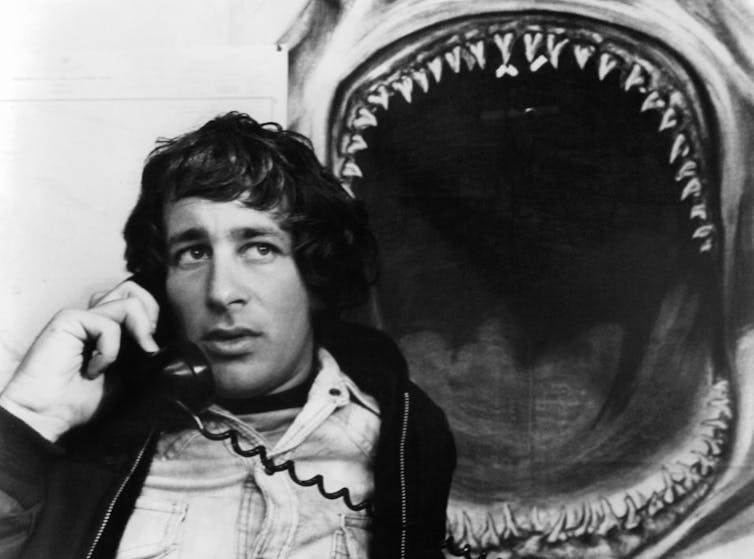
Young man with shoulder-length hair speaks on the phone in front of an image of a shark with its mouth open.
Steven Spielberg was just 26 years old when he signed on to direct ‘Jaws.’
Universal/Getty Images

The use of the two-note motif helped overcome the production issues Spielberg faced directing the first feature length movie to be filmed on the ocean. The malfunctioning animatronic shark forced Spielberg to leverage Williams’ minimalist theme to represent the shark’s ominous presence in spite of the limited appearances by the eponymous predatory star.

As Williams continued his legendary career, he would deploy a similar sonic motif for certain “Star Wars” characters. Each time Darth Vader appeared, the “Imperial March” was played to set the tone for the leader of the dark side.

As movie budgets creep closer to a half-billion dollars, the “Jaws” theme – and the way those two notes manipulate tension – is a reminder that in film, sometimes less can be more.

Jared Bahir Browsh, Assistant Teaching Professor of Critical Sports Studies, University of Colorado Boulder

This article is republished from The Conversation under a Creative Commons license. Read the original article.

Dive into “The Knowledge,” where curiosity meets clarity. This playlist, in collaboration with STMDailyNews.com, is designed for viewers who value historical accuracy and insightful learning. Our short videos, ranging from 30 seconds to a minute and a half, make complex subjects easy to grasp in no time. Covering everything from historical events to contemporary processes and entertainment, “The Knowledge” bridges the past with the present. In a world where information is abundant yet often misused, our series aims to guide you through the noise, preserving vital knowledge and truths that shape our lives today. Perfect for curious minds eager to discover the ‘why’ and ‘how’ of everything around us. Subscribe and join in as we explore the facts that matter.  https://stmdailynews.com/the-knowl


Start Your Morning Informed

Get the STM Morning Brief delivered to your inbox every weekday with breaking news, transportation updates, technology, science, and trending stories.

STM News Brief Ad 2

We don’t spam! Read our privacy policy for more info.

Continue Reading

documentaries

Vision Films Acquires Jeff Bridges–Narrated Doc “In The Company of Wolves” Ahead of Cannes Premiere

Vision Films acquires In The Company of Wolves: An American Journey, Susan Kucera’s new documentary narrated by Jeff Bridges, premiering at Cannes May 15, with a limited theatrical and TVOD release July 17, 2026.

Published

on

Vision Films has picked up In The Company of Wolves: An American Journey, an environmental documentary narrated by Academy Award® winner Jeff Bridges and directed by award-winning filmmaker Susan Kucera. The film is set to debut at the 2026 Cannes Film Festival on May 15 at the Olympia Theater, with a limited theatrical rollout and transactional VOD release to follow on July 17, 2026.

In The Company of Wolves:

A nature documentary that reframes American history

Rather than treating wolves as a backdrop to frontier mythology, In The Company of Wolves positions them—and other animals—as co-travelers through the American story. The documentary traces a sweeping timeline from the shores of England to the birth of the New Republic and into the colonization of the modern American West, exploring how the nation’s evolving relationship with wolves shaped folklore, identity, and the idea of “nationhood” itself.

Kucera describes the project as a shift in perspective: “I think this film stands apart because it reframes the American mythos—moving beyond human ambition to the deeper relationships that shaped the land, and in turn, the nation itself.”

A third collaboration for Kucera and Bridges

The documentary marks the third collaboration between Kucera and Bridges, following previous environmental projects including Living in the Future’s Past. Vision Films CEO and Managing Director Lise Romanoff said the company is “proud to partner with Susan Kucera again” and called the film “a spectacular visual journey and a reminder of the need to respect and preserve our planet’s ecosystem.”

Bridges, whose voice anchors the film’s historical and ecological throughline, added that the story “reminds us that the wild and the domesticated have always reflected the deeper story of who we are as a nation — and who we might yet become.” According to the release, Bridges is also using his compensation to support multiple conservation organizations, including The Vital Ground Foundation, which protects and connects wildlife habitat in the Northern Rocky Mountains.

Voices, experts, and an evocative score

The film features commentary from members of the Eastern Shoshone Tribe and Crow Nation, alongside historians and authors who have shaped public understanding of wolves and the American West. Participants named in the announcement include:

  • Michelle Paver, best-selling author of the Wolf Brothers series (over 3 million copies sold worldwide)
  • David Quammen, science writer (OutsideNational Geographic)
  • Professor Jon Coleman (University of Notre Dame), author of Vicious: Wolves and Men in America
  • Cristina Eisenberg, Native American ecologist and author
  • Jason Baldes, Eastern Shoshone conservationist (Intertribal Buffalo Council, Conservation Lands Foundation)
  • Cameron Krebs, fourth-generation sheep rancher

Adding to the film’s atmosphere is an original score by Keefus Ciancia, whose credits include True Detective.

Release plan: Cannes first, then theaters and TVOD

For audiences tracking Cannes premieres and documentary acquisitions, the release plan is straightforward:

  1. Cannes Film Festival premiere: May 15, 2026 (Olympia Theater)
  2. Limited theatrical release + TVOD: July 17, 2026

For updates, the filmmakers point viewers to the official site: inthecompanyofwolvesfilm.com.

About the companies behind the release

Vision Films is an independent sales and VOD aggregator with a catalog of more than 800 features, documentaries, and series, releasing 2–4 films per month across theatrical, VOD, DVD, and television.

Rangeland Productions, founded by producer Jim Swift, focuses on documentaries and independent films and has previously produced and executive produced projects with Kucera, including Living in the Future’s PastBreath of Life, and Hot Money.

What to watch for

With its Cannes debut and Jeff Bridges’ continued presence in environmental storytelling, In The Company of Wolves: An American Journey is positioned to land at the intersection of prestige documentary, American history, and conservation cinema—an increasingly crowded space where voice, point of view, and cultural framing matter as much as the visuals.

Advertisement
Get More From A Face Cleanser And Spa-like Massage


Related Links

Source: Vision Films

Continue Reading

awards and contests

The Largest AI Film Competition Is a Snapshot of Where AI Filmmaking Is Headed

Higgsfield released results from its largest AI filmmaking competition: nearly 8,800 submissions from 139 countries and $500,000 in prizes—highlighting a fast-growing, global, creator-led filmmaking ecosystem.

Published

on

Last Updated on April 25, 2026 by Daily News Staff

A year ago, “AI film” still sounded like a niche experiment—cool demos, rough edges, and lots of debate about whether it could ever look truly cinematic. Higgsfield’s latest competition results suggest we’ve crossed into a new phase: AI filmmaking is becoming a real, global production lane, driven by independent creators working outside traditional studio systems.

AI Filmmaking Goes Worldwide: Higgsfield Contest Highlights New Creator Hubs and Workflows
Higgsfield’s AI Film Competition

According to the company, its AI Film Competition drew nearly 8,800 submissions from 139 countries, with a $500,000 cash prize pool distributed to independent filmmakers. Beyond the winners, the dataset reads like a market signal: generative tools are lowering the cost of entry for high-end visuals, and the talent pipeline is no longer geographically locked to legacy production hubs.

A global creator map is replacing the old studio map

One of the most telling takeaways is where the work is coming from. Higgsfield reports the largest volume of entries came from:

  • India (1,805)
  • United States (1,041)
  • Germany (278)
  • France (230)
  • Italy (228)
  • Brazil (212)
  • United Kingdom (196)

Historically, cinematic action and high-end VFX were concentrated in a handful of established centers—places with the budgets, infrastructure, and specialized crews to pull off complex sequences. Higgsfield’s results point to a different reality: subscription-based, production-grade AI tools are reducing geographic barriers, enabling creators across Latin America, Southeast Asia, and Eastern Europe to compete in the same visual arena.

Higgsfield CEO Alex Mashrabov framed it as a creator inflection point, arguing that the scale of participation signals the next breakout franchise “can come from anywhere on Earth.” Whether or not you buy the blockbuster prediction, the underlying shift is hard to ignore: global access is now a feature of the production model.

AI Filmmaking Goes Worldwide: Higgsfield Contest Highlights New Creator Hubs and Workflows
Higgsfield’s AI Film Competition Winner, ‘Grandma vs Wasp’ by Muhannad Nassar and Simon Meyer

The judging criteria hints at what matters next

Another important detail: the prize pool wasn’t awarded for “best render” alone. Higgsfield says the jury—made up of both traditional production veterans and AI-native creators—prioritized storytelling and directorial intent over technical polish.

That’s a meaningful signal for where AI filmmaking is headed. As tools improve, the baseline for visual quality rises. What differentiates creators isn’t just the ability to generate a shot—it’s the ability to direct one: pacing, tone, character, and clarity of vision.

The jury included names and studios spanning both worlds, such as Secret Level (founded by Emmy-winning filmmaker Jason Zada), Buralqy, concept artist Jama Jurabaev, and PJ Ace of Genre.ai—who called it “the best-looking AI film contest” they’ve seen.

Decentralized production is no longer theoretical

The Grand Prize winner is also a case study in how AI changes collaboration. 1st Place ($150,000) went to Muhannad Nassar (Detroit) and Simon Meyer (Germany) for “GRANDMA vs WASP.” The pair reportedly never met in person, instead using an asynchronous workflow across time zones with Higgsfield’s Cinema Studio.

That’s not just a fun anecdote—it’s a preview of a parallel production ecosystem where teams form around taste and capability rather than geography. If the toolchain is centralized in the cloud, the “studio” becomes a workflow, not a building.

Winners show two pathways: new creators and experienced pros

The rest of the top placements reflect how broad the adoption curve is becoming:

  • 2nd Place ($100,000): Nikolay Shestak for “CUPID,” using Higgsfield to execute concepts that would normally be budget-prohibitive. He plans to apply the prize toward an independent superhero film.
  • 3rd Place ($50,000): Brothers Ash and Aram Gevorkyan for “SCRATCH,” created in five days. Ash noted audiences mistook it for a studio-backed theatrical release and asked for a link to the “full movie.”

What’s emerging is a two-lane future: newcomers using AI to enter filmmaking for the first time, and established creatives using it to expand what they can produce independently.

Money is starting to loop back into production

Higgsfield also highlights something that looks a lot like early-stage industry deal flow: one top winner is reportedly reinvesting prize money back into the platform to produce a feature-length film, and the project has already attracted involvement from a major Hollywood figure.

Advertisement
Get More From A Face Cleanser And Spa-like Massage

That matters because it suggests AI-generated work isn’t staying in a separate “AI corner.” It’s beginning to intersect with the traditional financing-and-distribution ecosystem—especially when the output looks cinematic enough to be taken seriously.

The market is growing—and the infrastructure is consolidating

The competition results land in a market that’s expanding quickly. Citing Grand View Research, Higgsfield notes the global AI video generator market was estimated at $788.5 million in 2025 and is projected to reach $3.44 billion by 2033 (a 20.3% CAGR).

Higgsfield is positioning itself as an all-in-one workflow layer, combining its own models with third-party options (including OpenAI’s Sora and Google’s Veo, among others) so creators can choose the best model per task without rebuilding pipelines. The company says it serves 20 million+ users who have generated 50 million+ videos, and it reports a most recent valuation of $1.3 billion.

What to watch for next

If you’re tracking where AI filmmaking is going, this competition offers a few clear “watch points”:

  • More global breakout creators as the cost of cinematic visuals continues to fall
  • Decentralized teams forming around projects, not locations
  • A shift from “can it look good?” to “can you direct it?” as quality becomes more accessible
  • Traditional industry crossover as AI-native projects attract recognizable partners

Want to see the winning films and action scenes? Higgsfield has them here: https://higgsfield.ai/contests/make-your-action-scene

Source: Higgsfield press release distributed via PRNewswire (March 18, 2026).

Looking for an entertainment experience that transcends the ordinary? Look no further than STM Daily News Blog’s vibrant Entertainment section. Immerse yourself in the captivating world of indie films, streaming and podcasts, movie reviews, music, expos, venues, and theme and amusement parks. Discover hidden cinematic gems, binge-worthy series and addictive podcasts, gain insights into the latest releases with our movie reviews, explore the latest trends in music, dive into the vibrant atmosphere of expos, and embark on thrilling adventures in breathtaking venues and theme parks. Join us at STM Entertainment and let your entertainment journey begin! https://stmdailynews.com/category/entertainment/

and let your entertainment journey begin!

Continue Reading

Trending


