

Economy
Dockworkers pause strike after Biden administration’s appeal to patriotism hits the mark
Dockworkers at East Coast ports halted a strike following government intervention, accepting a 62% wage increase, easing supply chain disruptions.

Last Updated on October 6, 2024 by Daily News Staff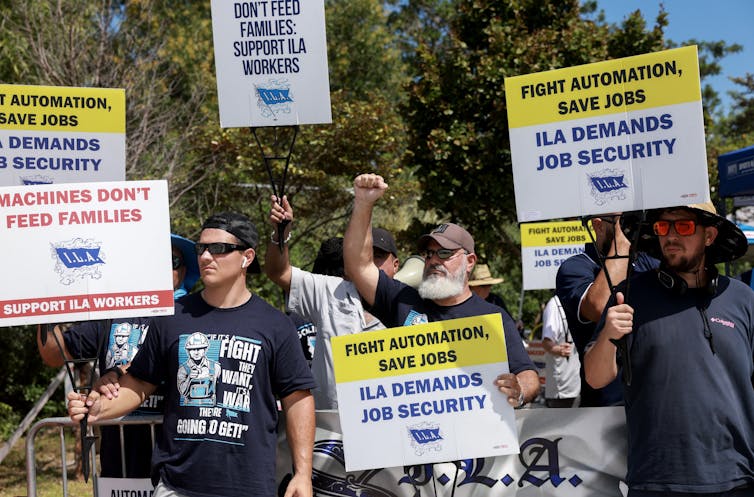
A dockworkers strike that froze operations at East Coast and Gulf Coast ports for 2½ days was paused on Oct. 3, 2024. The Conversation U.S. asked Anna Nagurney, a scholar of supply chains, to assess the extent of disruptions that likely occurred and how the swift return of 45,000 workers who had been on strike may stave off further problems down the road.
Why was the strike suspended?
Aided by intense pressure from senior Biden administration officials, the shipping companies, represented by the U.S. Maritime Alliance, significantly increased the raise they were offering the dockworkers to 62% from their previous offer of a 50% boost in pay. The International Longshoremen’s Association, the dockworkers’ union, was seeking a 77% raise, but it accepted the new offer, which will be phased in over six years.
The agreement labor leaders and management reached will suspend the strike until at least Jan. 15, 2025, allowing more time for additional collective bargaining and negotiations.
Talks over other contested conditions, including the adoption of more automation, will continue until then.
President Joe Biden applauded both sides. He thanked the union and management “for acting patriotically to reopen our ports and ensure the availability of critical supplies for Hurricane Helene recovery and rebuilding.”
How has this strike affected the economy?
About half of the products that the U.S. imports are handled by the ports that were paralyzed during this brief strike. About 1 million shipping containers arrive at these ports every month.
Imports include vast quantities of bananas and other fresh produce, coffee, pharmaceuticals, liquor, toys, apparel, furniture, machinery and vehicles. Exports include meats, commodities, machinery, chemicals, vehicles and vehicle parts.
The strike’s impact was immediate. More than 50 ships laden with hundreds of thousands of containers created a logjam at East Coast ports. Major retailers, such as Walmart, Costco, Lowes and Home Depot, were among the companies stuck waiting for the release of their stranded cargo.
It may take two to three weeks to relieve this logjam. Prices for some products, including coffee, were already rising before the negotiators reached their breakthrough.
Workers are critical to the functioning of each link in supply chains. When the dockworkers were on strike, other workers, such as truckers, rail employees and warehouse workers, were concerned about being affected, as well as all the businesses that rely on them, such as restaurants.
Why is the new time frame significant?
Shipping tied to the holiday season typically runs from July through early November. Members of the National Retail Federation, the largest U.S. retail trade group, have already been dealing with significant supply disruptions due to Houthi attacks in the Red Sea and Suez Canal. The attacks have forced shipping companies to take longer routes, delaying cargo delivery and increasing costs due to the need for more fuel and labor.
A prolonged dockworkers strike would put stress on the economy. According to J.P. Morgan, a lengthy dockworkers strike could have cost the U.S. economy US$5 billion per day.
The temporary agreement pushes the strike past the U.S. elections in November and the conclusion of the upcoming holiday season. That gives both sides a chance to return to the bargaining table to continue to negotiate and to reach an agreement on the issues that haven’t been resolved yet – notably the use of automation.
Having a shorter strike will reduce the risk of shortages of everything from mangos to Maseratis and the price increases that typically occur when products are scarce and in high demand.
What did the Biden administration do?
The Biden administration was eager for a settlement, especially with the ports serving as channels for recovery supplies after the massive damage seen in Florida, western North Carolina and other areas near the East Coast from Hurricane Helene.
Senior government officials made notable progress when they met with representatives of shipping companies before daybreak on Oct. 3 over Zoom.
Julie Su, the acting labor secretary, had been working hard to help the two sides settle their differences. She emphasized over Zoom that she could get the International Longshoremen’s Association to the bargaining table to extend the contract. Transportation Secretary Pete Buttigieg also stayed in touch with labor and management, and used that Zoom meeting to tell the shipping companies that they would need to offer the dockworkers a higher wage.
White House Chief of Staff Jeff Zients told the shipping companies on Zoom that they should make an offer to the union quickly so that the strike wouldn’t further exacerbate the effects of Hurricane Helene.
It seems clear to me that the pressure worked – helped, perhaps, by a bit of patriotism.
Anna Nagurney, Eugene M. Isenberg Chair in Integrative Studies, UMass Amherst
This article is republished from The Conversation under a Creative Commons license. Read the original article.
STM Daily News is a vibrant news blog dedicated to sharing the brighter side of human experiences. Emphasizing positive, uplifting stories, the site focuses on delivering inspiring, informative, and well-researched content. With a commitment to accurate, fair, and responsible journalism, STM Daily News aims to foster a community of readers passionate about positive change and engaged in meaningful conversations. Join the movement and explore stories that celebrate the positive impacts shaping our world.
Discover more from Daily News
Subscribe to get the latest posts sent to your email.


Economy
US Consumer Confidence Fell Sharply in January: What the Latest Conference Board Data Signals
In January 2026, U.S. consumer confidence plummeted to its lowest level since 2014, as the Consumer Confidence Index fell by 9.7 points to 84.5. Concerns about inflation, employment, and economic stability led to decreased optimism across all demographics and a cautious approach to major purchases, signaling potential recession ahead.


US consumers started 2026 on a noticeably more cautious note. New data from The Conference Board shows its Consumer Confidence Index® fell sharply in January, wiping out a brief December rebound and pushing overall sentiment to its weakest level in more than a decade.
Confidence drops to the lowest level since 2014
The Conference Board Consumer Confidence Index® fell 9.7 points in January to 84.5 (1985=100), down from an upwardly revised 94.2 in December. The organization noted that December’s figure was revised up by 5.1 points, meaning what initially looked like a decline last month was actually a small uptick—before January’s slide reasserted the broader downward trend.
The cutoff for the preliminary January results was January 16, 2026.
Both “right now” and “what’s next” got worse
The decline wasn’t isolated to one part of the survey. Both consumers’ views of current conditions and their expectations for the months ahead weakened.
- Present Situation Index: down 9.9 points to 113.7
- Expectations Index: down 9.5 points to 65.1
That Expectations reading matters because it’s well below 80, a level The Conference Board says “usually signals a recession ahead.”
Dana M. Peterson, Chief Economist at The Conference Board, summed it up bluntly: confidence “collapsed” in January, with all five components deteriorating. The overall Index hit its lowest level since May 2014.
What consumers are worried about (and what’s showing up in write-ins)
The Conference Board said consumers’ write-in responses continued to skew pessimistic. The biggest themes weren’t hard to guess:
- Prices and inflation
- Oil and gas prices
- Food and grocery prices
Mentions of tariffs and trade, politics, and the labor market also rose in January. References to health/insuranceand war edged higher.
In other words: consumers aren’t just feeling uneasy—they’re pointing to specific pressure points that affect day-to-day costs and long-term stability.
Labor market perceptions softened
Consumers’ views of employment conditions weakened, with fewer respondents saying jobs are plentiful and more saying jobs are hard to get.
- 23.9% said jobs were “plentiful,” down from 27.5% in December
- 20.8% said jobs were “hard to get,” up from 19.1%
That shift matters because consumer confidence often follows the labor market. When people feel less secure about job availability, they tend to pull back on big purchases and discretionary spending.
Expectations for business conditions and jobs turned more negative
Looking six months out, pessimism increased:
- 15.6% expected business conditions to improve (down from 18.7%)
- 22.9% expected business conditions to worsen (up from 21.3%)
On jobs:
- 13.9% expected more jobs to be available (down from 17.4%)
- 28.5% anticipated fewer jobs (up from 26.0%)
Income expectations cooled too:
- 15.7% expected incomes to increase (down from 18.8%)
- 12.6% expected incomes to decline (down slightly from 13.0%)
So while fewer people expected their income to fall, the bigger story is that optimism about income growth faded.
Who’s feeling it most: age, income, and politics
On a six-month moving average basis, confidence dipped across:
- All age groups (though under 35 remained more confident than older consumers)
- All generations (with Gen Z still the most optimistic)
- All income brackets (with those earning under $15K the least optimistic)
- All political affiliations (with the sharpest decline among Independents)
This broad-based decline suggests the shift isn’t confined to one demographic pocket—it’s spreading.
Big-ticket buying plans: more “maybe,” less “yes”
The survey also pointed to increased caution around major purchases.
Consumers saying “yes” to buying big-ticket items declined in January, while “maybe” responses rose and “no” edged higher.
- Auto buying plans were flat overall, though expectations for new cars continued to falter and plans to buy used cars climbed.
- Homebuying expectations continued to retreat.
- Plans to purchase appliances, furniture, and TVs decreased.
- Electronics purchase intentions dipped in most categories—except smartphones, which continued trending upward on a six-month moving average basis.
Services spending softened—but restaurants and travel stayed interesting
Planned spending on services over the next six months weakened in January, with fewer consumers saying “yes” and more shifting into “maybe.”
Still, a few categories stood out:
- Restaurants, bars, and take-out remained the top planned services spending category and continued to rise.
- Consumers also intended to spend more on hotels/motels for personal travel, airfare/trains, and motor vehicle services.
The Conference Board noted this was surprising given the plunge in vacation plans—especially for domestic travel—also recorded in the survey.
What to watch next
January’s report paints a clear picture: consumers are feeling squeezed by costs, less confident about the labor market, and more hesitant about major purchases. The Expectations Index dropping deeper below the “recession signal” threshold will likely keep economists, businesses, and policymakers watching the next few releases closely.
The Conference Board publishes the Consumer Confidence Index® at 10 a.m. ET on the last Tuesday of every month.
Source: The Conference Board, January 2026 Consumer Confidence Survey® (PRNewswire release, Jan. 27, 2026).
Discover more from Daily News
Subscribe to get the latest posts sent to your email.
Economy
Allegiant and Sun Country Airlines to Combine: A Bigger, More Competitive Leisure Airline Takes Shape
Allegiant and Sun Country announced a merger that would create a larger leisure-focused airline serving 22 million customers, nearly 175 cities, and 650+ routes—plus expanded international access and loyalty benefits.
Allegiant and Sun Country Airlines are planning to merge in a deal that would create one of the most significant leisure-focused airline platforms in the United States—one built around flexible capacity, underserved markets, and price-sensitive travelers.
Announced January 11, 2026, the definitive merger agreement calls for Allegiant (NASDAQ: ALGT) to acquire Sun Country (NASDAQ: SNCY) in a cash-and-stock transaction valued at an implied $18.89 per Sun Country share. If approved by regulators and shareholders, the combined company would serve roughly 22 million annual customers, fly to nearly 175 cities, operate 650+ routes, and manage a fleet of about 195 aircraft.
For travelers, the headline is simple: more leisure routes, more destination options, and a larger loyalty ecosystem. For the economy—especially in regions that rely on affordable air access—the bigger story is how consolidation among niche carriers could reshape competition, connectivity, and regional tourism.
Deal snapshot: how the merger is structured
Under the agreement, Sun Country shareholders would receive 0.1557 shares of Allegiant common stock plus $4.10 in cash for each Sun Country share. The offer represents a 19.8% premium over Sun Country’s closing price on January 9, 2026, according to the companies.
The transaction values Sun Country at approximately $1.5 billion, including $0.4 billion of net debt. After closing, Allegiant shareholders would own about 67% of the combined company, with Sun Country shareholders owning about 33% on a fully diluted basis.
The companies expect the deal to close in the second half of 2026, pending federal antitrust clearance, other regulatory approvals, and shareholder votes.
Why this combination matters in the leisure travel market
Allegiant and Sun Country are both known for leisure-first strategies, but they’ve historically approached the market from different angles:
- Allegiant has built its brand around connecting small and mid-sized cities to vacation destinations—often with nonstop, limited-frequency routes designed to match demand.
- Sun Country has operated more like a hybrid low-cost carrier, balancing scheduled passenger service with charter flying and a major cargo business.
In the press release, Allegiant CEO Gregory C. Anderson framed the merger as a natural fit between two “flexible” models designed to adjust quickly to demand. Sun Country CEO Jude Bricker emphasized the airline’s Minnesota roots and its diversified approach across passenger, charter, and cargo.
In a travel economy where consumer demand can swing quickly—fuel prices, inflation, seasonal travel surges, and shifting vacation trends all matter—flexibility is a competitive advantage. This merger is essentially a bet that scale plus adaptability can outperform traditional network strategies in the leisure segment.
What travelers could see: routes, destinations, and loyalty upgrades
The companies are pitching the merger as a way to expand choice without changing how customers book in the short term.
More routes and more nonstop options
The combined network would include 650+ routes, including 551 Allegiant routes and 105 Sun Country routes. The idea is that the two networks complement each other: Allegiant’s smaller-market footprint plus Sun Country’s strength in larger cities.
One specific promise: the merger would connect Minneapolis–St. Paul (MSP) more directly to Allegiant’s mid-sized markets, while also expanding service to popular vacation destinations.
Expanded international reach
Sun Country’s existing international network would give Allegiant customers access to 18 international destinationsacross Mexico, Central America, Canada, and the Caribbean.
For leisure travelers, that’s a meaningful shift—especially for customers in smaller cities who may currently need multiple connections (or higher fares) to reach international vacation spots.
A bigger loyalty program
The companies say the combined loyalty program would be larger and more flexible, adding Sun Country’s 2+ million members to Allegiant’s 21 million member base.
In practical terms, travelers should expect more ways to earn and redeem rewards—though the real value will depend on how the programs are integrated and what benefits survive the merger.
The economic angle: competition, regional access, and tourism dollars
This announcement lands in a broader conversation about airline consolidation and what it means for consumers and communities.
On one hand, a larger leisure-focused airline could:
- Increase air service options in underserved markets
- Improve seasonal connectivity to tourism hubs
- Support local economies that depend on visitor spending
On the other hand, consolidation can also raise concerns about:
- Reduced competition on certain routes
- Pricing power in smaller markets
- Fewer independent carriers fighting for leisure travelers
The companies argue the merger will create a “more competitive” leisure airline, not less. That claim will likely be tested during antitrust review—especially on routes where Allegiant and Sun Country overlap or where one carrier’s presence is a key source of low fares.
Cargo and charter: the less flashy, more stabilizing part of the deal
One of the most important (and most overlooked) parts of this merger is the emphasis on diversified operations.
Sun Country brings a major cargo business, including a multi-year agreement with Amazon Prime Air, plus charter contracts with casinos, Major League Soccer, collegiate sports teams, and the Department of Defense. Allegiant also has an existing charter business.
From an economic standpoint, these contract-driven revenue streams matter because they can:
- Smooth out seasonal swings in leisure demand
- Improve aircraft and crew utilization year-round
- Reduce exposure to consumer travel slowdowns
If the combined company can balance leisure flying with cargo and charter commitments, it may be better positioned to maintain service levels—even when discretionary travel dips.
Financial expectations: synergies, EPS, and fleet scale
Allegiant expects the merger to generate $140 million in annual synergies by year three after closing. The deal is also expected to be accretive to earnings per share (EPS) in year one post-closing.
The combined airline would operate about 195 aircraft, with 30 on order and 80 additional options. The companies also highlight the benefit of operating both Airbus and Boeing aircraft, and the ability to better utilize Allegiant’s 737 MAX fleet and order book.
For investors, the message is scale plus efficiency. For travelers and local economies, the question is whether those efficiencies translate into more routes, better reliability, and sustained low fares.
What happens next: timeline and what won’t change immediately
Even if the deal closes, Allegiant says both airlines will operate separately until they receive a single operating certificate from the FAA.
That means:
- No immediate changes to ticketing or schedules
- No immediate changes to the Sun Country brand
- Customers can continue booking and flying as they do today
The combined company would remain headquartered in Las Vegas, while maintaining a “significant presence” in Minneapolis–St. Paul.
Bottom line
If approved, the Allegiant–Sun Country merger would create a scaled leisure airline with a broader route map, expanded international access, and a loyalty program that reaches tens of millions of travelers.
For the U.S. travel economy, the deal is also a signal: the leisure segment—once treated like a niche—is becoming a battleground where scale, flexibility, and diversified revenue (cargo and charter) could define the next era of competition.
As regulators review the merger and the companies move toward a second-half 2026 closing, travelers and communities will be watching for the real-world impact: more service, more destinations, and whether “affordable leisure travel” stays affordable.
Quick facts (from the announcement)
- Deal announced: January 11, 2026
- Structure: cash + stock
- Implied value per Sun Country share: $18.89
- Premium: 19.8% over Jan. 9, 2026 close
- Combined scale: 22M annual customers, ~175 cities, 650+ routes, ~195 aircraft
- Expected synergies: $140M annually by year 3 post-close
- Expected close: second half of 2026 (subject to approvals)
For readers tracking the business side: Allegiant and Sun Country scheduled an investor conference call for Monday, January 12, 2026, at 8:30 a.m. Eastern Time, with a webcast posted via Allegiant’s investor relations site.
Related Links
- Allegiant Investor Relations (conference call/webcast info)
- SoaringForLeisure.com (transaction website)
- Allegiant SEC Filings
- Sun Country SEC Filings
SOURCE Allegiant Travel Company
Stay with STM Daily News: We’ll keep tracking this story as it develops—regulatory approvals, route updates, loyalty program changes, and what it could mean for travelers and the broader U.S. travel economy. For the latest coverage, visit https://stmdailynews.com.
Discover more from Daily News
Subscribe to get the latest posts sent to your email.
News
Major Popeyes Franchisee Sailormen Files for Chapter 11 — What It Means for Restaurants and the Economy
Sailormen Inc., a major Popeyes franchisee operating 130+ locations in Florida and Georgia, filed for Chapter 11 on Jan. 15, 2026 amid rising costs and heavy debt. Many restaurants are expected to remain open as restructuring continues.

A major Popeyes Louisiana Kitchen franchise operator is heading to bankruptcy court — but the headline does notmean Popeyes corporate is filing, or that every restaurant involved is about to close.
Sailormen Inc., a Miami-based Popeyes franchisee that has operated in the system since 1987, filed for Chapter 11 bankruptcy protection on Jan. 15, 2026. The company operates more than 130 Popeyes locations across Florida and Georgia (some industry coverage puts the count at 136), making it one of the chain’s largest franchise groups in the region.
Franchisee filing, not a Popeyes corporate bankruptcy
This case involves Sailormen (the operator) — not Popeyes corporate and not parent company Restaurant Brands International.
In a message referenced in industry reporting, Popeyes leadership said Sailormen’s filing does not reflect the overall health of the Popeyes brand, and that a large majority of Sailormen’s restaurants are expected to remain open while the company restructures.
What pushed Sailormen into Chapter 11
Court-related summaries and industry coverage point to a familiar mix of pressures hitting restaurant operators:
- Inflation and higher operating costs (food, labor, and day-to-day expenses)
- Higher borrowing costs as interest rates climbed
- Liquidity strain, including reports of falling behind on rent and facing pressure from landlords and vendors
- Legal disputes, including vendor-related claims tied to unpaid balances
The failed store sale that worsened the situation
One key detail: Sailormen reportedly tried to sell 16 Georgia restaurants to stabilize finances. That deal fell through, and the company remained responsible for lease guarantees tied to those locations — a liability that can linger even if other stores are performing.
The debt and the lender pressure
Industry reporting describes Sailormen as carrying a heavy debt load — cited at about $130 million overall.
More detailed figures cited in coverage include:
- Over $112 million in unpaid principal loan balance
- Over $17 million in accrued interest and fees
Reporting also points to pressure from BMO (BMO Bank), described as Sailormen’s largest lender. In December 2025, BMO reportedly sought to appoint a receiver, a move that can displace management and take control of a company’s assets. Sailormen’s Chapter 11 filing allows the company to continue operating as a debtor-in-possession while it attempts to reorganize.
Why this matters for “Food” and “Our Economy”
This isn’t just a Popeyes story — it’s a snapshot of what happens when restaurant operators face higher costs, value-conscious consumers, and more expensive debt at the same time.
Chapter 11 is designed to reorganize a business, not automatically liquidate it. For customers, the near-term impact may be limited if most locations stay open.
STM Daily News will follow this story as it develops, including any updates on store operations, restructuring plans, and potential sales of locations.
Sources
- Restaurant Business: “A big Popeyes franchisee files for bankruptcy” https://restaurantbusinessonline.com/financing/big-popeyes-franchisee-files-bankruptcy
- Restaurant Dive: “Large Popeyes franchisee files for Chapter 11” https://www.restaurantdive.com/news/popeyes-frachisee-sailormen-files-chapter-11-bankruptcy-protections/809854/
For more food business headlines and how they connect to the real economy, follow STM Daily News.
Authors


Discover more from Daily News
Subscribe to get the latest posts sent to your email.





